• العربية
  • فارسی
Brand
  • Iran Insight
  • Politics
  • Economy
  • Analysis
  • Special Report
  • Opinion
  • Podcast
  • Iran Insight
  • Politics
  • Economy
  • Analysis
  • Special Report
  • Opinion
  • Podcast
  • Theme
  • Language
    • العربية
    • فارسی
  • Iran Insight
  • Politics
  • Economy
  • Analysis
  • Special Report
  • Opinion
  • Podcast
All rights reserved for Volant Media UK Limited
volant media logo

Sunni Leader In Iran Slams Government Policies Amid New Restrictions

Iran International Newsroom
Feb 4, 2023, 18:55 GMT+0Updated: 17:47 GMT+1
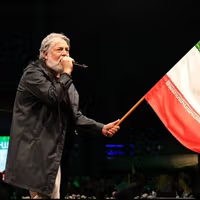
Mowlavi Abdolhamid, the top religious leader of Iran's largely Sunni Baluch population

Iran’s most prominent Sunni leader Mawlana Abdolhamid has criticized the government for not allowing criticism, while officials are planning more hijab enforcement.

In his Friday Prayer sermon in Zahedan, Abdolhamid called for freedom of speech and suggested that the Islamic Republic government should begin to include qualified secular individuals in its institutions.

The Sunni leader has become an outspoken critic of the Islamic Republic since nationwide protests broke out last September, and specially after security forces killed more than 80 civilians in the city on September 30.

Criticizing brutality in Iranian prisons, Abdolhamid said that inmates should not feel that they have been imprisoned by the enemy. "All Muslims and followers of other faiths should be treated fairly and equally in prisons. Wardens should not insult or attack the inmates," Abdolhamid stressed.

The call for fair treatment of inmates was made while photos of a political prisoner, Farhad Meysami has gone viral on social media and even found their way to more controlled traditional media. Meysami who has been in jail for five nearly years for doing nothing other than opposing the death sentence, supporting women who removed their scarves in public in 2018, and calling for the release of other political prisoners, is seen in these pictures with his ribs and bones alarmingly visible under his skin with almost no fat and flesh.

Abdolhamid also called for press freedom in Iran and said that journalists should be free to speak about the realities and highlight weaknesses. Meanwhile, he warned government officials that "there is no value in ruling over people who do not want you." In another part of his sermon, Abdolhamid called on the government to release Sunni leaders Mawlana Abdolmajid, Mawlana Gorgij and the Mamustas (Sunni clerics in Kurdistan) from jail. He said these men of God wish well for the society. So, they should not be intimidated or threatened.

The Sunni leader’s critical comments came one day after Shiite cleric Mousa Ghazanfarabadi, the head of the Iranian parliament's Judiciary Committee called for harsher treatment of those who undermine the compulsory hijab rule.

Ghazanfarabadi suggested that those women who undermine compulsory hijab should first receive a text message on their phone and then they should be fined in case they continue to ignore the hijab, and they will be deprived of all social services until they pay the fine.

He also suggested that bad-hijab women should be identified using face detection technology in the streets. Once they are identified, their ID cards will be confiscated, and they will be deprived of social services including using the banking system. He said the parliament is adamant to implement this plan once it is finalized and becomes a law.

However, he insisted that the new system of dealing with bad-hijab women does not include any physical confrontation.

The protests began when Mahsa Amini, a 22-year-old woman was fatally wounded in the custody of the ‘hijab police’ in September. During widespread street protests officials were careful not to speak about enforcing the veiling rule, but now they feel they have crushed the movement.

All this is happening against a backdrop of general dissatisfaction about the deteriorating economic situation. In one of the latest cases of unhappiness about the government's performance, Deputy Commander of the Iranian Army, Habibollah Sayyari said that the budget allocated to the army for the coming year is not enough to confront the many threats Iran is facing in the region.


Most Viewed

State media slam Araghchi's Hormuz tweet, say it let Trump claim victory
1

State media slam Araghchi's Hormuz tweet, say it let Trump claim victory

2
OPINION

The Hormuz get out of jail card turned to a grave

3

Iran International says it won’t be silenced after London arson attack

4
INSIGHT

How Tehran bends its own red lines to boost state rallies

5

Iran halts petrochemical exports to supply domestic market

Banner
Banner

Spotlight

  • Too early to tell who is winning Iran war, experts say
    PODCAST

    Too early to tell who is winning Iran war, experts say

  • How Tehran bends its own red lines to boost state rallies
    INSIGHT

    How Tehran bends its own red lines to boost state rallies

  • Iran blackout cripples freelancer, small business incomes
    VOICES FROM IRAN

    Iran blackout cripples freelancer, small business incomes

  • Ideology may be fading in Iran, but not in Kashmir's ‘Mini Iran'
    INSIGHT

    Ideology may be fading in Iran, but not in Kashmir's ‘Mini Iran'

  • US blockade enters murky phase as tankers spoof signals and buyers hesitate
    ANALYSIS

    US blockade enters murky phase as tankers spoof signals and buyers hesitate

  • Why the $100 billion Hormuz toll revenue is a myth
    ANALYSIS

    Why the $100 billion Hormuz toll revenue is a myth

•
•
•

More Stories

Iran Expels More Dissident University Professors

Feb 4, 2023, 17:41 GMT+0

Iranian media report that nine professors of Tehran Azad University have been forced into early retirement because of expressing critical views against the Islamic Republic.

Moderate news website Rouydad 24 has quoted Susan Safaverdi, one of the professors as saying that they were expelled because they were not “revolutionary”.

She further noted that she and the eight others, who are expelled on the pretext of reaching the retirement age, have been repeatedly accused of being “anti-establishment”.

Safaverdi also pointed out that the head of the faculty has repeatedly emphasized only those who support the country’s 83-year-ol ruler Ali Khamenei, should teach at the faculty.

Safaverdi is the wife of Mohammad Ali Ramin, deputy minister of culture and a presidential advisor in Mahmoud Ahmadinejad's cabinet.

In addition to the forced retirement of these nine professors, the Islamic Republic is trying to put more pressure on other university professors who support anti-regime protests.

In Khorasan Razavi province in the northeast, Mahshid Gohari, professor of literature at Ferdowsi University of Mashhad, announced on her Instagram page that after seven years of teaching, the university has expelled her.

Javad Atefeh, a playwright, director and theater instructor, announced on his Instagram page, "For reasons that I am sure you know", he was not offered to teach in universities for the next semester.

Court cases have also been filed against many university professors and they have been arrested or summoned.

Opposition Figure In Iran Calls For Fundamental Change, New Constitution

Feb 4, 2023, 14:50 GMT+0
•
Mardo Soghom

A prominent opposition figure says Iran needs a “fundamental change” based on “Woman, Life, Freedom” and constitutional change, in a statement released on Saturday.

Mir-Hossein Mousavi, who was a presidential candidate in 2009 and has been under house arrest since 2011, referring to government violence against protesters, said that such events have “demonstrated major truths for the nation.” The rulers of the Islamic Republic are not willing “to take the smallest step to meet the demands of the people.”

But what was noteworthy in Mousavi’s message, dubbed “To save Iran,” is his conclusion that the people have given up hope for reforms.

The leader of the Green Movement, born from large popular protests in 2009, is known as a staunch reformist, or someone who believes the Islamic Republic can be reformed to become a more democratic and tolerant polity.

But Mousavi’s statement seems to reject reform as a viable alternative, urging fundamental change, a new constitution and a constitutional assembly.

Although he does not openly call for regime change, but his demands, if implemented could lead to a new and democratic political system.

Mousavi in his statement has implicitly repeated what exiled Prince Reza Pahlavi has been saying for years, and other opposition activists have echoed in the past five months – transition from the Islamic Republic.

Mousavi and his wife voting in the 2009 presidential election
100%
Mousavi and his wife voting in the 2009 presidential election

“Iran and the Iranians need a fundamental change, that takes its main features from the pure movement of ‘Woman, Life, Freedom.’ Mousavi said. These three words are “the seeds of a bright future, free of oppression, poverty, humiliation and discrimination.”

This represents an important turning point when an opposition figure from inside Iran demands a new constitution, implicitly rejecting the current leadership altogether.

However, Mousavi carries a heavy political baggage that has dented his popularity. When protests began in 2009 against the highly suspicious victory of Mahmoud Ahmadinejad in presidential elections that year, millions of Iranians poured into streets. They saw Mousavi who was the opposing candidate, as their leader, but he refrained from criticizing Supreme Leader Ali Khamenei who was ultimately responsible for engineering the vote count and the subsequent suppression of protesters. Mousavi came across as someone who did not want to challenge the Islamic Republic.

He also served as prime minister in the 1980s, when the government killed thousands of people in prisons. His critics say that Mousavi has not apologized or explained why he remained silent at the time.

Nevertheless, Mousavi puts forth three demands in his statement. First, a free and untainted referendum about the necessity to change or write a new constitution. Second, in case of a positive vote by the people, to form a constitutional assembly composed of the “real representatives of the nation” through a free and fair election. Third, a second referendum to approve the draft constitution to establish a regime based on rule of law, in conformity with human rights and the will of the people.

Mousavi acknowledged that his three demands require further clarifications, as for example who would implement the changes needed, but he appealed to sense of unity and cooperation “to save Iran”.

Iranians have been hotly debating the need to form an opposition council to manage the protest movement and plan for transition to a new form of government. So far, there are no signs that prominent activists abroad are about to untie and establish a framework of coordination. Inside the country no such move is possible because of repression, but many people seem willing to support a council formed abroad.

Opposition Growing To Iran's Liquidation Of Public Assets

Feb 4, 2023, 09:06 GMT+0
•
Maryam Sinaiee

Many in Iran oppose a plan to hastily liquidate public assets with no supervision or clear process, as many fear it could massively increase corruption.

The so-called ‘privatization’ plan announced earlier this week to be carried out over the next two years is meant to augment the country’s budget. It involves the liquidation of billions of dollars of assets belonging to the government and its affiliated entities including banks under the supervision of a seven-man team with extraordinary powers and immunity from prosecution.

The country’s ruler Ali Khamenei has approved the plan, which is not a real privatization scheme. Well-connected and powerful buyers who are often secretive funds and endowments run by powerful officials are lined up to gobble up the prize.

First Vice President Mohammad Mokhber who is one of the members of the supervision team claimed Thursday that the “immunity” of the team has been misunderstood. “Immunity applies to decisions, not infringement of the law,” he said. His explanation, however, has done very little to reassure the public.

First Vice President Mohammad Mokhber (file photo)
100%
First Vice President Mohammad Mokhber

Many former officials and the media have expressed deep concerns over the plan. Mohammad Reza Salehi, a logistics chief of former President Hassan Rouhani’s office, in a speech at a meeting of former officials earlier this week argued that the so-called privatization would give rise to massive corruption, degenerate the regime from within and eventually cause its collapse. 

Reza Gheibi, an economic journalist told Iran International that the liquidation of assets would not help the government to overcome the economic crisis it is grappling with. “In the best-case scenario, it may balance some of the budget deficit,” he said, adding that transferring these assets to individuals and entities and companies connected with Khamenei’s office, who would be the likely beneficiaries, would give them control over the economy.

The new owners will use these assets to preserve the regime but if the regime is toppled, they will form a class of oligarchs with the power to control the economy, Gheibi said. “It’s a win-win game for the leader’s office and those close to its circle of power.”

In a tweet Wednesday, Iran's exiled prince, Reza Pahlavi, accused Khamenei of plundering the country’s national wealth “greedily” with the so-called privatization plan. “Plunderers should be aware that legal immunity will not help them, and the plundered assets of the Iranian nation should [one day] be restored to the treasury of the nation,” he wrote.

Right before the ‘privatization’ was announced, Mokhber misleadingly claimed that the former royal family had “stolen” the crown jewels when the Shah and his family left before the Islamic Revolution in 1979. The monarchy’s crowns and other crown jewels have been held in the Treasury of National Jewels in Tehran in the past four decades but have not been seen by the public for two years and his accusation worried many that these had been sold or stolen.

Minister of cultural heritage Ezzatollah Zarghami (file photo)
100%
Minister of cultural heritage Ezzatollah Zarghami

The claim, however, was disproved when minister of cultural heritage Ezzatollah Zarghami, published photos of his visit to the treasury with the crowns on display.

In a speech Thursday, head of the Mostazafan Foundation (Bonyad Mostazafan), Parviz Fattah, referred to other invaluable properties of the royals , including expensive art, a 500,000-piece stamp collection, bejeweled swords and daggers, and a unique vehicle collection including a gold-adorned vehicles belonging the to the Shah’s father, King Reza Pahlavi. Fattah’s mention of these assets, which have also remained in Iran, has worried some over the possibility that these invaluable national assets are also going under the hammer under the plan.

Opinion Survey Reveals Overwhelming Majority Rejecting Iran’s Regime

Feb 4, 2023, 04:30 GMT+0
•
Iran International Newsroom

An opinion survey involving 158,000 people in Iran showed that more than 80 percent of respondents reject the Islamic Republic and prefer a democratic government.

The Netherlands-based Gamaan institute conducted the survey from December 21-31, which also included a sample of 42,000 respondents in the diaspora, revealed very similar attitudes between those in the country and abroad.

“In response to the question “Islamic Republic: Yes or No?” 81% of respondents inside the country responded “No” to the Islamic Republic, 15% responded “Yes,” and 4% were not sure. Of the Iranian respondents abroad, 99% responded “No,” opting against the Islamic Republic,” GAMAAN reported.

In a follow-up question for those who answered “No”, the survey asked about their preferred democratic and secular alternative political system. Of those, 28% inside Iran and 32% outside Iran would prefer a presidential republic, 12% inside Iran and 29% outside Iran would prefer a parliamentary republic, and 22% inside Iran and 25% outside Iran would prefer a constitutional monarchy.

In a press release shared with Iran International, GAMAAN explained that "This survey was conducted online using a specialized and secure platform." Given the inaccessible nature of the country, Gamaan used a special online tool to reach respondents in Iran through diverse channels, to eliminate chance of selective targeting and include as much of a representative sample as possible.

But GAMAAN does explain that it “uses digital tools and different methods to extract the (real) opinions of Iranians about (sensitive) social and political topics. The rationale for GAMAAN’s innovative approach is the fact that conventional survey methods cannot yield valid results in the existing Iranian context.” It also ran reliability comparisons with available data and other surveys.

Regarding the antigovernment protests since mid-September, 80% of those inside the country support the movement; 67% believe the protests will succeed, while 14% think they will not succeed. Around 15% of the population inside the country oppose the protests. Respondents outside the country overwhelmingly support the protests; of these, 90% think they will succeed, and only 9% think they will not succeed.

Responses to multiple questions confirm a general view shared by many observers that the clerical regime in Iran enjoys a 10-15 percent support in the country.

While 60 percent of respondents inside Iran describe themselves as proponents of regime change as a pre-condition for any meaningful change, only 6 percent support gradual reforms and 11 percent support the principles of the Islamic Republic.

Another result that confirms reporting by Iran International and others was the lack of support for Iran’s football (soccer) team in the 2022 World Cup. About half of the respondents in Iran and abroad “state that they feel happy that the soccer team of the Islamic Republic of Iran lost against the United States’ team. In contrast, 23% of those in the country and 8% of those outside report having felt sad about the game’s outcome.”

Iran's protests (file photo)
100%
Iran's protests

The survey revealed that 85 percent of respondents in Iran who support the protests agree with the formation of a so-called solidarity council, or opposition council comprising prominent activists of various political orientation to assume the leading role in the campaign against the Islamic Republic. Nearly 60 percent expect the council to form a transition council and a provisional government. Respondents name around 20 prominent figures in Iran and abroad as candidates for this council.

Prince Reza Pahlavi, Ali Daei, Ali Karimi, Hamed Esmaeilion, Hossein Ronaghi, Nazanin Boniadi, Fatemeh Sepehri, Masih Alinejad, Nasrin Sotoudeh, Toomaj Salehi, Narges Mohammadi, Molavi Abdolhamid, Golshifteh Farahani are the top candidates picked by respondents.

Remarkably, 73 percent inside the country believe that Western countries should defend the protestors’ rights by seriously pressuring Tehran. Of the Iranian respondents outside the country, 96% support this view. In contrast, around 19% of respondents inside the country think that Western powers should not intervene, as the protests are an internal matter.

Also, “a majority of 70% agree with Western governments proscribing the Islamic Revolutionary Guard Corps (IRGC) as a terrorist organization, expelling the ambassadors of the Islamic Republic, allowing international foreign intervention to protect protestors, sanctioning officials who played a role in suppressing the protests, and seizing Iran’s property and assets to cut the government’s access to them,” Gamaan says.

Note: In the original version of this article, a mistaken statement was published saying that the methodology of the survey was not fully clear. After further investigation paragraph 5 was amended.

Award-winning Iranian Filmmaker Released On Bail

Feb 3, 2023, 20:43 GMT+0

Prominent Iranian film director Jafar Panahi was released on bail on Friday after he started a hunger strike to demand to be freed pending a retrial.

The Directors Guild of Iran announced his release on Friday a day after he had embarked on the hunger strike, adding that his sentence has been declared void by the country’s Supreme Court.

“I firmly declare that in protest against the illegal and inhumane behavior of the judicial and security apparatus and their hostage-taking, I have started a hunger strike since the morning of February 1… I will refuse to eat and drink any food and take medicine until the time of my release,” read a statement he sent to his wife.

The director was imprisoned in early July after going to Evin prison to enquire about the whereabouts of other renowned filmmakers Mohammad Rasoulof and Mostafa Al-Ahmad following their arrest a few days earlier.

Later, it was announced the authorities had decided to reactivate a six-year sentence originally meted out to Panahi in 2010 alongside a 20-year filmmaking and travel ban.

The charges were connected to his attendance at the funeral of a student who was shot dead in 2009 during the Green Movement protests and his later attempt to shoot a feature about the uprising.

In October, Iran’s Supreme Court announced that Panahi’s sentence had passed the country’s ten-year statute of limitations. Accordingly, this should have granted Panahi immediate release, but he is still behind bars.

Panahi has won several international awards, including the 2015 Berlin Film Festival's Golden Bear for his film "Taxi".