• العربية
  • فارسی
Brand
  • Iran Insight
  • Politics
  • Economy
  • Analysis
  • Special Report
  • Opinion
  • Podcast
  • Iran Insight
  • Politics
  • Economy
  • Analysis
  • Special Report
  • Opinion
  • Podcast
  • Theme
  • Language
    • العربية
    • فارسی
  • Iran Insight
  • Politics
  • Economy
  • Analysis
  • Special Report
  • Opinion
  • Podcast
All rights reserved for Volant Media UK Limited
volant media logo

Iranian Experts Concerned About Russia Dragging Iran Into War
Iran International Newsroom
Feb 1, 2023, 09:09 GMT+0Updated: 18:03 GMT+1
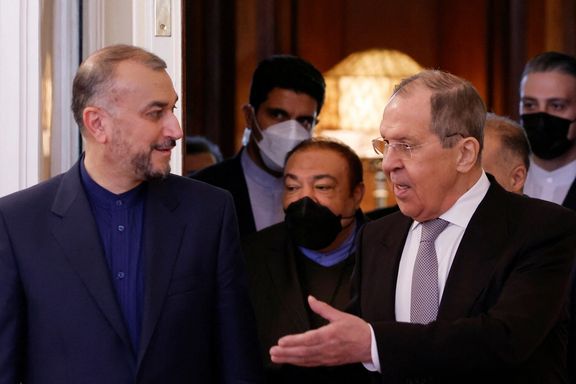
Iran's foreign minister Hossein Amir-Abdollahian with Russia Sergei Lavrov in Moscow in March 2022

Commentators and former officials in Iran are increasingly warning about Tehran’s close cooperation with Moscow and its impact on the country’s isolation.

Former head of Iranian parliament's National Security and Foreign Policy Committee Heshmatollah Falahatpish told local media: "If it were not for the issue of sending Iranian drones to Russia to be used in the war in Ukraine, Europe was highly unlikely to ratify a resolution against Iran."

Falahatpisheh, who is one of the few domestic critics still allowed to speak to print media, further said he is worried that Iran might become the second front in Russia's war against Ukraine.

The conservative pundit explained that Europe and the United States had agreed [in March 2022] on two matters – Iran upholding its nuclear commitments and the West reducing sanctions imposed, but at the last moment Russian negotiator Mikhail Ulyanov said that Russia cannot take part in implementing the agreement because of US sanctions on Moscow.

"Later Russian Foreign Minister Sergey Lavrov said that Russia would sign the agreement only if all of Russia's nuclear, trade, and military dealings with Iran are exempted from the sanctions. This led to an impasse and the talks were suspended," Falahatpisheh said.

Meanwhile, in an interview with moderate proreform Rouydad24 website, Falahatpisheh charged that some Iranian officials behave in a way as if they are paid to speak against Iran's national interests.

Former head of Iranian parliament's National Security and Foreign Policy Committee Heshmatollah Falahatpish
100%
Former head of Iranian parliament's National Security and Foreign Policy Committee Heshmatollah Falahatpish

He added that "Statements made by a group of people who have no knowledge of foreign policy have only led to a catalogue of threats against Iran." He was probably referring to individuals such as ultraconservative presidential aide Saeed Jalili and his likeminded allies in the parliament particularly ultraconservative Paydary Party members who staunchly oppose the revival of the 2015 nuclear deal or effectively any agreement with the United States.

Meanwhile, accusing the Islamic Republic of weakening the political elites, Falahatpisheh charged that "Some of Iran's politicians have no proper definition of the government and mainly believe in running the country's affairs like a militia. They have no understanding of the concepts of government, development, international relations, détente, international economy and other political concepts. They do not care what will happen to the next generation of Iranians as a result of Iran's isolation. And that is dangerous."

Falahatpisheh argued that many of the sanctions against Iran are the outcome of such a political approach. "While Iran owns two third of the Persian Gulf waterways and it should naturally attach high importance to the waterway's security, some members of parliament and others threaten to close the Strait of Hormuz. The current situation of Iran and its isolation is a legacy of this kind of grandstanding."

He also said that measures such as sending drones to Russia leads to the IRGC being listed as a terrorist organization in the West rather than the Russian army.

In a related development, Ahmad Bakhshayesh, another former member of parliament's National Security and Foreign Policy Committee said in similar remarks that "The Iranian government believes creating a foreign enemy will lead to solidarity inside the country.”

Referring to the recent drone attack on a military installation in Esfahan, Bakhshayesh said: "Benjamin Netanyahu creates foreign crises as a way of dealing with political divisions inside Israel." Meanwhile, he charged that "the attack was done by Israel from the Republic of Azerbaijan as part of Israel's confrontation with Iran as a country that harasses Israel by its presence in the Golan Heights and its support of the Lebanese Hizballah."

Bakhshayesh added that Iran has recently armed [its proxy groups] in the West Bank, in an area only 15 kilometers away from Israel. He characterized this action as "creating permanent tension" in that region.


Most Viewed

US blockade enters murky phase as tankers spoof signals and buyers hesitate
1
ANALYSIS

US blockade enters murky phase as tankers spoof signals and buyers hesitate

2

US tightens financial squeeze on Iran, warns banks over oil money flows

3
INSIGHT

Ideology may be fading in Iran, but not in Kashmir's ‘Mini Iran'

4
INSIGHT

Hardliners push Hormuz ‘red line’ as US blockade tests Iran’s leverage

5
VOICES FROM IRAN

Hope and anger in Iran as fragile ceasefire persists

Banner
Banner

Spotlight

  • Hardliners push Hormuz ‘red line’ as US blockade tests Iran’s leverage
    INSIGHT

    Hardliners push Hormuz ‘red line’ as US blockade tests Iran’s leverage

  • Ideology may be fading in Iran, but not in Kashmir's ‘Mini Iran'
    INSIGHT

    Ideology may be fading in Iran, but not in Kashmir's ‘Mini Iran'

  • War damage amounts to $3,000 per Iranian, with blockade set to add to losses
    INSIGHT

    War damage amounts to $3,000 per Iranian, with blockade set to add to losses

  • Why the $100 billion Hormuz toll revenue is a myth
    ANALYSIS

    Why the $100 billion Hormuz toll revenue is a myth

  • US blockade targets Iran oil boom amid regional disruption
    ANALYSIS

    US blockade targets Iran oil boom amid regional disruption

  • Iran's digital economy battered by prolonged blackout
    INSIGHT

    Iran's digital economy battered by prolonged blackout

•
•
•

More Stories

Iran Warns Pakistan To Complete Pipeline Or Face $18B Penalty: Media

Jan 31, 2023, 15:47 GMT+0

Pakistani media report that Tehran has warned Islamabad to construct its portion of the Iran-Pakistan gas pipeline until March 2024 or pay a penalty of $18 billion.

Iranian officials have communicated the message to a visiting Pakistani delegation about three weeks ago, a senior official of Pakistan’s Ministry of Energy told the media.

According to the official, Iran has stated that the US sanctions on Tehran are illegal and Pakistan, is bound to construct the 780-kilometer pipeline on its portion till February-March 2024.

The Islamic Republic has already completed part of the pipeline in its territory from the gas fields in the west to the border with Pakistan in the east.

The 25-year contract to export Iran's natural gas through a pipeline to Pakistan was signed between the two countries in 2009 and was supposed to be implemented by 2015, but international and US sanctions against Iran and Washington’s pressure on Islamabad have prevented its implementation so far.

The two sides inked a revised deal in September 2019. Iran agreed not to approach any international court if Pakistan would finish the pipeline until 2024.

Now the Iranian authorities have warned that there is only a short time left until March 2024, adding that if Pakistan does not complete the pipeline within 15 months, Tehran will demand $18 billion in compensation for the losses from laying the pipeline to the Pakistani border.

Academic Warns Raisi: There Is No Room For Trial And Error In Diplomacy

Jan 31, 2023, 13:47 GMT+0
•
Iran International Newsroom

University professors, former politicians and pundits warn the Iranian government of ignoring rationality and making wrong appointments amid serious crises.

Ebrahim Fayyaz, a professor of sociology at the University of Tehran, said in an interview with Rouydad24 website that enmity with “knowledge and particularly humanities” has made academic and research institutions useless. He said the demographic situation in Iran has made it difficult for the country's rulers to keep the society under control, and it is going to be even more difficult as we go further.

As an example, he said: "We did not consider the rules of the global game when we started to sell drones to Russia. As a result, Russia took advantage of us because our foreign minister did not know how to protect the country’s interests."

Iran has supplied hundreds of kamikaze drones to Russia which have been used against Ukraine’s civilian infrastructure, angering the United States and Europe.

Fayyaz warned that there is no room for trial and error in International diplomacy, but this is what Iran is doing constantly. He said: "We should have defined our foreign policy with the help of the academia. But unfortunately, our government does not want to interact with the universities. Our officials want to talk. They do not want to listen to others."

Ebrahim Fayyaz, professor of sociology in Tehran
100%
Ebrahim Fayyaz, professor of sociology in Tehran

"Under the circumstances," he said, "the university does not have anything to do with the government, and the government does not take the universities seriously. The government thinks that thanks to the oil money at its disposal, it no longer needs the university. This situation pushes the universities into the opposition's lap."

Fayyaz also criticized the state television for dictating the official views to the interviewees and asking them to repeat the party line. He said: "The rulers should follow men of knowledge and not vice versa." He added: I have been barred from appearing on TV because I wanted to say what I think, not what the government wants me to say.

Fayyaz's statements was so similar to what some Economists such as Moreza Ezzati, who has said, "public interest is not a priority for the government," and politicians such as former lawmaker Gholam Ali Jafarzadeh Imanabadi who regrets that "There are no wise and educated individuals around President Ebrahim Raisi."

Imanabadi has recently charged in an interview with Nameh News that the Iranian President has given big jobs in his cabinet to day dreamers and naïve individuals. Instead, he has removed a lot of wise, highly skilled, expert and well-educated individuals from their posts.

"The situation will be like this as long as national interests are not among the priorities of top officials and they make their decisions based on their biases and grudges and give opportunities to radical elements devoid of wisdom," Imanabadi argued.

"The only thing these officials can do is criticize former officials and blame them for all the problems that have been created recently." He added: "Even the Taleban in Afghanistan have realized that they need to talk with America if they want to solve their problems, but Iranian officials ignore obvious realities. At the same time, they fabricate their own figures to pretend that the country is on the course of progress. Raisi recently made so many claims…all contradicting the Central Bank and the Statistical Center's official figures."

Stating that general dissatisfaction in Iran is at a record level, Imanabadi said that Raisi should set aside factional differences and bring back the experts to the government. Referring to Raisi's frequent analogy about the "train of progress," Imanabadi said: "Where is this train? It either does not have a driver to steer it, or it has been derailed."

Women's Declining Economic Role Key Factor In Iran Unrest - Ex-Official

Jan 31, 2023, 08:59 GMT+0
•
Maryam Sinaiee

Ali Rabiei, a former labor minister and government spokesman, says discrimination against women in Iran is a significant factor propelling Iran's protests.

In a note published by the reformist Etemad newspaper Monday, Rabiei said one must examine economic indices with a gender-based bias to understand why women are such a strong driving force in the current protests.

He pointed out that the rate of women’s participation in Iran’s economy has never exceeded 17 percent compared with 60 percent for men, whereas the global average for women stands at 50 percent, adding that the rate which stood at 12 percent in 2014 climbed to 17.6 percent in 2018, the highest in the past two decades.

Rabiei added that unfortunately this modest gain was wiped out in the past three years, mainly because of the COVID pandemic and women’s economic participation now stands at 13 percent. “One of the country’s fundamental problems is that women’s health and education has improved but there have not been opportunities for women to expand their role in the economy and politics.

Former government spokesman, Ali Rabiei
100%
Former government spokesman, Ali Rabiei

Around 25 percent of Iranian women over the age of eighteen have higher education.

“This means that women have achieved social status but have not had the opportunity to participate and faced barriers. The same applies to the middle class,” he wrote.

“Undoubtedly a section of those demanding change in the recent protests belong to this group,” Rabiei said and opined that the feminine character of the protests can be the outcome of inequality that bars women from accessing economic opportunities.

But the issue for many women is not just jobs, as they understand that there is systemic discrimination against them and lack of social freedoms. After all, the protests did not ignite because of economic demands, but for the freedom to walk in public free of the Islamic dress code.

Hardliners generally define the role of women in society first and foremost as mothers and wives. In his speeches, Supreme Leader Ali Khamenei often tells women to marry early and have children. He has also insisted, on many occasions, that wearing the hijab does not limit women’s social role and their careers.

Hardliners in Iran protest against the UN 2030 Agenda in 2017
100%
Hardliners in Iran protest against the UN 2030 Agenda in 2017

“One of the greatest mistakes of western thinking about the issue of [the role of] women is this gender equality... Why should women be asked to carry out tasks [fit for men]? What is the glory in having women carry out tasks [fit for] men? I am sorry that sometimes women themselves are sensitive about this issue,” he said in a speech in April 2014.

“The main issue with respect to women's emancipation in the West is dragging women from home to the factory, using them as cheap labor,” he said in a recent speech in which he insisted men and women have equal rights in Islam but different roles and that women's primary and most important duty is being mothers and wives, that is, their role as housewives.

With Khamenei’s backing, hardliners battled fiercely to prevent the government of President Hassan Rouhani from implementing the UN’s 2030 Agenda for Sustainable Development, particularly its Goal 5 regarding eradication of discrimination against women and their empowerment.

Hardliners held rallies to protest the government’s plans to implement the UN guidelines and even tried to smear Rouhani during his reelection campaign in 2017 by claiming that the guidelines included immoral things such as “teaching students about homosexuality”.

Ensieh Khazali, Vice President for Women and Family Affairs, said last week that the UN 2030 Agenda for Sustainable Development is now being implemented but certain parts would be modified according to the government’s own views regarding their appropriateness.

Many have strongly criticized Khazali for her unverified claim about the implementation of the UN guidelines during a live televised debate with her reformist predecessor Masoumeh Ebtekar. Critics say the reason for hardliners’ objection to the implementation of the guidelines was their political rivalry with Rouhani.

US Iran Envoy Says Diplomacy Is Best Despite Worsening Problems

Jan 30, 2023, 19:56 GMT+0
•
Iran International Newsroom

Problems with Iran have gotten worse in the past two years despite talks over its nuclear program, US Special Envoy for Iran Rob Malley told the BBC’s Hard Talk.

Asked If he would acknowledge that the two-year diplomatic effort has failed, Malley said, “Diplomacy never ends as we do other things,” adding that the Biden administration has added sanctions, tried to contain Iran in the region and “mobilized the international community.”

However, he acknowledged that relations with Iran have worsened since the Biden administration came to office and started indirect talks with Tehran in April 2021.

The negotiation ended in deadlock in September, as US said Iran presented “extraneous” demands.

Pressed to acknowledge if the 2015 nuclear accord known as the JCPOA is dead, Malley avoided a direct answer, saying that Iran “turned down multiple opportunities to end this crisis…so you could reach your own conclusion.” He reiterated that the US is willing to continue talks with Iran “to reach a diplomatic outcome.”

Following the brutal and deadly suppression of protests in Iran many US politicians and Iranian activists have demanded an official end to the talks aimed at reviving the JCPOA, abandoned by former President Donald Trump in 2018.

Iranian activists have been demanding Malley's resignation, seeing him as an advocate of unending talks with the Islamic Republic, instead of opting for more pressure.

Malley reiterated that diplomacy is still the priority for the administration and a military option is only “a last resort,” apparently meaning to stop Iran from building a nuclear weapon. He added that the military option “is a very difficult option, a very dangerous option that President Biden would not engage in cavalierly.”

On the issue of how long the administration is willing to continue diplomacy with Iran when a point comes that it seems useless, Malley confirmed that the US has been sending “messages to Iran, but let’s not overstate,” and call it negotiations. He insisted that the US needs to convey messages, including about possible consequences if Iran supplies ballistic missiles to Russia.

When asked, Malley did not deny an Iran International report recently that he held three meetings with Iran's ambassador at the United Nations.

Asked if expanding close US and Israeli military cooperation and large joint military exercises are aimed at sending a message to Iran, Malley said these steps are designed to show that the US “has Israel’s back and we will work with Israel,” on protecting shared interests. He also said the drills aimed to demonstrate that regardless of what is happening in Europe “we could do other things, we could mobilize to defend our interests.”

In responding to a question if the administration is “compartmentalizing” its policy toward Iran, in terms of separating the nuclear issue from the gross violations of human rights, Malley said, “There is a degree to which we have to, in the sense that we can do two things,” support the people in Iran and defend the US national interest in not allowing Iran to go nuclear. He added “there is no contradiction between these two.”

The US envoy also defended the administration’s efforts in supporting the protest movement in Iran, citing frequent statements by President Joe Biden and his top officials and mobilizing international support to expel Iran from the UN Commission on the Status of Women in December. However, Malley reiterated that US “is not in the business of regime change.”

Malley praised the convergence of positions with Europe regarding Iran and said Tehran had a clear choice of returning to its obligations under the JCPOA, and to stop supporting Russia in its war against Ukraine. He added that US is not asking something “tantamount to surrender” but a “realistic choice, which is in their hands.”

Iranian Bank Report Reveals Shady Lending, Huge Losses

Jan 30, 2023, 00:39 GMT+0
•
Iran International Newsroom

A new report says an Iranian governmental bank has given over 150 trillion rials – roughly $500 million – in loans to foreign entities likely to those of Lebanon, Syria, and Venezuela. 

Bank Melli Iran, known as the first national and commercial retail bank of Iran, has recently published an advertorial on its financial statements for the first six months of the Iranian year (started March 21, 2022) as a way to promulgate its achievements and advertise the conduct of its manager, Mohammad-Reza Farzin who was recently appointed the governor of the Central Bank of Iran (CBI). 

In February 2022, Farzin had claimed that the accumulated losses of the bank fell from $2.3 billion to $2.2 billion (based on exchange rate at the time) with him at the helm.

However, according to the 99-page report, the accumulated losses of the bank increased again in 2022 to roughly $2.5 billion. 

Despite these losses, by late July of last year, the bank had paid over 182 trillion rials (roughly about $600 million) of loans to individuals and companies abroad. The figure was about 20 trillion rials in the previous year. Considering the sanctions and the lack of access to SWIFT banking system, it seems that these funds are mostly related to countries like Venezuela, Syria and Lebanon, wrote economic journalist Hirsh Saidian in an article published on Aftab News on Saturday. The report said that from March to July about 18 trillion rials – or about $60 million – was paid to a small bank called the Federal Bank of Lebanon, which seems to be under US sanctions. 

The bank has not yet confirmed or denied this issue, nor provided any details about the recipients of the funds. In addition to lack of transparency in the country’s banking system, the government has been criticized for giving free aid to projects in Hezbollah-controlled southern Lebanon and Houthi-controlled parts of Yemen despite high inflation and lack of investment in Iran's own domestic projects. 

Iran's Supreme Leader Ali Khamenei and Hezbollah’s Leader Hassan Nasrallah  (file photo)
100%
Iran's Supreme Leader Ali Khamenei and Hezbollah’s Leader Hassan Nasrallah

Lebanese media reported late in December that Hezbollah is facing financial problems due to the current protests across Iran, as it cannot import Iranian goods to sell at a discount to its supporters. Makram Rabah, a Lebanese political activist, emphasized in an interview with Iran International that the consequences of the uprising of Iranians against the regime could now be seen in Lebanon. He said the dire situation of the Islamic Republic, as the biggest financial and political supporter of Hezbollah, causes this group to lose the ability to stand on its own feet. 

The Bank Melli report did not elaborate on why and how a bank with such a huge amount of loss is still providing loans to entities linked with its proxy forces in the region. The report provides a rare glimpse into the opaque workings of Iranian banks, which usually serve the foreign and domestic policies of the Islamic Republic. 

Moreover, some experts have claimed that the accumulated loss of the bank is actually 2 quadrillion rials (over $6 billion), which has been the result of years of corruption, mismanagement and giving loans to influential people and projects without economic justification, the article added. Such losses have caused banks to rely more on the resources of the central bank, making it print money that fuels the over 50-percent inflation rate.






