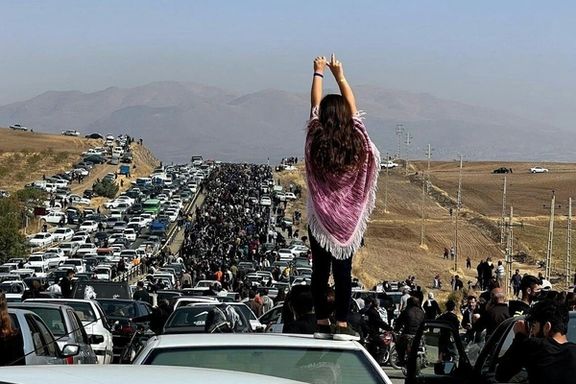
A funeral and protest march in Saqqez, Mahsa Amini's hometown in October 2022
Ali Rabiei, a former labor minister and government spokesman, says discrimination against women in Iran is a significant factor propelling Iran's protests.
In a note published by the reformist Etemadnewspaper Monday, Rabiei said one must examine economic indices with a gender-based bias to understand why women are such a strong driving force in the current protests.
He pointed out that the rate of women’s participation in Iran’s economy has never exceeded 17 percent compared with 60 percent for men, whereas the global average for women stands at 50 percent, adding that the rate which stood at 12 percent in 2014 climbed to 17.6 percent in 2018, the highest in the past two decades.
Rabiei added that unfortunately this modest gain was wiped out in the past three years, mainly because of the COVID pandemic and women’s economic participation now stands at 13 percent. “One of the country’s fundamental problems is that women’s health and education has improved but there have not been opportunities for women to expand their role in the economy and politics.
“This means that women have achieved social status but have not had the opportunity to participate and faced barriers. The same applies to the middle class,” he wrote.
“Undoubtedly a section of those demanding change in the recent protests belong to this group,” Rabiei said and opined that the feminine character of the protests can be the outcome of inequality that bars women from accessing economic opportunities.
But the issue for many women is not just jobs, as they understand that there is systemic discrimination against them and lack of social freedoms. After all, the protests did not ignite because of economic demands, but for the freedom to walk in public free of the Islamic dress code.
Hardliners generally define the role of women in society first and foremost as mothers and wives. In his speeches, Supreme Leader Ali Khamenei often tells women to marry early and have children. He has also insisted, on many occasions, that wearing the hijab does not limit women’s social role and their careers.
Hardliners in Iran protest against the UN 2030 Agenda in 2017
“One of the greatest mistakes of western thinking about the issue of [the role of] women is this gender equality... Why should women be asked to carry out tasks [fit for men]? What is the glory in having women carry out tasks [fit for] men? I am sorry that sometimes women themselves are sensitive about this issue,” he said in a speech in April 2014.
“The main issue with respect to women's emancipation in the West is dragging women from home to the factory, using them as cheap labor,” he said in a recent speechin which he insisted men and women have equal rights in Islam but different roles and that women's primary and most important duty is being mothers and wives, that is, their role as housewives.
With Khamenei’s backing, hardliners battled fiercely to prevent the government of President Hassan Rouhani from implementing the UN’s 2030 Agenda for Sustainable Development, particularly its Goal 5 regarding eradication of discrimination against women and their empowerment.
Hardliners held rallies to protest the government’s plans to implement the UN guidelines and even tried to smear Rouhani during his reelection campaign in 2017 by claiming that the guidelines included immoral things such as “teaching students about homosexuality”.
Ensieh Khazali, Vice President for Women and Family Affairs, said last week that the UN 2030 Agenda for Sustainable Development is now being implemented but certain parts would be modified according to the government’s own views regarding their appropriateness.
Many have strongly criticized Khazali for her unverified claim about the implementation of the UN guidelines during a live televised debate with her reformist predecessor Masoumeh Ebtekar. Critics say the reason for hardliners’ objection to the implementation of the guidelines was their political rivalry with Rouhani.
Reports from Iran say the Islamic Republic has imposed a travel ban on Masoud Kimiai, a prominent film director amid widespread repressive measures related to protests.
Hamshahri Online wrote Monday that “Masoud Kimiai, who planned to go to the Netherlands Sunday night along with his son to participate in The International Film Festival Rotterdam, faced a travel ban at the airport.”
Hamshahri Online, which is affiliated to Tehran municipality, quoted one of the filmmaker’s friends as saying that Kimiai wanted to attend the screening of his film called ‘Killing A Traitor’.
Authorities allowed Ali Owji, the producer of the film, to leave Iran for the Netherlands.
Earlier, the Iranian Independent Filmmakers Association had announced the ban on Kimiai.
Killing A Traitor, the latest work by Masoud Kimiai, which is about the contemporary history of Iran, is slated to be screened in the Harbor section of the festival.
The ban on the famous director comes after a large number of Iranian cinematographers and artists have been summoned, arrested or banned from leaving the country since the beginning of nationwide protests in mid-September.
Officials are yet to provide an explanation about Kimiai’s travel ban, but on September 22, he released a video saying, “They killed Mahsa Amini, and this is the main reason to rise up.”
Kimiai is considered a pioneer of modern Iranian cinema, having gained acclaim with his 1969 film ‘Qeysar’ which was released 10 years before the Islamic revolution.
People in the quake-hit city of Khoy in West Azarbaijan Province
The victims of a recent earthquake in Iran’s West Azarbaijan province are in critical condition while the authorities keep promising to resolve their issues soon.
Reports from Khoy, the epicenter of the Saturday quake say the victims spent Sunday night in the streets amid freezing temperatures.
According to the reports received by Iran International, the process of providing aid to the affected people is “terrible.”
The earthquake-hit people of Khoy are still deprived of having access to tents, and the government has used water cannons against residents who protested the unbearable conditions.
Videos sent to Iran International show widespread disorganization in the distribution of food and necessities among the people.
Another video published on social media shows people who have gathered in front of the governor’s office asking for help.
“We talked to the governor about the need for tents. He says it has nothing to do with me. I say to the authorities, help people. If the earthquake didn’t kill people, don’t let the cold kill them,” says a quake-hit citizen.
Also, Faraz online newspaper announced most of the bakeries in Khoy do not work, and enough bread was not supplied and distributed among people.
Hengaw Human Rights Organization has asked the people of surrounding cities to help the earthquake victims because “government bodies basically do not have a specific plan for adequate and immediate assistance.”
An earthquake with a magnitude of 5.9 hit northwest Iran near the border with Turkey on Saturday, killing at least three people and injuring over 800.
Iran says a statement by German Chancellor Olaf Scholz comparing the situation in Iran with past Argentinian dictatorship is interference in its domestic affairs.
In a statement on Monday, foreign ministry spokesman Nasser Kanaani said, “In an amateurish and biased comparison, the chancellor of Germany once again proved that he still stands on the wrong side of history.”
Scholz, who was speaking in Buenos Aires Sunday, remembered the victims of the 1976-1983 military dictatorship in Argentina and compared this regime with the one currently ruling Iran.
Scholz participated in a ceremony at Río de la Plata, explaining that he cannot help but think immediately of the young people who are being murdered in Iran when they defend their freedom and struggle for a better.
It is estimated that between 7,000 and 30,000 people lost their lives during the military dictatorship in Argentina. Some of the victims were thrown into the Rio de la Plata in so-called death flights without the relatives being informed.
“The fact that dictatorship brings suffering, oppression and death is very visible here, just as we perceive it everywhere in the world today,” the German chancellor noted.
US-based Human Rights Activists News Agency (HRANA) released a report Sunday that at least 527 protesters have been killed in Iran since the protests began more than four months ago following the death in custody of Mahsa Amini.
Iran has also executed four young protesters so far to contain the nationwide demonstrations.
A sit-in protest by Tehran's Polytechnic University students on November 15, 2022
Five months into the nationwide uprising against the Islamic Republic, the regime has targeted universities, through forced retirement and dismissal of professors.
According to reports received by Iran International, the activity of at least nine professors at the Faculty of Political Science of Tehran Azad University have been terminated.
In Khorasan Razavi province in the east, Mahshid Gohari, professor of literature at Ferdowsi University of Mashhad, announced on her Instagram page that after seven years of teaching, the university has expelled her.
Javad Atefeh, a playwright, director and theater instructor, announced on his Instagram page, "For reasons that I am sure you know", he is not offered to teach in universities for the next semester.
Earlier, there were reports of suspensions and dismissals of university professors who supported the protests against the Islamic Republic following the death in custody of Mahsa Amini in mid-September.
Court cases have also been filed against many university professors and they have been arrested or summoned.
For example, in Kordestan Province in the west, Mohammad Sadeq Amiri, a professor of Sanandaj Azad University, was arrested by security forces on December 7.
Zahra Khoshkjan, a professor of political science at Shahid Bahonar University of Kerman, was summoned to the disciplinary committee for not holding classes on December 5, 6, and 7, in support of protests and she has now been banned from entering the university.
A large Iranian rally in London to demand the listing of IRGC as a terrorist group. January 8, 2023
A leading activist has urged Iranians to unite and put aside disputes over an “unreal” fear of dictatorship or Iran's dismemberment after the fall of the regime.
“Let’s not fear having a dictatorship in the future. Let’s not fear Iran's dismemberment. These fears are not real … Let’s agree on [our] minimum demands and dig the grave of this rotten corpse,” the Canada-based Hamed Esmaeilion wrote in an Instagram post Sunday.
He wrote the comment on the anniversary of Ayatollah Ruhollah Khomeini’s return from exile to Tehran in 1979 and the establishment of the Islamic Republic. The post has been liked by nearly 200,000 so far.
In his long commentary, Esmaeilion urged Iranians both inside the country and abroad to unite, whether republicans or monarchists, belonging to minority religious or ethnic groups, on the right of the political spectrum or on the left.
“Many of the mistakes of the past will not be repeated if we leave political disputes to after the toppling of the descendants of the demon [Khomeini],” he wrote adding that unreasonable arguments would only delay the waves of protests in Iran where people no longer fear fighting the regime.
Hamed Esmaeilion, Iranian activist and a leading opposition figure
Like the exiled prince Reza Pahlavi, activists Masih Alinejad, Nazanin Boniadi, and footballer Ali Karimi, many on social media have expressed support for Esmaeilion’s membership in an opposition council to be formed for transition from the Islamic Republic.
Last week, Prince Reza Pahlavi also urged pro-democracy forces to unite. “I’m extending my hand, once again, for cooperation to all pro-democracy forces, including individuals, parties and groups, to support the Iranian national revolution,” he said in a statement published via his social media accounts.
The exiled prince’s plea came soon after his supporters launched a campaign to endorse him as the trustee of the Iranian people in transition to secular rule. Over 433,000 have so far signed the petition launched in mid-January.
Exiled Prince Reza Pahlavi and former crown prince
Esmaeilion and others have recently been under heavy fire on social media for not having joined the campaign to give power of attorney to the exiled prince. Critics of the campaign say it has played a divisive role, caused rifts among the opposition, and led to the cooling of the revolutionary fervor on the streets in Iran.
In his recent statement, the exiled prince set three preconditions for cooperation with others: Accepting to ensure Iran's territorial integrity and the people’s right to determine the form of the future political system through a free vote as well as belief in human rights-based secular democracy.
Some Kurdish, Baluch, Turkic speaking groups and individuals, and those supporting federalism, argue that the mention of territorial integrity is divisive and is a sign federalism will not be tolerated. Others, particularly supporters of the exiled prince say demanding federalism is only a cover for separatism and dismemberment of Iran.
In the past four months, protesters across the country, particularly in Kurdish and Baluchi cities, have often chanted slogans such as “From Baluchestan (or Kordestan) to Tehran, we sacrifice our lives for Iran” to repudiate claims of separatism and stress the unity of all Iranians against the regime.
Hundreds of thousands of Iranians welcomed a New Year message tweeted by Prince Reza Pahlavi, Alinejad, Karimi, Boniadi, and Esmaeilion as well as actress Golshifteh Farahani on December 31 in which these opposition figures had wished that further solidarity and organizing could make 2023 the last year of the clerical rule in Iran.
Many believed that the tweet heralded the formation of a revolutionary council in exile that could take on the role of leading the Iranian revolution in the absence of strong revolutionary political parties and leaders in the country.