• العربية
  • فارسی
Brand
  • Iran Insight
  • Politics
  • Economy
  • Analysis
  • Special Report
  • Opinion
  • Podcast
  • Iran Insight
  • Politics
  • Economy
  • Analysis
  • Special Report
  • Opinion
  • Podcast
  • Theme
  • Language
    • العربية
    • فارسی
  • Iran Insight
  • Politics
  • Economy
  • Analysis
  • Special Report
  • Opinion
  • Podcast
All rights reserved for Volant Media UK Limited
volant media logo

Party Leader Says Mistreatment Of Women Triggered The Iranian Revolt
Iran International Newsroom
Jan 23, 2023, 08:51 GMT+0Updated: 17:35 GMT+1
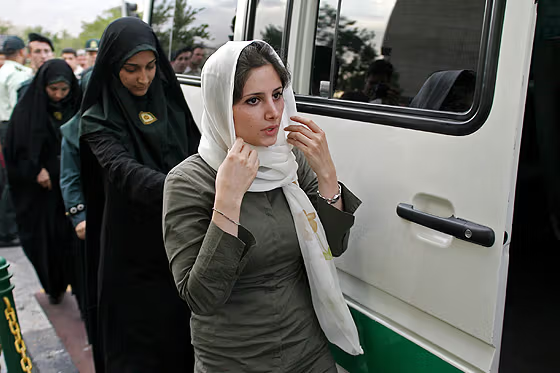
The woman in white scarf stopped by female hijab police in the street, who are taking her into a police van

Some politicians and pundits in Iran warn that the government is again pushing the wrong policies that led to the recent wave of protests and uprising in Iran.

Criticizing the insistence of hard-liners on hijab, Azar Mansouri, the female leader of reformist Unity of Nation Party in Iran has argued that the reason why Iranian women burned their headscarves during the recent protests is that the government tried to impose a certain dress code on them in the name of religion.

She said in an article in Etemad newspaper that those who made this mistake did not understand that Islam came to give dignity to all human beings regardless of their gender. "What you are doing is like cutting off the branch you are sitting on," Mansouri told Iranian officials.

Mansouri said people remember viral videos before the protests that started in mid-September, in which a woman was begging the morality police not to arrest her ailing daughter, or many other videos that showed the police's brutality while arresting women for not fully respecting the dress code the government imposed on the people. "Mahsa Amini's death in custody flared up a fire that was under the ashes," Mansouri said in a statement that was identical with what centrist commentator Sadeq Zibakalam had said the previous day.

Mansouri quoted Iranian scholars as saying that "The Woman, Life, Freedom movement started as a result of accumulated dissatisfactions and the widening divides between the government and the Iranian society. She warned that the uprising could still re-emerge.

Reformist party leader Azar Mansouri. Undated
100%
Reformist party leader Azar Mansouri. Undated

The politician expressed hope that the government will adopt a realistic policy about how to deal with the people and will start serious legal and structural reforms. However, she warned that what people hear from official podiums erodes any hope in reforms. She pointed out the arrest of Iranian artists for removing their hijab and heavy sentences for them, as well as the killing of many young men and women during the protests as an indication that reforms are unlikely in Iran.

Opposition to the government's heavy-handed approach to enforcing hijab and punishing detained protesters has been on the rise during the past days even by some Muslim clerics. Mohammad Ashrafi-Esfahani has said that "Executions carried out following recent protests are not based on sound legal foundations." He also pointed out that "many top clerics are silent about it because they think no one in the government will care for their attestations."

However, Ashrafi-Esfahani stopped short of saying that many top clerics fear retribution by the government if they speak against the hardliners who control the government and the Judiciary system and are supported by Supreme Leader Ali Khamenei. Nonetheless, the cleric said: "It might help if the leader in a bid to calm the situation tells the Judiciary to deal with prisoners compassionately. This will also be a good publicity for the Islamic Republic."

In her article in Etemad, Ms. Mansouri observed that Iranian women have expressed their opposition to the dress code imposed by the government all along in the past four decades. They have also objected to discrimination against women under the Islamic Republic. But nobody paid any attention to their grievances. She argued that there were no serious confrontations between women and the government until hardliners boldly introduced the morality police.

In the meantime, she said, a government-imposed glass ceiling prevented Iranian women's access to equal rights with men in the areas of education and employment. She concluded that it was this unfair treatment of women and ignoring their rights that triggered their revolt in September and what is now known as the ‘Woman, Life, Freedom’ movement.


Most Viewed

Ideology may be fading in Iran, but not in Kashmir's ‘Mini Iran'
1
INSIGHT

Ideology may be fading in Iran, but not in Kashmir's ‘Mini Iran'

2
INSIGHT

Hardliners push Hormuz ‘red line’ as US blockade tests Iran’s leverage

3
VOICES FROM IRAN

Hope and anger in Iran as fragile ceasefire persists

4

Iran International says it won’t be silenced after London arson attack

5

US sanctions oil network tied to Iranian tycoon Shamkhani

Banner
Banner

Spotlight

  • Hardliners push Hormuz ‘red line’ as US blockade tests Iran’s leverage
    INSIGHT

    Hardliners push Hormuz ‘red line’ as US blockade tests Iran’s leverage

  • Ideology may be fading in Iran, but not in Kashmir's ‘Mini Iran'
    INSIGHT

    Ideology may be fading in Iran, but not in Kashmir's ‘Mini Iran'

  • War damage amounts to $3,000 per Iranian, with blockade set to add to losses
    INSIGHT

    War damage amounts to $3,000 per Iranian, with blockade set to add to losses

  • Why the $100 billion Hormuz toll revenue is a myth
    ANALYSIS

    Why the $100 billion Hormuz toll revenue is a myth

  • US blockade targets Iran oil boom amid regional disruption
    ANALYSIS

    US blockade targets Iran oil boom amid regional disruption

  • Iran's digital economy battered by prolonged blackout
    INSIGHT

    Iran's digital economy battered by prolonged blackout

•
•
•

More Stories

Iranian Parliament Approves Budget Bill With Huge Deficit

Jan 22, 2023, 20:39 GMT+0
•
Iran International Newsroom

The Iranian parliament has approved the outlines of the budget bill for the next Iranian year – starting March 21 -- without considering its unrealistic assumptions. 

President Ebrahim Raisi Sunday defended the bill at the parliament by a rhetorical statement, "The strategy of the enemy is to create despair, while the strategy of the government and the parliament should be to create hope in the hearts of the people." The deficit in the current budget that the government admits is about 4,760 trillion rials – more than ten billion dollars. But the real deficit will be perhaps twice as much, with rosy estimates of oil sales and staggering tax collection.

As the bill was being approved, the Iranian currency rial hit a new historic low, dropping to 455,000 against the US dollar. But that did not deter Raisi from claiming that Iran is witnessing “a very bright future,” citing data supposedly indicating that the country’s economy grew in the past year.

President Ebrahim Raisi (center) at the parliament on January 22, 2023
100%
President Ebrahim Raisi (center) at the parliament on January 22, 2023

He claimed that "this year the country is witnessing an economic growth of four percent," adding that "a million jobs have been created in the country." When he presented the outlines of the budget, he had claimed that economic growth in this budget would be eight percent.

According to an International Monetary Fund report, economic growth will decrease from four percent in the previous Iranian year to three percent in the current year and two percent in the next year. That is still an estimate based on figures mainly supplied by the Iranian government.

Meanwhile, Gholamhossein Shafei, the head of Iran's Chamber of Commerce, said last year that the country's economic growth has been zero in the past 10 years.

Gholamhossein Shafei, the head of Iran's Chamber of Commerce (file photo)
100%
Gholamhossein Shafei, the head of Iran's Chamber of Commerce

The budget bill that was submitted to parliament more than a month late, places its hope on exporting 1.4 million barrels of oil per day, a lofty goal given that US sanctions are in place and Tehran is exporting less than a million barrels under current conditions. The budget also estimates that each barrel of oil can be sold at $85, while that is the highest price in global market, but Iran has to give steep discounts to ship illicit cargoes to its main buyer, China.

The total tax revenues planned in the draft budget will surpass $20 billion based on the current rate of exchange. In Iranian currency, however, this is a staggering 8.3 quadrillion rials – that is with 15 zeros.

Despite the huge tax bill for the people, the government budget will still have a 50-percent deficit, due to a chaotic downturn in the economy mainly triggered by US sanctions on its oil exports and international banking.

The 59-percent jump in planned tax collection means that taxpayers have to pay at least 10 percent more than the estimated 50-percent annual inflation rate.

The Raisi administration started with a rate of exchange for US dollars of 250,000 rials which has so far risen to over 450,000 rials.

Inflation in the country has soared to over 50%, the highest level in decades. Youth unemployment remains high with over 50% of Iranians being pushed below the poverty line, according to reports by Iran's Statistical Center.

The Iranian currency rial has lost its value by more than elevenfold in five years, making imports of food and other essential necessities equally expensive for consumers.


List Of Unsafe Buildings In Tehran Not Released To Avoid ‘Panic’

Jan 22, 2023, 20:30 GMT+0

Although two members of Tehran City Council said they will officially publish the list of unsafe buildings in the capital, the promise remained unfulfilled once again because it "would worry the people".

Last week, Mehdi Abbasi and Nasser Amani, two members of Tehran City Council, had emphasized that they would publish the list on Saturday, but mayor Alireza Zakani once again announced, “we are not responsible for publishing the list of unsafe buildings, but we will give it to the legal authorities.”

Meanwhile, lawmaker Mohammad Hasan Asafari told the ILNA news agency that "announcing the names of these buildings can have a psychological effect and make people anxious, so there is no need to create such fears in the society."

Earlier, in November Alireza Zakani said “If we release the list, no one will stay in Tehran anymore.”

The list of 129 unsafe buildings in Tehran became a hot topic about five years ago, after the Plasco incident.

The Plasco Building was a 20-story high-rise that collapsed on January 19, 2017 after it caught fire. Twenty firefighters were reportedly killed and at least 70 others were injured by the collapse. Another major building collapse in Khuzestan province last year, made the issue of identifying unsafe buildings an urgent matter.

IRNA state news agency reported in June that there are currently "33,000 unsafe buildings" in Tehran.

Many Iranians Vote For Exiled Prince, Others Demand Alternatives

Jan 22, 2023, 16:53 GMT+0
•
Maryam Sinaiee

Iran's exiled crown prince, Reza Pahlavi, has urged pro-democracy forces to unite following arguments over endorsing him as trustee in transition to secular rule.

“I’m extending my hand, once again, for cooperation to all pro-democracy forces, including individuals, parties and groups, to support the Iranian national revolution on the basis of three minimum common principles: Iran's territorial integrity, human rights-based secular democracy, and people’s right to determine the form of the [future] political system through a free vote,” he said in a statement published via his social media accounts Saturday.

The statement came after a petition endorsing him as representative of his supporters to lead a transition from the Islamic Republic to secular rule launched Tuesday by actor Ehsan Karami received over 300,000 signatures by Saturday. “This petition helps the people of Iran to express their opinion,” Karami said.

One of the first to support the campaign was expatriate Iranian football star Ali Karimi, a key supporter of the popular uprising, who has millions of followers on Instagram and Twitter. The number of signatures has now risen to over 350,000 on Sunday.

Karami said he had launched the petition because the exiled crown prince had in an interview with London-based Manoto TV asked the people of Iran to give him power of attorney to lead the movement against the Islamic Republic.

Iranian football star Ali Karimi with German President Frank-Walter Steinmeier on December 21, 2022
100%
Iranian football star Ali Karimi with German President Frank-Walter Steinmeier on December 21, 2022

In response to a question why he was not openly accepting the leadership of the movement, Pahlavi said any kind of work, presumably lobbying with world powers and international organizations, required “a legitimate basis or some kind of power of attorney from inside Iran."

Signatories of the petition include several celebrities but so far Karimi is the only high-profile expatriate opposition figure recognized as one of the likely members of a future transitory council to have signed the petition and campaigned for it.

Other known figures representing the protest movement, including actress and human rights activist Nazanin Bonyadi, journalist and activist Masih Alinejad, actress Golshifteh Farahani, activist Hamed Esmaeilion, and Nobel Peace Laureate Shirin Ebadi have so far neither endorsed nor rejected the plea.

Some regime opponents imprisoned in Iran, including Manouchehr Bakhtiari have endorsed him. Bakhtiari is an ardent believer in reviving the monarchy. He is jailed for his anti-regime activism after his 23-year-old son Pouya was shot in the head during the November 2019 protests in Karaj.

Political prisoner Manouchehr Bakhtiari with his son Pouya who was killed by a sniper during the 2019 protests in Iran
100%
Political prisoner Manouchehr Bakhtiari with his son Pouya who was killed by a sniper during the 2019 protests in Iran

The petition has given rise to intense arguments on social media with those in favor tweeting with the hashtag “I endorse power of attorney” and others using the hashtag “I do not endorse power of attorney”. The exiled prince is currently among the top ten Persian-language hashtags on Twitter now.

In recent years, the former crown prince has not laid claim to the throne, and at least on one occasion said his own desirable government would be a republic rather than a monarchy, but many of his supporters, who always refer to him affectionately as ‘The Prince’ see him as the future king of the country.

“Based on the Iranian Constitution [of 1906], Prince Reza Pahlavi is the heir to the Iranian throne. There’s no plan for him to establish a government … This [power of attorney] is giving him permission to meet political representatives and officials of other governments,” Kamelia Entekhabifard, chief editor of the Persian website of The Independent, told the BBC’s Persian television Wednesday.

Entekhabifard argued that giving such power of attorney to the exiled crown prince would prevent others without proper credentials, a clear past, and well-defined demands to meet with foreign officials.

“At least the Prince is emphasizing the principles of territorial integrity of the country, freedom of religion, equal rights for all Iranians,” she said while stressing that Pahlavi has always emphasized it is the Iranian people who should decide their future form of government through free elections.

Others -- notably some republicans and leftist politicians and activists – reject giving power of attorney to the exiled crown prince while even some of his supporters say empowering one person is undemocratic and would pave the way for future troubles.

In their view, only a council consisting of prominent political figures and activists can be a true representative of the Iranian people in any talks over the future of the Islamic Republic with world powers.

“I endorse power of attorney”, the Marxist Iran Left Party (Fadaiyan-e Khlagh) said in a statement Saturday, “is undemocratic both is form and content” and argued that appointing the exiled crown prince as Iranians’ representative, without setting any conditions, is similar to the yes-no referendum in 1979 that determined Iran's form of government as an Islamic Republic and disregards the “political and civil society in the country”.

Proponents of endorsing the exiled prince as a representative say those who do not want him can propose their own candidates, but the revolution needs leadership.

Iranian Regime Continues Arresting Activists, Issuing Heavy Sentences

Jan 22, 2023, 16:29 GMT+0

In the fifth month of protests against Iran’s clerical rulers, the Islamic Republic continues to arrest activists and journalists and issues heavy sentences for detainees.

In the most recent case, Kian Pirfalak's mother has been banned from her job at a school. The ten-year-old Kian Pirfalak was shot dead by plainclothesmen in Izeh in the southwestern province of Khuzestan on November 16.

According to the Coordinating Council of Iranian Teachers' Trade Association the ministry of education summoned Zeinab Mollaie-Rad, on Saturday telling her that "until further notice, she must not go to school."

Meanwhile, brother of Ahmad Raisi, the former employee of a university in the western city of Hamedan reported that his brother is locked in solitary confinement and has been on a hunger strike for the past 10 days.

Reports also say prisoners are still being tortured in custody. Activists say Mazaher Heydari, a detainee belonging to the Gonabadi Dervish religious sect, was transferred from Chabahar Prison in the south to Shahrekord in the west last week for more interrogation. Heydari, had previously informed about his torture and forced confessions.

The judiciary further continues to issue heavy sentences for detainees. Reyhaneh Taravati, a photographer and civil activist, was sentenced to six years in prison on a charge of "holding gatherings and propaganda against the regime", which will be enforceable for 5 years if confirmed in the appeals court.

Melika Heshemi, the reporter of Shahr news agency, who had gone to Evin prison, has been arrested too.

Politicians Call For Reforms In Iran, Replacing Cabinet Members

Jan 22, 2023, 02:04 GMT+0
•
Iran International Newsroom

A prominent commentator says the Iranian uprising is a fire under the ashes that can flare up any moment for any reason and create even a more massive movement.

In an interview with reformist daily Etemad, centrist academic Sadegh Zibakalam also warned the government about its annoying treatment of women and young Iranians. It would be wrong to go back to repressive policies the government followed prior to the death in custody of Mahsa Amini, which led to the country's biggest uprising since mid-September.

Zibakalam added that some Iranian officials deny the crisis in Iran and believe that protests were created by foreigners, but it is over now. However, he warned that the reasons for the uprising are still there, and future protests could be even more widespread.

The outspoken pundit said if there is no change in Iran and the government continues its repressive policies, there are reasons to be worried about the future of the regime. The people's demand for regime change is an outcome of disillusionment and despair and lack of hope in reforms, he argued.

After four months of unrest, protesters are more determined that the clerical regime should go and a secular, democratic political system must replace it.

Prominent commentator and academic Sadegh Zibakalam
100%
Prominent commentator and academic Sadegh Zibakalam

Zibakalam said that university students were the driving force behind the protests. It looks like there is a slowdown in protests only because the universities are currently closed for exams and because because of enormous government pressure. But this does not mean the protests have receded.

The academic said that during the past 43 years, the student Basij was created to stop Iran's student movement, but not only the Basij has not been successful, the student movement has gained more power and momentum year after year.

Criticizing the consolidation of conservative's control over Iran in the 2021 presidential election by barring others from running, Zibakalam said you cannot control 80 million Iranians by one or two million radical revolutionaries.

Meanwhile, reformist lawmaker Massoud Pezeshkian criticized his colleagues at the Iranian Parliament (Majles) for chanting slogans such as death to this or that country instead of trying to correct the state of affairs in Iran. "We need to tolerate others and work and collaborate with the world," he said adding that "we need to create solidarity inside Iran."

A critique of hardliners, lawmaker Massoud Pezeshkian. File photo
100%
A critique of hardliners, lawmaker Massoud Pezeshkian

"When you say death to this or that country, they will also say death to you," Pezeshkian quipped.

Referring to some officials' radical threats against other nations during the past week, the lawmaker from Tabriz, criticized the government for doing away with experts in the government and giving big jobs to incapable people with no experience or knowledge. The failure of government policies is the outcome of our choice of managers and officials, he said.

Pezeshkian then asked whether the government can replace some officials and appoint new ones. "This cannot be done. This government is basically incapable of solving the country's current problems," he said.

Levelling similar accusations against the government, conservative politician Hedayatollah Khademi told Nameh News that President Ebrahim Raisi needs to replace some of his ministers in order to save himself. "There is no reason for him to continue working with these inefficient individuals who are the subject of many jokes among citizens. All cabinet members must be changed," he said, adding that "Iran is the only country in the world whose foreign minister and nuclear negotiators cannot speak English."

Khademi also criticized the parliament for failing to supervise the government's performance. He charged that most lawmakers are currently working on their re-election or if they have no hope, they are appeasing the government to make sure that they will get a job after they finish their term in the parliament.