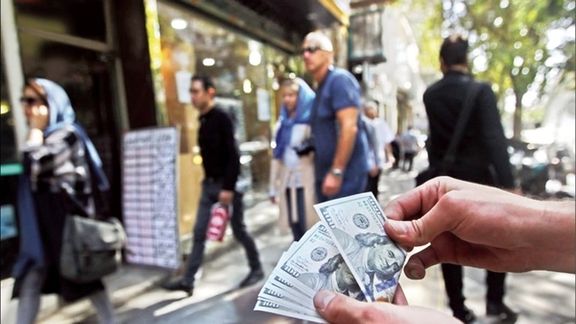
Iran's unofficial foreign currency market determines the fate of the economy
At the start of the work week in Iran on Saturday, the national currency reached new lows against the US dollar, as economic and political uncertainty continued.
The US dollar was trading well above 440,000 rials in Tehran’s unofficial market where cash dollars and Hawala money transfers take place. The new demand for dollars came after a couple of weeks when the rial hovered around 400,000 to the dollar.
One year ago, the dollar was around 300,000 rials and it was gaining strength every time there was hope of a nuclear agreement with the United States and its Western allies. But those hopes evaporated first in March, after the Russian invasion of Ukraine as 12 months of talks in Vienna came to an end, and finally in September when the last attempt to bridge the gaps fell apart.
An agreement to revive the 2015 nuclear deal known as the JCPOA would have lifted US economic sanctions, allowing Iran to sell more crude at higher prices and secure revenues for the government.
The Islamic Republic’s government and parliament are now in the midst of examining a budget draft for the new Iranian year starting March 21. Confusion, uncertainty, and lack of clarity surround the budget bill that is said to carry a 50-percent deficit and a 50-percent annual inflation rate.
Although street protests have lost their intensity, most pundits in Tehran and even many regime insiders do not consider the current situation stable. Any day and any event can trigger more nationwide protests, as the clerical regime has lost its legitimacy in the eyes of many citizens, especially the younger generation.
Abbas Akhoundi, a conservative lawmaker told local media this weekthat as a result of a failing foreign policy, Iran lags behind its development plans, international trade has been disrupted, inflation is beyond control and poverty can be seen everywhere while the society in on the verge of collapse.
Other politicians compared Iran with neighboring Iraq and Afghanistan, saying that their currencies are more stable despite decades of instability.
However, Iraq’s currency has begun to decline for a totally different reason than economic weakness. The Wall Street Journal reported January 19 that the United States has begun to monitor dollar banking transactions from Iraq, stopping wire transfers that lack transparency and full information about the sender and the recipient. This has led to shortages of dollars for imports and cash dollar banknotes have risen around 10 percent against the Iraqi dinar.
However, this is also related to Iran as the US suspects Iraq’s banking system is being used by Tehran to hide its illicit dollar transactions through the international banking system.
US sanctions on Iran not only penalize countries and companies that buy oil from Tehran but also bans its dollar transactions. The sanctions have also led to a de facto international boycott of Iranian banks that have been cut off from the global SWIFT transaction network. As a result, exports and imports cost at least 25 percent more for the Iranian government and companies.
Since its deadly suppression of popular protest in the past four months that has killed around 500 civilians, the Islamic Republic has become more isolated in the world and Western countries continue to issue more sanctions, adding to the prevailing economic uncertainty and the fall of the rial.
Jalil Rahimi Jahanabadi, a lawmaker from northeast Iran, has said that “our policies anger the young generation,” and our economy has a mafia-like structure.
Jahanabadi further charged that Iranian officials do not believe in governance as an expertise and try to “re-invent the wheel” instead of learning from 200 other countries.
"Iranian politicians are constantly reinventing the wheel. They never ask themselves how their counterparts in 200 other countries treat and manage their national currencies and foreign exchanges. They do not believe in banking as a knowledge-based practice and an expertise. With all that I wonder why we are so complacent and always believe that we can correct the world," the lawmaker said.
He drew attention to the fact that officials during the past weeks claimed that the fall in the value of Iran’s currency was the outcome of the protests. But they never ask themselves why it keeps falling even when the streets are calmer.
MP Jalil Rahimi Jahanabadi
Jahanabadi explained that when society is volatile, some people tend to invest in real estate in other countries. This has happened during the protests in 2017-2019. In 2022, a lot of capital left Iran for purchasing properties in Armenia, Georgia, Turkey and the United Arab Emirates.
Furthermore, at times of unrest, many shift their capital to gold and foreign currencies to prevent the devaluation of their assets. Iran’s rial has fallen more sharply and is more vulnerable than even in Iraq and Afghanistan.
Jahanabadi maintained that almost everyone knows that “our political, economic, foreign and cultural policies need reform, but no one knows who should start that reform.” However, he added: "As one of 290 Iranian lawmakers, I think this country needs essential reforms. We need to change the structures, methods, views and policies." He added that as a result of the current situation buying a house, a car and finding a job have been turned into a dream for many young Iranians. Why shouldn't they be depressed and desperate?"
Reformist politician Hassan Rasouli
Meanwhile, reformist politician Hassan Rasouli has said in an interview that Iranians' demands are miles apart from views held by officials. Top officials regularly make many false claims. He argued that the political system’s main responsibility is to be responsive to the wishes of the people and this requires comprehensive, long-term and realistic plans.
Rasouli added that the current situation leaves no hope of improvement. Problems in Iran's domestic politics have left no international respect for Iran.
He was probably referring to the government's violent and ruthless reaction to recent protests in Iran and its ignorance of challenges in the international arena. What the officials have been doing in this regard so far, Rasouli said, has been nothing other than simply ignoring or denying problems, while inefficiency is visible in all economic, security, cultural and social matters.
On Thursday, economist Bahman Arman had said that decisions in the government are affected by the influence of a group that is against development and progress. He was probably referring to the intervention of ultraconservative figures, mainly the members of Paydari Party in the affairs of the government, and individuals like former nuclear negotiator Saeed Jalili who offer suggestions to the Raisi Administration on many matters including the nuclear issue without being accountable for the consequences of their intervention.
Like Rasouli, Arman also said that the government does not have an intelligent roadmap and as a result makes too many errors without trying to compensate for them later. As a result, said Rasouli, divides between the people and the government are likely to further widen and Iran's vanishing middle class is likely to be turned into a needy class, although government officials will probably continue to brag about a "progress" that as they claim makes Iran's enemies jealous.
Tankers belonging to the National Iranian Tanker Company
Panama’s shipping registry says it has withdrawn its flag from 136 vessels linked to Islamic Republic in the last four years, denying claims it is knowingly helping Iran violate sanctions.
"The Panamanian registry canceled 136 ships in which their direct link with the National Iranian Oil Company (NIOC) was proven," Panama's Maritime Authority (AMP), said in a statement late on Tuesday. According to the US Treasury, the NIOC has strong links with Iran’s Islamic Revolutionary Guard Corps, which is coordinating the country’s sanctions evasion campaign.
An AMP spokesperson said that one-fifth of the 678 ships for which the registry withdrew flags for various reasons since 2019 were Iran-linked, adding "Panamanian authorities maintain a close relationship with the US secretary of the Treasury and other authorities of the United States.
Providing its flag to some 8,650 ships, the AMP runs the world’s largest vessel registry with 16 percent of the global fleet. It denied failing to act on evidence that tankers operating under its flag had shipped Iranian crude oil in contravention of US sanctions, reacting to allegations by United Against Nuclear Iran (UANI), which seeks to prevent the Islamic Republic from becoming a nuclear-armed regional superpower.
On Monday, former Florida Governor Jeb Bush, who is a member of UANI, called on Washington to pressure Panama to stop "helping" Tehran to evade sanctions.
Shipments of Iranian crude were much higher in 2022 than in 2019 and 2020, when US sanctions had a greater impact. Iran boosted illicit shipments to China from late 2020 as Joe Biden got elected US president and pledged to return to the 2015 nuclear deal, the JCPOA.
Earlier in the month, Iranian navy commander Rear Admiral Shahram Irani said Tehran is planning to extend its area of operation to the Panama Canal that divides South and North America.
University lecturer and former housing minister Abbas Akhoundi
Some Iranian ‘moderate conservative’ politicians suggest that Iran should act to compensate for the damage and isolation caused by a problematic foreign policy.
Correcting Iran's policy regarding Russia's war in Ukraine, by adopting a neutral stance, is a recurrent suggestion.
As the European parliament overwhelmingly voted to support the designation of Iran’s Revolutionary Guard, the IRGC, as a terrorist organization, University lecturer and former housing minister Abbas Akhoundi suggested that Tehran should enter transparent and direct talks with the EU to shed light on its positions about the war in Ukraine.
In fact, Tehran has tried several times to whitewash its support for Russia in the Ukraine war and the deployment of its drones to Russia, but no one even in Iran has accepted the regime’s claims of neutrality, as evidence about the destructive role of Iranian drones in attacks on civilian targets is damning.
Meanwhile, Akhoundi said that Russia should not drag Iran into a war it is not a part of. He further maintained that Iran's involvement in the war in Ukraine is the main cause of rising tensions between Tehran and the European Union. The resulting adverse impact on the suspended nuclear talks cannot be compensated, Akhoundi said, adding that resolving the controversy about Iran's role in the Ukraine war is even more urgent than trying to revive the 2015 nuclear deal known as the JCPOA.
He added that leaving behind this crisis needs a level of intelligence which is beyond the Iranian government's capacity. He said this comes while some members of the European Parliaments have questioned the legitimacy of the Islamic Republic. This, Akhoundi said, will prepare the world's public opinion for any action against Iran.
IRGC general and member of parliament Esmail Kowsari
He argued that aggressive responses by some Iranian officials plays into the hands of “warmongers” in Europe. Akhoundi was possibly referring to IRGC general and Iranian lawmaker Esmail Kowsari's threats against Europe in case the EU lists the IRGC as a terrorist organization.
Akhoundi said that as a result of a failing foreign policy, Iran lags behind its development plans, international trade has been disrupted, inflation is beyond control and poverty can be seen everywhere while the society in on the verge of collapse.
Motahari added: "Iran's involvement in the war in Ukraine has prompted the UK parliament as well as the European Parliament to follow an anti-Islamic-Republic policy, as the war in Ukraine has generally affected the security of the entire European continent."
Mehdi Ayati, another political observer also said that Iran's problems will not be solved as long as Tehran is not determined to communicate with the world. Because of Iran's ideological foreign policy, it would have not made any difference even if reformist Mohammad Khatami was president, instead of the ultraconservative Ebrahim Raisi.
Ayati characterized the current situation as a foreign relations impasse which will not be resolved before Iran proves to be genuinely interested in a reproachment. He added that Iran's main problem is mismanagement, not sanctions. Pointing out Iran's foreign policy crisis, Ayati charged that "unfortunately, some Iranian officials' actions and rhetoric widen the gap between Iran and the world community.”
A view of Zahedan on Sept. 30 2022, when security forces killed more than 80 civilians
Ali Khamenei’s representative in Sistan-Baluchestan Province has strongly blamed the Raisi government for the shortcomings in the impoverished and restive region.
Video footage from the December 29 inauguration ceremony of the new governor of the southeastern province, IRGC Brigadier General Mohammad Karami, contains parts of a speech by Supreme Leader’s representative Mostafa Mahami, and some lawmakers.
Mahami who also serves as the Shiite Friday Imam in the Sunni majority province capital, Zahedan, is seen in the video criticizing the government of President Ebrahim Raisi for economic hardships resulting from high inflation.
“Is it weakness [of the government], or God forbid, we are facing the mafia [of profiteers], or the ministers and authorities cannot stand against these mafias,” he said.
“I told the president that all governments have craftily made rosy reports, but we need to see the outcome in people’s subsistence,” Mahami said while asking officials to tell him that people’s problems will not be solved by mere “talking therapy” and saying things should happen without taking action.
Mahami also strongly criticized the foreign ministry for failing to resolve the dispute with the Taliban over Iran's share of the waters of Helmand (Hirmand in Persian) and revival of the Afghan-Iranian 1973 water treaty.
Mostafa Mahami, Ali Khamenei's representative in Sistan-Baluchistan
“The foreign ministry has been extremely useless in pursuing Sistan’s share of the waters,” he said. “You rattle sabers for the US but don’t have what it takes to secure your rights from Afghanistan?” he asked.
Tehran has for decades complained about not always receiving its fair share of the water. In 1999, for instance, the Taliban turned off the flow completely. In August 2021, a Taliban spokesman dismissed as "enemy propaganda" reports and a video circulating on social media showing waters flowing from the Kamal Khan Dam towards Iran, insisting the water was not for Iran.
Sistan is the northern, Shiite majority part of the province while Baluchestan refers to the southern, Sunni majority part. The province has suffered heavily from draught and seen hundreds of villages abandoned in the past two decades.
The new governor, Karami, who served as the commander of IRGC Ground Forces in southeastern Iran replaced Hossein Modarres Khiabani following the escalation of protests in the Sunni majority areas and particularly its capital Zahedan.
The Sunni Baluch population have taken to the streets in Zahedan and several other cities of the province every Friday after prayers since September 30 when government forces cracked down on protesters after prayers led by the popular cleric Mowlavi Abdolhamid in Zahedan and killed more than 80 protesters.
This week locals have reported extra heavy security measures in Zahedan including check points on all roads leading to the city and around Makki Mosque where Abdolhamid delivers his fiery speeches every Friday to thousands of Sunnis, presumably in preparation for stopping the flow of worshippers to the mosque this Friday.
In his sermons Abdolhamid has protested to the “mass arrests on the streets” and accused the authorities of torturing detainees until they accept crimes that they never committed. He has also said he holds Khamenei responsiblefor the violence against Sunni Baluchis and other protesters.
The province, Iran's least developed where around two-thirds of the population live in extreme poverty, is located on a drug trafficking route from neighboring Afghanistan and is known for one of the highest counts of executions in the country which are often related to drug trafficking.
According to Baluch activists one-third of over 500 executions in the country in 2022 involved people of Baluch ethnicity.
People in long lines for gas in capsules in Zabol, Sistan-Baluchestan province, on January 18
Amid catastrophic energy shortages across Iran, kilometer-long queues of cars have been formed at gas stations in several cities while more oil industry workers stage strikes.
According to videos on social media, truckers in some cities such as Tabriz in northwestern Iran and Zahedan in southeastern are stranded around gas stations apparently due to a lack of diesel fuel and compressed natural gas (CNG).
Gas supplies to homes, which the government tried to protect during past cold season crunches, have also been interrupted in some regions. While offices and schools in Iran have been closed for days due to a serious natural gas shortage, long lines have also been formed in the cities where people use gas in capsules for their daily needs.
On Thursday, workers of the Qeshm oil terminal joined the strikes which have already started with gatherings in Ahvaz, Asaluyeh, Dehloran, Shiraz, Ilam, Bandar Lengeh and Aghajari in the south and southwest of Iran.
The Qeshm oil terminal is a major oil export terminal being developed in the Qeshm Island that lies along the strategically important trade route of the Strait of Hormuz, off the southern coast of Iran.
Fadahossein Maleki, the representative of Zahedan in the parliament, said Wednesday that "There is no gas supply in many areas of Sistan-Baluchistan province.” Even bottled gas and kerosene that should be given to the people is scarce, he added.
Moineddin Saeedi, Chabahar’s representative at parliament
Moineddin Saeedi, representing Chabahar, in the underprivileged province said at the parliament Wednesday that "In August, the oil minister predicted a harsh winter in Europe... Now we have seen that this did not happen there and unfortunately it happened in our own country." He added that gas has become a "luxury commodity" and access to it has become a dream for many people.
Similar problems have also been reported in other parts of the country such as the central province of Esfahan (Isfahan), northern provinces of Mazandaran and Golestan, and northeastern Khorasan provinces.
While Islamic Republic officials predicted a bad winter in Europe, offices, organizations, schools, and universities were shut down in many parts of Iran.
With natural gas shortage, Iran resorted to burning mazut at power stations, which is an extremely polluting fuel compared with cleaner diesel.
Iran has failed to invest in its gas production sector, although it has the world’s second largest reserves, while with extremely cheap prices for consumers, usage has been increasing ever faster. The distribution network also needs upgrades as more than 25 percent of the gas is lost during transfer.
Iran's gas production and extraction capacity is limited to around 800 million cubic meters per day. According to the ministry of energy, about 650 million cubic meters are consumed by domestic, commercial, and administrative users, however, the data has changed a lot in different years and contradict international estimates. The international energy organizations say less than 40% of Iran's natural gas is consumed at homes, but the Islamic Republic is trying to blame the shortage of gas on home users.