• العربية
  • فارسی
Brand
  • Iran Insight
  • Politics
  • Economy
  • Analysis
  • Special Report
  • Opinion
  • Podcast
  • Iran Insight
  • Politics
  • Economy
  • Analysis
  • Special Report
  • Opinion
  • Podcast
  • Theme
  • Language
    • العربية
    • فارسی
  • Iran Insight
  • Politics
  • Economy
  • Analysis
  • Special Report
  • Opinion
  • Podcast
All rights reserved for Volant Media UK Limited
volant media logo

Politicians Speak Of Inefficiency, Widening Divides In Iranian Society
Iran International Newsroom
Jan 20, 2023, 22:32 GMT+0Updated: 17:38 GMT+1
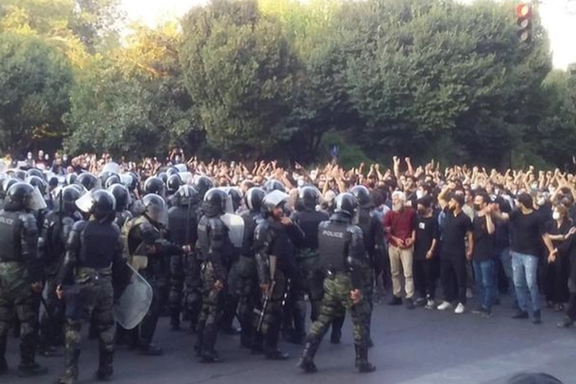
Protests in Iran
Protests in Iran

Jalil Rahimi Jahanabadi, a lawmaker from northeast Iran, has said that “our policies anger the young generation,” and our economy has a mafia-like structure.

Jahanabadi further charged that Iranian officials do not believe in governance as an expertise and try to “re-invent the wheel” instead of learning from 200 other countries.

"Iranian politicians are constantly reinventing the wheel. They never ask themselves how their counterparts in 200 other countries treat and manage their national currencies and foreign exchanges. They do not believe in banking as a knowledge-based practice and an expertise. With all that I wonder why we are so complacent and always believe that we can correct the world," the lawmaker said.

He drew attention to the fact that officials during the past weeks claimed that the fall in the value of Iran’s currency was the outcome of the protests. But they never ask themselves why it keeps falling even when the streets are calmer.

MP Jalil Rahimi Jahanabadi
100%
MP Jalil Rahimi Jahanabadi

Jahanabadi explained that when society is volatile, some people tend to invest in real estate in other countries. This has happened during the protests in 2017-2019. In 2022, a lot of capital left Iran for purchasing properties in Armenia, Georgia, Turkey and the United Arab Emirates.

Furthermore, at times of unrest, many shift their capital to gold and foreign currencies to prevent the devaluation of their assets. Iran’s rial has fallen more sharply and is more vulnerable than even in Iraq and Afghanistan.

Jahanabadi maintained that almost everyone knows that “our political, economic, foreign and cultural policies need reform, but no one knows who should start that reform.” However, he added: "As one of 290 Iranian lawmakers, I think this country needs essential reforms. We need to change the structures, methods, views and policies." He added that as a result of the current situation buying a house, a car and finding a job have been turned into a dream for many young Iranians. Why shouldn't they be depressed and desperate?"

Reformist politician Hassan Rasouli  (file photo)
100%
Reformist politician Hassan Rasouli

Meanwhile, reformist politician Hassan Rasouli has said in an interview that Iranians' demands are miles apart from views held by officials. Top officials regularly make many false claims. He argued that the political system’s main responsibility is to be responsive to the wishes of the people and this requires comprehensive, long-term and realistic plans.

Rasouli added that the current situation leaves no hope of improvement. Problems in Iran's domestic politics have left no international respect for Iran.

He was probably referring to the government's violent and ruthless reaction to recent protests in Iran and its ignorance of challenges in the international arena. What the officials have been doing in this regard so far, Rasouli said, has been nothing other than simply ignoring or denying problems, while inefficiency is visible in all economic, security, cultural and social matters.

On Thursday, economist Bahman Arman had said that decisions in the government are affected by the influence of a group that is against development and progress. He was probably referring to the intervention of ultraconservative figures, mainly the members of Paydari Party in the affairs of the government, and individuals like former nuclear negotiator Saeed Jalili who offer suggestions to the Raisi Administration on many matters including the nuclear issue without being accountable for the consequences of their intervention.

Like Rasouli, Arman also said that the government does not have an intelligent roadmap and as a result makes too many errors without trying to compensate for them later. As a result, said Rasouli, divides between the people and the government are likely to further widen and Iran's vanishing middle class is likely to be turned into a needy class, although government officials will probably continue to brag about a "progress" that as they claim makes Iran's enemies jealous.


Most Viewed

Iran negotiators ordered to return after internal rift over Islamabad talks
1
EXCLUSIVE

Iran negotiators ordered to return after internal rift over Islamabad talks

2
EXCLUSIVE

Iran’s central bank warns economy may take 12 years to rebuild after war

3
INSIGHT

Iran's digital economy battered by prolonged blackout

4
ANALYSIS

US blockade enters murky phase as tankers spoof signals and buyers hesitate

5
ANALYSIS

Why the $100 billion Hormuz toll revenue is a myth

Banner
Banner

Spotlight

  • Hardliners push Hormuz ‘red line’ as US blockade tests Iran’s leverage
    INSIGHT

    Hardliners push Hormuz ‘red line’ as US blockade tests Iran’s leverage

  • Ideology may be fading in Iran, but not in Kashmir's ‘Mini Iran'
    INSIGHT

    Ideology may be fading in Iran, but not in Kashmir's ‘Mini Iran'

  • War damage amounts to $3,000 per Iranian, with blockade set to add to losses
    INSIGHT

    War damage amounts to $3,000 per Iranian, with blockade set to add to losses

  • Why the $100 billion Hormuz toll revenue is a myth
    ANALYSIS

    Why the $100 billion Hormuz toll revenue is a myth

  • US blockade targets Iran oil boom amid regional disruption
    ANALYSIS

    US blockade targets Iran oil boom amid regional disruption

  • Iran's digital economy battered by prolonged blackout
    INSIGHT

    Iran's digital economy battered by prolonged blackout

•
•
•

More Stories

Iran Arrests Stonemason Who Made A Tombstone For Hanged Protester

Jan 20, 2023, 22:13 GMT+0

A stonemason who was hired to make a gravestone for executed protester Mohammad Hosseini has been arrested by Iran’s security agents.

The arrest was reported by Kamelia Sajjadian, a mother whose son, Mohammad Hassan Torkaman, was shot dead by the security forces during protests in the northern city of Babol in September. 

She said in a tweet on Thursday that her friends informed her the stonemason and his coworkers were arrested for the crime of measuring the grave to make a tombstone, adding that “I have never seen such brutality anywhere in the world.” 

“A government that considers itself a regional power is afraid of the stone on a dead person's grave,” she noted. 

The 39-year-old Hosseini – with no apparent family members -- was one of the loneliest victims of the regime’s crackdown, and his hanging drew massive reactions on social media where Iranians can speak freely. Grieving over his execution, people regularly gather at his grave and shower it with flowers and distribute food and sweets in the honor of their new hero, as is customary by bereaved families in Iran. 

The regime hanged Hosseini along with Mohammad Mahdi Karami for allegedly killing a member of the security forces during protests that were triggered following the death of 22-year-old Kurdish woman Mahsa Amini in police custody in September. The convictions were not based on a criminal charge related to the murder per se, but they were charged with ‘moharebeh’, meaning “war against God”, a vague religious concept. 

In the past few weeks, the Islamic Republic prevented the installation of a stone on the grave of Mohsen Shekhari, the first protester that the regime executed. Later, they broke the tombstone that was installed stealthily.

Top Sunni Imam In Iran Delivers Fiery Anti-Regime Sermon

Jan 20, 2023, 17:46 GMT+0
•
Maryam Sinaiee

Mowlavi Abdolhamid delivered yet another fiery sermon in southeastern Zahedan Friday while another Sunni imam, Mowlavi Gorgij, was put under house arrest in northern Iran.

“A government that does not listen to the voice of the people does not deserve to rule,” said Mowlavi Abdolhamid in his Friday sermon in Zahedan, capital of the restive Sistan-Baluchestan Province.

Thousands of Abdolhamid’s congregation took to the streets in Zahedan for the 16th consecutive week after his sermon and chanted “Down with the Dictator” and “Khamenei is a murderer, his rule is illegitimate”.

The Sunni Baluch population have taken to the streets in Zahedan every Friday after prayers since September 30 when government forces cracked down on protesters and killed more than 80 protesters.

Similar protests were held Friday in Rask, another city in Sistan-Baluchestan, in support of Abdolhamid and Mowlavi Abdul Ghaffar Naghshbandi, another Sunni Baluch cleric. In the past four months Naghshbandi has been under pressure from the authorities for confirming that allegations of a police chief raping a fifteen-year-old Baluch girlwere not true.

A Revolutionary Guard commander, Brigadier General Mohammad Karami, was appointed as provincial governor three weeks ago. Security measures and restrictions in the province and particularly its capital Zahedan have escalated to an unprecedented level.

In his sermon this week, Abdolhamid also protested to the doubling of checkpoints in Zahedan. “Seven stop and search checkpoints have turned into fifteen,” he said.

The new measures include at least fifteenconcrete block stop and search checkpoints on roads leading to Zahedan to control the flow of cars into the city, with security forces demanding identification and often questioning passengers. Internet connection has also been heavily restricted in the province since protests began four months ago.

Abdolhamid also argued that the government’s unjustified security-driven attitude to Sistan and Baluchestan impedes development as it discourages investment and progress. “People will establish security themselves [if allowed],” he said.

By “security-driven attitude” Abdolhamid apparently meant the government’s and the Shia establishment’s general lack of trust in Sunni communities across the country. Some officials and Shiite clerics who see Iran's Sunni minority as a threat to the Shia establishment occasionally raise alarm over the growth of the Sunni population in Iran.

Over 1,300 kilometers north of Zahedan, in the northern Golestan Province where there are large Sunni Baluch communities living for decades, another Mowlavi (Imam), Mohammad-Hossein Gorgij, has reportedly been put under house arrest in Galikesh.

Sunni imam Mowlavi Gorgij (file photo)
100%
Sunni imam Mowlavi Gorgij

Gorgij who served as the Sunni imam of Azad Shahr, 35 kilometers from Galikosh, was dismissed as Friday Imam of the Sunni community of Azad Shahr in Golestan in December 2021 by Supreme Leader Ali Khamenei’s representative in the province for protesting to Shiites slandering Sunni caliphs.

Khamenei’s provincial representatives have the power to appoint and sack not only Shiite but also Sunni imams.

“Authorities have told me that my participation in Friday prayers is not befitting. My presence at Friday prayers is people’s wish not my own,” Gorgij told his supporters who had rallied outside his home in Galikosh Friday. “A government that is not on people’s side is not worthy of ruling,” he said.

Sistan and Baluchestan is Iran's largest but least developed province where around two-thirds of the population live in extreme poverty. The northern part of the province, Sistan, is predominantly Shiite while the southern part, Baluchestan, is Sunni majority.

Netherlands Voices Support For Listing IRGC As Terror Group

Jan 20, 2023, 15:38 GMT+0

As the European Council is set to decide about European Parliament’s call to list Iran’s Revolutionary Guard as a terror group, the Netherlands has already expressed its support. 

Dutch Foreign Minister Wopke Hoekstra said in a tweet on Thursday that “The Netherlands is strongly in favour of listing the IRGC as an entity, a step that requires the joint commitment of EU member states.”

He added that he held talks with High Representative of the EU for Foreign Affairs and Security Policy Josep Borrell about Russia and Iran. 

“We also addressed the grave human rights violations in Iran,” he said, noting that “We need to continue to sanction those responsible.” 

Hoekstra also said he will also hold talks with German Foreign Minister Annalena Baerbock to address this issue at the upcoming EU Foreign Affairs Council. 

The Dutch foreign minister also held talks with US Special Envoy for Iran Robert Malley. “Productive meeting with Foreign Minister Hoekstra. We discussed our common steps to confront Iran's human rights abuses and counter its provision of weapons to Russia for use in its brutal war of aggression against Ukraine,” Malley said. 

Although the European Parliament overwhelmingly passed the non-binding resolution on January 19, it cannot decide to designate the IRGC, which is an issue within the purview of the EU Council, comprised of ministers of each EU country. If the resolution garners enough support, it is then upon the national governments of the EU member states to make the final decision. The listing of the IRGC must have a unanimous vote by all 27 EU members in the EU Council.

Iranians Rejoice Europe’s Move Against IRGC As Regime Vents Anger

Jan 20, 2023, 14:35 GMT+0
•
Iran International Newsroom

While many Iranians welcomed the European Parliament’s resolution that calls on EU to list the Revolutionary Guard as a terrorist group, regime officials have threatened to respond. 

After the European Parliament overwhelmingly passed the resolution Thursday that may eventually lead to the designation of the IRGC, people on social media started to congratulate each other, describing it as yet another victory for their revolt against the clerical regime. 

Since the beginning of the current wave of antigovernment protests ignited by a Iranian young woman – Mahsa Amini – the Iran’s government is becoming more isolated in the international community. So far, the Islamic Republic was voted out from the United Nations Commission on the Status of Women (CSW) for policies contrary to the rights of women and girls in December. Another step was by the Geneva-based UN Human Rights Council’s decision on November 24 to launch an independent investigation into the regime’s deadly repression of protests that has killed around 500 civilians, including about 60 children. Several rounds of sanctions by the European Union, the US, Canada and others also targeted officials and entities involved in the crackdown. 

According to social media videos, people in some Kurdish cities, including Saqqez – the hometown of Amini -- and Mahabad, came to the streets and rejoiced with fireworks following the approval of the resolution. 

Videos sent to Iran International from different cities such as Qom – home to Iran’s biggest seminary -- and the southern city of Bandar Abbas show people distributing candies to celebrate the decision. In one video, someone said that they are watching the European Parliament’s session live on Iran International TV, adding that it is more exciting than the World Cup matches. 

Meanwhile, Islamic Republic’s officials, who had started threatening Europe even before the vote, have intensified their rhetoric against European countries over the decision. 

Foreign Ministry spokesman Nasser Kanaani said the reason for the designation of IRGC as a terrorist organization is that Europe is infuriated over the IRGC’s leading role in the fight against terrorism. “The reason behind the anger of the ‘global club of terrorists’ is crystal clear. The IRGC is the world’s largest counter-terrorism institution,” he wrote in a tweet on Friday.”

Foreign Ministry spokesman Nasser Kanaani (file photo)
100%
Foreign Ministry spokesman Nasser Kanaani

In a statement on Friday, the Army condemned the move, claiming that it exposed the enemies’ grudge against the Islamic establishment in Iran. “The measure of the European Parliament, which claims to be fighting terrorism, against an anti-terrorist institution is out of their desperation and failure in supporting recent riots in Iran,” read the statement.

Hardliner Iranian lawmaker Mohammad Esmail Kowsari, himself a former IRGC commander, said on Friday, "One should ask where the IRGC has committed terrorist acts. They conspired to overthrow the Islamic Republic and the IRGC foiled it." Vowing that the parliament will announce its retaliatory measures on Sunday, he asked, “What part of the IRGC is a terrorist group?” 

Criticizing the motion, Speaker of Iran’s parliament, Mohammad Bagher Ghalibaf, said that “If the European Union makes such a decision and lists the Guards as a terrorist organization, it means that the European Union acts as a supporter of terrorism, because the IRGC is the biggest and most successful anti-terrorist entity.”

The whole argument of the Islamic Republic in defense of the IRGC – which has armed proxies in many countries across the region – is its limited role in the battle against the ISIS. But in fact, IRGC was building its own Shiite militant proxy network and to an extent fought against the Sunni extremist group.

The European Parliament cannot decide to designate the IRGC because the terrorists list is not a list decided by the Parliament itself but by the EU Council, comprised of ministers of each EU country. If the resolution garners enough support, it is then upon the national governments of the EU member states to make the final decision. The listing of the IRGC must have a unanimous vote by all 27 EU members in the EU Council.

Some Iran Conservatives Call for A Swift Change in Foreign Policy

Jan 20, 2023, 11:23 GMT+0
•
Iran International Newsroom

Some Iranian ‘moderate conservative’ politicians suggest that Iran should act to compensate for the damage and isolation caused by a problematic foreign policy.

Correcting Iran's policy regarding Russia's war in Ukraine, by adopting a neutral stance, is a recurrent suggestion.

As the European parliament overwhelmingly voted to support the designation of Iran’s Revolutionary Guard, the IRGC, as a terrorist organization, University lecturer and former housing minister Abbas Akhoundi suggested that Tehran should enter transparent and direct talks with the EU to shed light on its positions about the war in Ukraine.

In fact, Tehran has tried several times to whitewash its support for Russia in the Ukraine war and the deployment of its drones to Russia, but no one even in Iran has accepted the regime’s claims of neutrality, as evidence about the destructive role of Iranian drones in attacks on civilian targets is damning.

Meanwhile, Akhoundi said that Russia should not drag Iran into a war it is not a part of. He further maintained that Iran's involvement in the war in Ukraine is the main cause of rising tensions between Tehran and the European Union. The resulting adverse impact on the suspended nuclear talks cannot be compensated, Akhoundi said, adding that resolving the controversy about Iran's role in the Ukraine war is even more urgent than trying to revive the 2015 nuclear deal known as the JCPOA.

He added that leaving behind this crisis needs a level of intelligence which is beyond the Iranian government's capacity. He said this comes while some members of the European Parliaments have questioned the legitimacy of the Islamic Republic. This, Akhoundi said, will prepare the world's public opinion for any action against Iran.

IRGC general and member of parliament Esmail Kowsari. FILE PHOTO
100%
IRGC general and member of parliament Esmail Kowsari

He argued that aggressive responses by some Iranian officials plays into the hands of “warmongers” in Europe. Akhoundi was possibly referring to IRGC general and Iranian lawmaker Esmail Kowsari's threats against Europe in case the EU lists the IRGC as a terrorist organization.

Akhoundi said that as a result of a failing foreign policy, Iran lags behind its development plans, international trade has been disrupted, inflation is beyond control and poverty can be seen everywhere while the society in on the verge of collapse.

Former lawmaker Ali Motahari had also earlier criticized Iran's foreign policy which he said was marked by over-reliance on Russia and China and called for an improvement in Iran's ties with the West. He told Sharq newspaper on Wednesday that "Iran's involvement in the war in Ukraine is the main problem that has ruined Iran's relations with Europe.”

Motahari added: "Iran's involvement in the war in Ukraine has prompted the UK parliament as well as the European Parliament to follow an anti-Islamic-Republic policy, as the war in Ukraine has generally affected the security of the entire European continent."

Mehdi Ayati, another political observer also said that Iran's problems will not be solved as long as Tehran is not determined to communicate with the world. Because of Iran's ideological foreign policy, it would have not made any difference even if reformist Mohammad Khatami was president, instead of the ultraconservative Ebrahim Raisi.

Ayati characterized the current situation as a foreign relations impasse which will not be resolved before Iran proves to be genuinely interested in a reproachment. He added that Iran's main problem is mismanagement, not sanctions. Pointing out Iran's foreign policy crisis, Ayati charged that "unfortunately, some Iranian officials' actions and rhetoric widen the gap between Iran and the world community.”