• العربية
  • فارسی
Brand
  • Iran Insight
  • Politics
  • Economy
  • Analysis
  • Special Report
  • Opinion
  • Podcast
  • Iran Insight
  • Politics
  • Economy
  • Analysis
  • Special Report
  • Opinion
  • Podcast
  • Theme
  • Language
    • العربية
    • فارسی
  • Iran Insight
  • Politics
  • Economy
  • Analysis
  • Special Report
  • Opinion
  • Podcast
All rights reserved for Volant Media UK Limited
volant media logo

Fuel, Energy Shortages Continue In Strike-Hit Iran
Iran International Newsroom
Jan 19, 2023, 20:00 GMT+0Updated: 17:57 GMT+1
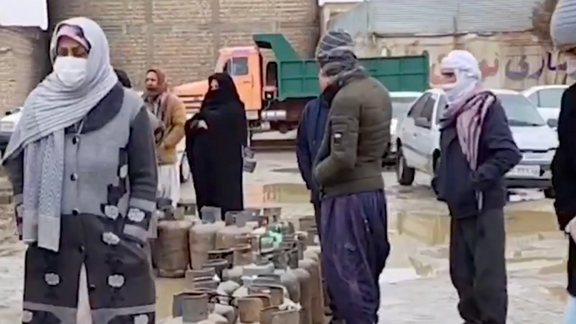
People in long lines for gas in capsules in Zabol, Sistan-Baluchestan province, on January 18

Amid catastrophic energy shortages across Iran, kilometer-long queues of cars have been formed at gas stations in several cities while more oil industry workers stage strikes. 

According to videos on social media, truckers in some cities such as Tabriz in northwestern Iran and Zahedan in southeastern are stranded around gas stations apparently due to a lack of diesel fuel and compressed natural gas (CNG). 

Gas supplies to homes, which the government tried to protect during past cold season crunches, have also been interrupted in some regions. While offices and schools in Iran have been closed for days due to a serious natural gas shortage, long lines have also been formed in the cities where people use gas in capsules for their daily needs. 

Amid natural gas shortage due to the government inability to invest in production, a new wave of strikes by oil and gas industry workers has kicked off in the country.

On Thursday, workers of the Qeshm oil terminal joined the strikes which have already started with gatherings in Ahvaz, Asaluyeh, Dehloran, Shiraz, Ilam, Bandar Lengeh and Aghajari in the south and southwest of Iran.

The Qeshm oil terminal is a major oil export terminal being developed in the Qeshm Island that lies along the strategically important trade route of the Strait of Hormuz, off the southern coast of Iran.

Fadahossein Maleki, the representative of Zahedan in the parliament, said Wednesday that "There is no gas supply in many areas of Sistan-Baluchistan province.” Even bottled gas and kerosene that should be given to the people is scarce, he added. 

Moineddin Saeedi, Chabahar’s representative at parliament  (file photo)
100%
Moineddin Saeedi, Chabahar’s representative at parliament

Moineddin Saeedi, representing Chabahar, in the underprivileged province said at the parliament Wednesday that "In August, the oil minister predicted a harsh winter in Europe... Now we have seen that this did not happen there and unfortunately it happened in our own country." He added that gas has become a "luxury commodity" and access to it has become a dream for many people.

Similar problems have also been reported in other parts of the country such as the central province of Esfahan (Isfahan), northern provinces of Mazandaran and Golestan, and northeastern Khorasan provinces. 

While Islamic Republic officials predicted a bad winter in Europe, offices, organizations, schools, and universities were shut down in many parts of Iran. 

With natural gas shortage, Iran resorted to burning mazut at power stations, which is an extremely polluting fuel compared with cleaner diesel.

Iran has failed to invest in its gas production sector, although it has the world’s second largest reserves, while with extremely cheap prices for consumers, usage has been increasing ever faster. The distribution network also needs upgrades as more than 25 percent of the gas is lost during transfer.

Iran's gas production and extraction capacity is limited to around 800 million cubic meters per day. According to the ministry of energy, about 650 million cubic meters are consumed by domestic, commercial, and administrative users, however, the data has changed a lot in different years and contradict international estimates. The international energy organizations say less than 40% of Iran's natural gas is consumed at homes, but the Islamic Republic is trying to blame the shortage of gas on home users.


Most Viewed

Iran negotiators ordered to return after internal rift over Islamabad talks
1
EXCLUSIVE

Iran negotiators ordered to return after internal rift over Islamabad talks

2
INSIGHT

Iran's digital economy battered by prolonged blackout

3
ANALYSIS

US blockade enters murky phase as tankers spoof signals and buyers hesitate

4
ANALYSIS

Why the $100 billion Hormuz toll revenue is a myth

5

US tightens financial squeeze on Iran, warns banks over oil money flows

Banner
Banner

Spotlight

  • Hardliners push Hormuz ‘red line’ as US blockade tests Iran’s leverage
    INSIGHT

    Hardliners push Hormuz ‘red line’ as US blockade tests Iran’s leverage

  • Ideology may be fading in Iran, but not in Kashmir's ‘Mini Iran'
    INSIGHT

    Ideology may be fading in Iran, but not in Kashmir's ‘Mini Iran'

  • War damage amounts to $3,000 per Iranian, with blockade set to add to losses
    INSIGHT

    War damage amounts to $3,000 per Iranian, with blockade set to add to losses

  • Why the $100 billion Hormuz toll revenue is a myth
    ANALYSIS

    Why the $100 billion Hormuz toll revenue is a myth

  • US blockade targets Iran oil boom amid regional disruption
    ANALYSIS

    US blockade targets Iran oil boom amid regional disruption

  • Iran's digital economy battered by prolonged blackout
    INSIGHT

    Iran's digital economy battered by prolonged blackout

•
•
•

More Stories

Famous Iranian Veteran Wrestlers Continue Criticism Of Government

Jan 19, 2023, 15:57 GMT+0

Two Iranian veteran athletes, brothers Amir-Reza and Rasoul Khadem, continue harshly criticizing the policies and performance of the regime in Iran.

Rasoul Khadem, former champion, and coach of the national wrestling team criticized the “false promises” of President Ebrahim Raisi and Vice President Mohammad Mokhber about building four million houses in four years.

In a post on his Instagram Wednesday, Rasoul Khadem also lashed out at Raisi because of the declining value of Iran’s currency and soaring prices for cars and housing.

During his campaign Raisi had promised to build one million affordable housing units in each year of his term in office.

Earlier, Amir-Reza Khadem, the former Head of Iran’s Wrestling Federation, also lashed out at the recent statements by the Interior Minister following months of protests by ordinary people, saying "You have confused the people with the terrorists of al-Qaeda, ISIS...!"

Interior Minister Ahmad Vahidi, on Monday once again called the support of famous figures and celebrities for the popular protests a "criminal act".

He also warned that if celebrities do not stop, the judiciary must intervene.

In response, Amir-Reza Khadem wrote on his Instagram that "Your first duty is to provide peace, not to play the role of a reeve or an ambassador of torment!"

In another part of his comment, the Iranian wrestling champion said those athletes and artists who expressed support for people are neither in need of fame nor money; and if they were, they would have emigrated.

In the past months, the Khadem brothers have levelled sharp criticism against the regime and its officials, especially on social networks.

Iran Government Plans To Give Oil To Armed Forces To Sell

Jan 19, 2023, 15:53 GMT+0
•
Iran International Newsroom

Following an eventful row between Iran’s parliament and administration, the budget bill is finally getting the approval of lawmakers, but there is a catch about the country’s oil exports. 

When the administration of President Ebrahim Raisi submitted the substantially enlarged draft state budget last week, it was apparent that the government has come up with plans to depend more on tax revenues instead of oil income. But now that the parliament has started reviewing the bill, it has become clearer that the administration plans to outsource most of its oil sales to military and religious organs. 

In the budget bill for the next Iranian year, which starts March 21, the government has granted new permits to some departments such as the General Staff of the Armed Forces of the Islamic Republic and Astan Quds Razavi -- the Mashhad-based custodian and the administrative organization which managing a major religious shrine -- as well as a number pension funds to sell oil products on behalf of the government and earn some of the income. 

According to the Note 1 of the bill – titled “Oil and its relations with the government” -- the National Iranian Oil Company is obligated to deliver “crude oil and gas condensates” to entities introduced by the executive bodies. As per the new measures, the General Staff of the Armed Forces is given the authority to sell and refine oil up to €4.5 billion. It means that the Armed forces can give crude oil to refineries and receive products that should be exported. 

According to legal experts, this move, which also exists in a limited way in the current year’s budget, violates the constitution. This year, the government gave this permission to some individuals under the general title of "persons approved by executive bodies". The parliament had approved to give €3.5 billion of crude oil “to individuals” to sell on the world market and give the proceeds to the military. Last February, the Revolutionary Guard also received $80 million of oil from the government to sell as an additional budget appropriation. It also remains unclear who and under what conditions will export the oil amid US sanctions. Many members of Iran's hardliner dominated parliament are former members of the IRGC.

Economics professor Sirous Omidvar (file photo)
100%
Economics professor Sirous Omidvar

Sirous Omidvar, an Economics professor at the Allameh Tabatabai University, told Tejarat News that the legal details of such a mechanism are unclear and such economic handouts exclude ordinary business people. He predicts that such a mechanism is expected to lead to corruption.

A well-publicized scandal broke in 2013 when authorities arrested Babak Zanjani, a businessman, for embezzling at least $2.7 billion from illicit oil sales during international sanctions from 2009-2013. Zanjani used companies affiliated with the Revolutionary Guard (IRGC) for the oil he exported, leading to speculations that well-connected officials had a stake in the scheme. He received the death penalty which has so far not been carried out.

The draft budget is based on 1.4 million barrels of oil exports per day, despite US sanctions, an increase from the current reported figure of 800 thousand barrels. The discrepancy between reality and budget estimates gets even more interesting as the government expects to sell each barrel of oil for $85, while Iran is reportedly selling its oil to China at half that amount. The government estimate would mean more than $43 billion in oil revenues from March 2023 to March 2024. However, the official website of the government, IRNA, emphasized that the exact figure of crude exports is confidential and would not be announced due to the sanctions.

The projected oil exports in the budget are the clearest sign of unrealistic revenue estimates that will not materialize unless Iran resolves its differences with the United States over its nuclear program.

The government being aware that its oil revenue estimates are not realistic, it has substantially increased tax collection projections. In July, the Supreme Accounting Office released a report covering the period March 21- May 20 showing that except tax revenues, all other major sources of income grossly underperformed. The government’s revenues from taxes, oil exports, customs duties, etc. totaled 880 trillion rials or about $3.5 billion (average free market exchange rate at the time) in the 60-day period. This was just 37 percent of the projected budget revenues. It is important to note that only 15 percent of the projected oil income was collected.

Campaign To Give Power Of Attorney To Iran’s Exiled Prince Gains Momentum

Jan 18, 2023, 18:27 GMT+0

Many Iranians, including artists and athletes have signed a petition endorsing exiled Prince Reza Pahlavi as their representative to lead a transition from clerical to secular rule.

An online campaign to give Prince Reza Pahlavi power of attorney has been launched by Iranian actor Ehsan Karami and it has been signed by more than 160,000 people until the time of this publication.

Iranian football legend Ali Karimi, a key supporter of the popular uprising, has also signed the petition appointing Pahlavi as his representative.

He wrote in a tweet that "I give power of attorney to Prince Reza Pahlavi, for the period of transition [to oust] the child-killing regime and [holding] a free referendum for a free and prosperous Iranian."

Singers Hamed Nikpey and Hamid Talebzadeh, actors Borzou Arjmand and Hamid Farrokhnejad, and actresses Rounak Younesi and Parastou Salehi are among the other public figures supporting the campaign.

Prince Reza Pahlavi, in an interview with Farsi-speaking London-based "Manoto" TV and in response to a question why he does not clearly assume the role of leading the movement said, "any kind of work we do must have a legitimate basis or some kind of power of attorney from inside Iran."

There has been no reaction from other key opposition figures including British-Iranian actress and human rights activist Nazanin Boniadi, journalist and activist Masih Alinejad, actress Golshifteh Farahani and activist Hamed Esmaeilion.

In a joint message on Monday, the first four along with prince Reza Pahlavi urged the international community to list Iran's Revolutionary Guard as a terror group.

Iran’s Judiciary Claims 98% Of Detained Protesters In Tehran Released

Jan 18, 2023, 17:56 GMT+0
•
Iran International Newsroom

Iran’s judiciary spokesman claims about 98 percent of those arrested in Tehran province during the nationwide protests have been released, without mentioning a total number.

Masoud Setayeshi said Wednesday that a total of 5,200 people arrested in the capital Tehran have been freed.

Setayeshi had previously announced 1,200 detained demonstrators across the country had been released, alleging that “a population of about 4,000 people are now freed from prisons throughout the country.”

However, he did not provide any details about the current legal status of the 5,200 people and refused to say how many of them been released on bail or awaiting trial.

The judiciary spokesperson noted that the number of detainees released in Tehran province is "98.5% and it seems to be the same across the country".

It is not clear what the reason for this ambiguity is, but if the percentage is true, the total number of detainees based on the claim of the Judiciary spokesperson is less than 5,500 people, which is so different from the numbers provided by human rights organizations.

Some human rights sources say between 19,000 and 20,000 people have been detained during the suppression of the protests following the death of Mahsa Amini in police custody four months ago.

Iranian protesters (file photo)
100%
Iranian protesters

However, all those who are released have emphasized their release is "temporary" and on bail.

According to a part of the Fars news agency's confidential bulletins that were leaked last month, "29,400 people" had been arrested during the recent protests in Iran.

Setayeshi also talked about the execution of the British-Iranian national Alireza Akbari, but without mentioning the details of the case, he called the UK’s strong reaction a sign of "the malevolence of the British government."

Alireza Akbari was one of Iran's senior military and defense officials in early 2000s. He travelled to Britain with his family and became a citizen of the UK, but the Iranian regime claims granting him the citizenship was a "reward" for "espionage".

Akbari was arrested in 2019 while travelling from the United Kingdom to Iran and sentenced to death for spying for Britain.

On January 14, the Iranian Judiciary announced Akbari had been hanged after having been convicted of espionage.

Setayeshi said that his execution was a sign of Iranian Judiciary’s “strength and sensitivity,” adding, “

British Prime Minister Rishi Sunak condemned Akbari's execution, saying “this was a callous and cowardly act, carried out by a barbaric regime with no respect for the human rights of their own people.”

Elsewhere in his remarks, Setayeshi once again accused detained Belgian national Olivier Vandecasteele of “espionage” stressing that there will be no "concessions" in his case.

Vandecasteele, who was detained in 2022, has been sentenced to 40 years in prison in a secret trial without a fair chance to defend himself.

He worked in Iran for humanitarian organizations for more than six years and left the country. Later, he was lured back by “a girlfriend” and was detained in February 2022.

Belgium and Vandecasteele’s family believe he is innocent and a victim of hostage taking by the Iranian regime. They say Tehran intends to force Brussels to release Iranian diplomat Assadollah Assadi who was sentenced to 20 years in prison in Belgium in 2021.


In Fear Of IRGC Terrorist Listing, Regime Officials Threaten Europe

Jan 18, 2023, 14:39 GMT+0
•
Iran International Newsroom

On the eve of a significant vote at the European Parliament that might eventually lead to designation of Iran’s Revolutionary Guards as terrorists, regime officials are issuing threats. 

The European Parliament has been discussing a resolution to condemn the Islamic Republic’s human rights violations and its destabilizing activities, including the military support for the Russian invasion of Ukraine, since Monday. Following the plenary session to debate the listing of the IRGC, the 700 members of the body will put to vote the resolution that would call for the designation of Iran’s Guards on Thursday. 

However, the resolution seems to be bound for approval as an amendment that calls for the EU and its member states to include the IRGC on the EU’s terrorist list was approved with an overwhelming majority on Wednesday. Nearly 600 members out of the 638 who were attending the session voted to adopt a phrase that “calls for the EU and its Member States to include the IRGC on the EU's terrorist list in the light of its terrorist activity, the repression of protesters and its supplying of drones to Russia.” The amendment which was proposed by the European Conservatives and Reformists group (ECR Group) has become part of the European Parliament report on the implementation of the common foreign and security policy.

The European Parliament cannot decide to designate the IRGC because the terrorists list is not a list decided by the Parliament itself but by the EU Council, comprised of ministers of each EU country. If the resolution garners enough support, it is then upon the national governments of the EU member states to make the final decision. The listing of the IRGC must have a unanimous vote by all 27 EU members in the EU Council.

The fear of listing the IRGC as a terrorist organization – similar to that the United states id in 2019 and on the agenda in the United Kingdom, seems to be a big concern for the regime -- prompting officials to threaten European countries over the consequences of such a move. 

Hardliner Iranian lawmaker Mohammad Esmail Kowsari, himself a former IRGC commander, said Wednesday that Euope might not be able to withstand the consequences of such a move. “EU officials know that this conspiracy was designed upon the instigation of the US and the Zionist regime (Israel) and has no logic,” he claimed. 

“The European Union and European countries must prove their independence from America and oppose any action against the IRGC; If they want to return to the JCPOA and negotiate with Iran, they know that such actions can close the door to any dialogue and negotiation,” Kowsari added. He added the IRGC is one of the most powerful military institutions and organizations in the world, such a measure cannot limit it. 

Hardliner Iranian lawmaker Mohammad Esmail Kowsari (file photo)
100%
Hardliner Iranian lawmaker Mohammad Esmail Kowsari

European countries prioritized diplomacy with the Islamic Republic in the hope of concluding a nuclear deal. Talks in Vienna to revive the deal, officially known as the JCPOA came to an abrupt stop in March 2022, reportedly for Iran’s insistence that the IRGC be removed from the US list of Foreign Terrorist Organizations (FTO). Later talks elsewhere failed to bring about an agreement. 

Also on Wednesday, Mahmoud Nabavian, a cleric and a hardliner politician representing a constituency near Tehran at the parliament, said the European Union wants to be in line with the United States, and impose additional sanctions against the IRGC. He added that “Nowhere in the world is it customary to sanction the military force of a country,” slamming former US President Donald Trump for creating such a precedent. 

Didier Reynders, the European Commissioner for Justice, once again condemned the regime’s crackdown on dissent, including the execution of protesters as well as British-Iranian national Alireza Akbari. “The internal situation in Iran continues to be a source of great concern. The current uprisings reveal deep frustration. The key demands of the current protests are respect for fundamental human rights, dignity, and real change,” he said.

“Over the past three months, the Council added 60 individuals and 8 entities to the list of those subject to restrictive measures due to their role in the death of Mahsa Amini and the violent response to the ensuing demonstrations. And let me state clearly that this approach will continue as long as necessary, as outlined in the Council Conclusions adopted in December,” he added. 

Expressing support for listing IRGC as a terrorist group, European Commission President Ursula Von Der Leyen told reporters on the sidelines of the World Economic Forum in the Swiss ski resort of Davos, “The actions of the Iranian regime are atrocious and horrible, and they are trampling fundamental human rights with their feet, so it is unbelievable what we are seeing, what is happening in Iran and that needs a very strong message and a very strong reaction. And therefore, we are looking indeed at a new round of sanctions, and I would support also listing the Revolutionary Guards. I have heard several ministers asking for that and I think they are right."

The European Union is discussing a fourth round of sanctions against Tehran over the crackdown and its supply of weapons to Russia. Diplomatic sources have told Reuters that more members of the Islamic Revolutionary Guard Corps (IRGC) will be added to the sanctions list next week.

On Monday, more than 12 thousands of Iranians from across Europe gathered outside the headquarters of the European Parliament in Strasbourg in northeastern France to urge the European Union to list the IRGC as a terrorist organization.

Designating the IRGC as a terrorist group would mean that it would become a criminal offence to belong to the group, attend its meetings, and carry its logo in public.

So far over 500 protesters have been killed by security forces, mainly consisting of the IRGC and its Basij militia. Four protesters have been executed so far by the state after hasty trials devoid of any regard for due process. Others are on death row.