• العربية
  • فارسی
Brand
  • Iran Insight
  • Politics
  • Economy
  • Analysis
  • Special Report
  • Opinion
  • Podcast
  • Iran Insight
  • Politics
  • Economy
  • Analysis
  • Special Report
  • Opinion
  • Podcast
  • Theme
  • Language
    • العربية
    • فارسی
  • Iran Insight
  • Politics
  • Economy
  • Analysis
  • Special Report
  • Opinion
  • Podcast
All rights reserved for Volant Media UK Limited
volant media logo

Iran Executes British-Iranian It Accused Of Espionage For UK
Iran International Newsroom
Jan 14, 2023, 08:08 GMTUpdated: 17:59 GMT+1

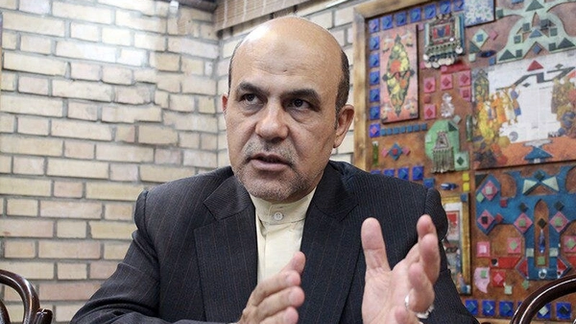
Iran has executed British-Iranian national Alireza Akbari, after sentencing the former Iranian deputy defense minister to death on charges of spying for Britain.

Britain called the execution a barbaric act immediately after announcement by Iran on Saturday and said it would not go unpunished.

"I am appalled by the execution of British-Iranian citizen Alireza Akbari in Iran," British Prime Minister Rishi Sunak said on Twitter. "This was a callous and cowardly act, carried out by a barbaric regime with no respect for the human rights of their own people."

British Foreign Secretary James Cleverly also tweeted to say: "This barbaric act deserves condemnation in the strongest possible terms. This will not stand unchallenged."

British Foreign Secretary James Cleverly had said late on Friday Iran must not follow through with the execution - a call echoed by the US State Department. Britain had described the death sentence as politically motivated and called for his release.

Before the execution was announced, the US State State Department had joined the UK to condemn Akbari's death sentence.

"The United States echoes the British government's strong call for Iran not to proceed with this execution, and to release Mr. Akbari immediately. The charges against Ali Reza Akbari, and his sentencing to execution, were politically motivated. His execution would be unconscionable," Vedant Patel State Department Principal Deputy Spokesperson said.

Mizan website of Iran’s hardliner Judiciary said in a Tweet early on Saturday the sentence had been carried out, without saying when.

"Alireza Akbari, who was sentenced to death on charges of corruption on earth and extensive action against the country’s internal and external security through espionage for the British government's intelligence service ... was executed,” it said.

The report accused Akbari, arrested in 2019, of receiving 1,805,000 euros, 265,000 pounds, and $50,000 for spying.

In a 30-minute audio recording from Akbari received by Iran International on Thursday, he is heard saying that after thousands of hours of interrogation he was forced to confess to acts he never committed.

"After more than 3,500 hours of torture, psychedelic drugs, and physiological and psychological pressure, they took away my will. They drove me to the brink of madness. They instilled in me what they wanted and forced me to make false confessions at gunpoint and threats of death," he said.

Iranian state media broadcast a video on Thursday that they said showed that Akbari played a role in the 2020 assassination of Iran's top nuclear scientist, Mohsen Fakhrizadeh, killed in a 2020 attack outside Tehran which authorities blamed at the time on Israel.

In the video, Akbari did not confess to involvement in the assassination but said a British agent had asked for information about Fakhrizadeh.

Iran’s state media often airs forced confessions by suspects in politically charged cases.

London-Tehran ties have deteriorated in recent months as efforts have stalled to revive Iran's 2015 nuclear pact, to which Britain is a party.

Britain has also been critical of the Islamic Republic's violent crackdown on antigovernment protests, sparked by the death in custody of a young Iranian-Kurdish woman in September.

A British foreign office minister said on Thursday that Britain was actively considering proscribing Iran's Revolutionary Guard as a terrorist organization but has not reached a final decision.

Iran has issued dozens of death sentences as part of the crackdown on the unrest, executing at least four people.

Akbari was a close ally of Ali Shamkhani, now the secretary of Iran’s Supreme National Security Council, who was defense minister from 1997 to 2005, when Akbari was his deputy.

A source close to the Islamic Revolutionary Guard Corps has provided documents to Iran International showing that accusations against Akbari and his death sentence were aimed at weakening Shamkhani’s position in the clerical regime. It seems that President Ebrahim Raisi, Intelligence Minister Esmail Khatib and Interior Minister Ahmed Vahidi are exerting pressure to remove Shamkhani from the post.

With reporting by Reuters

Most Viewed

US terminates green cards of 3 Iranians tied to Islamic Republic
1

US terminates green cards of 3 Iranians tied to Islamic Republic

2
PODCAST

Worst outcome is Islamic Republic’s survival, ex-CIA official says

3
ANALYSIS

Iran brings unusually broad team to US talks to blunt future blame

4
INSIGHT

Tehran sends tough message but keeps diplomacy door open

5

Zoroastrian religious figure arrested in Iran

Banner
Banner

Spotlight

  • Tehran sends tough message but keeps diplomacy door open
    INSIGHT

    Tehran sends tough message but keeps diplomacy door open

  • Worst outcome is Islamic Republic’s survival, ex-CIA official says
    PODCAST

    Worst outcome is Islamic Republic’s survival, ex-CIA official says

  • Why the Iran-US truce is more likely to buy time than peace
    ANALYSIS

    Why the Iran-US truce is more likely to buy time than peace

  • Engaged but uncommitted: China watches Iran and US fight and talk
    ANALYSIS

    Engaged but uncommitted: China watches Iran and US fight and talk

  • A truce for the world, a reckoning for Iran’s economy
    ANALYSIS

    A truce for the world, a reckoning for Iran’s economy

  • Why the world failed to bypass the Strait of Hormuz
    ANALYSIS

    Why the world failed to bypass the Strait of Hormuz

•
•
•

More Stories

Tehran Seeks To Hang Ex-Official On Forced Confessions Of Spying For UK

Jan 13, 2023, 23:20 GMT

A former Iranian defense ministry official who faces execution on espionage charges says his confessions were made under torture, an audio file has revealed. 

Alireza Akbari, who holds dual Iranian-British citizenship and is sentenced to death on charges of spying for the UK, says in the audio file his forced confessions are a result of 3,500 hours of torture. 

According to the audio file obtained by Iran International, Akbari says he only confessed because the authorities had promised to release him. 

"After more than 3,500 hours of torture, psychedelic drugs, and physiological and psychological pressure, they took away my will. They drove me to the brink of madness. They instilled in me what they wanted and forced me to make false confessions at gunpoint and threats of death," he said. 

The regime’s state media reported January 11 that Akbari will be executed for allegedly spying for MI6. In a statement published by Iran's Intelligence Ministry, Akbari was described as "one of the most important infiltrators of the country's sensitive and strategic centers". There are unconfirmed reports that Akbari, who was kept in the notorious Evin prison in Tehran since 2019, has already been executed. Iran’s state media denied the rumors on Friday. 

The agents promised him freedom in exchange for forced confessions and said that if he resists, they will send him to the dungeons of Evin, where he would be whipped, Akbari claimed. 

He added that the intelligence ministry imposed its desired verdict on the judge, noting that "The prosecutor's office ordered my release with the minimum amount of bail, but the Intelligence Ministry prevented it. The Supreme Court overturned the (execution) sentence, but the Intelligence Ministry threatened the judge and reinstated the verdict."

"I was under temporary detention for more than three years with an illegal sentence, and the judge in the case who intended to annul the sentence suddenly died," he said. 

Ali Shamkhani, the secretary of the Supreme National Security Council (file photo)
100%
Ali Shamkhani, the secretary of the Supreme National Security Council

He alleged in this audio file that there is no evidence against him while the Ministry of Intelligence claims he took information from Ali Shamkhani, the secretary of the Supreme National Security Council, and passed it on to Britain. "The Ministry of Intelligence claims that I met Shamkhani in 2018 or 2019 and I gave him a bottle of perfume and a shirt and Mr. Shamkhani gave me secret information about the country, and I passed it to foreigners.”

Akbari says that he told the judge if this allegation is true, why doesn't he summon Shamkhani and former president Hassan Rouhani, to which he replied, "I don't have the power to summon them, but I will destroy you."

Akbari had been deputy defense minister under the reformist President Mohammad Khatami, from 1997 to 2005. He was an advocate of the Iran nuclear deal known as the JCPOA that was eventually signed in 2015 with world powers. 

He was also close to Ali Shamkhani, the secretary of the Supreme National Security Council of Iran, who is now rumored to be replaced because his former aide received the death penalty as a “British spy”. A source close to the Islamic Revolutionary Guard Corps has provided documents to Iran International showing that the death sentence for Akbari is aimed at weakening Shamkhani’s position in the clerical regime. It seems that President Ebrahim Raisi, Intelligence Minister Esmail Khatib and Interior Minister Ahmed Vahidi are exerting pressure to remove Shamkhani from the post.

UK foreign secretary James Cleverly Thursday called on Tehran not to execute Akbari. In a tweet, James Cleverly said the Islamic Republic “must halt the execution of British-Iranian national Alireza Akbari and immediately release him.” He further called the move a “politically motivated act by a barbaric regime that has total disregard for human life.” 

On Friday, he again tweeted about Akbari, saying that “The Iranian regime should be in no doubt. We are watching the case of Alireza Akbari closely. Iran must not follow through with their brutal threat of execution.” 

"Our priority is securing his immediate release and we have reiterated our request for urgent consular access," a UK Foreign Office spokesperson said.

Iran’s FM Meets Hezbollah, Palestinian Islamic Jihad Chiefs In Lebanon

Jan 13, 2023, 21:03 GMT

Iran’s Foreign Minister Hossein Amir-Abdollahian traveled to Beirut to meet with senior Lebanese officials and political figures such as Hezbollah chief Hassan Nasrallah Friday. 

Hezbollah said in a statement that Nasrallah and Amir-Abdollahian discussed Israel’s new, hardline government and regional developments.

He also held a meeting with Secretary-General of Palestinian Islamic Jihad Ziyad al-Nakhalah during his trip to Lebanon on Friday. The group has been designated a terrorist organization by several countries, including the United States, the European Union, the United Kingdom, Japan, Canada, and Australia. 

During a joint press conference with Lebanese Foreign Minister Abdullah Bou Habib, Amir-Abdollahian said, “The Islamic Republic of Iran has been and will remain Lebanon’s friend in hard times.”

“The Islamic Republic of Iran will continue supporting the Islamic resistance in Lebanon and Palestine,” he said, noting, “We consider Lebanon’s security as Iran’s and region’s security.”

For Iran’s clerical regime Lebanon means a country dominated by Hezbollah and a base from where to threaten Israel. Many Shiites see Iran as a source of financial support, but others among Christians and Sunnis resent Hezbollah and Iran’s influence.

Nevertheless, Amir-Abdollahian insisted that “Iran does not interfere in the internal affairs of Lebanon.”

Amir-Abdollahian told reporters in Beirut that he met with Saudi Foreign Minister Prince Faisal bin Farhan Al Saud during a conference in Jordan last month, noting that talks between Tehran and Riyadh are continuing and could eventually restore diplomatic relations severed since 2016. Saudi Arabia has not confirmed Iran’s claims of continuing talks.

“There was an agreement in our points of view to continue with the Saudi-Iran dialogue in what would eventually normalize relations between the two countries,” Amir-Abdollahian said about the December meeting in Jordan.

Iran Imam Says Less Rain Result Of Women Without Hijab

Jan 13, 2023, 17:27 GMT

The Supreme Leader’s representative in the city of Karaj says the reason for low precipitation in the country is a lack of hijab observance of hijab, after many women took off their veils following months of protests. 

Mohammad-Mehdi Hosseini Hamedani, the Friday prayer imam of the city, reiterated that observance of hijab should be enforced strictly in society. 

Describing anyone who unveils in public as an enemy, he emphasized that all such people must be confronted by the state. "It is not possible to imagine that we are living in an Islamic country when we enter some institutions, shopping malls, pharmacies, etc.!" he said, calling on the authorities to warn shops and malls that serve women who have removed their hijab and close them down if warnings did not suffice. 

This is not the first time that the Islamic Republic’s hardliners are linking Islamic rituals to drought or natural disasters. 

Ahmad Alamolhoda, a senior firebrand cleric who is the father-in-law of President Ebrahim Raisi, had earlier called on people to say prayers for rain to solve the problem of drought in the country. 

Prosecutor General Mohammad Jafar Montazeri in 2019 said, "The judicial system does not allow women to unveil in public, because it causes natural disasters such as floods and earthquakes in the country.”

Yousef Tabatabai Nejad, Ali Khamenei’s representative in the central city of Esfahan (Isfahan), said in 2016 that women who unveiled and took photos “like Europeans” are the reason for the city’s river, Zayandeh-Roud (Zayanderud) to go dry and added that if this continues, its headwaters will also dry up. 

The water crisis has been getting worse in Iran for the past decade because of mismanagement in constructing unnecessary dams, encouraging water-thirsty crops like rice and political influence in water distribution.


Iranian Chess Referee Accuses Governing Body Of Succumbing To Politics

Jan 13, 2023, 13:12 GMT

Iranian chess referee Shohreh Bayat says the game's global body has kicked her off a commission because of a gesture of solidarity with protests in Iran. 

The feud with the International Chess Federation (FIDE) occurred after Bayat wore a T-shirt bearing the main motto of the current wave of antigovernment protesters "Women, Life, Freedom" at a tournament in Iceland in October, soon after rallies began following the death in custody of 22-year-old Mahsa Amini. 

The 35-year-old international referee, who is among a string of sports figures to clash with authorities over the mandatory hijab policy and express solidarity with anti-government demonstrators, told Reuters that "I don't think it's normal to stay quiet about this,"

She noted that the FIDE had removed her from its arbiters' commission after she angered its President Arkady Dvorkovich, a former Russian deputy prime minister from 2012 to 2018.

Bayat, who was also accused by Iran of violating hijab practice at a tournament in 2020, said Dvorkovich asked her to change her attire in Iceland. She reappeared at the tournament in a yellow suit and blue blouse: the colors of the Ukrainian flag. FIDE confirmed Dvorkovich had requested she not wear the shirt about women's rights. 

Bayat accused Dvorkovich of succumbing to geopolitics, saying, "Iran and Russia are very united in the war against Ukraine. When I was told by Dvorkovich to take off my T-shirt, that was the reason probably. My T-shirt was not political at all ... It's one of the most beautiful women's rights messages in the world."

Hezbollah Condemns 'Insulting' Khamenei Cartoons By Charlie Hebdo

Jan 13, 2023, 11:28 GMT

The Lebanese Hezbollah has condemned the publication of caricatures by the French satirical magazine Charlie Hebdo depicting Iran’s Supreme Leader Ali Khamenei.

This is Hezbollah’s first reaction related to popular anti-regime protests in Iran in four months, calling the caricatures as an “ominous” development, Iran International’s correspondent reported from Beirut.

Some Lebanese in social media have reacted to Hezbollah’s statement, asking why the pro-Islamic Republic militant group never condemned the killing of young Iranians during the protests, but condemns a French magazine exercising its media freedom.

Charlie Hebdo published its caricatures showing Khamenei as a despot and made fun of Iran’s ruling clerics. The Islamic Republic quickly condemned the publication and even lodged protests with the French government. The commander of the Revolutionary Guard, Hossein Salami, also threatened Charlie Hebdo that has already been the target of deadly attacks by Muslim extremists in the past.

The leader of the group, Hassan Nasrallah, who is very vocal in condemning Western countries, Israel or some Arab states on various occasions, has so far remained silent over the protests in Iran.

Hezbollah’s statement accused Charlie Hebdo of attempting “to weaken the highest religious and Islamic authority in the world.” Khamenei’s propaganda machine portrays him as “the leader of Muslims”, when in fact he represents a part of the Shiite sect, which is a small minority compared with the dominant Sunni majority.

Hezbollah also urged France “to punish” the perpetrators of “the shameless insult to sanctities.”






