• العربية
  • فارسی
Brand
  • Iran Insight
  • Politics
  • Economy
  • Analysis
  • Special Report
  • Opinion
  • Podcast
  • Iran Insight
  • Politics
  • Economy
  • Analysis
  • Special Report
  • Opinion
  • Podcast
  • Theme
  • Language
    • العربية
    • فارسی
  • Iran Insight
  • Politics
  • Economy
  • Analysis
  • Special Report
  • Opinion
  • Podcast
All rights reserved for Volant Media UK Limited
volant media logo

IRGC Quds Commander Threatens Region, Insults Women
Iran International Newsroom
Dec 21, 2022, 15:09 GMT+0Updated: 17:29 GMT+1
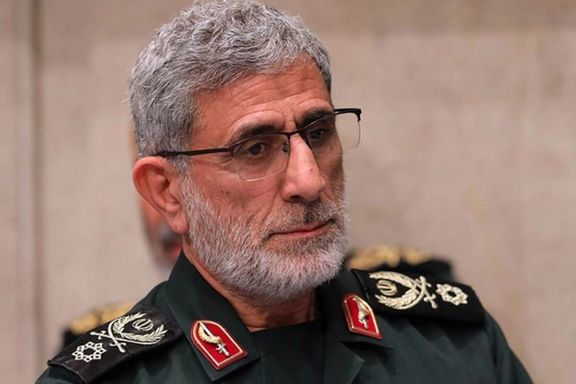
Esmail Ghaani (Qaani), the commander of IRGC’s Quds (Qods) Force

While the Islamic Republic’s foreign minister was in Jordan Tuesday in a regional summit, the Revolutionary Guard issued threatening messages to some neighbors. 

Esmail Ghaani (Qaani), the commander of IRGC’s Quds (Qods) Force -- a division primarily responsible for extraterritorial military and clandestine operations – said on Tuesday that it won't be long before the Palestinians eventually rid their land from Israelis. 

He gave the warning at a ceremony held on the occasion of the first death anniversary of former Iranian ambassador to Yemen Hassan Irlou, who died in suspicious circumstances. 

He claimed that Israel is “desperate and under intense pressure” as 40 to 50 operations are carried out against their forces in the West Bank per day. 

Lacking a coherent argument about the recent antiregime protests, Ghaani delivered a speech full of contradictions, and people immediately started making fun of him on social media, saying he was under the influence of a stimulant drug. 

Despite the growing number of Iranian women who appear in public without the mandatory dress code, Ghaani said that “no decent woman has unveiled in public,” practically insulting a significant part of the population. His attack on women showed the degree of anger and frustration among Islamic Republic officials over the new status, when many women have challenged the regime. 

The popular rebellion against forced hijab has shaken the ideological foundations and of the regime and its perceived control over the population.

He also repeated the famous paradox often seen in the Islamic Republic rhetoric: Violence and unrest in Iran is instigated by the West, especially the US and Israel, but at the same time they are unable to do anything against the interests of the regime.

Former commander of IRGC’s Quds (Qods) Force Qasem Soleimani (file photo)
100%
Former commander of IRGC’s Quds (Qods) Force Qasem Soleimani

Referring to the targeted killing of his predecessor Lieutenant General Qassem Soleimani, who was killed by a US drone strike in Iraq in January 2020. Ghaani said the “Zionists will soon have to leave the occupied territories,” and warned Israelis to sell their houses and “leave Palestine. “ He added, “Today, we see that in the occupied territories, old Jewish figures have created organizations to [promote] leaving the occupied territories,” without citing any evidence.

No matter what is unfolding on the ground, the Islamic Republic authorities seem so clueless that they repeat the same rhetoric over and over. The entire country is gripped with the boldest challenge against the clerical regimesince 1979 and talks to revive .

The regime is also more isolated than ever in international arenas evident from its expulsion from the UN women’s body and an overwhelming unanimity to establish a fact-finding mission over its rights abuses, its long-time ally China is siding with its archnemesis Saudi Arabia and its partner Russia is competing with it to sell more oil to Iran’s buyers.

All of this is against the backdrop of regular strikes and protests by ordinary people as well as the elite who are fed up with the country’s lack of fundamental freedoms and dire economic situation. But the regime’s propaganda line does not change: The Supreme Leader claims the country is a regional powerhouse, and “Western imperialism” is on decline.


Most Viewed

Iran International says it won’t be silenced after London arson attack
1

Iran International says it won’t be silenced after London arson attack

2

State media slam Araghchi's Hormuz tweet, say it let Trump claim victory

3
VOICES FROM IRAN

Hope and anger in Iran as fragile ceasefire persists

4
INSIGHT

How Tehran bends its own red lines to boost state rallies

5

Iran halts petrochemical exports to supply domestic market

Banner
Banner

Spotlight

  • Too early to tell who is winning Iran war, experts say
    PODCAST

    Too early to tell who is winning Iran war, experts say

  • How Tehran bends its own red lines to boost state rallies
    INSIGHT

    How Tehran bends its own red lines to boost state rallies

  • Iran blackout cripples freelancer, small business incomes
    VOICES FROM IRAN

    Iran blackout cripples freelancer, small business incomes

  • Ideology may be fading in Iran, but not in Kashmir's ‘Mini Iran'
    INSIGHT

    Ideology may be fading in Iran, but not in Kashmir's ‘Mini Iran'

  • US blockade enters murky phase as tankers spoof signals and buyers hesitate
    ANALYSIS

    US blockade enters murky phase as tankers spoof signals and buyers hesitate

  • Why the $100 billion Hormuz toll revenue is a myth
    ANALYSIS

    Why the $100 billion Hormuz toll revenue is a myth

•
•
•

More Stories

US Might Have Targeted Iran Cyber Infrastructure Before Midterm Vote

Dec 20, 2022, 10:58 GMT+0

The US military’s Cyber Command disrupted foreign adversaries’, including Iran’s potential interference in the mid-term elections, it said on Monday.

US Army General Paul Nakasone said the cyber effort to secure the vote began before the November 8 vote and carried through until the elections were certified.

"We did conduct operations persistently to make sure that our foreign adversaries couldn't utilize infrastructure to impact us," Nakasone, who is also the director of the US National Security Agency, told reporters.

"We understood how foreign adversaries utilize infrastructure throughout the world, we had that mapped pretty well, and we wanted to make sure that we took it down at key times."

Nakasone's language suggests Cyber Command carried out both offensive and defensive cyber operations.

There have been many cyber intrusions of Iranian government institutions by hacktivist groups in the past few months and a great amount of stolen documents have surfaced.

He declined to identify which adversaries were targeted but acknowledged he saw the same kinds of foreign adversaries as he had in the past.

"I saw the same foreign adversaries that I've seen before, a lot of the same ones, the proxies and the elements of the Russian and Iranian governments that do this type of work," Nakasone said.

The United States has given high priority to cyber operations to safeguard major elections in recent years, particularly since US intelligence agencies accused Russia of trying to sway 2016 elections, a charge Moscow has denied. US agencies also accused Iran of trying to influence American elections, which Tehran has denied.

Reporting by Reuters

Q & A: Snapback, Drones, The UN, & The Iran Nuclear Deal

Dec 18, 2022, 01:29 GMT+0
•
Iran International Newsroom

The UN Security Council meets Monday to discuss SC Resolution 2231, passed in 2015 to endorse the Iran nuclear deal (Joint Comprehensive Plan of Action, JCPOA).

The United States, France, and the United Kingdom are arguing that Russia and Iran are violating UN Security Council Resolution 2231 by Tehran sending military drones to Moscow. While US spokesman Vedant Patel told a press briefing Friday that he was “not going to get ahead of the UN internal deliberations,” there has been chatter for months that the US wants to restore UN sanctions against Iran under a ‘snapback’ procedure in the JCPOA.

What is ‘snapback,’ and why does it matter?

The JCPOA lifted international sanctions against Iran in return for strict limits on the Iranian nuclear program. Under the terms of the JCPOA, the sanctions can ‘snapback’ if Iran violates the agreement.

Is Iran violating the agreement?

Iran began breaching JCPOA limits – for example enriching uranium to 60 percent rather than the permitted 3.67 percent, and by using more advanced centrifuges – in 2019, the year after President Donald Trump withdrew the US from the 2015 agreement and imposed ‘maximum pressure’ sanctions.

So why is ‘snapback’ being raised now?

It has come up because France, Germany, the US and the UK have told the UN that Iran’s supply of military drones to Russia for use in Ukraine breaches a clause in Resolution 2231 required prior UNSC approval (up to October 2023) for the transfer to and from Iran of certain military equipment and weapons. These powers say Iran’s supply of drones violates that clause – and this has raised the possibility of snapback, under which multilateral sanctions would come back onto Tehran.

Does the drone supply for sure violate Resolution 2231?

That is yet to be decided. Monday’s meeting may produce a view from the UN secretariat as to whether Russia and Iran are violating Resolution 2231 – following up a request for an investigation made in a letter sent in October by the US, France, Germany and the UK.

Snapback relates to “significant non-performance of commitments.” Resolution 2231 refers to a 79-page document submitted at the time by the US – S/2015/546– that listed categories of weapons needing prior Security Council approval. S/2015/546 refers to drones “capable of delivering at least a 50kg payload to a range of at least 300km,” and while Iranian-made drones can have a range of over 1,000km they carry a slightly lighter payload. There would be a clearer violation if Iran transferred Fateh-110 and Zulfiqar missiles.

How would ‘snapback’ work?

Any party to the JCPOA can move snapback within the ‘JCPOA Commission.’ If after 30 days, the issue is not resolved, then UN sanctions would come back into effect. For the issue to be resolved, a UNSC member would need to move at the Security Council that sanctions not come back into play, and this could be vetoed by any other member.

This was the basis for the claims from President Barack Obama and Secretary of State John Kerry at the time the JCPOA was signed that Russia, or China, could not stop snapback. It’s as if the veto power is reversed.

But can the US move ‘snapback’? Didn’t it leave the JCPOA?

When the Trump administration tried to move snapback in 2020, other JCPOA members, including the three European signatories (France, Germany, and the UK) said it couldn’t because it had left the agreement.

But this interpretation has been challenged. Gabriel Noronha, an Iran advisor 2019-21 to Trump, argued in tweets November that the US could still move snapback.

What would be the practical effect of snapback?

Some say the ‘bark’ would be worse than the ‘bite.’ For Europe to reimpose sanctions on Iran would make little difference given its trade has massively reduced under US ‘maximum pressure,’ under which the US can penalize any third party for dealings with Iran, and which has left Tehran unable to access billions frozen around the world. Russia and China will argue that the US left the JCPOA and is in no position to cite it to justify any actions.

What are US intentions?

State Department Spokesman Ned Price has been unenthusiastic when asked about snapback, although his references November to a possible Russian veto were speedily rebutted by Noronha. US officials have referred to various other means of restricting Iran-Russia links, including US sanctions on Iranian defense companies and generals.

Washington may be less concerned over Iranian-made drones – which are useful to Russia but less effective in the conflict than the publicity suggests – than over the possible transfer of missiles. US strategy is to run down Russia’s military capacities.

How is the Ukraine war affecting talks to revive the JCPOA?

One reason for the US not to move snapback may be the logic, inherent in the JCPOA, that the nuclear file should be kept largely separate from other issues. Given JCPOA critics argue such separation is difficult, if not impossible, the Biden administration is saying it can take stringent measures against Iran – over missiles, or treatment of protests – while remaining open to reviving the JCPOA. Only time will tell if they are right.

CIA Chief Sees ‘Dangerous Impact’ Of Iran-Russia Partnership

Dec 17, 2022, 15:38 GMT+0

CIA Director William Burns has spoken of a nascent Tehran-Moscow defense partnership just as the US faces “major-power competition with China and Russia.”

With Burns a former ambassador to Russia and as Deputy Secretary of State a key player in behind-the-scenes talks that led to the 2015 Iran nuclear agreement, many expected President Joe Biden to assign Burns a diplomatic post. His appointment to head the Central Intelligence Agency raised some eyebrows in Washington.

Two years into the job, Burns Friday gave an interview to PBS where he expressed pride in the CIA’s work at a “moment of profound transformation on the international landscape.” A revolution in technology was “transforming…the way the intelligence profession works,” he said, while emphasizing “the rise of major power competition with China and with Russia.”

Burns argued that Iran’s supply of military drones to Russia marked “at least the beginnings of a full-fledged defense partnership… with the Russians beginning to look at ways in which, technologically or technically, they can support the Iranians.” This, he said, could “have an even more dangerous impact on the Middle East [than in Ukraine] …if it continues.” Without elaborating, or being asked to, Burns added that the US took the matter “very, very seriously.”

The Ukraine war, he argued, was exposing Russian weaknesses, for example in its troop mobilization and inability to match the weapons being supplied to Ukraine. Some Washington analysts have highlighted as ‘good news’ evidence of ships travelling from Iran to Russia turning off tracking devices to hide shipments – ‘good news’ in the sense it signals the success in the US strategy of eroding Russia’s military capacity.

The aftermath of an Iranian-made drone striking Kyiv on October 17, 2022
100%
The aftermath of an Iranian-made drone striking Kyiv on October 17, 2022

But Burns acknowledged the consequences of the war and sanctions not just on Moscow’s war effort but within Russia itself. The Russian economy has suffered long-term damage,” he said. “Most of the progress that the Russian middle class has made over the last 30 years is being destroyed.”

CIA ‘struck’ by Iran protests

Turning to Iran, Burns said CIA analysts had been “struck” at “the duration and scope of current protests,” which reflected “a growing number of Iranians… fed up with economic decay, with corruption, with the social restrictions that especially affect Iranian women.”

Protests have slowed economic growth as Iran struggles in the fifth year of US ‘maximum pressure sanctions with 40 percent inflation and the authorities expanding money supply to meet a fiscal challenge. But Burns did not express the view, or hope, held by some US conservatives, that this would lead soon to dramatic political change.

“I don’t think the Iranian regime perceives an immediate threat to its grip,” he said. “It still has some very practiced habits of repression and brutality that it’s continuing to employ.”

The diplomat in Burns resurfaced as he acknowledged China’s “reluctance” to supply weapons requested by Russia, and of both Chinese President Xi Jinping and India’s Prime Minister Narendra Modi in “raising their concerns about use of nuclear weapons.” But this did not distract the CIA director from his main concern. “We have no higher priority at CIA,” he said, “than not just Taiwan, but the longer-term geopolitical challenge that Xi’s China poses.”

Victims’ Families Reject Trial In Iran For Downed Airliner

Dec 16, 2022, 08:26 GMT+0
•
Iran International Newsroom

Iran's Islamic regime has held the third hearing of a trial for a group of IRGC personnel it says are responsible for shooting down a Ukrainian airliner in 2020.

The hearing session was held Thursday after a one-year gap with the presence of ten defendants.

Flight PS 752 was hit with two surface-to-air missiles as it was taking off from Tehran on January 8, 2020, in the tense aftermath of Iran's missile attack on United States military bases in Iraq. The missile attack on US bases was in retaliation for the US killing of Iranian general Qassem Soleimani in Baghdad days earlier.

All 176 onboard the jetliner died but for three days the government lied about shooting down the plane.

Without mentioning any names, the regime’s judiciary only said ten defendants from different military ranks were present.

The Association of Families of Flight PS752 Victims, however, warned Wednesday that the Islamic Republic is “planning yet another mockery of justice” in a military court.

In a statement the Association stated, “Tehran’s military court will be resuming its show trials on the downing of flight PS752, which claimed the lives of 176 innocent passengers and crew, along with an unborn child.”

Based on the information obtained, added the statement, not a single high-ranking or even mid-level officer or commander of the armed forces are among the accused.

“The case and charges are based on a false theory of negligence and human error. There have been no independent experts to investigate the case. Everything has happened behind closed doors and without any transparency towards the families of the victims,” reads the statement.

Victim families at the first court session in Tehran in January 2022
100%
Victim families at the first court session in Tehran in January 2022

The families have instead endured and resisted nearly three years of “persecution, intimidation, threats, and sometimes deceitful offers of compensation,” it added.

Families of flight PS752 victims underlined that in recent days, the world witnessed how “innocent civilians were summarily tried and executed with no due process. Meanwhile, the culprits who ordered or carried out the orders to shoot down a civilian airliner continue to roam around with full impunity after nearly three years.”

The Islamic Republic recently executed two protesters, Majidreza Rahnavardand Mohsen Shekari in less than a week after charging them with either killing or injuring government agents during anti-regime protests sparked by the September death of 22-year-old Iranian woman, Mahsa Amini in police custody.

At least 494 people have been killed in the demonstrations amid a heavy-handed security crackdown, according to human rights groups. More than 18,000 have been detained by authorities.

“It is our duty to inform the public of the nefarious plots of the Islamic Republic thugs and their leaders,” families of flight PS752 victims stressed, underscoring that the regime “intends to close this blood-stained file in silence and at a time when the West is on holidays.”

They stated that Supreme Leader Ali Khamenei, IRGC Commander Hossein Salami, Secretary of the Supreme National Security Council Ali Shamkhani, Chief of Staff for the Armed Forces Mohammad Bagheri, Commander of IRGC’s Aerospace Force Amir Ali Hajizadeh, and many others among the highest ranks of the Islamic regime are “the real culprits behind this crime and must be put on trials.”

Some parents of the victims also boycotted the proceedings last year, saying that the trial of those allegedly responsible lacks transparency and due process.

The families of victims have filed a lawsuit at the International Criminal Court to investigate the case as a war crime or crime against humanity.

In May 2021, some family members also filed a civil lawsuit against the government and senior officials they believe were to blame for the incident. Canada’s Ontario Court ruled that the downing of the plane was an intentional act of terrorism.

Despite Bans, Mahan Air Transferring Arms To Iran’s Regional Proxies

Dec 15, 2022, 20:30 GMT+0
•
Iran International Newsroom

While Israel attacks shipments of Iranian arms to Syria and Lebanon, new information indicates that Mahan Air, a sanctioned airline continues transferring weapons across the region. 

While Israel attacks shipments of Iranian arms to Syria and Lebanon, new information indicates that Mahan Air, a sanctioned airline continues transferring weapons across the region. 

According to a report by Israeli daily Yedioth Ahronoth on Wednesday, the airline is pursuing its activities under cover of a travel agency with normal tickets. It presents itself as a privately-owned airline, established in 1991 by the son of then-Iranian President Akbar Rafsanjani and is headquartered at Tehran’s Imam Khomeini International Airport. 

The company was sanctioned by the US in 2008 for links to the Quds (Qods) Force of Iran’s Revolutionary Guard, but that does not prevent it from flying to multiple countries around the world, including frequent and worrisome flights from Iran to Syria and Lebanon. It is barred entry by the United States, Saudi Arabia, Israel, Canada, Japan, Germany and France, but it continues to fly to countries outside of the Middle East, including China.

Data disclosed by the Alma Research and Education Center, an Israeli defense watchdog that specializes in threats from Lebanon and Syria, indicate that Mahan Air serves as the Islamic Republic’s main cover for transporting sizeable quantities of weapons to its proxies across the region. 

“Ostensibly, Mahan Air transports passengers and cargo, and is the largest Iranian private airline. It operates under an umbrella organization, the supposedly civilian Mullah El Muvaadin Charity,” Tal Beeri of the Alma Center told Jewish News Syndicate on Wednesday. 

“The charity is in fact an economic mask for the Islamic Revolutionary Guards Corps (IRGC), allowing it to operate legally and conduct its financial operations,” he said, adding that “Mahan Air operates as a civilian business, which is in actuality working as a full surrogate for Quds Force."

mahan-AIr-IRGC-Alma
100%

The Alma report also includes a list of the 63 Mahan Air pilots allegedly involved in the smuggling of weapons. “These pilots are not officially affiliated with the IRGC. However, it is highly likely that some of these are IRGC pilots that were loaned to the company. Other pilots who may not be of the IRGC are simply turning a blind eye,” said Beeri. 

According to Beeri, the company works closely with Quds Force Unit 190 -- assigned to the mission of arming Iran’s proxies -- with fake passenger names to Syria and Lebanon. “As of now, so far this year, Mahan Air flew to Damascus International Airport at least 110 times, and 39 times to Beirut’s Rafiq Hariri Airport. It flew at least 12 times to Syria’s Aleppo Airport,” he said.

Mahan Air has direct connections to two Iranian travel agencies, the main being known as Hamrah and the second as Utab Gasat, Beeri said, adding, “Between 2018 and 2021, some 60,000 plane tickets were booked with Mahan, with many of these tickets going to Hamrah. A look at passenger names reveals that despite tens of thousands of tickets being booked, there are no more than nine names that appear and reappear on the passenger list. Out of 2,000 tickets, just 15 passenger phone numbers appear.”

The Alma report concludes that “From this, it can be understood that Hamrah is, in fact, an executive body of the IRGC whose task is to coordinate and organize the transportation of equipment, weapons and operatives.” 

Also on Wednesday, Israel’s military chief of staff strongly suggested that Israel was behind a strike on a truck convoy in Syria last month, a rare glimpse into Israel’s shadow war against Iran and its proxies across the region. Lt. Gen. Aviv Kochavi said Israeli military and intelligence capabilities made it possible to strike specific targets that pose a threat. 

“We could have not known a few weeks ago about the Syrian convoy passing from Iraq to Syria. We could have not known what was in it, and we could have not known that out of 25 trucks, that was the truck. Truck No. 8 is the truck with the weapons,” he told a conference at a university north of Tel Aviv. 

Earlier in the month, Israel threatened to bomb Beirut’s airport if it is used by the Iranian regime to smuggle weapons. London-based Asharq Al-Awsat quoted on Saturday some political sources in Tel Aviv as saying that Israel will not be lenient with the transport of Iranian weapons through Beirut airport, warning to launch military strikes if the airport is used for Iranian ammo deliveries. Last week, Al-Arabiya reported that Iran’s Meraj Airlines had begun conducting direct flights from Iran to the Lebanese capital of Beirut.