• العربية
  • فارسی
Brand
  • Iran Insight
  • Politics
  • Economy
  • Analysis
  • Special Report
  • Opinion
  • Podcast
  • Iran Insight
  • Politics
  • Economy
  • Analysis
  • Special Report
  • Opinion
  • Podcast
  • Theme
  • Language
    • العربية
    • فارسی
  • Iran Insight
  • Politics
  • Economy
  • Analysis
  • Special Report
  • Opinion
  • Podcast
All rights reserved for Volant Media UK Limited
volant media logo

CIA Chief Sees ‘Dangerous Impact’ Of Iran-Russia Partnership
Dec 17, 2022, 15:38 GMT+0
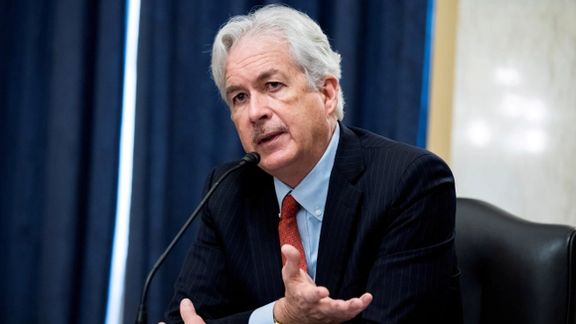
CIA Director William Burns

CIA Director William Burns has spoken of a nascent Tehran-Moscow defense partnership just as the US faces “major-power competition with China and Russia.”

With Burns a former ambassador to Russia and as Deputy Secretary of State a key player in behind-the-scenes talks that led to the 2015 Iran nuclear agreement, many expected President Joe Biden to assign Burns a diplomatic post. His appointment to head the Central Intelligence Agency raised some eyebrows in Washington.

Two years into the job, Burns Friday gave an interview to PBS where he expressed pride in the CIA’s work at a “moment of profound transformation on the international landscape.” A revolution in technology was “transforming…the way the intelligence profession works,” he said, while emphasizing “the rise of major power competition with China and with Russia.”

Burns argued that Iran’s supply of military drones to Russia marked “at least the beginnings of a full-fledged defense partnership… with the Russians beginning to look at ways in which, technologically or technically, they can support the Iranians.” This, he said, could “have an even more dangerous impact on the Middle East [than in Ukraine] …if it continues.” Without elaborating, or being asked to, Burns added that the US took the matter “very, very seriously.”

The Ukraine war, he argued, was exposing Russian weaknesses, for example in its troop mobilization and inability to match the weapons being supplied to Ukraine. Some Washington analysts have highlighted as ‘good news’ evidence of ships travelling from Iran to Russia turning off tracking devices to hide shipments – ‘good news’ in the sense it signals the success in the US strategy of eroding Russia’s military capacity.

The aftermath of an Iranian-made drone striking Kyiv on October 17, 2022
100%
The aftermath of an Iranian-made drone striking Kyiv on October 17, 2022

But Burns acknowledged the consequences of the war and sanctions not just on Moscow’s war effort but within Russia itself. The Russian economy has suffered long-term damage,” he said. “Most of the progress that the Russian middle class has made over the last 30 years is being destroyed.”

CIA ‘struck’ by Iran protests

Turning to Iran, Burns said CIA analysts had been “struck” at “the duration and scope of current protests,” which reflected “a growing number of Iranians… fed up with economic decay, with corruption, with the social restrictions that especially affect Iranian women.”

Protests have slowed economic growth as Iran struggles in the fifth year of US ‘maximum pressure sanctions with 40 percent inflation and the authorities expanding money supply to meet a fiscal challenge. But Burns did not express the view, or hope, held by some US conservatives, that this would lead soon to dramatic political change.

“I don’t think the Iranian regime perceives an immediate threat to its grip,” he said. “It still has some very practiced habits of repression and brutality that it’s continuing to employ.”

The diplomat in Burns resurfaced as he acknowledged China’s “reluctance” to supply weapons requested by Russia, and of both Chinese President Xi Jinping and India’s Prime Minister Narendra Modi in “raising their concerns about use of nuclear weapons.” But this did not distract the CIA director from his main concern. “We have no higher priority at CIA,” he said, “than not just Taiwan, but the longer-term geopolitical challenge that Xi’s China poses.”


Most Viewed

Iran negotiators ordered to return after internal rift over Islamabad talks
1
EXCLUSIVE

Iran negotiators ordered to return after internal rift over Islamabad talks

2
INSIGHT

Iran's digital economy battered by prolonged blackout

3
ANALYSIS

US blockade enters murky phase as tankers spoof signals and buyers hesitate

4
ANALYSIS

Why the $100 billion Hormuz toll revenue is a myth

5

US tightens financial squeeze on Iran, warns banks over oil money flows

Banner
Banner

Spotlight

  • Hardliners push Hormuz ‘red line’ as US blockade tests Iran’s leverage
    INSIGHT

    Hardliners push Hormuz ‘red line’ as US blockade tests Iran’s leverage

  • Ideology may be fading in Iran, but not in Kashmir's ‘Mini Iran'
    INSIGHT

    Ideology may be fading in Iran, but not in Kashmir's ‘Mini Iran'

  • War damage amounts to $3,000 per Iranian, with blockade set to add to losses
    INSIGHT

    War damage amounts to $3,000 per Iranian, with blockade set to add to losses

  • Why the $100 billion Hormuz toll revenue is a myth
    ANALYSIS

    Why the $100 billion Hormuz toll revenue is a myth

  • US blockade targets Iran oil boom amid regional disruption
    ANALYSIS

    US blockade targets Iran oil boom amid regional disruption

  • Iran's digital economy battered by prolonged blackout
    INSIGHT

    Iran's digital economy battered by prolonged blackout

•
•
•

More Stories

Iran Calls UNGA Resolution On Rights Violations ‘Hypocritical’

Dec 17, 2022, 13:38 GMT+0
•
Iran International Newsroom

Iran on Saturday dismissed a UN General Assembly resolution against its human rights violations, calling it “hypocritical and devoid of legitimacy."

Foreign Ministry Spokesman Nasser Kanaani said in a statement Friday “The hypocritical approach of sponsors of this resolution in exploiting international institutes to exert pressure on the Islamic Republic of Iran is a clear example of abusing sublime human rights concepts and values to pursue short-sighted political objectives.”

The United Nations General Assembly adopted a series of resolutions on December 15, with one condemning serious rights violations by Iran.

The resolution titled, “Situation of human rights in the Islamic Republic of Iran” passed by a recorded vote of 80 in favor and 29 against, with 65 abstentions.

Iran’s spokesman reiterated claims that this is part of the efforts of Western countries to maintain the “Iranophobia project” and “psychological war” against the Islamic Republic.

Meanwhile, several Iranian Friday Imams called the United Nations a “victim” of goals pursued by the United Sates in their sermons on Friday.

The resolution expressed serious concern at the significant increase in use of the death penalty in Iran; disproportionate application of the death penalty to persons belonging to minorities; and continuing disregard for protections under Iranian law or internationally recognized safeguards relating to the death penalty.

It strongly urged Iran to eliminate all forms of systemic discrimination and other human rights violations against women and girls; ensure women’s and girls’ equal protection and access to justice, including by prohibiting so-called honor killings and child, early and forced marriage.

Nasser Kanaani, spokesman of Iran's foreign ministry. FILE
100%
Nasser Kanaani, spokesman of Iran's foreign ministry

The resolution further called on the regime to lift restrictions on women’s and girls’ equal access to primary and secondary education; and remove legal and cultural barriers to women’s equal participation in the labor market and all aspects of economic, cultural, and political life.

The Assembly also expressed serious concern that the enforcement of the hijab and chastity law and its violent implementation by the Iranian morality police fundamentally undermines the human rights of women and girls.

It strongly urged Iran to cease the use of excessive force against peaceful protestors, such as in the aftermath of Mahsa Amini’s arbitrary arrest and subsequent death while in custody.

Further, it called on Iran to eliminate all forms of discrimination based on thought, religion, or belief, reiterating the importance of independent investigations for all allegations of human rights violations, including excessive use of force, arbitrary arrest, detention and torture.

The Assembly also called on Iran to cooperate fully with the Special Rapporteur on human rights in Iran, including by accepting repeated requests to visit the country.

The new draft resolution comes just days after the Islamic Republic was voted out from the United Nations Commission on the Status of Women (CSW) for policies contrary to the rights of women and girls.

On Wednesday, members of the UN Economic and Social Council (ECOSOC) adopted a US-drafted resolution to "remove with immediate effect the Islamic Republic of Iran from the Commission on the Status of Women for the remainder of its 2022-2026 term" over the regime’s bloody crackdown on protests ignited by the death of a young woman in custody of hijab – or the so-called “morality” -- police.

The Commission on the Status of Women (CSW) is the principal global intergovernmental body exclusively dedicated to the promotion of gender equality and the empowerment of women.

Out of the 54-member body, 29 members voted in favor of the resolution while eight voted against and 16 countries abstained. The Islamic Republic itself, Palestine, Syria, Cuba, China, Russia, Eritrea, Belarus, Zimbabwe, and North Korea voted to keep Iran in the body.

The vote was the first time in United Nations history that a country was expelled from the commission.

Iranians Continue Rallies In Europe, Australia To Support Protesters

Dec 16, 2022, 21:19 GMT+0

Iranian communities in several European cities held rallies Friday in support of protests in Iran and to demand the closure of Islamic Republic’s missions in Europe.

Iranian Australians also held a protest in Brisbane outside the regional parliament of Queensland. The crowd sand protest songs and displayed photographs of civilians killed by government forces since September, when nationwide protests began after the death in police custody of Mahsa Amini who was arrested for ‘improper hijab’.

In Europe, Iranians gathered in Stockholm and Frankfurt demanding freedom for imprisoned journalists in Iran and urging European countries to cut ties with the Islamic Republic.

Iranians who have settled in Europe hold regular protests for three months. The community in Stockholm is one of the most active. Sweden’s Foreign Minister Tobias Billström visited the rally expressing support for rights of protesters in Iran and condemning the execution of young people by the clerical regime.

Iranians in Frankfurt gathered outside Islamic Republic’s consulate demanding that Germany expel all regime diplomats. A group of protesters have camped at the location for the past 24 days and have gone on a hunger strike. German media covered the Frankfurt rally.

The Italian Senate in Rome was the venue of a conference Friday in support of protesters in Iran, with the participation of Italian Iranians. The foreign affairs committee of the Italian Senate was the organizer of the event to hear the views of the Iranian community.

Iranian in Britain had held rallies and protests on Thursday in Newcastle, Birmingham, Glasgow and London.

Iran’s ‘Century Of Politics’ Makes It Different

Dec 16, 2022, 20:44 GMT+0
•
Iran International Newsroom

Popular anti-regime protests in Iran have reawakened expectations in the United States of a pro-American, ‘postmodern’ future in the Middle East.

In an article published by Bloomberg December 15, headlined ‘A Democratic Iran is Coming and it will lead the Middle East,’ Robert Kaplan suggests that “nothing has the potential to change the region as much as a more liberal regime” in Iran.

Named by Foreign Policy magazine in 2011 and 2012 as ‘one of the top 100 global thinkers,’ Kaplan supported the 2003 US-led Iraq invasion on the basis that it would unleash what he told NPR in October 2002 was a “secular, urbanized developed tradition”. However, he was not alone in that optimistic assessment. Most of the US Congress and media were also believers in removing Saddam Hussein from power.

Unlike many Arab countries, Kaplan argues, Iran’s borders are not “artificial…drawn by Europeans.” This, he claims, Iran shares with the Persian Gulf emirates and kingdoms – although Saudi Arabia dates only to 1932.

Whatever his views about ‘democracy’ or ‘liberalism,’ Kaplan is firmly a realist. He notes “Saudi Arabia may understandably offend Western humanitarians” and expects the US to broker a future Iranian ‘normalization’ with Israel.

Noting Iran’s rich energy reserves, currently hemmed in by US ‘maximum pressure’ sanctions, Kaplan admires the doyen of the realist school, the US Secretary of State who saw Iran’s Pahlavi shah as a US ally against adversaries Iraq and the Soviet Union.

“Henry Kissinger told me that had the Pahlavi dynasty remained in power, Iran, given its strong state and civilizational richness,” Kaplan writes, “would have evolved into a constitutional monarchy with an economy comparable to South Korea’s.”

Kaplan’s commitment to real politic rather than ‘humanitarianism’ opens him to the possibility of a “post-clerical” Iran asserting itself regionally, perhaps “developing even stronger ties” with China than “Germany now has.” And Kaplan is also aware that a “somewhat chaotic, less centrally controlled” Iran might grapple with “large Kurdish, Azeri, Turkoman and Baluch minorities.”

A century of politics

The priority of Reuel Marc Gerecht and Ray Takeyh, writing in the Wall Street Journal December 12, is disputing the assessment of the Central Intelligence Agency (CIA) that current unrest in Iran “poses no threat to the regime.”

Gerecht, a fellow at the Foundation for Defense of Democracies and a former ‘Iranian-targets’ CIA officer, championed, like Kaplan, the Iraqi and Afghan interventions. In March 2003, he signed a statement that US intervention in Iraq would help the “democratization of the wider Middle East.”

The problem was that most optimists on Iraq were simplifying the environment in the Middle East and not considering the Islamic Republic’s long-held policy of exporting its Shia ideology and playing the role of a spoiler.

WithTakeyh, a senior fellow at the Council on Foreign Relations, Gerecht argues that the CIA has been misled by the “disappointing results of the Arab Spring and of Western military interventions in Afghanistan and Iraq.” Iran differs from the Arab world in its history since the 1905-11 Constitutional Revolution, Gerecht and Takeyh write, with a century of Iranians’ “involvement in politics” under both Shahs and since 1979 the Islamic Revolution.

Iranians’ “critiques of authoritarianism,” they continue, have increased with the “massive expansion” or Iran’s “educational infrastructure” since 1979 with now “nearly six million university students, almost 60% of whom are women.”

Hence Iranians “are unlikely to fall victim again to the allure of a secular strongman or militant mullah, having seen the damage such leaders cause. The Arabs who revolted against tyranny a decade ago didn’t have the advantage of decades of trial and error. Self-criticism isn’t a Middle Eastern forte, but Iranians have come far in placing the blame for their own predicament on themselves.”

Gerecht and Takeyh rule out dangers of ethnic fragmentation and look forward to a “post-Islamic Iran…[with] a far bigger Western fan club that did the elected Islamists of North Africa.” Presumably evoking the Egyptian military regime that receives the second biggest chunk of US foreign aid after Israel, the pair cite Samuel Huntington – he of the ‘clash of civilizations’ – to note that US support for “nascent democracies increases the chance of their survival.”

US Sanctions Chinese Video Surveillance Firm Supplying Iran

Dec 16, 2022, 17:37 GMT+0

The United States on Thursday blacklisted a Chinese video surveillance equipment maker accusing the company of selling technology to Iran’s Revolutionary Guard.

NBC News reported Friday that Tiandy Technologies firm has used its facial recognition software to help Chinese authorities identify Uyghurs or other ethnic minorities. It has also provided Iran’s IRGC with the technology as well.

The Commerce Department sanctions against Tiandy restrict American firms from exporting components to the company.

The processors for Tiandy’s video recording systems were provided by California-based semiconductor giant Intel Corporation. However, Intel had removed references to Tiandy from its website before the decision was announced by the Biden administration, added NBC News.

Intel Corp. spokesperson Penny Bruce told NBC News Thursday that the company ceased doing business with the Chinese company “following an internal review.”

Tiandy is a private firm based in the northern city of Tianjin, which ranks among the top video surveillance companies in China and the world.

An industry survey says the annual sales revenue of Tiandy was more than $800 million in 2021, but it has branches in over 60 countries.

The Financial Times also wrote Thursday that Washington is set to put the chipmaker Yangtze Memory Technologies on a trade blacklist, in its latest efforts to target Chinese technology companies that it believes threaten the country’s security.

It comes two months after the Biden administration unveiled harsh export controls that made it more difficult for Beijing to acquire and produce advanced semiconductors.

How Much Was Iran’s Oil Income In 2022?

Dec 16, 2022, 17:24 GMT+0
•
Mardo Soghom

While many oil industry sources believe Iran exports around one million barrels of crude per day, others believe the volume is much less and the income modest.

TankerTrackers, Vortexa, Kpler, and other sources estimate Iran exported anywhere from 810,000 to 1.2 million barrels of crude oil per day in recent months. Iran keeps the export volume secret, but top officials constantly claim revenues are increasing.

But the US Energy Information Administration estimates that currently Iran’s daily crude exports are around 600,000 barrels. In addition, Iran is selling a maximum of 400,000 barrels of oil products such as diesel per day. So, the estimate about crude exports ranges from 0.6 to 1,2 million barrels, quite a large spread.

Iran also does not reveal how much it earns from crude oil exports, but if we take the lower estimate of 0.6 million shipments p/d and an average price of $90 p/b for 2022, revenues should total $20-22 billion for the 12 months of 2022.

The higher export volume estimate of one million barrels per day would return an annual revenue of about $32 billion.

The oil products Iran exports in addition to crude also generate roughly the same rate of income as crude oil. This means that if Iran has been selling 400,000 barrels p/d of these products, it earned about $13 billion in 2022.

Thus, total oil export revenues for the year ranges from $35-45 billion depending on which crude export volume is closer to reality.

These are rough estimates because we do not know how much discount Iran offers to its main buyer, China, and how much hard currency it recoups from the sales. Many observers believe Tehran might be bartering some of its oil to get food and other necessities. Also, using middlemen and illicit methods to conceal its shipments and repatriate cash amid US banking sanctions cost more money.

The prevailing financial situation in Iran is perhaps an indication that the lower estimate of its 2022 oil income might be closer to reality. Its currency, the rial, has fallen almost 30 percent in the past 12 months to a historic low of 380,000 against the US dollar.

The central bank has accelerated its habit of printing money to finance government operation and rescue inefficient state banks. Media in Tehran reported Thursday that in the past seven months the government has printed 1,000 trillion rials of money, while the currency was losing value.

If Iran’s oil exports were closer to $45 billion perhaps the currency would not have fallen so precipitously, because the exchange market in Tehran is not that big and the infusion of less than $100 million more every few days could have better supported the currency.

Popular anti-regime protests since September have put a lot of pressure on the government, that risks mass rebellion by a nation suffering from a 50-percent inflation rate and growing poverty.

The government’s official news website IRNA claimed Friday that daily exports have reached 1.5 million barrels, perhaps as a tactic to talk up the rial, but that is also a politically dangerous game because a public under tremendous financial pressure can ask where all the income has gone.