• العربية
  • فارسی
Brand
  • Iran Insight
  • Politics
  • Economy
  • Analysis
  • Special Report
  • Opinion
  • Podcast
  • Iran Insight
  • Politics
  • Economy
  • Analysis
  • Special Report
  • Opinion
  • Podcast
  • Theme
  • Language
    • العربية
    • فارسی
  • Iran Insight
  • Politics
  • Economy
  • Analysis
  • Special Report
  • Opinion
  • Podcast
All rights reserved for Volant Media UK Limited
volant media logo

Iran's Out-of-Touch Leaders Are Likely To Repeat Old Mistakes
Iran International Newsroom
Dec 20, 2022, 09:08 GMT+0Updated: 17:38 GMT+1
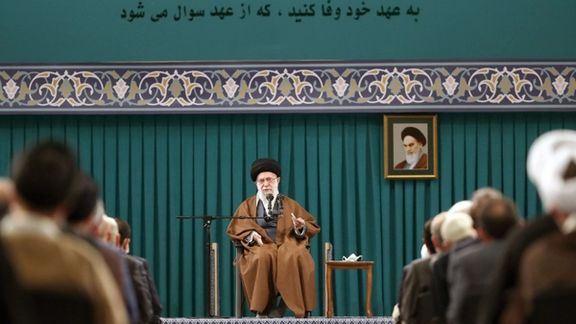
Ali Khamenei speaking to regime insiders in April 2022

A 25-percent fall in the value of Iran’s currency in 3 months has shaken the Iranian government and led to sharp criticism even among conservatives.

Conservative politician Mansoor Haqiqatpur has accused the President Ebrahim Raisi’s administration of sharply reducing the value of assets held by rich and ordinary Iranians.

“Less than 18 months ago, when Raisi took office as the President of the Islamic Republic one US dollar was equal to 230,000 rials in Tehran markets. Now the value of every US dollar is over 380,000 rials. The devaluating Iranian currency is now as cheap as straw. This means Iranians have lost half of their assets during this period."

In fact since Haqiqatpur spoke the rial has dropped further and on Tuesday it is close to 400,000 against the US dollar.

The significance of this remark by a conservative who is a natural ally of President Raisi should not be taken lightly. In his interview with ILNA website, Haqiqatpur, like many other Iranian politicians, said that the Islamic Republic needs to update and upgrade its governance.

He charged that "the government in Iran does not follow a pre-planned path. We still do not know who is in charge of culture or identity. Who has to determine and engineer the identity of generation Z?" It appears that he still believes in strong government control even over the citizens' identity.

Haqiqatpur went on to say that "a new governance can help, but in some areas we need to change the Islamic Republic's constitution." This has become a fashionable catch phrase by some regime insiders after their political position was shaken by nationwide protests.

Mansoor Haqiqatpur, Iranian conservative speaking with ILNA. Dec. 18, 2022
100%
Mansoor Haqiqatpur, Iranian conservative speaking with ILNA

But like other Iranian politicians and political observers he also ignored Supreme Leader Ali Khamenei's role in undermining the constitution and other laws of the country.

The main issue with the constitution is the overwhelming power of the Supreme Leader that is the commander of chief of the armed forces and the religious institutions of the clerical regime. Therefore, he easily augments his powers, making other constitutional institutions like the presidency irrelevant.

Insiders shy away from saying that the Islamic Republic is a dictatorship and Khamenei is the only one who has the final say even in the people's private lives. How many children they need to have, what they need to wear and what they are allowed to watch on television. He even did not consult the parliament when he decided to deploy troops to Syria to save another dictator or to send weapons to Russia to assist with Putin's ambitions in Ukraine.

Three Iranian presidents, Mohammad Khatami, Mahmoud Ahmadinejad and Hassan Rouhani begged Khamenei to change a couple of articles in the constitution to allow for some reforms, but he arrogantly silenced them.

However, Haqiqatpur was brave enough to criticize the Guardian Council for its unilateral decisions to allow some politicians to run for parliament and to disqualify others without offering any explanation for its decisions. But he also said that some of the articles of the constitution including the powers of the Supreme Leader are unchangeable. Without that clarification, his words would not have been published in Tehran.

However, it was easy for him to attack Raisi as a soft target.

Iranian academic observers spoke along the same line in a gathering to probe into the idea of progress and development in Iran." Social scientists Hadi Khaniki, Ahmad Meydari and Mohammad Fazeli concluded at the gathering in Tehran that "many of Iran's problems today are because of the limitations imposed on political participation. When there is no political participation, there will be political decline," they said.

The academics further agreed that the only way out of the current crisis in Iran is recognizing the role of dialogue in social processes. Meanwhile they paid tribute to Iranian political economist Professor Majid Tehranian who had predicted the Islamic revolution in 1976, three years before it took place. "But no one heard him," Said Khaniki.

Fazeli added that "if Iranian politicians refuse to pay attention to the route Iranian government took in the 1970s, and Iranian leaders avoided contact with the public, they are likely to make the same mistakes as their predecessors."


Most Viewed

State media slam Araghchi's Hormuz tweet, say it let Trump claim victory
1

State media slam Araghchi's Hormuz tweet, say it let Trump claim victory

2

Iran International says it won’t be silenced after London arson attack

3
INSIGHT

How Tehran bends its own red lines to boost state rallies

4
OPINION

The Hormuz get out of jail card turned to a grave

5

Iran halts petrochemical exports to supply domestic market

Banner
Banner

Spotlight

  • Too early to tell who is winning Iran war, experts say
    PODCAST

    Too early to tell who is winning Iran war, experts say

  • How Tehran bends its own red lines to boost state rallies
    INSIGHT

    How Tehran bends its own red lines to boost state rallies

  • Iran blackout cripples freelancer, small business incomes
    VOICES FROM IRAN

    Iran blackout cripples freelancer, small business incomes

  • Ideology may be fading in Iran, but not in Kashmir's ‘Mini Iran'
    INSIGHT

    Ideology may be fading in Iran, but not in Kashmir's ‘Mini Iran'

  • US blockade enters murky phase as tankers spoof signals and buyers hesitate
    ANALYSIS

    US blockade enters murky phase as tankers spoof signals and buyers hesitate

  • Why the $100 billion Hormuz toll revenue is a myth
    ANALYSIS

    Why the $100 billion Hormuz toll revenue is a myth

•
•
•

More Stories

US Lawmakers Propose Legislation To Bar Iran Regime Insiders

Dec 19, 2022, 21:53 GMT+0

A bipartisan group of US lawmakers have proposed legislation to refuse visas and revoke any issued to Iranian regime insiders and their families.

The initiative is dubbed Revoking Entry Granted to Iranian Mullahs and Elites Act of 2022 or REGIME Act. It would target not only those officials responsible for repression and crackdown on protesters but also their immediate family members, Al Monitor reported Monday.

The legislation would direct the Secretary of State to conduct a review of whether a wide-ranging group of Islamic Republic officials – including members of the Revolutionary Guard (IRGC), Supreme Leader’s office and security forces – and their family members are in possession of US visas or have applied for them.
The legislation is led by Reps. Joe Wilson (R-S.C.), Josh Gottheimer (D-N.J.), Claudia Tenney (R-N.Y.), and Vicente Gonzalez (D-Texas).

It is not clear what sorts of US visas will be impacted if the legislation is adopted. Already, some individuals fitting the criteria might have obtained US permanent residency or even became naturalized citizens.

These individuals can apply for visas for their immediate family members according to US immigration law.

Recently, Canada also issued regulations banning entry for 10,000 IRGC members and possibly people affiliated with Key elements of the Iranian regime.

“In light of the actions of the regime it is particularly unbelievable that Iranian officials and family members are being given visas to come to the US to enjoy the very liberties their own citizens can only imagine,” Wilson told Al-Monitor.

Economists Doubt Iran Can Mitigate Financial Crisis

Dec 18, 2022, 15:28 GMT+0
•
Iran International Newsroom

As Iran’s central bank chief partly blamed political unrest for the national currency’s unprecedented fall, economists express profound doubt about any solution.

Iran’s rial was hovering near 400,000 against the US dollar on Sunday, while in most of 2021 the rial was stable at around 250,000, a more than 50-percent drop in 15 months, which coincides with the presidency of hardliner Ebrahim Raisi.

The head of the Central Bank of Iran (CBI), Ali Salehabadi said in addition to US sanctions on Iran, recent popular protests have encouraged capital flight from the country and contributed to the fall of the rial. But he promised to reduce the alarming growth in the money supply until March, when the Iranian calendar year ends.

He also claimed that the current 50-percent annual inflation rate will decrease after March 2023, without offering a roadmap, except his promise to control the money supply.

Bahaoldin Hosseini-Hashemi, an economist in Tehran, expressed bewilderment at these remarks, telling a local website that the closing months of the year is usually when more money is printed by the CBI, because the government has to pay its obligations.

Bahaoldin Hosseini-Hashemi, an economist in Tehran
100%
Bahaoldin Hosseini-Hashemi, an economist in Tehran

The central bank in Iran enjoys little independence from the executive branch, or the whims of powerful circles such as the Revolutionary Guard and many economic entities linked to prominent clerics and their “charitable” organizations.

Hosseini-Hashemi drew attention to official reports showing that the CBI has printed money at a faster pace since the end of September as government debt to the bank has increased. A second challenge is presented by state or quasi-state banks, which also rely on borrowing from the CBI.

“Our money supply growth rate has reached an unprecedented level…it is a machine that just creates more liquidity and inflation,” the economist said. He added that the optimism expressed by the CBI chief will be tested when it comes to the government budget, but it is a fact that the deficit is higher than in other year.

Therefore, it is not clear what Salehabadi is basing his optimism on. Tax revenues have not increased either, and in the current crisis there is no outlook for higher tax revenues.

The economist, like many of his peers in Iran, sees the only solution to control or ameliorate the crisis lies in a foreign policy change. Oil export and banking sanctions imposed by the United States over Iran’s nuclear program must end. This is prerequisite to any chance of stopping current negative trends.

He also pointed out that Iran has a problem with the demands made by the international financial watchdog, the FATF since 2017, to enact legislation against money laundering and financing of terrorism. Without this, Iran will remain blacklisted by many international financial institutions.

Hosseini-Hashemi said in his interview that contrary to what Salehabadi promised, he believes things will get worse in the coming months. Both the pace in money supply and inflation will increase, judging by current indicators. “Maybe it is possible to make these statements on paper, but what we can see in the statistics, the reality is just the opposite…When they [officials] say that they have written a plan and held meetings, it means they have nothing to count on.”

Iranians Lose Hope Having The ‘Worst Government In 80 Years’

Dec 18, 2022, 09:38 GMT+0
•
Iran International Newsroom

Iranian politician Hojjat Mirzaei, a former economic official, has characterized President Ebrahim Raisi's team as "the weakest of its kind in the past 80 years."

In an interview with moderate news website Khabar Online on Saturday, December 17, Mirzaei further said that the Raisi government’s plan to create "a paradise" with reliance on China and Russia has turned out to be an illusion. A very good paradise was how the president’s budget people earlier described the future of Khamenei's Looking East policy and Iran's cooperation with China and Russia.

Earlier, conservative commentator Mohammad Mohajeri had also called the Raisi administration "the weakest government in Iran's history." It appears that the view is shared by most of Islamic Republic political factions. Most recently, reformist cleric Mohammad Ashrafi Esfahani called the Raisi administration "the weakest government in Iran after the 1979 revolution."

Like Mirzaei, Ashrafi Esfahani further added that Iranians are in desperation as they have lost their hopes of a better future because of the poor performance of the Raisi administration. He said: "It is obvious that the people's financial situation will worsen, and their hopes will fade away when the government replaces experienced officials with those who have no outstanding background or experience.

He was clearly referring to the make-up of the government, which is stacked with less experienced hardliners loyal to the Revolutionary Guard and Iran’s ruler Ali Khamenei.

On Saturday, former Iranian Interior Minister Abdollah Nouri also said that "The Islamic Republic has reached a dead-end." He added that most independent observers in Iran are against the course the Islamic Republic pursues, but all the decisions in the country are being made by Supreme Leader Ali Khamenei and that is causing the impasse as no one listens to the majority of Iranians.

Khabar Online website in Tehran wrote that Raisi's slogans have not led to anything tangible. He promised to restore the battered currency rial, but in his 16 months in power the rial has fallen by nearly 50 percent, leading to fears to hyper-inflation.

Mirzaei argued that although the government is weak, but personnel changes will not help it much. "Iran's international relations and the structure of the government are the main problems," he said, adding that "the government should strive to revive the 2015 nuclear deal (JCPOA) and enact laws demanded by the international financial watchdog, the FATF, while also improving its ties with Iran's neighbors."

Mirzaei added that the most important jobs for the government is to introduce transparency, to control financial corruption and to pursue good governance. He maintained that "none of these have happened and it appears that there has been no will in Iran since 2017 to improve the situation. Hardliners have prevented the revival of the JCPOA before Raisi’s election and portrayed the former government as inefficient. These situation led to major protests in 2017 and 2019, and the latest presidential election in Iran in 2021 made the situation even worse."

The politician quipped that "While the situation is getting worse, Raisi is constantly talking about the train of progress."

However, it is not just Raisi who appears to be out of touch with the realities on the ground. Khamenei has also said on various occasions that foreigners have instigated the ongoing protests as they aim to stop Iran's progress.

Into Fourth Month Of Unrest, Tehran Accuses ‘Enemies’ Of Sedition

Dec 17, 2022, 22:13 GMT+0

Iran’s president continues to reiterate Supreme Leader’s claim that dissent is “sedition by enemies,” three months after “Woman, Life, Freedom” protests began.

“Enemies thought they could play the Iranian people, like the people of other countries, with false and grandiose slogans. They thought they could deceive people with the word ‘freedom’ and believed people would trust them if they spoke of ‘life’,” President Ebrahim Raisi told a hand-picked audience in Nahbandan, a small town of around 50,000 in South Khorasan Province, during a visit on Friday.

The slogan has turned into the signature motto of the protests after a young woman, Mahsa Amini died in the custody of morality police in September. She was arrested for ‘improper hijab.’

Raisi also told the United States and other western countries “to open their eyes” and understand that people are determined not to give in despite “problems caused by sanctions, threats, enmity and vindictiveness” and leave the resolution of problems to their own government. “Do you believe people our dear youth and students will be deceived by your words?” he asked while insisting, like Supreme Leader Ali Khamenei, that the “enemies miscalculated the situation as in previous seditions [they stirred up].”

Iran's aging authoritarian ruler Khamenei prophesied in a speech November 19that the protests would end soon because, he claimed, organizers of “riots” failed to mobilize the people.

Khamenei has always referred to past and current protests as “riots” incited by “enemies” and accused protesters of “sedition”. In his speech he also claimed that “the organizers” of the protests, that are foreign powers he insisted, “failed to bring the people to the scene” so they were trying to “exhaust” the authorities, but they were wrong “because these mischiefs make the people hate them more.”

In his speech Khamenei also made no mention of the 400 civilian victims of government violence until then, but accused “rioters” of killing government forces, which he claimed would “anger the nation.”

The number of protesters killed by security forces has now risen to nearly 500 and two young protesters have been executed in an apparent attempt to instill fear among protesters, but an end to protests is nowhere near in sight.

Despite denial of the seriousness of the current protests, authorities including Khamenei seem to be extremely wary of the situation. A secret report by IRGC's media arm, Fars News Agency, which was leaked by hackers in late November, quoted Khamenei as saying protests would not end anytime soon while blaming others for failing to contain the situation including their failures in the “media war” against protesters.

Although there has been a drop in the number of protesters on the streets in the past two weeks, there are still plenty of calls on social media to protest, and according to Mark Pyruz, a military history image analyst, an uptick in nightly arson attacks by individuals and small teams who target municipal banners, monuments, Basij militia and government offices, seminary sites, and local official residences.

The uptick somehow is reflected in the increased calls on social media for “honorable sabotage” against government targets in the past few days. There have also been calls for formation of small independently acting saboteur groups and naming them after Mohsen Shekari, the first protester to be executed by the government last week.

Iran’s ‘Century Of Politics’ Makes It Different

Dec 16, 2022, 20:44 GMT+0
•
Iran International Newsroom

Popular anti-regime protests in Iran have reawakened expectations in the United States of a pro-American, ‘postmodern’ future in the Middle East.

In an article published by Bloomberg December 15, headlined ‘A Democratic Iran is Coming and it will lead the Middle East,’ Robert Kaplan suggests that “nothing has the potential to change the region as much as a more liberal regime” in Iran.

Named by Foreign Policy magazine in 2011 and 2012 as ‘one of the top 100 global thinkers,’ Kaplan supported the 2003 US-led Iraq invasion on the basis that it would unleash what he told NPR in October 2002 was a “secular, urbanized developed tradition”. However, he was not alone in that optimistic assessment. Most of the US Congress and media were also believers in removing Saddam Hussein from power.

Unlike many Arab countries, Kaplan argues, Iran’s borders are not “artificial…drawn by Europeans.” This, he claims, Iran shares with the Persian Gulf emirates and kingdoms – although Saudi Arabia dates only to 1932.

Whatever his views about ‘democracy’ or ‘liberalism,’ Kaplan is firmly a realist. He notes “Saudi Arabia may understandably offend Western humanitarians” and expects the US to broker a future Iranian ‘normalization’ with Israel.

Noting Iran’s rich energy reserves, currently hemmed in by US ‘maximum pressure’ sanctions, Kaplan admires the doyen of the realist school, the US Secretary of State who saw Iran’s Pahlavi shah as a US ally against adversaries Iraq and the Soviet Union.

“Henry Kissinger told me that had the Pahlavi dynasty remained in power, Iran, given its strong state and civilizational richness,” Kaplan writes, “would have evolved into a constitutional monarchy with an economy comparable to South Korea’s.”

Kaplan’s commitment to real politic rather than ‘humanitarianism’ opens him to the possibility of a “post-clerical” Iran asserting itself regionally, perhaps “developing even stronger ties” with China than “Germany now has.” And Kaplan is also aware that a “somewhat chaotic, less centrally controlled” Iran might grapple with “large Kurdish, Azeri, Turkoman and Baluch minorities.”

A century of politics

The priority of Reuel Marc Gerecht and Ray Takeyh, writing in the Wall Street Journal December 12, is disputing the assessment of the Central Intelligence Agency (CIA) that current unrest in Iran “poses no threat to the regime.”

Gerecht, a fellow at the Foundation for Defense of Democracies and a former ‘Iranian-targets’ CIA officer, championed, like Kaplan, the Iraqi and Afghan interventions. In March 2003, he signed a statement that US intervention in Iraq would help the “democratization of the wider Middle East.”

The problem was that most optimists on Iraq were simplifying the environment in the Middle East and not considering the Islamic Republic’s long-held policy of exporting its Shia ideology and playing the role of a spoiler.

WithTakeyh, a senior fellow at the Council on Foreign Relations, Gerecht argues that the CIA has been misled by the “disappointing results of the Arab Spring and of Western military interventions in Afghanistan and Iraq.” Iran differs from the Arab world in its history since the 1905-11 Constitutional Revolution, Gerecht and Takeyh write, with a century of Iranians’ “involvement in politics” under both Shahs and since 1979 the Islamic Revolution.

Iranians’ “critiques of authoritarianism,” they continue, have increased with the “massive expansion” or Iran’s “educational infrastructure” since 1979 with now “nearly six million university students, almost 60% of whom are women.”

Hence Iranians “are unlikely to fall victim again to the allure of a secular strongman or militant mullah, having seen the damage such leaders cause. The Arabs who revolted against tyranny a decade ago didn’t have the advantage of decades of trial and error. Self-criticism isn’t a Middle Eastern forte, but Iranians have come far in placing the blame for their own predicament on themselves.”

Gerecht and Takeyh rule out dangers of ethnic fragmentation and look forward to a “post-Islamic Iran…[with] a far bigger Western fan club that did the elected Islamists of North Africa.” Presumably evoking the Egyptian military regime that receives the second biggest chunk of US foreign aid after Israel, the pair cite Samuel Huntington – he of the ‘clash of civilizations’ – to note that US support for “nascent democracies increases the chance of their survival.”