• العربية
  • فارسی
Brand
  • Iran Insight
  • Politics
  • Economy
  • Analysis
  • Special Report
  • Opinion
  • Podcast
  • Iran Insight
  • Politics
  • Economy
  • Analysis
  • Special Report
  • Opinion
  • Podcast
  • Theme
  • Language
    • العربية
    • فارسی
  • Iran Insight
  • Politics
  • Economy
  • Analysis
  • Special Report
  • Opinion
  • Podcast
All rights reserved for Volant Media UK Limited
volant media logo

Islamic Law Experts Question Basis Of Iran’s Death Sentences
Iran International Newsroom
Dec 11, 2022, 23:25 GMTUpdated: 17:40 GMT+1

As the Islamic Republic is adamant to execute more protesters, some Islamic law experts are voicing opposition to the Judiciary’s interpretation of Sharia. 

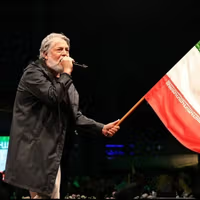
Iranian Shia theologian Morteza Moghtadaei -- the deputy chairman of Society of Seminary Teachers of Qom told Iran’s Labour News Agency Sunday that the judicial system does not adhere to Islamic law, or sharia, regarding limitation to issuing death sentence.

Himself a former Revolution Court judge and head of Supreme Court of Iran, Moghtadaei said "In cases where a person does not fight with a group and only fights with one person, that person is not called a mohareb," referring to the charge of "moharebeh" that the Islamic Republic’s judiciary has issued for many protesters. 

“Moharebeh” is an Islamic-Arabic term that in the lexicon of the Iranian regime means “fighting God” and its punishment is death.

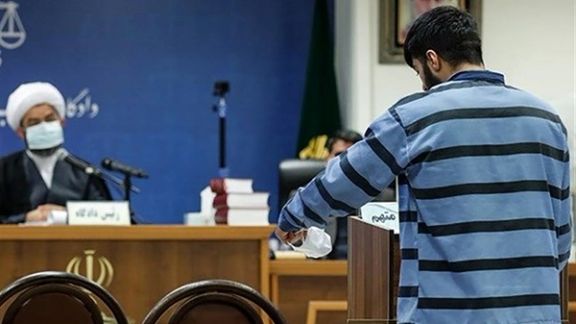
The judiciary announced on Thursday the execution of Mohsen Shekari, a twenty-three-year-old protester convicted of injuring a security guard with a knife and closing off a street in the capital Tehran. He was charged with Moharebeh that along with another Islamic concept translated as “corruption on earth” are used as broad concepts by the regime to issue maximum sentences against opponents.

Clerical judges who take orders from the hardliner Judiciary convict people to death without a real trial, often with no defense lawyers and behind closed doors. The defendants have no way of challenging state evidence or introducing witnesses.

Moghtadaei elaborated that "If a mohareb kills someone, he should get the death sentence, but if he only threatens and intimidates, even if he is convicted, he should not get a death sentence; which means although he is a mohareb but should not be executed.”

ranian Shia theologian Morteza Moghtadaei (file photo)
100%
ranian Shia theologian Morteza Moghtadaei

Mohammad-Ali Ayazi, another Shia scholar and a seminary teacher, also said that everyone has the right to protest and can defend himself against government agents who want to prevent him. That is not committing ‘moharebeh’, he underlined.

He added that "In an important issue such as execution, it is important that an independent lawyer defends the accused and that a public hearing is held in the presence of a jury." If these principles are not respected, the cycle of violence will continue, Ayazi noted. 

Prominent Iranian lawyer Nemat Ahmadi also criticized the judiciary for the prompt decision to issue death sentences for some of the detained protesters, saying that death sentences cannot be issued so haphazardly. He said that according to Article 279 of the Islamic Penal Code, a person is called a mohareb when he takes up a weapon against the people to cause insecurity by threatening others’ lives, property and honor. “Those who oppose the government are not recognized as mohareb,” he explained.

He added that many Islamic scholars believe the term should be used to describe bandits who endanger the security of the society, considering the historic context in which the term came into existence in the first place. It is very important to determine the use of the term with a lot of caution.

Mohammad-Hossein Saket, another lawyer and law researcher, said that “in general, it is not good to mix legal issues with political issues and make hasty decisions.” 

In a speech after the execution of the first protester, President Ebrahim Raisi announced that "the trial and punishment of the protesters" will continue. Also, Ahmad Khatami, a hardliner cleric and Friday prayer Imam expressed his gratitude “for the decisiveness of the Judiciary, which sent the first rioter to the gallows.” Judiciary spokesman Masoud Setayeshi had announced Tuesday that five more people indicted in the killing of a Basij militia member, Rouhollah Ajamian, were sentenced to death.

Shekari’s hanging after a hasty and unfair trial has sparked deep anger among Iranians, who believe his killing was meant to instill fear among the people, and world leaders who describe the act as the acme of atrocity and a nadir of humanity.

Iran’s top Sunni religious leader has also slammed the executions of protesters as violations of Sharia law and warned the authorities that this will not stop the antigovernment movement.

Nationwide protests that erupted after the death of 22-year-old Kurdish Iranian woman Mahsa Amini on September 16 represent one of the biggest challenges to the Islamic Republic since its establishment in 1979. So far, around 500 civilians have been killed by security forces and at least 18,000 arrested. While many have been released, around 1,500 face criminal charges, and at least 80 detainees face the death sentence.

Most Viewed

US terminates green cards of 3 Iranians tied to Islamic Republic
1

US terminates green cards of 3 Iranians tied to Islamic Republic

2
PODCAST

Worst outcome is Islamic Republic’s survival, ex-CIA official says

3
ANALYSIS

Iran brings unusually broad team to US talks to blunt future blame

4
INSIGHT

Tehran sends tough message but keeps diplomacy door open

5

Zoroastrian religious figure arrested in Iran

Banner
Banner

Spotlight

  • Tehran sends tough message but keeps diplomacy door open
    INSIGHT

    Tehran sends tough message but keeps diplomacy door open

  • Worst outcome is Islamic Republic’s survival, ex-CIA official says
    PODCAST

    Worst outcome is Islamic Republic’s survival, ex-CIA official says

  • Why the Iran-US truce is more likely to buy time than peace
    ANALYSIS

    Why the Iran-US truce is more likely to buy time than peace

  • Engaged but uncommitted: China watches Iran and US fight and talk
    ANALYSIS

    Engaged but uncommitted: China watches Iran and US fight and talk

  • A truce for the world, a reckoning for Iran’s economy
    ANALYSIS

    A truce for the world, a reckoning for Iran’s economy

  • Why the world failed to bypass the Strait of Hormuz
    ANALYSIS

    Why the world failed to bypass the Strait of Hormuz

•
•
•

More Stories

Mother Of Murdered Political Prisoner Threatened By Iran’s Regime

Dec 11, 2022, 22:31 GMT

An elderly woman, whose son was killed in prison eleven years ago, says the Iranian regime has increased pressure and threats against her and her family members.

Gohar Eshghi, the mother of the 35-year-old blogger Sattar Beheshti, who was killed under torture in prison, announced in a video message Sunday that she and her family have been threatened by government agents.

Sattar Beheshti's mother emphasized that “If something happens to us, the [supreme] Leader [Ali Khamenei] is responsible.”

She added that the security forces have been threatening her for eleven years, but she and the people of Iran are ready to expel them and their master (Khamenei) from the country.

Gohar Eshghi had previously reported threats against her by the clerical regime in early December saying, “No one is afraid of death! Don't threaten!”

Last year, she was assaulted by unknown individuals when she was on her way to visit her son’s grave. Two people approached on a motorcycle and one of them attacked the elderly woman knocking her to the ground. People who saw the incident took her to a hospital, with injuries.

She has been demanding justice for her son who was arrested by security forces for his blogging activity and died a few days later, in what was believed to be a case of torture in detention.

Beheshti was an ordinary laborer who was active on Facebook and maintained a blog, often criticizing Islamic Republic officials.

Former Head Of Iran’s State TV Says Killing Protesters Must End

Dec 11, 2022, 21:01 GMT

The former chief of Iran’s state Radio and TV says the current way of governance is “unsustainable” and the regime faces such “misery it cannot meet the smallest demands of the people.”

Mohammad Sarafraz said in a video message that “beating and killing [protesters] will not work and sooner or later it will reach a dead end, so this method must end.”

The comments by Sarafaraz, which can be interpreted as an unprecedented warning by an official appointed by Supreme Leader Ali Khamenei, were made in a conversation with Shahrazad Mirqolikhan.

Mirqolikhan was arrested and imprisoned for five years in the US for trying to send military equipment to Iran.

After her release, she went to Oman and later became the public relations manager of Press TV, the English-language Iranian state TV channel, which was headed by Mohammad Sarfraz at the time.

In his unprecedented speech, Sarafraz warned Supreme Leader’s son, Mojtaba Khamenei saying “the method of putting pressure on people and not paying attention to their political and economic demands and their legitimate freedoms will not work.”

“I am in a situation that I know by making these remarks, anything may happen to me, so I have written my will,” added Sarafraz.

Revolutionary Youth Groups In Iran Publish Manifesto For Future

Dec 11, 2022, 20:18 GMT
•
Maryam Sinaiee

An alliance of 30 youth groups organizing protests and strikes in various Iranian cities since mid- October through social media, has published its manifesto.

The so-called neighborhood youth groups have assumed a leading role in organizing protests when first they separately announced their existence on social media. These underground groups, whose members remain anonymous, use Twitter and Telegram as their main platforms. Several of the groups recently announced they had formed an alliance calling it United Youth of Iran (UYI).

The group said its manifesto circulated on social media on Sunday is meant to “pave the grounds for dialogue and cooperation” among various trade organizations, unions, political groups and activists inside Iran and abroad.

Iranian protesters have made it clear in the past three months that they are not seeking reforms within the system of the Islamic Republic. Their slogans against Supreme Leader Ali Khamenei show, they are seeking a revolution - a complete regime change. “This is not protest anymore, this is a revolution,” demonstrators often chant.

The youth groups alliance says getting rid of the Islamic Republic, separation of religion and state, and the “formation of an inclusive, democratic government” form the cornerstone of the 43-article manifesto, The document highlights the strictly secular nature of any future government.

A part of the manifesto of the United Youth of Iran (December 11, 2022)
100%
A part of the manifesto of the United Youth of Iran

The first article of the manifesto is inspired by a famous Persian poem from the 13th century poet Saadi, which is also inscribed on a large hand-made carpet at the United Nations headquarters in New York, that says:

"Human Beings are members of a whole

In creation of one essence and soul

If one member is inflicted with pain

Other members uneasy will remain

If you have no sympathy for human pain

The name of human you cannot pertain"

The articles of the manifesto emphasize the right of the Iranian people to self-determination, citizens' equality before the law, full equality of men and women, freedom of belief and religion, freedom of speech, freedom of forming trade and other unions, as well as personal freedoms.

“Political parties must have freedom of action within the framework of law, respect for the country’s territorial integrity, fundamental human rights, transparency, and they must abide by democracy,” article 22 of the manifesto says.

The country’s foreign policy should be based on securing national interests and maintaining global peace, and non-interference, the manifesto says, and underlines that the future government of Iran should be committed to international charters and conventions, including the Universal Declaration of Human Rights, International Covenant on Civil and Political Rights, International Covenant on Economic, Social and Cultural Rights, Convention on the Elimination of all Forms of Discrimination Against Women, and Convention on the Rights of the Child.

Several of the articles of the manifesto outline the future government’s duties to work for the welfare of its citizens, especially those not capable of providing for themselves without state assistance, provide free education and healthcare to all, protect the environment, and ensure that the rich pay their taxes in proportion to their income.

The manifesto can become an outline or a guide for a new, post-Islamic Republic constitution, reflecting the aspirations of a majority of young and older Iranians.

Tehran Protest Youth Group Urges Coalition Of Opposition Abroad

Dec 11, 2022, 16:14 GMT
•
Maryam Sinaiee

An underground Tehran youth group has warned that the expatriate opposition’s delay in forming a coalition may provide the regime a chance to suppress the protest movement.

In a statement released on their Twitter account Saturday, Neighborhood Youth of Tehran has urged the opposition abroad to form a coalition to represent Iranian protesters among “other nations of the free world”.

The anonymous underground group was the first of youth groups to emerge in various Iranian cities that have taken a leading role in organizing protests since October when they announced their existence on social media. These groups use Twitter and Telegram as their main platforms. Several of the groups recently announced they had formed a larger group calling itself Neighborhood Youth of Iran (Javanan-e Mahallat-e Iran).

These groups which have gained considerable influence in a short time are united in their goal of toppling the regime through organizing protests and strikes. Their only platform is social media despite heavy internet restrictions and blocking all major platforms.

The Tehran group’s new statement has stressed that a revolution can only happen through protests and strikes, while indirectly criticizing various political figures and groups abroad for having failed to reach an agreement among themselves to form a coalition that can help the revolution and be its international voice.

“One day we decided to organize together, despite some ideological differences, and to focus on one goal, the toppling of this child-killing regime, in solidarity and unity,” the statement said. “Revolutionaries inside the country have long been waiting for news [of such a coalition] any delay of which could cause loss of hope to combatants,” they said.

Iran's exiled Prince Reza Pahlavi (file photo)
100%
Iran's exiled Prince Reza Pahlavi

“Who will be our representative in talks with other nations of the free world if patriotic and freedom-seeking political groups abroad cannot form a coalition in tandem with heroic movement of the people across this land?”, the statement said, adding that any delay in the formation of such a coalition would only give the regime a better chance of suppressing the movement and “bloodshed”.

“We urge you to agree on a mechanism and procedure to elucidate the perspectives on the day after the victory [of the revolution] and unite under one flag, for the sake of the innocent bloods shed in this path, to introduce the path of solidarity so that others will join you along,” the statement said.

Popular soccer player Ali Karimi (file photo)
100%
Popular soccer player Ali Karimi

Revolutionaries of the “leaderless revolution of Iran” have invested their hopes in some political figures living abroad who have the means to relay their message to the world to unite and take the role of leaders of the movement for the time-being and through the period of transition from the Islamic Republic to a new government.

Among these, several appear to have high popularity, at least according to some social media polls, including the former Crown Prince of Iran, Reza Pahlavi, activists Hamed Esmaeilion, Nazanin Bonyadi, Masih Alinejad, environmentalist Kaveh Madani, and very popular soccer player Ali Karimi.

Several dissident figures still living in Iran also appeared to be popular in a Twitter poll two weeks ago which offered a long list of possible candidates.

Legendary footballer Ali Daei (left) and popular player Vorya Ghafouri  (file photo)
100%
Legendary footballer Ali Daei (left) and popular player Vorya Ghafouri

Two political prisoners, Hossein Ronaghi and Fatemeh Sepehri, were among the most popular as well as and two popular soccer players, the legendary player Ali Daei and Vorya Ghafouri, who have openly supported the protest movement despite pressures, constant intimidation. The regime shut down Daei’s businesses last week and Ghafouri was arrested in November and later released on bail.

The regime has almost effectively wiped out or neutralized independent political parties and groups, non-governmental organizations, dissident figures and even moderate critics through prosecution and censorship.

The few extant reformist parties have lost their influence among the populace in the past few years. “People have been through periods of reformism and have not achieved any results. They have now put reformists behind,” Ali Shakourirad, a veteran reformist and spokesman of the once very influential Reformist Front said at a political gathering on November 29 while Mohsen Mirdamadi, another prominent reformist figure, said last week that disillusioned Iranians have put behind them “not only reformists, but also everything [within the Iranian polity]” including any hopes of change through elections or reforms.

Iranians Win Franco-German Prize For Human Rights

Dec 11, 2022, 13:37 GMT

The Franco-German Prize for Human Rights and the Rule of Law 2022 has been awarded to Mahsa Amini and the people of Iran for their courageous fight for freedom.

Since 2016, France and Germany have jointly honored personalities or organizations who have made outstanding contributions to human rights.

The award winners are NGOs, lawyers, journalists, or activists who defend “the inalienable rights of every human being.” The winners stand up for those whose voices would often not be heard including women, survivors of sexual violence, LGBTIQ+ people, prisoners, children, or migrant workers.

The foreign ministers of France and Germany on Saturday jointly awarded the prize dedicated to Mahsa Amini and people of Iran for standing up for human rights.

The 22-year-old Iranian woman Mahsa Amini was killed in mid-September in police custody for allegedly not wearing proper hijab. Her death resulted in the largest Iranian protests against regime.

“Today, we honor Mahsa Amini and the people of Iran for their courageous commitment with the Franco-German Prize for Human Rights…with our French friends, we stand firmly by the side of these courageous men and women,” said German Foreign Minister Annalena Baerbock.

France’s Foreign Minister Catherine Colonna further stated that “France and Germany are determined to continue to accompany the men and women of Iran in their just struggle. You can count on Annalena Baerbock’s and my support. And we will continue our efforts to ensure the oppressors will not go unpunished.”