• العربية
  • فارسی
Brand
  • Iran Insight
  • Politics
  • Economy
  • Analysis
  • Special Report
  • Opinion
  • Podcast
  • Iran Insight
  • Politics
  • Economy
  • Analysis
  • Special Report
  • Opinion
  • Podcast
  • Theme
  • Language
    • العربية
    • فارسی
  • Iran Insight
  • Politics
  • Economy
  • Analysis
  • Special Report
  • Opinion
  • Podcast
All rights reserved for Volant Media UK Limited
volant media logo

Iran, US Look On As China’s President Xi Heads For Saudi Arabia
Iran International Newsroom
Dec 6, 2022, 21:22 GMT+0Updated: 17:43 GMT+1
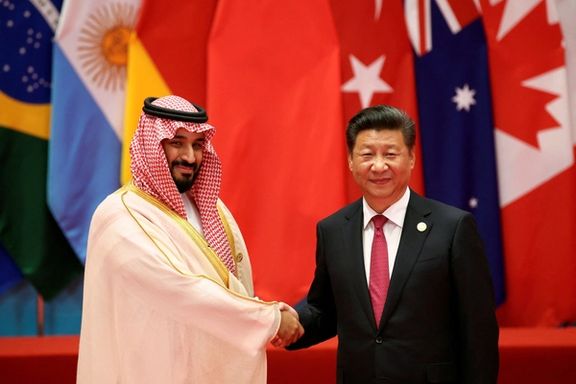
FILE PHOTO: Chinese President Xi Jinping with Saudi Arabia's Crown Prince Mohammed bin Salman during the G20 Summit in China September 4, 2016.

President Xi Jinping’s visit to Saudi Arabia, beginning Wednesday, marks China’s rising influence in the Middle East and the wider world.

Saudi official news agency SPA is calling Riyadh-Beijing relations a “strategic partnership” encompassing both rising trade and regional security, contrasting with United States officials portraying China as a threatening axis alongside Russia and bemoaning Saudi-Russian cooperation in agreeing oil production targets through Opec+.

Foreign Minister Wang Yi in October said Saudi Arabia was a “priority” for China. While this is due partly to supplying of 1.77 million barrels of Saudi oil a day (bpd) reaching Beijing in the first ten months of 2022 (18 percent of China’s total crude purchases), overall bilateral trade reached $87 billion in 2021 and China is keen to extend infrastructure investment in line with its 149-country Belt and Road Initiative (BRI).

Saudi Arabia’s plans to diversify away from oil and develop the $500-billion NEOM city in the north west are widely expected to offer significant opportunities for Chinese companies, who are already active in refining and petrochemicals.

Deeping ties with Saudi Arabia has not stopped Beijing continuing as Iran’s main oil buyer, taking between 500,000 and 1 million bpd this year, despite the threat of punitive action by Washington under the ‘maximum pressure’ Iran sanctions introduced in 2018. Both China and Saudi Arabia are uncomfortable by recent US assertions that its foreign policy is based on ‘human rights.’

China has a 25-year cooperation agreement with Iran, reached in 2021, but last month signed a 27-year liquid natural gas (LNG) supply deal with Qatar, which shares with Iran the world’s largest gas-field, the Qatari part known as North Dome and the Iranian part South Pars. Iran has struggled under US ‘maximum pressure’ to develop LNG facilities – the form of gas most suitable for export. French major Total, an LNG specialist, reluctantly pulled out 2018 from a contract to develop phase 11 of South Pars.

‘Leveraging rivalry’

Saudi Arabia, like China, seeks a transactional foreign policy. The Chinese are this week reportedly ready for $30 billion in arms contracts with Riyadh, reflecting Saudi Arabia’s position as the third largest defense spender in the world after the US and China. Riyadh bought 23 percent of all US weapons sold globally 2017-21, according to the Stockholm International Peace Research Institute.

Xi’s visit will also include an inaugural China-Arab Summit, which is expected to include leaders from the countries of the Gulf Cooperation Council and the wider Arab world, including Iraq.

Iran and Saudi Arabia despite a few rounds of exploratory talks still do not have diplomatic relation severed in early 2016. Tehran continues to label Riyadh as an enemy and periodically makes threats against the Sunni power, which considers Shia Iran a threat.

While some Persian Gulf observers continue to insist that nothing has diminished US sway in the region, John Calabrese of the Washington-based Middle East Institute in a briefing published Monday wrote that “Saudi Arabia and its Gulf Arab neighbors …situated both literally and figurately at the crossroads of intensifying global rivalry between US and China…seek to leverage [that rivalry] to their benefit.”


Most Viewed

US blockade enters murky phase as tankers spoof signals and buyers hesitate
1
ANALYSIS

US blockade enters murky phase as tankers spoof signals and buyers hesitate

2

US tightens financial squeeze on Iran, warns banks over oil money flows

3
INSIGHT

Ideology may be fading in Iran, but not in Kashmir's ‘Mini Iran'

4
INSIGHT

Hardliners push Hormuz ‘red line’ as US blockade tests Iran’s leverage

5
VOICES FROM IRAN

Hope and anger in Iran as fragile ceasefire persists

Banner
Banner

Spotlight

  • Hardliners push Hormuz ‘red line’ as US blockade tests Iran’s leverage
    INSIGHT

    Hardliners push Hormuz ‘red line’ as US blockade tests Iran’s leverage

  • Ideology may be fading in Iran, but not in Kashmir's ‘Mini Iran'
    INSIGHT

    Ideology may be fading in Iran, but not in Kashmir's ‘Mini Iran'

  • War damage amounts to $3,000 per Iranian, with blockade set to add to losses
    INSIGHT

    War damage amounts to $3,000 per Iranian, with blockade set to add to losses

  • Why the $100 billion Hormuz toll revenue is a myth
    ANALYSIS

    Why the $100 billion Hormuz toll revenue is a myth

  • US blockade targets Iran oil boom amid regional disruption
    ANALYSIS

    US blockade targets Iran oil boom amid regional disruption

  • Iran's digital economy battered by prolonged blackout
    INSIGHT

    Iran's digital economy battered by prolonged blackout

•
•
•

More Stories

Two Iranian Lawyers Call For Annulment Of Death Sentences For Protesters

Dec 6, 2022, 09:49 GMT+0

Two prominent Iranian lawyers have called for the unconditional release of all detained protesters and the cancellation of all convictions and sentences.

Nasrin Sotoudeh who is in prison and Mohammad Seifzadeh in a joint letter said revolutionary courts “do not have legal authority,” emphasizing that proceedings in such courts are not “fair and judges are not impartial.”

Hours before the publication of this letter Iran's Chief Justice Gholam-Hossein Mohseni Ejei said the death sentences for several protesters have been confirmed and will be executed soon.

The letter is one of the first reactions to the threatening statements made by the Chief Justice on Monday.

The two human rights lawyers also added that most of those arrested were “convicted in revolutionary courts…where they were deprived of the right to have an independent lawyer, and also due to lack of fair proceedings in the judiciary and the impartiality of the judges, the verdicts are completely invalid.”

Based on leaked briefing documents for senior officials from Fras News Agency, over 29,000 people have been arrested during nationwide protests against the regime following the death of Mahsa Amini.

None of the detained had the right to choose a lawyer, and a number of them have been tried and sentenced to death without access to a fair trial.

Government Frustrated Over Inability To Stop Exodus Of Iranians

Dec 5, 2022, 23:47 GMT+0
•
Iran International Newsroom

Amid nationwide protests, economic hardship and uncertainty about their future, more Iranians are emigrating, with Oman as a new favorite destination. 

The accelerating exodus is not limited to medical and engineering professionals anymore as many business owners have also started to transfer their businesses to nearby countries where trade transactions are easier, especially to the Persian Gulf littoral states. 

According to a recent article in the Tehran newspaper Arman Melli, during the past year about 30,000 personnel of different medical professions, including doctors, nurses, and paramedical technicians, have applied for Certificates of Good Standing with intent to immigrate to Oman. The paper claimed that within the last four years, 16,000 general practitioners have left the country. The high number of emigrations has become so alarming that the officials of medical organizations have warned of serious shortages of doctors in the near future. 

In April, Iran's Medical Council said about 4,000 doctors have applied for Certificates of Good Standing in the previous 12 months with the intent to leave the country. Council spokesman Reza Laripour said that the annual number of such applications was less than 600 between 2013 and 2015.

Head of the Medical Council of the Islamic Republic, Mohammad Raeeszadeh, said, "The medical community faces fundamental challenges in some specialties, so that we may not have graduates in some fields in the future.” He warned of the risk of regression to 40 years ago when it had to hire foreign doctors to meet domestic needs.

Head of the Medical Council of the Islamic Republic, Mohammad Raeeszadeh (file photo)
100%
Head of the Medical Council of the Islamic Republic, Mohammad Raeeszadeh

Lack of a promising future is the main reason why professionals decide to leave. Incomes have sharply declined in the past years as Iran’s currency has lost its value by more than tenfold, and the state seems to become more inept and arbitrary in governing the country.

On the backdrop of Iranian doctors emigrating in droves, the health ministry in September increased the exit permit bond for medical, dental and pharmacy students to $5,000 per year. Deputy minister for education at the health ministry, Abolfazl Bagherifard, said that students in graduate levels should provide 1.5 billion rials ($5,000) to leave the country for a year and undergraduate levels should provide bonds worth $2,000. Students must provide an official letter of commitment to return as well as another person's guarantee by depositing a real estate bond or a bank guarantee.

Experts and social scientists in Iran and abroad have told the media that the brain drain in the past few decades, beginning with the 1980-88 war with Iraq, has been accelerated by lack of social freedoms in the clerical-dominated system, political upheavals, deterioration of the economy, and government repression.

The government has stepped up pressures and restrictions on students and graduates. Late in November, the parliament presented a proposal to ban students who participate in protests from traveling abroad for ten years. Recently, the Ministry of Science Research and Technology has also approved regulations that would increase the costs of receiving university degrees six to 10 times. 

All Iranians who study in government universities must work about twice the duration of their studies for a state institution before they can get their certificates. If they opt out of working for the government, they should pay the cost of their education to get their document. As per recent regulations, the fees to get their degrees have increased up to 10-fold. 

However, even those measures are not enough to stop Iranians from leaving the country, with many families deciding to either send their children abroad before starting university or forgetting about getting a degree altogether. Ali Sharifi-Zarchi, a professor at Tehran’s Sharif University of Technology, believes that the new measures would even accelerate emigration, saying that the new fees mean that the government is urging students to forget about Iranian universities and study abroad where they can find a job and help pay for their expenses.

Almost half of Iranian youth want to leave the country amid pessimism about their future, a recent opinion survey conducted from abroad shows.

UN Rapporteur Wants Prosecutions Over Iran Human Rights

Dec 5, 2022, 17:58 GMT+0
•
Iran International Newsroom

In an Iran International interview Javaid Rehman has outlined his plans for a UN probe into an “unprecedented level of violence and state brutality in Iran.”

Rehman, the United Nations Special Rapporteur on Human Rights in Iran, said the “independent and international” fact-finding mission established by a UN Human Rights Council vote November 24 would focus on Iran’s high number of executions, including drug offenders, “the killing of children and ethnic minorities,” and establishing accountability of individuals.

Rahman said 21 people involved in protests had been indicted on crimes carrying the death sentence, and at least “15,000 protestors arrested.” He applauded the Human Rights Council for “listening to the Iranian people,” and explained that he would be working very closely with the investigation given his “expertise and knowledge.” Rehman, a Pakistani-British legal scholar based in London, has been special rapporteur since 2018 but, unlike a UN special rapporteur on the human-rights consequences of sanctions, has not been allowed to visit Iran.

The UN mission, which reportedly will have a $3.67 million budget and 15 staff, would collect and preserve evidence for future prosecutions, dismissing “mis-information” and using the experience of members, Rahman said. He envisaged a detailed report by February-March 2024 for the council’s 55th session.

Accountability for human rights violations would come, he told Iran International, through “future legal proceedings” in international courts and through cases in national courts on the principle of universal jurisdiction. “These individuals better be careful because we are going to hold them accountable in courts of law,” he said.

A screenshot of Javaid Rehman during the interview
100%
A screenshot of Javaid Rehman during the interview

National courts have been generally reluctant to apply universal jurisdiction, with the United States among those world powers most resistant to the principle. In recent instances a Swedish court in July sentenced to life imprisonment Hamid Nouri, a former Iranian official, over 1988 prison executions, and in January a German court jailed for life Anwar Raslan, a former Syrian intelligence office, for murder and rape of prisoners in Damascus. Rahman did not explain any potential role of the International Criminal Court, which has generally indicted Africans and which the US has refused to join, insisting for example it has no jurisdiction over US troops in Afghanistan.

‘Key principles’

In his interview with Iran International’s TV correspondent and host Sima Sabet, Rehman criticized the Iranian constitution, which he said “violates democratic norms, violates key principles of constitutionalism,” including a lack of separation of powers. He called the judiciary’s role “problematic” and said one of his “big concerns” was women being excluded from “serious political positions.”

Looking ahead to the work of the UN mission, the special rapporteur welcomed submissions from victims of violence, and also from journalists and their families receiving threats “in the UK, European and north American countries.”

“That is what the Islamic Republic is all about,” Rehman said. “It wants fear to be spread…The Islamic Republic of Iran wants a complete blackout of the news.” Rehman encouraged Iran International to “continue your excellent work.” He noted that in contacts with Iranian officials, they had accused him of “talking to terrorists” and “not being objective.”

Iran's Foreign Ministry Slams Western Criticism Over Human Rights

Dec 5, 2022, 13:42 GMT+0
•
Mardo Soghom

Iran’s foreign ministry reiterated Monday that ongoing protests in the country are an internal issue and others should not use the situation for political ends.

Ministry spokesman Nasser Kanaani in his weekly briefing on Monday lashed out at the United States and other Western countries for proposing to expel Iran from the UN Commission on the Status of Women.

US Vice President Kamala Harris said in early November that Washington will try to remove Iran from the 45-member CSW over the government's denial of women's rights and its brutal crackdown on protests. Some European countries have joined the effort as part of their reaction to Iran's mistreatment of women.

The Islamic Republic is just starting a four-year term on the commission, which meets annually every March and aims to promote gender equality and the empowerment of women.

Kanaani attributed all such attempts, including a UN Human Rights Council resolution passed last month calling for an investigation into Tehran’s violations during recent protests, as politically motivated actions by the West.

Iranian officials have been linking criticism of their human rights record to the stalled nuclear negotiations, trying to argue that any human rights censure is simply an attempt to put pressure on Tehran.

However, the unrest since mid-September and the deadly use of force against civilians has pushed the US, its European allies and Canada to unprecedented vocal criticism and limited new sanctions on the Islamic Republic.

The fact that protests started following the brutal killing of a 22-year-old woman arrested by the notorious ‘morality police’, and the leading role of young women in the ensuing protests, galvanized support not only in the West but also in other countries such as Turkey.

International criticism further weakens the clerical regime’s status inside the country because it comes as yet another sign of its isolation that has hurt the economy and impoverished tens of millions of its citizens.

This is why Kanaani on Monday tried to argue that criticism of Islamic Republic’s human rights record has not weakened its foreign relations. He claimed that Iranian foreign ministry and other officials are visiting different countries and receiving the appropriate reception.

He told reporters, “You follow news events and developments and are aware of various diplomatic trips of foreign ministry officials at different levels,” and the contacts of various typed with foreign governments.

In particular, he mentioned the recent regional travels by deputy foreign minister and nuclear negotiator Ali Bagheri-Kani to Russia, Qatar and India as a sign that the regime is not internationally isolated.

Kanaani also defended Iran’s bilateral relations with China, that has come under the spotlight of critics after Beijing signed a $60-billion gas deal with Qatar, while Iran’s production is decreasing due to lack of investments and technology.

Both countries share the same underwater gas reserves in the Persian Gulf, where Qatar has been expanding production in cooperation with Western oil giants, while Iran has lagged suffering from isolation.

“Islamic Republic’s ties with China constitute a relationship between that is growing,” he said, but admitted that US sanctions do pose limits om Tehran’s ability to broaden interactions with other countries.

France’s Macron Says Islamic Republic Has Told Many Lies

Dec 4, 2022, 19:15 GMT+0
•
Iran International Newsroom

French President Emmanuel Macron has denounced “lies” by Iranian authorities in face of the “unacceptable” imprisonment of French nationals.

The Islamic Republic is holding more than a dozen French and other Western citizens on trumped-up charges of espionage or working against its security.

Macron in an interview with Le Parisien said that after the arrest of some French nationals “a lot of lies have been told.”

He stated that some French compatriots went to Iran for academic or other reasons adding that “there is nothing that justifies their imprisonment, it is unacceptable in our view,” assuring that French diplomacy would continue to “fight to free them.”

The Islamic Republic has detained at least seven French nationals on different charges including “spying for foreign intelligence services.”

Human rights organizations accuse Iran of a systematic policy of hostage taking over four decades from the earliest period of the Islamic republic after the ouster of the Shah, starting with the 1979-1981 siege at the US embassy in Tehran.

Iranian students attack the US Embassy in Tehran (November 4, 1979)
100%
Iranian students attack the US Embassy in Tehran (November 4, 1979)

Tehran denies any policy of hostage taking and insists all foreigners are arrested and tried according to legal processes, while all such trials are held without transparency and due process. In addition, it has frequently shown readiness for prisoner exchanges and participated in swaps in the past.

In another part of his interview Macron said “I put very firm pressure on the Iranian president so that their rights are respected and that consular visits are possible. But above all, that we see them released as soon as possible.”

In early October, France accused the Iranian regime of “dictatorial practices” after Iran’s state TV aired the forced confessions of two French nationals arrested by the clerical-military government controlled by its 83-year-old anti-Western ruler, Ali Khamenei.

In the video of the forced confessions, one of the two French nationals - Cecile Kohler - said they were in Iran to “prepare the ground for the revolution and the overthrow of the regime of Islamic Iran.”

Iran’s state media are infamous for purported confessions by prisoners in politically charged cases. Such prisoners are held without due process of law and usually cannot choose their own defense attorney.

Deadly government violence against protesters in Iran has triggered a wave of tough criticism in the West in recent weeks. Germany and France, two powers are also signatories of the 2015 nuclear deal with Iran have adopted a strong stance against Tehran’s human rights violations.

Tensions mounted further between Tehran and Paris after Iran summoned the French ambassador November 30 over comments made by the country’s foreign minister in the National Assembly against the Islamic Republic.

Nicolas Roche was summoned to Iran’s Foreign Ministry over what Tehran called “unacceptable” remarks by Catherine Colonna which led to approval of a resolution in the assembly on human rights violations in Iran.

On November 28, the French National Assembly unanimously adopted a resolution offering “support for the Iranian people” and condemning the restriction of women's freedoms and rights.

President Emmanuel Macron's Renaissance party deputy Hadrien Ghomi, himself a descendant of Iranian immigrants, said the 149 votes in favor of the motion in the National Assembly “sent a strong message” to the world. The resolution condemns in the "strongest terms the brutal and widespread repression" against "non-violent demonstrators".