• العربية
  • فارسی
Brand
  • Iran Insight
  • Politics
  • Economy
  • Analysis
  • Special Report
  • Opinion
  • Podcast
  • Iran Insight
  • Politics
  • Economy
  • Analysis
  • Special Report
  • Opinion
  • Podcast
  • Theme
  • Language
    • العربية
    • فارسی
  • Iran Insight
  • Politics
  • Economy
  • Analysis
  • Special Report
  • Opinion
  • Podcast
All rights reserved for Volant Media UK Limited
volant media logo

France’s Macron Says Islamic Republic Has Told Many Lies
Iran International Newsroom
Dec 4, 2022, 19:15 GMT+0Updated: 17:41 GMT+1
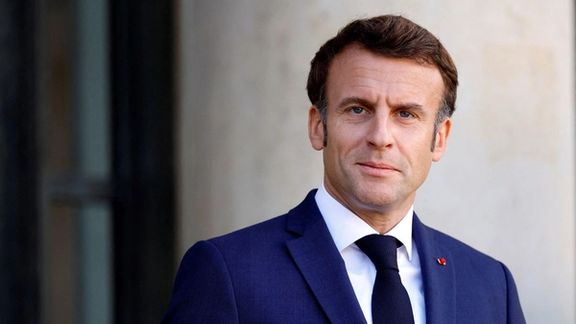
French President Emmanuel Macron

French President Emmanuel Macron has denounced “lies” by Iranian authorities in face of the “unacceptable” imprisonment of French nationals.

The Islamic Republic is holding more than a dozen French and other Western citizens on trumped-up charges of espionage or working against its security.

Macron in an interview with Le Parisien said that after the arrest of some French nationals “a lot of lies have been told.”

He stated that some French compatriots went to Iran for academic or other reasons adding that “there is nothing that justifies their imprisonment, it is unacceptable in our view,” assuring that French diplomacy would continue to “fight to free them.”

The Islamic Republic has detained at least seven French nationals on different charges including “spying for foreign intelligence services.”

Human rights organizations accuse Iran of a systematic policy of hostage taking over four decades from the earliest period of the Islamic republic after the ouster of the Shah, starting with the 1979-1981 siege at the US embassy in Tehran.

Iranian students attack the US Embassy in Tehran (November 4, 1979)
100%
Iranian students attack the US Embassy in Tehran (November 4, 1979)

Tehran denies any policy of hostage taking and insists all foreigners are arrested and tried according to legal processes, while all such trials are held without transparency and due process. In addition, it has frequently shown readiness for prisoner exchanges and participated in swaps in the past.

In another part of his interview Macron said “I put very firm pressure on the Iranian president so that their rights are respected and that consular visits are possible. But above all, that we see them released as soon as possible.”

In early October, France accused the Iranian regime of “dictatorial practices” after Iran’s state TV aired the forced confessions of two French nationals arrested by the clerical-military government controlled by its 83-year-old anti-Western ruler, Ali Khamenei.

In the video of the forced confessions, one of the two French nationals - Cecile Kohler - said they were in Iran to “prepare the ground for the revolution and the overthrow of the regime of Islamic Iran.”

Iran’s state media are infamous for purported confessions by prisoners in politically charged cases. Such prisoners are held without due process of law and usually cannot choose their own defense attorney.

Deadly government violence against protesters in Iran has triggered a wave of tough criticism in the West in recent weeks. Germany and France, two powers are also signatories of the 2015 nuclear deal with Iran have adopted a strong stance against Tehran’s human rights violations.

Tensions mounted further between Tehran and Paris after Iran summoned the French ambassador November 30 over comments made by the country’s foreign minister in the National Assembly against the Islamic Republic.

Nicolas Roche was summoned to Iran’s Foreign Ministry over what Tehran called “unacceptable” remarks by Catherine Colonna which led to approval of a resolution in the assembly on human rights violations in Iran.

On November 28, the French National Assembly unanimously adopted a resolution offering “support for the Iranian people” and condemning the restriction of women's freedoms and rights.

President Emmanuel Macron's Renaissance party deputy Hadrien Ghomi, himself a descendant of Iranian immigrants, said the 149 votes in favor of the motion in the National Assembly “sent a strong message” to the world. The resolution condemns in the "strongest terms the brutal and widespread repression" against "non-violent demonstrators".


Most Viewed

State media slam Araghchi's Hormuz tweet, say it let Trump claim victory
1

State media slam Araghchi's Hormuz tweet, say it let Trump claim victory

2

Iran International says it won’t be silenced after London arson attack

3
INSIGHT

How Tehran bends its own red lines to boost state rallies

4
OPINION

The Hormuz get out of jail card turned to a grave

5

Iran halts petrochemical exports to supply domestic market

Banner
Banner

Spotlight

  • Too early to tell who is winning Iran war, experts say
    PODCAST

    Too early to tell who is winning Iran war, experts say

  • How Tehran bends its own red lines to boost state rallies
    INSIGHT

    How Tehran bends its own red lines to boost state rallies

  • Iran blackout cripples freelancer, small business incomes
    VOICES FROM IRAN

    Iran blackout cripples freelancer, small business incomes

  • Ideology may be fading in Iran, but not in Kashmir's ‘Mini Iran'
    INSIGHT

    Ideology may be fading in Iran, but not in Kashmir's ‘Mini Iran'

  • US blockade enters murky phase as tankers spoof signals and buyers hesitate
    ANALYSIS

    US blockade enters murky phase as tankers spoof signals and buyers hesitate

  • Why the $100 billion Hormuz toll revenue is a myth
    ANALYSIS

    Why the $100 billion Hormuz toll revenue is a myth

•
•
•

More Stories

Taliban ‘Real Disaster’, But Tehran Must Side with Them: Iran Envoy

Dec 4, 2022, 08:58 GMT+0

Iran's ambassador to Afghanistan believes that the Taliban group is a disaster for Afghanistan, the region and the world, but Iran has no choice but to use this opportunity “to civilize them.”

The comments by Bahador Aminian were published after the hacktivist group Black Reward got access to IRGC-affiliated Fars News Agency database last month.

However, Iran’s embassy in Kabul denied the statements and described it as a conspiracy to create crisis in the region.

After explaining the nature of the Taliban as well as the problems the Islamic Republic has with the group, the Iranian ambassador is quoted as saying, “We have no choice but to side with the Taliban and make use of them.”

He believes that the Taliban, despite having fought against the United States for two decades, are not anti-American, and if the Islamic Republic is slow to move, “the Americans can easily seize them.”

In another part of the file, Aminian says he is worried that Supreme Leader Ali Khamenei has the fewest followers in Afghanistan and “most of the Shias in Afghanistan are followers of Ayatollah Sistani and others.”

Aminian also talks about the water dispute between Tehran and Kabul, saying that the Taliban have said, “We must not give even a drop of water to Iran”.

Iran has been accusing Afghanistan of holding the water from the Hirmand River by constructing a series of dams.

He also states that generally Iranians’ view of Afghans is a racist and humiliating one.

With Iran ‘In Discord,’ DC Think-Tank Wants New Ideas

Dec 3, 2022, 17:28 GMT+0

The Atlantic Council, a leading Washington think-tank, this week announced a new forum to debate the future of Iran and offer policy recommendations.

In a press release December 2, the council said the ‘Iran Strategy Project’ reflected “the unprecedented level of discord and uncertainty in Iran” and was “driven by recent events,” including the “women-led Iranian social movement demanding freedom and autonomy, the near-term potential for a new Supreme Leader, Iran’s evolving role in the region…and the likely end of the Joint Comprehensive Plan of Action (JCPOA).”

The council described the JCPOA – the 2015 Iran nuclear deal, which the US left in 2018 – as “the prism through which US and European policy toward Iran has been based for much of the past decade.”

Founded in 1961, the Atlantic Council stands broadly for a close relationship with Europe and a philosophy of ‘Atlanticism.’ This put it at odds with former president Donald Trump, who ignored European objections in withdrawing the US from the JCPOA and unleashing ‘maximum pressure’ sanctions against Iran. Former journalist Barbara Slavin, who led the Atlantic Council’s work on Iran and will shortly leave, was a prominent advocate of the JCPOA.

While President Joe Biden came to office in 2021 committed to reviving the JCPOA, 18-months of multilateral and bilateral talks saw Washington and Tehran failing to agree how to restore the 2015 agreement, leaving draconian sanctions in place and the Iranian nuclear program expanding. Recent protests in Iran, and Tehran’s military cooperation with Russia, have emboldened enthusiasts of ‘maximum pressure’ and put JCPOA supporters on the back foot.

The ‘Iran Strategy Project’ leader Jonathan Panikoff, a former US intelligence officer
100%
The ‘Iran Strategy Project’ leader Jonathan Panikoff, a former US intelligence officer

The ‘Iran Strategy Project’ will be led by Jonathan Panikoff, a former US intelligence officer, with an advisory board including General Frank McKenzie, former US commander in the Middle East, Michael Morell, former deputy director of the Central Intelligence Agency, and Stuart Levey, a banker who as US Treasury undersecretary 2004-11 was a major architect of the current sanctions regime.

Taking a ‘holistic look’

Also on the board will be Sanam Vakil of the Middle East and North Africa program at Chatham House, London, Rob Macaire, British ambassador to Iran 2018-21, Ladan Boroumand, founder of the Washington-based Boroumand Centre, and Marjan Keypour, director of the Alliance for Rights of Minorities and active supporter of Israel.

Panikoff said the project would take “a holistic look” at all issues relating to Iran – “political, human rights, security, economic, nuclear, social, and natural resources” – and that it would offer a “forum for experts across the political spectrum, and with varying functional expertise, to discuss and debate the future of Iran, and to provide concrete strategic options for policymakers.”

The choice of advisory board suggests the Iran Strategy Project will look to balance an appraisal of US security interests with wider concerns. Its work is likely to be relatively dispassionate, even if this is hard given the passionate nature of debates over Iran. The Atlantic Council has substantial funding, including from the United Arab Emirates, the United Kingdom, Saudi-Lebanese billionaire Bahaa Hariri, the Rockerfeller Foundation, and Facebook.

US Envoy Slammed For Wearing Hijab In Meeting With Hezbollah Supporters

Dec 3, 2022, 11:42 GMT+0

Critics say the US ambassador in Lebanon was wrong to wear a headscarf in a meeting with Hezbollah supporters and her move weakens US support for protesting women in Iran.

Lebanese media have recently published a photo of Dorothy Shea wearing hijab during a meeting with Lebanon’s Higher Shia Islamic Council members.

One senior diplomatic source told the Washington Free Beacon that the act undermines Washington’s efforts to support Iranian protesters who are against the clerical regime.

Hezbollah is backed by Iranian regime to expand its military and ideological influence in the region.

The images raised eyebrows among some officials in the State Department. Iranian-American groups have also expressed shock over the photos of the US diplomat in a headscarf.

“What message does this send to them in this unspoken, yet highly symbolic act of submission by a US ambassador who takes on the very appearance of the oppressors? I understand that as diplomats we are supposed to be sensitive to the culture in which we work, but sometimes, events take priority,” a senior State Department official told Washington Free Beacon.

“Shame on Shea for wearing a headscarf at Lebanon's request—who we all know take their orders from Tehran as Iranian women are being killed for their courageous actions of saying no to mandatory hijab," Bryan Leib, executive director of advocacy group Iranian-Americans for Liberty, told Washington Free Beacon.

Tehran Asks Moscow For Help To Suppress Protests - Sources

Dec 3, 2022, 08:55 GMT+0
•
Iran International Newsroom

The Islamic Republic has asked Russia for help to quell the popular uprising by supplying anti-riot equipment and training, Iran International has learned.

The Iranian regime has asked Moscow to dispatch advisors as it is preparing for a long-term confrontation with protesters and concerned about its limited resources both in manpower and equipment.

Secret files recently obtained by hackers and shared with Iran International also shows that Tehran is relying on information from Moscow to assess its own internal situation. There are references in the documents that Russia is eavesdropping on Western communications to give Tehran assessments about the nature and strength of the protest movement.

The new information about Tehran asking Moscow’s help confirmed remarks late in October by the White House that Russia may be advising Tehran on optimal methods to suppress the ongoing protests.

White House press secretary Karine Jean-Pierre said during a joint press briefing with Coordinator for Strategic Communications at the National Security Council in the White House John Kirby that Moscow may be helping the Islamic Republic, drawing on its own experience in suppressing demonstrations.

"The evidence that Iran is helping Russia rage its war against Ukraine is clear and it is public. Iran and Russia are growing closer the more isolated they become," Jean-Pierre said. "Our message to Iran is very, very clear: Stop killing your people and stop sending weapons to Russia to kill Ukrainians."

Iran's riot police ready for action in Tehran in early October 2022
100%
Iran's riot police ready for action in Tehran in early October 2022

Kirby said that the White House is certain about Russia’s help in the crackdown on protesters, adding that it is not an allegation but a fact. “We know they may be considering some sort of support to Iran’s ability to crack down on protesters. And sadly, Russia has experience at doing that,” he said.

Kirby called it “just yet another example of Russia and Iran now working together to violate the — not only the human rights and civil rights of people in Iran but, of course, put in further danger the lives of Ukrainians.”

The growing outcry against Iran’s brutal crackdown on anti-government protests ignited by the beating to death of Mahsa Amini that has led to about 470 other killings has now been magnified by the Islamic Republic’s tilt toward Russia and arms support for its invasion of Ukraine.

It has already caused a policy shift in Washington as the Biden administration has said that the revival of the 2015 Joint Comprehensive Plan of Action (JCPOA) is not a priority at present and that the US focus is on the protests in Iran. US Special Envoy for Iran Robert Malley said earlier in the week that President Joe Biden is prepared for a military option to prevent Iran from acquiring a nuclear weapon in case sanctions and diplomacy fail.

A senior Revolutionary Guard commander Saturday told Iran International that the IRGC's chief commanders have called up 1,000 retired members to help quell the popular uprising as they don't have enough forces, but only 300 accepted to return to service and crack down on protests.

Earlier in the week, an audio file obtained by the hacktivist group, Black Reward, revealed concerns among Iranian officials about their worn-out security forces, media failures and labor strikes.

Black Reward found access to Fars News Agency’s data servers in recent days providing Iran International with an audio tape of a meeting between a Revolutionary Guard general and a group of media managers or representatives from outfits affiliated with the IRGC.

About 18,000 people have been arrested since the beginning of the protests, and some death sentences have already been issued for the protesters, though none have been carried out. According to Norway-based HRANA on December 2, 469 protestors and 61 members of the security forces have been killed in protests since September 17.

Iran Oil Cargo Previously Seized By US Unloads In Syria

Dec 2, 2022, 21:26 GMT+0

An Iranian-flagged tanker, which the US had previously confiscated around Greece, has unloaded its oil cargo in Syria. 

A ship tracker said on Friday that Lana delivered an oil shipment of around 700,000 barrels in the Syrian port of Banias, ending months of uncertainty about the cargo. 

The seizure from the Lana prompted Iranian forces in May to seize two Greek tankers in the Persian Gulf which were released on November 16. 

Claire Jungman, the chief of staff with US advocacy group United Against Nuclear Iran (UANI), which monitors Iran-related tanker traffic through ship and satellite tracking, said Iran's shipments to Damascus "are regarded as a way of strengthening the country's regional position and are also a major part of the regime's survival strategy". 

The Lana's last reported position on November 20 was anchored off Syria's coast, according to ship tracking on Eikon. The ship, previously called Pegas and renamed Lana in March, had reported an engine problem in April. It was headed to the southern Peloponnese peninsula to offload its cargo on to another tanker but rough seas forced it to moor just off Karystos where it was seized, according to the Athens News Agency.

Syria is undergoing severe fuel rationing as a response to shortages, leading to rolling cuts in the electricity and telecoms sectors. According to UANI analysis, Syria received 1.39 million barrels in shipments from Iran in November, down from 3.5 million barrels in October and 3.7 million barrels in September. 

For over two months, the Lana remained under arrest off the Greek island of Evia. It was tugged to Piraeus following court orders that allowed its release.