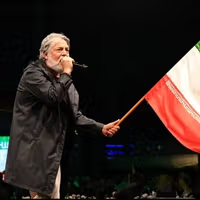
Iran’s foreign ministry reiterated Monday that ongoing protests in the country are an internal issue and others should not use the situation for political ends.
Ministry spokesman Nasser Kanaani in his weekly briefing on Monday lashed out at the United States and other Western countries for proposing to expel Iran from the UN Commission on the Status of Women.
US Vice President Kamala Harris said in early November that Washington will try to remove Iran from the 45-member CSW over the government's denial of women's rights and its brutal crackdown on protests. Some European countries have joined the effort as part of their reaction to Iran's mistreatment of women.
The Islamic Republic is just starting a four-year term on the commission, which meets annually every March and aims to promote gender equality and the empowerment of women.
Kanaani attributed all such attempts, including a UN Human Rights Council resolutionpassed last month calling for an investigation into Tehran’s violations during recent protests, as politically motivated actions by the West.
Iranian officials have been linking criticism of their human rights record to the stalled nuclear negotiations, trying to argue that any human rights censure is simply an attempt to put pressure on Tehran.
However, the unrest since mid-September and the deadly use of force against civilians has pushed the US, its European allies and Canada to unprecedented vocal criticism and limited new sanctions on the Islamic Republic.
The fact that protests started following the brutal killing of a 22-year-old woman arrested by the notorious ‘morality police’, and the leading role of young women in the ensuing protests, galvanized support not only in the West but also in other countries such as Turkey.
International criticism further weakens the clerical regime’s status inside the country because it comes as yet another sign of its isolation that has hurt the economy and impoverished tens of millions of its citizens.
This is why Kanaani on Monday tried to argue that criticism of Islamic Republic’s human rights record has not weakened its foreign relations. He claimed that Iranian foreign ministry and other officials are visiting different countries and receiving the appropriate reception.
He told reporters, “You follow news events and developments and are aware of various diplomatic trips of foreign ministry officials at different levels,” and the contacts of various typed with foreign governments.
In particular, he mentioned the recent regional travels by deputy foreign minister and nuclear negotiator Ali Bagheri-Kani to Russia, Qatar and India as a sign that the regime is not internationally isolated.
Kanaani also defended Iran’s bilateral relations with China, that has come under the spotlight of critics after Beijing signed a $60-billion gas deal with Qatar, while Iran’s production is decreasing due to lack of investments and technology.
Both countries share the same underwater gas reserves in the Persian Gulf, where Qatar has been expanding production in cooperation with Western oil giants, while Iran has lagged suffering from isolation.
“Islamic Republic’s ties with China constitute a relationship between that is growing,” he said, but admitted that US sanctions do pose limits om Tehran’s ability to broaden interactions with other countries.
French President Emmanuel Macron has denounced “lies” by Iranian authorities in face of the “unacceptable” imprisonment of French nationals.
The Islamic Republic is holding more than a dozen French and other Western citizens on trumped-up charges of espionage or working against its security.
He stated that some French compatriots went to Iran for academic or other reasons adding that “there is nothing that justifies their imprisonment, it is unacceptable in our view,” assuring that French diplomacy would continue to “fight to free them.”
The Islamic Republic has detained at least seven French nationals on different charges including “spying for foreign intelligence services.”
Human rights organizations accuse Iran of a systematic policy of hostage taking over four decades from the earliest period of the Islamic republic after the ouster of the Shah, starting with the 1979-1981 siege at the US embassy in Tehran.
Iranian students attack the US Embassy in Tehran (November 4, 1979)
Tehran denies any policy of hostage taking and insists all foreigners are arrested and tried according to legal processes, while all such trials are held without transparency and due process. In addition, it has frequently shown readiness for prisoner exchanges and participated in swaps in the past.
In another part of his interview Macron said “I put very firm pressure on the Iranian president so that their rights are respected and that consular visits are possible. But above all, that we see them released as soon as possible.”
In early October, France accused the Iranian regime of “dictatorial practices” after Iran’s state TV aired the forced confessions of two French nationals arrested by the clerical-military government controlled by its 83-year-old anti-Western ruler, Ali Khamenei.
In the video of the forced confessions, one of the two French nationals - Cecile Kohler - said they were in Iran to “prepare the ground for the revolution and the overthrow of the regime of Islamic Iran.”
Iran’s state media are infamous for purported confessions by prisoners in politically charged cases. Such prisoners are held without due process of law and usually cannot choose their own defense attorney.
Deadly government violence against protesters in Iran has triggered a wave of tough criticism in the West in recent weeks. Germany and France, two powers are also signatories of the 2015 nuclear deal with Iran have adopted a strong stance against Tehran’s human rights violations.
Tensions mounted further between Tehran and Paris after Iran summoned the French ambassador November 30 over comments made by the country’s foreign minister in the National Assembly against the Islamic Republic.
Nicolas Roche was summoned to Iran’s Foreign Ministry over what Tehran called “unacceptable” remarks by Catherine Colonna which led to approval of a resolution in the assembly on human rights violations in Iran.
On November 28, the French National Assembly unanimously adopted a resolution offering “support for the Iranian people” and condemning the restriction of women's freedoms and rights.
President Emmanuel Macron's Renaissance party deputy Hadrien Ghomi, himself a descendant of Iranian immigrants, said the 149 votes in favor of the motion in the National Assembly “sent a strong message” to the world. The resolution condemns in the "strongest terms the brutal and widespread repression" against "non-violent demonstrators".
A group of actors in Tehran in November showing their solidarity with women against forced hijab
A member of the Committee to Follow up on Situation of Arrested Artists says at least 40 filmmakers have been detained during the national uprising against the Islamic Republic.
In an interview with Shargh daily on Saturday, Mehdi Kouhian said around 150 cinema figures have been summoned, arrested, accused, banned from leaving the country or persecuted in various ways by the regime during the recent protests.
He added that most of the detainees are "lesser-known figures whose families have not announced their names yet.”
To protect their privacy, said Kouhian, as long as their families do not reveal their identities, “we will not release the names of the incarcerated artists.”
According to Kouhian, the members of the committee met November 30 with one of the judiciary officials to call for the release of the arrested, and the official was also “very optimistic that the current situation will change, but within the past few days, another artist was apprehended.”
Kouhian was talking about famous cinema star Mitra Hajjar who was arrested for some hours recently.
Previously, Katayoun Riahi and Hengameh Qaziani, two other actresses, were arrested after posting their pictures without the mandatory hijab in solidarity with women who have been leading the antigovernment protests. However, they were later released on bail.
Toomaj Salehi and Emad Qavidel, the rap singers as well as some other directors and actors like Soheila Golestani and Hamid Pour Azari are still in custody.
Iranian envoy Bahador Aminian meeting with a Taliban leader. Undated
Iran's ambassador to Afghanistan believes that the Taliban group is a disaster for Afghanistan, the region and the world, but Iran has no choice but to use this opportunity “to civilize them.”
The comments by Bahador Aminian were published after the hacktivist group Black Reward got access to IRGC-affiliated Fars News Agency database last month.
However, Iran’s embassy in Kabul denied the statements and described it as a conspiracy to create crisis in the region.
After explaining the nature of the Taliban as well as the problems the Islamic Republic has with the group, the Iranian ambassador is quoted as saying, “We have no choice but to side with the Taliban and make use of them.”
He believes that the Taliban, despite having fought against the United States for two decades, are not anti-American, and if the Islamic Republic is slow to move, “the Americans can easily seize them.”
In another part of the file, Aminian says he is worried that Supreme Leader Ali Khamenei has the fewest followers in Afghanistan and “most of the Shias in Afghanistan are followers of Ayatollah Sistani and others.”
Aminian also talks about the water dispute between Tehran and Kabul, saying that the Taliban have said, “We must not give even a drop of water to Iran”.
Iran has been accusing Afghanistan of holding the water from the Hirmand River by constructing a series of dams.
He also states that generally Iranians’ view of Afghans is a racist and humiliating one.
Iran's prosecutor general Mohammad Jafar Mointazeri
Iran's Prosecutor General says although he has always supported limiting access to the Internet, he has concluded that this kind of censorship is not effective.
"We shut down one VPN today and immediately it is replaced by another one supplied by foreign countries." He added that "The only solution is shutting down the Internet completely, which is neither possible, nor the officials want this to happen."
Although he blamed foreign countries for providing VPNs, it is local businesses, most controlled by people close to the regime who sell the software.
Montazeri said he has been criticized by Internet users for insisting on blocking websites and application, but previous government disobeyed Supreme Leader Ali Khamenei's order about strictly controlling the Internet.
He made the comment mindless of the fact that one of President Ebrahim Raisi’s main promises in the 2021 presidential election was giving access to high-speed Internet to all Iranians in a bid to boost business.
Montazeri said that “enemies” have tried all sorts of campaigns against the Islamic Republic during the past four decades. Today, he said, they have resorted to a hybrid war.
The term has become a buzz word of Iranian officials and military commanders who have been repeating Khamenei's words probably without fully understanding it. Montazeri added that "the main perpetrators of this hybrid war are Israelis, Americans, Germans and the French."
He explained that this hybrid war consists of political cyber campaigns, fake news and diplomatic actions, adding that Khamenei had particularly warned about the cultural aspect of this war many years ago, but officials did not take his warning seriously.
A report published by proreform Fararu news website indicated that up to 10 million Iranians' livelihood may be adversely affected by government’s Internet access denials and its ban on social media platfoems. This has prevented Internet-based businesses from marketing and selling their products and services. Economists told Fararu that the limitation will have alarming repercussions for Iran's economy while the country is suffering from high inflation and recession.
Fararu added that only during the past two months while the protests were raging on, Iranians lost up to 300 thousand jobs as a result of the restrictions imposed on the Internet. Some 53 percent of Internet-related businesses have been losing some 500 million rials ($1,500) per day each. According to the trade union of computer-based businesses, Instagram has a penetration rate of 80 percent in the market with some 3.5 million jobs depending on the platform.
Economist Ehsan Soltani warned that "the officials do not want to listen to this problem. They do not realize that filtering and slowing down the Internet will add to economic problems. They keep adding to the country's problems by insisting on their mistakes."
The government has been severely restricting Internet access in general and access to popular social media platforms, such as Instagram, that play a key role in e-commerce. The government is extremely nervous that people use the Internet and social media to share news and images about protests, possibly motivating a larger segment of the population to join demonstrations.
Earlier this year, several US lawmakers and former US official Victoria Coates, who served as senior advisor to the energy secretary in the Trump administration, called on entrepreneur Elon Musk to activate Starlink satellite access for Iranians. Reports on social media during September and October saidthat private entities have smuggled Starlink reception equipment into Iran. But there is still no substantial indication how widespread Starlink’s use is.
Photo showing seized ammunition and propellants by US Navy. Dec. 3, 2022
The US Navy has intercepted a fishing trawler smuggling over 50 tons of ammunition, fuses and propellants for rockets in the Gulf of Oman on its way from Iran to Yemen.
The Bahrain-based United States Fifth Fleet said in a statement Saturdaythat it was the “second major illegal weapons seizure within a month" along the maritime route.
“This significant interdiction clearly shows that Iran’s unlawful transfer of lethal aid and destabilizing behavior continues,” said Vice Adm. Brad Cooper, commander of US Naval Forces Central Command.
“US naval forces remain focused on deterring and disrupting dangerous and irresponsible maritime activity in the region,” he underlined.
The statement also said that the fishing trawler, intercepted Thursday, was transporting “nearly 7,000 rocket fuses and over 2,100 kilograms of propellant used to launch rocket propelled grenades.”
“The direct or indirect supply, sale or transfer of weapons to the Houthis in Yemen violates UN Security Council Resolution 2216 and international law,” added the statement.
Last month the US navy said it had scuttled a vessel carrying “explosive materials” from Iran to supply the Houthis, with enough power to fuel a dozen ballistic rockets.
The Houthis receive military and political support from Iran in their conflict with other Yemenis, who have been backed by a Saudi-led coalition since 2014. Iran has been sharing its missile and drone technology with Yemen’s Houthis and has also supplied other proxy forces, such as the Lebanese Hezbollah and Iraqi Shiite militias.