• العربية
  • فارسی
Brand
  • Iran Insight
  • Politics
  • Economy
  • Analysis
  • Special Report
  • Opinion
  • Podcast
  • Iran Insight
  • Politics
  • Economy
  • Analysis
  • Special Report
  • Opinion
  • Podcast
  • Theme
  • Language
    • العربية
    • فارسی
  • Iran Insight
  • Politics
  • Economy
  • Analysis
  • Special Report
  • Opinion
  • Podcast
All rights reserved for Volant Media UK Limited
volant media logo

Prosecutor Says Total Internet Shutdown In Iran Is Impossible
Iran International Newsroom
Dec 3, 2022, 20:31 GMT+0Updated: 17:55 GMT+1
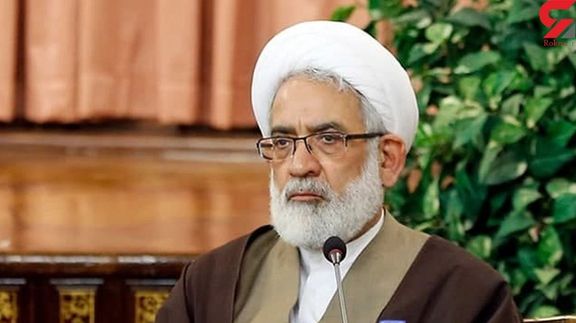
Iran's prosecutor general Mohammad Jafar Mointazeri

Iran's Prosecutor General says although he has always supported limiting access to the Internet, he has concluded that this kind of censorship is not effective.

Mohammad Jafar Montazeri said while explaining what he called "the hybrid war in recent riots, "December 1 that Iranians use various Virtual Private Networks (VPN) to circumvent government Internet filters.

"We shut down one VPN today and immediately it is replaced by another one supplied by foreign countries." He added that "The only solution is shutting down the Internet completely, which is neither possible, nor the officials want this to happen."

Although he blamed foreign countries for providing VPNs, it is local businesses, most controlled by people close to the regime who sell the software.

Montazeri said he has been criticized by Internet users for insisting on blocking websites and application, but previous government disobeyed Supreme Leader Ali Khamenei's order about strictly controlling the Internet.

He made the comment mindless of the fact that one of President Ebrahim Raisi’s main promises in the 2021 presidential election was giving access to high-speed Internet to all Iranians in a bid to boost business.

Montazeri said that “enemies” have tried all sorts of campaigns against the Islamic Republic during the past four decades. Today, he said, they have resorted to a hybrid war.

The term has become a buzz word of Iranian officials and military commanders who have been repeating Khamenei's words probably without fully understanding it. Montazeri added that "the main perpetrators of this hybrid war are Israelis, Americans, Germans and the French."

He explained that this hybrid war consists of political cyber campaigns, fake news and diplomatic actions, adding that Khamenei had particularly warned about the cultural aspect of this war many years ago, but officials did not take his warning seriously.

A report published by proreform Fararu news website indicated that up to 10 million Iranians' livelihood may be adversely affected by government’s Internet access denials and its ban on social media platfoems. This has prevented Internet-based businesses from marketing and selling their products and services. Economists told Fararu that the limitation will have alarming repercussions for Iran's economy while the country is suffering from high inflation and recession.

Fararu added that only during the past two months while the protests were raging on, Iranians lost up to 300 thousand jobs as a result of the restrictions imposed on the Internet. Some 53 percent of Internet-related businesses have been losing some 500 million rials ($1,500) per day each. According to the trade union of computer-based businesses, Instagram has a penetration rate of 80 percent in the market with some 3.5 million jobs depending on the platform.

Economist Ehsan Soltani warned that "the officials do not want to listen to this problem. They do not realize that filtering and slowing down the Internet will add to economic problems. They keep adding to the country's problems by insisting on their mistakes."

The government has been severely restricting Internet access in general and access to popular social media platforms, such as Instagram, that play a key role in e-commerce. The government is extremely nervous that people use the Internet and social media to share news and images about protests, possibly motivating a larger segment of the population to join demonstrations.

Earlier this year, several US lawmakers and former US official Victoria Coates, who served as senior advisor to the energy secretary in the Trump administration, called on entrepreneur Elon Musk to activate Starlink satellite access for Iranians. Reports on social media during September and October said that private entities have smuggled Starlink reception equipment into Iran. But there is still no substantial indication how widespread Starlink’s use is.


Most Viewed

Ghalibaf defends Iran-US talks amid hardline backlash
1
INSIGHT

Ghalibaf defends Iran-US talks amid hardline backlash

2
ANALYSIS

From instability to influence: Pakistan’s pivotal role in US-Iran diplomacy

3
ANALYSIS

100 days on: why Iran’s January protests spread across social classes

4

War-hit homeowners feel abandoned as Iran’s reconstruction aid fades

5
INSIGHT

100 days on: the anatomy of Iran’s January crackdown

Banner
Banner

Spotlight

  • Bread shortages, soaring prices strain households in Iran, residents say
    VOICES FROM IRAN

    Bread shortages, soaring prices strain households in Iran, residents say

  • War-hit homeowners feel abandoned as Iran’s reconstruction aid fades

    War-hit homeowners feel abandoned as Iran’s reconstruction aid fades

  • 100 days on: the anatomy of Iran’s January crackdown
    INSIGHT

    100 days on: the anatomy of Iran’s January crackdown

  • Ghalibaf defends Iran-US talks amid hardline backlash
    INSIGHT

    Ghalibaf defends Iran-US talks amid hardline backlash

  • 100 days on: why Iran’s January protests spread across social classes
    ANALYSIS

    100 days on: why Iran’s January protests spread across social classes

  • From instability to influence: Pakistan’s pivotal role in US-Iran diplomacy
    ANALYSIS

    From instability to influence: Pakistan’s pivotal role in US-Iran diplomacy

•
•
•

More Stories

US Intercepts Vessel Smuggling Ammunition From Iran To Yemen

Dec 3, 2022, 19:53 GMT+0

The US Navy has intercepted a fishing trawler smuggling over 50 tons of ammunition, fuses and propellants for rockets in the Gulf of Oman on its way from Iran to Yemen.

The Bahrain-based United States Fifth Fleet said in a statement Saturday that it was the “second major illegal weapons seizure within a month" along the maritime route.

“This significant interdiction clearly shows that Iran’s unlawful transfer of lethal aid and destabilizing behavior continues,” said Vice Adm. Brad Cooper, commander of US Naval Forces Central Command.

“US naval forces remain focused on deterring and disrupting dangerous and irresponsible maritime activity in the region,” he underlined.

The statement also said that the fishing trawler, intercepted Thursday, was transporting “nearly 7,000 rocket fuses and over 2,100 kilograms of propellant used to launch rocket propelled grenades.”

“The direct or indirect supply, sale or transfer of weapons to the Houthis in Yemen violates UN Security Council Resolution 2216 and international law,” added the statement.

Last month the US navy said it had scuttled a vessel carrying “explosive materials” from Iran to supply the Houthis, with enough power to fuel a dozen ballistic rockets.

The Houthis receive military and political support from Iran in their conflict with other Yemenis, who have been backed by a Saudi-led coalition since 2014. Iran has been sharing its missile and drone technology with Yemen’s Houthis and has also supplied other proxy forces, such as the Lebanese Hezbollah and Iraqi Shiite militias.

With Iran ‘In Discord,’ DC Think-Tank Wants New Ideas

Dec 3, 2022, 17:28 GMT+0

The Atlantic Council, a leading Washington think-tank, this week announced a new forum to debate the future of Iran and offer policy recommendations.

In a press release December 2, the council said the ‘Iran Strategy Project’ reflected “the unprecedented level of discord and uncertainty in Iran” and was “driven by recent events,” including the “women-led Iranian social movement demanding freedom and autonomy, the near-term potential for a new Supreme Leader, Iran’s evolving role in the region…and the likely end of the Joint Comprehensive Plan of Action (JCPOA).”

The council described the JCPOA – the 2015 Iran nuclear deal, which the US left in 2018 – as “the prism through which US and European policy toward Iran has been based for much of the past decade.”

Founded in 1961, the Atlantic Council stands broadly for a close relationship with Europe and a philosophy of ‘Atlanticism.’ This put it at odds with former president Donald Trump, who ignored European objections in withdrawing the US from the JCPOA and unleashing ‘maximum pressure’ sanctions against Iran. Former journalist Barbara Slavin, who led the Atlantic Council’s work on Iran and will shortly leave, was a prominent advocate of the JCPOA.

While President Joe Biden came to office in 2021 committed to reviving the JCPOA, 18-months of multilateral and bilateral talks saw Washington and Tehran failing to agree how to restore the 2015 agreement, leaving draconian sanctions in place and the Iranian nuclear program expanding. Recent protests in Iran, and Tehran’s military cooperation with Russia, have emboldened enthusiasts of ‘maximum pressure’ and put JCPOA supporters on the back foot.

The ‘Iran Strategy Project’ leader Jonathan Panikoff, a former US intelligence officer
100%
The ‘Iran Strategy Project’ leader Jonathan Panikoff, a former US intelligence officer

The ‘Iran Strategy Project’ will be led by Jonathan Panikoff, a former US intelligence officer, with an advisory board including General Frank McKenzie, former US commander in the Middle East, Michael Morell, former deputy director of the Central Intelligence Agency, and Stuart Levey, a banker who as US Treasury undersecretary 2004-11 was a major architect of the current sanctions regime.

Taking a ‘holistic look’

Also on the board will be Sanam Vakil of the Middle East and North Africa program at Chatham House, London, Rob Macaire, British ambassador to Iran 2018-21, Ladan Boroumand, founder of the Washington-based Boroumand Centre, and Marjan Keypour, director of the Alliance for Rights of Minorities and active supporter of Israel.

Panikoff said the project would take “a holistic look” at all issues relating to Iran – “political, human rights, security, economic, nuclear, social, and natural resources” – and that it would offer a “forum for experts across the political spectrum, and with varying functional expertise, to discuss and debate the future of Iran, and to provide concrete strategic options for policymakers.”

The choice of advisory board suggests the Iran Strategy Project will look to balance an appraisal of US security interests with wider concerns. Its work is likely to be relatively dispassionate, even if this is hard given the passionate nature of debates over Iran. The Atlantic Council has substantial funding, including from the United Arab Emirates, the United Kingdom, Saudi-Lebanese billionaire Bahaa Hariri, the Rockerfeller Foundation, and Facebook.

Israel To Prevent Hezbollah 2 In Iraq, Syria: Chief Of Staff

Dec 3, 2022, 16:01 GMT+0

Israeli Army’s chief of staff says the government is seeking to prevent “the formation of another Hezbollah” in Syria and Iraq.

In an interview with the Jerusalem Post, Aviv Kochavi said Israel had been carrying out its “war between the wars” strategy mainly through a series of airstrikes on Iranian targets in Syria and Iraq, in order to prevent the formation of a “Hezbollah 2”.

Israeli officials have rarely admitted their bombing campaign of Iranian targets in Syria.

Kochavi further noted that the Islamic Republic has sought to deploy drones and air defenses to Syria and even building a base called Imam Ali on the border with Iraq near Albukamal.

“Hezbollah has massively increased its power in the last decade and a half… In a sense, Hezbollah has already become Hezbollah 2 and it would like to establish Hezbollah 3 in Syria, while it grooms another Hezbollah in Iraq and in Yemen… Trying to keep them from fully swallowing part of Syria is a major challenge,” Kochavi told the Jerusalem Post.

Iran has been deeply involved in the Syrian civil war for more than a decade, deploying tens of thousands of its own forces as well as hired Afghan, Iraqi and Pakistani Shiite fighters, who helped save Bashar al-Assad’s regime, with help from Russia.

However, since 2017 Iran has been trying to set up a presence on the Israeli border, possibly to create a new front to complement what the Lebanese Hezbollah has in southern Lebanon against Israel.

UN Experts Demand Release Of Jailed Iranian Activist With Cancer

Dec 3, 2022, 14:57 GMT+0
•
Maryam Sinaiee

UN human rights experts have expressed alarm over the deteriorating health of jailed activist Arash Sadeghi, a cancer patient, and called for his immediate release.

“Arash Sadeghi suffers from life-threatening bone cancer, and he has been deprived of some medication he requires since his arrest in October,” the UN experts including Javaid Rehman, special rapporteur on human rights in Iran, said.

Sadeghi, 36, who is currently held by the intelligence ministry at its own dedicated ward at Tehran’s Evin prison, was diagnosed with bone cancer in 2018.His cancer-affected arm had to be amputated in 2019. He also suffers from various kidney and stomach problems resulting from hunger strikes.

Sadeghi was arrested on October 20 for unknown reasons during the ongoing anti-government protests that began in September and have spread to many cities and towns across the country.

Sadeghi has been in and out of prison many times since 2009 and has gone on hunger strike several times, including a 71-day hunger strike in protest to his wife’s arbitrary detention in 2016.

Iranian authorities have repeatedly denied him proper medical care outside prison, despite his physicians’ advice, including after a serious infection following a surgery to remove the tumor in his arm in 2018.

UN experts said in their statement Friday that they have sent five official letters on Sadeghi’s detention to the Iranian government between 2016 and 2020 about his arbitrary arrest and detention, violations of his right to fair trial and due process, as well as his poor detention conditions. They specifically highlighted that the activist had been deprived of medical care.

The experts have also noted that Sadeghi’s case is not an isolated one.

“We remain gravely concerned about the safety of prisoners in Iran, particularly those who have been arrested and arbitrarily detained in connection with the current wave of protests in the country,” the experts said while noting that, according to civil society organizations, by April this year 65 persons had died in detention since 2017 because they were denied access to medical care.

There are several other reports about life-threating denial of medical care for those arrested in recent protests.

The US-based Center for Iran Human Rights reported Friday that Hajir (Hazhir) Bakhishi who was arrested in protests in Tehran in September was denied access to vital medicine. The computer engineer was beaten up during his arrest and had head trauma. He has been charged with “assembly and collusion against national security” by Tehran Revolutionary Court and is held at the notorious Fashafouyeh Prison in the south of Tehran.

According to Iran Human Rights News Agency (HRANA), theater actor Nazi (Fatemeh) Habibi, is also being denied medical care. Authorities of Qarchak Prison in the south of Tehran have reportedly refused to accept medications from her family while also denying her the right to see her lawyer and pressuring her for self-incriminating “confessions”. Habibi was reportedly arrested on November 24 with several other artists for staging a street play in Tehran.

“Given the large number of allegations of torture and ill-treatment in Iranian detention facilities brought to our attention, we are fearful about the potential for irreversible health consequences for detainees, especially those being deprived of critical medical care,” the UN experts said.

US Envoy Slammed For Wearing Hijab In Meeting With Hezbollah Supporters

Dec 3, 2022, 11:42 GMT+0

Critics say the US ambassador in Lebanon was wrong to wear a headscarf in a meeting with Hezbollah supporters and her move weakens US support for protesting women in Iran.

Lebanese media have recently published a photo of Dorothy Shea wearing hijab during a meeting with Lebanon’s Higher Shia Islamic Council members.

One senior diplomatic source told the Washington Free Beacon that the act undermines Washington’s efforts to support Iranian protesters who are against the clerical regime.

Hezbollah is backed by Iranian regime to expand its military and ideological influence in the region.

The images raised eyebrows among some officials in the State Department. Iranian-American groups have also expressed shock over the photos of the US diplomat in a headscarf.

“What message does this send to them in this unspoken, yet highly symbolic act of submission by a US ambassador who takes on the very appearance of the oppressors? I understand that as diplomats we are supposed to be sensitive to the culture in which we work, but sometimes, events take priority,” a senior State Department official told Washington Free Beacon.

“Shame on Shea for wearing a headscarf at Lebanon's request—who we all know take their orders from Tehran as Iranian women are being killed for their courageous actions of saying no to mandatory hijab," Bryan Leib, executive director of advocacy group Iranian-Americans for Liberty, told Washington Free Beacon.






