• العربية
  • فارسی
Brand
  • Iran Insight
  • Politics
  • Economy
  • Analysis
  • Special Report
  • Opinion
  • Podcast
  • Iran Insight
  • Politics
  • Economy
  • Analysis
  • Special Report
  • Opinion
  • Podcast
  • Theme
  • Language
    • العربية
    • فارسی
  • Iran Insight
  • Politics
  • Economy
  • Analysis
  • Special Report
  • Opinion
  • Podcast
All rights reserved for Volant Media UK Limited
volant media logo

‘We Need To Verify’: UN Nuclear Chief ‘Still Hopeful’ Over Iran Probe
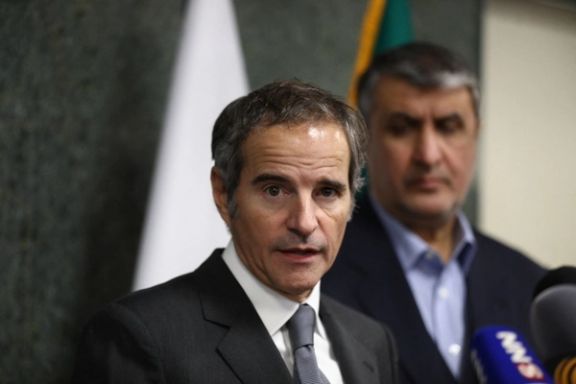
Dec 2, 2022, 20:49 GMT+0
IAEA's Rafael Grossi in Tehran with Iran nuclear chief Mohammad Eslami on March 5, 2022

The United Nations nuclear head said Friday his discussions with Tehran over its atomic program lacked “the momentum” needed to get “back to life.”

Speaking to the government-sponsored Mediterranean Dialogues conference in Rome, Rafael Mariano Grossi, director-general of the International Atomic Energy Agency (IAEA), expressed concern at lack of progress in discussions over uranium traces found in ‘non-nuclear’ sites and at Tehran’s recent decision to enrich uranium to 60 percent at a second atomic facility.

The IAEA reported in early November that Iran had agreed to meet during the month to discuss the uranium traces, which the agency discovered in 2021, but the meetings have not taken place. Grossi signaled back in May that he found answers given by Iran unsatisfactory. In June and mid-November, the 35-state IAEA board of governors passed resolutions censoring Tehran. “We don’t seem to be seeing eye-to-eye with Iran over their obligations to the IAEA,” Grossi told the conference.

Tehran has argued that the discovery of uranium traces, which relate to work carried out before 2003, came only after allegations made by Israel in 2018. But Grossi has said that adequate explanations are required under Tehran’s basic ‘safeguards’ commitments under the Nuclear Non-Proliferation Treaty (NPT) particularly to establish what subsequently happened to the uranium.

Iran has also argued that IAEA questioning into the uranium traces should be shelved as part of reviving the 2015 Iran nuclear agreement, the JCPOA (Joint Comprehensive Plan of Action). Talks beginning early 2021 to restore the JCPOA, which the US left in 2018, reached stalemate in the summer.

Grossi said Friday he was “still hopeful” Tehran would satisfy the agency over the uranium traces. “We need to put our relationship back on track,” he argued.

The IAEA has charted in successive reports the expanding Iranian program, which began to exceed JCPOA limits in 2019, the year after the US left the JCPOA, which curbed Iran’s nuclear program in return for easing international sanctions.

‘Tripling capacity’

Grossi said that Iran’s recent announcement over enriching to 60 percent at Fordow, in addition to the 60-percent enrichment that began at the Natanz site in 2021, was “tripling, not doubling…their capacity to enrich uranium at 60 percent.” This brought Iran “very close to military level, which is 90 percent,” Grossi added, referring to the purity usually required for an atomic weapon. Under the JCPOA, Iran enriched only to 3.67 percent, and has also increased the efficiency and speed of enriching by using more advanced centrifuges that were barred under the 2015 agreement.

The IAEA director-general has also expressed consistent concern at Iran limiting agency monitoring to that required by the NPT. Tehran began reducing access in early 2021 in response to the killing of a scientist and attacks on sites, both widely attributed to Israel. “We need to go, we need to verify,” Grossi said Friday.


Most Viewed

State media slam Araghchi's Hormuz tweet, say it let Trump claim victory
1

State media slam Araghchi's Hormuz tweet, say it let Trump claim victory

2

Iran International says it won’t be silenced after London arson attack

3
INSIGHT

How Tehran bends its own red lines to boost state rallies

4
VOICES FROM IRAN

Hope and anger in Iran as fragile ceasefire persists

5

Iran halts petrochemical exports to supply domestic market

Banner
Banner

Spotlight

  • Too early to tell who is winning Iran war, experts say
    PODCAST

    Too early to tell who is winning Iran war, experts say

  • How Tehran bends its own red lines to boost state rallies
    INSIGHT

    How Tehran bends its own red lines to boost state rallies

  • Iran blackout cripples freelancer, small business incomes
    VOICES FROM IRAN

    Iran blackout cripples freelancer, small business incomes

  • Ideology may be fading in Iran, but not in Kashmir's ‘Mini Iran'
    INSIGHT

    Ideology may be fading in Iran, but not in Kashmir's ‘Mini Iran'

  • US blockade enters murky phase as tankers spoof signals and buyers hesitate
    ANALYSIS

    US blockade enters murky phase as tankers spoof signals and buyers hesitate

  • Why the $100 billion Hormuz toll revenue is a myth
    ANALYSIS

    Why the $100 billion Hormuz toll revenue is a myth

•
•
•

More Stories

Biden Has Agreed To Military Option Against Iran If Diplomacy Fails

Dec 1, 2022, 14:23 GMT+0
•
Iran International Newsroom

US Special Envoy for Iran Robert Malley says President Joe Biden is prepared for a military option to prevent Iran from acquiring a nuclear weapon in case sanctions and diplomacy fail.

During an interview with Foreign Policy’s podcast Playlist released on Wednesday, Malley said that the US and Iran came very close to reaching an agreement to revive the 2015 nuclear deal – or the Joint Comprehensive Plan of Action (JCPOA) -- many times in the past two years, the latest of which was in August, but each time Iran stepped back and came up with new demands that often had nothing to do with the nuclear talks. 

“We'll have the sanctions, pressure and diplomacy. If none of that works, the President has said, and, as a last resort, he will agree to a military option because if that’s what it takes to stop Iran from acquiring a nuclear weapon, that’s what will happen. But we’re not there," he said. 

Defending the Biden administration’s efforts to keep diplomacy as an option and criticizing the Trump administration for its maximum-pressure campaign, he said, “We owe it to ourselves to have an honest examination of how sanctions work and how they don’t work.”

The Iranian system as a whole is divided, and not yet concluded whether they really want to come back to the deal, and so each time Tehran was presented with a deal, even about the deals that were considered fair by other parties such as Russia and China, Iran was the one that walked back. 

The Palais Coburg, the venue of Iran nuclear talks in Vienna (file photo)
100%
The Palais Coburg, the venue of Iran nuclear talks in Vienna

“Iran has rejected countless opportunities to come back to the deal... We are prepared for a world with the JCPOA and without the JCPOA. We’ve continued to put pressure on Iran... We made sure there are sanctions for their support for terrorism, their human rights violations, for their ballistic missile program and for their nuclear program,” he added. “The JCPOA is not on the agenda because of Iran’s position, and we’re continuing with our policy to respond to all of Iran’s destabilizing activities.”

Malley also said reviving the deal would be dead when the non-proliferation benefits of the deal do not justify or warrant the sanctions relief that the US is ready to offer, emphasizing that the US focus and energy are not on the deal. Currently, the focus is on what is happening in Iran and its support for the Russian invasion of Ukraine. 

He also talked about many troubling issues emanating from Iran, saying the US supports aspirations of the Iranian people to achieve the fundamental rights and freedoms that all peoples across the globe should enjoy. “We are mobilizing international attention, putting the spotlight on what’s happening in Iran. It’s very important that the world know at a time when the Iranian regime is trying to hide what’s happening and to distort what’s happening,” he said. 

The administration has also put the spotlight on developments in Iran by sanctioning those up and down the chain who are violating the basic rights of the Iranian people, “whether it’s a top leadership or whether it’s an anonymous person in a prison,” Malley noted. “The world should know who is behind that repression.”

He also said Washington is pushing for measures against the Islamic Republic in international bodies, mentioning the resolution at the UN Human Rights Council and the move to kick out Iran from the UN Commission on the Status of Women. “It’s an aberration, a complete anomaly, that Iran would be on the commission that is supposed to defend the rights of women when they are repressing them,” he added.

The US will continue to voice its support for the Iranians who are protesting for their rights, he reiterated, saying that “it's an extraordinary page in Iran’s history that’s being written right now.”

Praising “the courage, the determination, the persistence and the creativity of Iranians, particularly women and girls,” Malley said “we’re not going to be the authors; we can be there to express support for the fundamental rights of Iranians. This page will be written by Iranians themselves. It won’t be written in Washington, in London or anywhere around the globe other than Iran.”

Also on Wednesday, The US secretary of state says that the Islamic Republic has a deeply incorrect understanding of its people and is trying to blame others for the current protests.

Iran Protests Reveal True Face Of Regime To World: Netanyahu

Dec 1, 2022, 14:23 GMT+0

Recently re-elected Israeli Prime Minister Benjamin Netanyahu says the nuclear deal with Iran is dead because Tehran has shown its real face to the world by its brutal crackdown on protesters.

Netanyahu, who was speaking to Fox News DigitalWednesday, added that the end of nuclear talks with the regime has been achieved by the people of Iran themselves as they clearly say they do not want clerics.

“That's thanks to the extraordinarily brave Iranian women and men who took to the streets – who take to the streets – against this vicious, murderous, and brutal regime. And I think people ask themselves, ‘Do we want the ayatollahs, who chant death to America, to have the weapons of mass death and the ballistic missiles to deliver them to any part on Earth?’ and the answer is of course not,” explained Likud party chief.

He further added that the protests are exposing the leadership's vulnerability, stressing that “it also highlights the fact that they’re really weak – that they govern only with basically the threat of murder, and the people are showing remarkable resilience.”

Netanyahu went on to say that the political spectrum is more united against Iran now to keep the clerical regime from getting a nuclear weapon.

To do this, he noted, both “crippling sanctions” and a “military threat” are needed, and Israel is ready to act regardless of Washington’s approval, although there is more “forward-leaning American position on this matter.”

IRGC Commander Praises Khamenei For Not Needing A Nuclear Deal

Dec 1, 2022, 10:52 GMT+0
•
Iran International Newsroom

The commander of Iran’s Revolutionary Guard says the Supreme Leader wants to reach a point where having a nuclear deal with the West will make no difference for Iran.

Speaking to a large crowd on Thursday, General Hossein Salami also tried to present the IRGC and its paramilitary Basij as “servants of the people,” amid a popular uprising in which security forces have so far killed around 450 civilians since mid-September.

Salami repeated regime slogans about “independence” and “self-sufficiency” and said, Khamenei “has turned a few issues into a matter of pride that America cannot swallow. One of these is his strong stand on the issue of JCPOA, and it has reached a stage when the acceptance or rejection of the JCPOA has no importance for Iran.”

After 18 months of indirect negotiations by the Biden Administration to revive the 2015 nuclear accord known as the JCPOA, talks broke down in early September, when the US rejected excessive demands by Iran.

Salami also praised the 83-year-old authoritarian ruler for spreading the influence of the Islamic Republic to other countries, adding that “enemies” cannot accept “this development.”

The Islamic regime uses the term “enemies” to refer to the US, Israel, Saudi Arabia and lately Western Europe, as many countries have criticized its use of deadly violence against protesters.

Many countries raise the issue of Tehran’s “malign activities” in the Middle East, by financially and militarily building a network of militant groups in Iraq, Syria, Lebanon, Yemen and elsewhere.

People celebrating in the Kurdish city of Sanandaj after the Islamic Republic’s soccer team lost against the US and exit the World Cup on November 29, 2022
100%
People celebrating in the Kurdish city of Sanandaj after the Islamic Republic’s soccer team lost against the US and exit the World Cup on November 29, 2022

The IRGC commander then went on repeating accusations made by Khamenei and other officials in the past two months against “enemies” for plotting to destroy Iran. At the same time, he claimed that Iran has become a “powerful force” and “the enemy is fleeing from the Islamic world.”

For this reason, he claimed, the United States is fomenting unrest in Iran, but the Iranian people “are standing up to America.”

In fact, thousands of Iranians across the country celebrated the defeat of Iran’s team by the US side in the World Cup on Tuesday, seeing the loss as a defeat for the regime that tries to use sports to strengthen its image.

The United States has repeatedly dismissed accusations that it has anything to do with the anti-regime protests. Secretary of State Antony Blinken said Wednesday that one of the “profound mistakes” that the “regime makes is in accusing the United States or any other country” of somehow being “responsible for, instigating what’s happening. That’s not at all the case. And to misunderstand their own people is at the heart of the problem that they’re facing.”

But the Biden Administration has also voiced support for Iranians to have the right to peacefully protest and officials have met with Iranian activists to underline that policy.

Blinken in a separate interview with NBC also reiterated the administration’s policy, saying “the most important thing that we can do is first to speak out very clearly ourselves in support of the people’s right to protest peacefully, to make their views known, and as I said, to take what steps we can take to go after those who are actually oppressing those rights, including through sanctions.”

Iranians mainly blame Khamenei, the Revolutionary Guard and its Basij paramilitaries for deadly use of violence against protesters. Many have reached the point that they will accept nothing short of a complete regime change and the establishment of a secular, democratic political system.

Iran Pundits Claim Talks Will Resume Once Protests Calm Down

Nov 30, 2022, 16:14 GMT+0
•
Iran International Newsroom

Politicians and pundits aligned with Iran's government are telling local media that nuclear talks with the United States will resume once the uprising ebbs.

These statements appear to be attempts to reassure the restless public that sees the freeze in nuclear talks as yet another ominous sign for the country’s future.

Iranian lawmaker Mohammad Hassan Asafari, a former – and possibly current – Iranian intelligence officer, told Nameh News that the talks over Iran's controversial nuclear program will be resumed in January.

Referring to Foreign Minister Hosein Amir-Abdollahian's uncorroborated comments about messages being exchanged between Tehran and Washington, Nameh News website wrote that there are signs indicating the Americans are after finding the right go-between to resume the talks after a three-month freeze.

The United States has denied the claims that it is messaging Iran to resume the talks.

Meanwhile, he told Nameh News that “it is also in the United States' interest to try to solve its problems with Iran through negotiations." He added that less than two years before the next presidential elections in the United States, Democrats need to show some achievements to voters to help them keep the White House.

ranian lawmaker Mohammad Hassan Asafari. FILE
100%
ranian lawmaker Mohammad Hassan Asafari

The lawmaker warned that if the Americans show no interest in resuming the talks, and decide to continue their pressures on Iran, Tehran has also options on the table that might not be in Washington's interest.

Asafari said: "The Americans have realized that there is no way other than negotiations to settle their difference with the Islamic Republic. They have also realized that threats, sanctions, pressures and an endless series of resolutions against Iran cannot force Tehran to retreat."

This comes while economic analyst Hadi Haghshenas says that the UN Human Rights Commission's recent resolution has left a negative impact on Iran's economy and coupled with the country's chronic economic crisis, it has made solving Iran's problems even more complicated than ever before.

Tehran economist and commentator Hadi Haghshenas. FILE
100%
Tehran economist and commentator Hadi Haghshenas

Haghshenas told Nameh News: "Economic variables such as inflation, unemployment and even economic growth will be affected by both economic and non-economic factors including floods, earthquakes, sanctions and protests." He reminded that Iran’s currency rose every time there was a positive development about the negotiations with the West, and declined every time there seemed to be no prospect for success.

He reiterated that establishing an investigation committee under the supervision of the UN to probe into the use of force and violence by the government during the protests has adversely affected the status of the country's economy.

Nonetheless, like Asafari, political activist and commentator Ahmad Bakhshayesh Ardestani is also adamant that diplomacy will resume once we see a decline in the protests.

Boastfully reiterating that Iran is the only country in the world that can say "No" to the United States, Ardestani said that naturally, the US will do anything to bring Iran under pressure. However, he argued, the West's policy toward Iran “depends on our domestic politics.” Currently, with unrest in Iran, “Westerners try to support the protests.” They work based on their interests.

"That is why they issued resolutions against Tehran at international forums to exert further pressures on Iran. But if Iran manages to come to terms with the protesters and leave the crisis behind, then the Americans would want to resume diplomacy," Ardestani said.

If Iran manages to calm down the protesters, Iran's nuclear case will not be sent to the Un Security Council, there will be no snap-back and no military action against Iran, he maintained.

Iran's Only Options Are Nuclear Diplomacy Or War, Says Politician

Nov 27, 2022, 12:05 GMT+0
•
Iran International Newsroom

After more than two months of relative silence in Iranian media about nuclear talks, pundits have started debates on the diplomatic impasse amid popular protests.

What triggered the new debates was Tehran's declaration about expanding 60-percent uranium enrichment at a second site in response to the IAEA Board of Governor's resolution this month condemning Iran's lack of cooperation with the International Atomic Energy Agency (IAEA).

In an article in Tehran's leading economic daily, Donyay-e Eqtesad, Heshmatollah Falahatpisheh, the former head of the Iranian parliament's Foreign Policy and National Security Committee said that the new developments indicate that the nuclear dispute with the West has become more challenging than ever as the two sides are left to choose between diplomacy or war.

The Europeans trio, the UK, France and Germany, condemned Iran's "nuclear escalation" after IAEA Chief Rafael Grossi confirmed the news about 60 percent enrichment at a new site. The E-3 said they will consult with their international partners on how to deal with the issue. This comes while Russia's nuclear negotiator Mikhail Ulyanov has supported Iran's move as "A predictable decision on Tehran's part regarding US and Europe's action to escalate tensions."

Falahatpisheh told Donya-ye Eqtesad that "handling the nuclear challenge has become very difficult as Iran is taking steps to preserve its bargaining power in possible negotiations." He added that the West's policy is to continue its pressures on Iran through imposing sanctions. This will bring the debate out of the diplomatic framework. At the same time, Iran which is badly hit by the sanctions does not wish to waste any time and that is why it resorted to [more] 60-percent enrichment."

He said the next step for Europe would be taking Iran's case to the UN Security Council. "If this happens, Tehran might boost enrichment to beyond the 60-percent level. So, the Europeans will activate the trigger mechanism" that brings back all the previous international sanctions against Tehran. He said in any case Iran will boost its enrichment level and this is in no one's interest.

As a result, argued Falahatpisheh, "there are only two options: Starting a war or returning to the negotiating table.” It appears that by expanding the 60-percent enrichment, “Iran is saying that it is also prepared for war." He added that in case the West begins a hybrid war against Tehran, Iran will also follow a series of hybrid challenges. However, as far as Tehran is concerned, going to war is the least likely option.

Meanwhile, Reformist daily Arman Emrooz wrote on Saturday that although the US government wishes to return to the 2015 nuclear accord (JCPOA) or a similar agreement, it knows that accepting a deal will harm its image in the international community. Although Arman Emrooz did not elaborate, it most likely meant that Washington does not want to make a deal with a country plunged in turmoil for over two months as protesters take to the streets daily, chanting slogans against its embattled dictator Ali Khamenei.

The paper quoted Iranian analyst Mehdi Motaharnia as saying that Iran and its supporters Russia and China are in favor of the status quo. This corroborates with what Khamenei said in his speech to the Basij militia on Saturday when he absolutely ruled out any sort of dialogue with the United States.

In one of the latest political commentaries that suggest reaching an agreement with the United States can calm down the ongoing protests in Iran, conservative political commentator Mohammad Mohajeri said: "The Iranian government should accept international laws and respect others' rights and interact with the world community in a way that would put the country's economy in a good shape. And this is not possible in any way other than [reviving] the JCPOA."



