• العربية
  • فارسی
Brand
  • Iran Insight
  • Politics
  • Economy
  • Analysis
  • Special Report
  • Opinion
  • Podcast
  • Iran Insight
  • Politics
  • Economy
  • Analysis
  • Special Report
  • Opinion
  • Podcast
  • Theme
  • Language
    • العربية
    • فارسی
  • Iran Insight
  • Politics
  • Economy
  • Analysis
  • Special Report
  • Opinion
  • Podcast
All rights reserved for Volant Media UK Limited
volant media logo

IRGC Commander Praises Khamenei For Not Needing A Nuclear Deal
Iran International Newsroom
Dec 1, 2022, 10:52 GMT+0Updated: 17:39 GMT+1
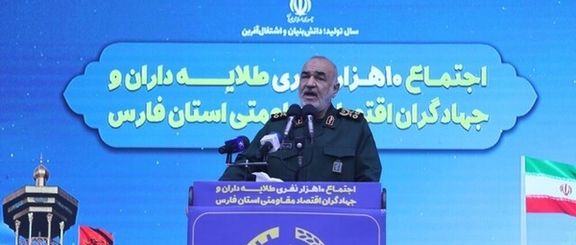
IRGC commander Hossein Salami speaking on December 1, 2022

The commander of Iran’s Revolutionary Guard says the Supreme Leader wants to reach a point where having a nuclear deal with the West will make no difference for Iran.

Speaking to a large crowd on Thursday, General Hossein Salami also tried to present the IRGC and its paramilitary Basij as “servants of the people,” amid a popular uprising in which security forces have so far killed around 450 civilians since mid-September.

Salami repeated regime slogans about “independence” and “self-sufficiency” and said, Khamenei “has turned a few issues into a matter of pride that America cannot swallow. One of these is his strong stand on the issue of JCPOA, and it has reached a stage when the acceptance or rejection of the JCPOA has no importance for Iran.”

After 18 months of indirect negotiations by the Biden Administration to revive the 2015 nuclear accord known as the JCPOA, talks broke down in early September, when the US rejected excessive demands by Iran.

Salami also praised the 83-year-old authoritarian ruler for spreading the influence of the Islamic Republic to other countries, adding that “enemies” cannot accept “this development.”

The Islamic regime uses the term “enemies” to refer to the US, Israel, Saudi Arabia and lately Western Europe, as many countries have criticized its use of deadly violence against protesters.

Many countries raise the issue of Tehran’s “malign activities” in the Middle East, by financially and militarily building a network of militant groups in Iraq, Syria, Lebanon, Yemen and elsewhere.

People celebrating in the Kurdish city of Sanandaj after the Islamic Republic’s soccer team lost against the US and exit the World Cup on November 29, 2022
100%
People celebrating in the Kurdish city of Sanandaj after the Islamic Republic’s soccer team lost against the US and exit the World Cup on November 29, 2022

The IRGC commander then went on repeating accusations made by Khamenei and other officials in the past two months against “enemies” for plotting to destroy Iran. At the same time, he claimed that Iran has become a “powerful force” and “the enemy is fleeing from the Islamic world.”

For this reason, he claimed, the United States is fomenting unrest in Iran, but the Iranian people “are standing up to America.”

In fact, thousands of Iranians across the country celebrated the defeat of Iran’s team by the US side in the World Cup on Tuesday, seeing the loss as a defeat for the regime that tries to use sports to strengthen its image.

The United States has repeatedly dismissed accusations that it has anything to do with the anti-regime protests. Secretary of State Antony Blinken said Wednesday that one of the “profound mistakes” that the “regime makes is in accusing the United States or any other country” of somehow being “responsible for, instigating what’s happening. That’s not at all the case. And to misunderstand their own people is at the heart of the problem that they’re facing.”

But the Biden Administration has also voiced support for Iranians to have the right to peacefully protest and officials have met with Iranian activists to underline that policy.

Blinken in a separate interview with NBC also reiterated the administration’s policy, saying “the most important thing that we can do is first to speak out very clearly ourselves in support of the people’s right to protest peacefully, to make their views known, and as I said, to take what steps we can take to go after those who are actually oppressing those rights, including through sanctions.”

Iranians mainly blame Khamenei, the Revolutionary Guard and its Basij paramilitaries for deadly use of violence against protesters. Many have reached the point that they will accept nothing short of a complete regime change and the establishment of a secular, democratic political system.


Most Viewed

Ideology may be fading in Iran, but not in Kashmir's ‘Mini Iran'
1
INSIGHT

Ideology may be fading in Iran, but not in Kashmir's ‘Mini Iran'

2
INSIGHT

Hardliners push Hormuz ‘red line’ as US blockade tests Iran’s leverage

3
VOICES FROM IRAN

Hope and anger in Iran as fragile ceasefire persists

4

US sanctions oil network tied to Iranian tycoon Shamkhani

5

Iran halts petrochemical exports to supply domestic market

Banner
Banner

Spotlight

  • Hardliners push Hormuz ‘red line’ as US blockade tests Iran’s leverage
    INSIGHT

    Hardliners push Hormuz ‘red line’ as US blockade tests Iran’s leverage

  • Ideology may be fading in Iran, but not in Kashmir's ‘Mini Iran'
    INSIGHT

    Ideology may be fading in Iran, but not in Kashmir's ‘Mini Iran'

  • War damage amounts to $3,000 per Iranian, with blockade set to add to losses
    INSIGHT

    War damage amounts to $3,000 per Iranian, with blockade set to add to losses

  • Why the $100 billion Hormuz toll revenue is a myth
    ANALYSIS

    Why the $100 billion Hormuz toll revenue is a myth

  • US blockade targets Iran oil boom amid regional disruption
    ANALYSIS

    US blockade targets Iran oil boom amid regional disruption

  • Iran's digital economy battered by prolonged blackout
    INSIGHT

    Iran's digital economy battered by prolonged blackout

•
•
•

More Stories

Iran Pundits Claim Talks Will Resume Once Protests Calm Down

Nov 30, 2022, 16:14 GMT+0
•
Iran International Newsroom

Politicians and pundits aligned with Iran's government are telling local media that nuclear talks with the United States will resume once the uprising ebbs.

These statements appear to be attempts to reassure the restless public that sees the freeze in nuclear talks as yet another ominous sign for the country’s future.

Iranian lawmaker Mohammad Hassan Asafari, a former – and possibly current – Iranian intelligence officer, told Nameh News that the talks over Iran's controversial nuclear program will be resumed in January.

Referring to Foreign Minister Hosein Amir-Abdollahian's uncorroborated comments about messages being exchanged between Tehran and Washington, Nameh News website wrote that there are signs indicating the Americans are after finding the right go-between to resume the talks after a three-month freeze.

The United States has denied the claims that it is messaging Iran to resume the talks.

Meanwhile, he told Nameh News that “it is also in the United States' interest to try to solve its problems with Iran through negotiations." He added that less than two years before the next presidential elections in the United States, Democrats need to show some achievements to voters to help them keep the White House.

ranian lawmaker Mohammad Hassan Asafari. FILE
100%
ranian lawmaker Mohammad Hassan Asafari

The lawmaker warned that if the Americans show no interest in resuming the talks, and decide to continue their pressures on Iran, Tehran has also options on the table that might not be in Washington's interest.

Asafari said: "The Americans have realized that there is no way other than negotiations to settle their difference with the Islamic Republic. They have also realized that threats, sanctions, pressures and an endless series of resolutions against Iran cannot force Tehran to retreat."

This comes while economic analyst Hadi Haghshenas says that the UN Human Rights Commission's recent resolution has left a negative impact on Iran's economy and coupled with the country's chronic economic crisis, it has made solving Iran's problems even more complicated than ever before.

Tehran economist and commentator Hadi Haghshenas. FILE
100%
Tehran economist and commentator Hadi Haghshenas

Haghshenas told Nameh News: "Economic variables such as inflation, unemployment and even economic growth will be affected by both economic and non-economic factors including floods, earthquakes, sanctions and protests." He reminded that Iran’s currency rose every time there was a positive development about the negotiations with the West, and declined every time there seemed to be no prospect for success.

He reiterated that establishing an investigation committee under the supervision of the UN to probe into the use of force and violence by the government during the protests has adversely affected the status of the country's economy.

Nonetheless, like Asafari, political activist and commentator Ahmad Bakhshayesh Ardestani is also adamant that diplomacy will resume once we see a decline in the protests.

Boastfully reiterating that Iran is the only country in the world that can say "No" to the United States, Ardestani said that naturally, the US will do anything to bring Iran under pressure. However, he argued, the West's policy toward Iran “depends on our domestic politics.” Currently, with unrest in Iran, “Westerners try to support the protests.” They work based on their interests.

"That is why they issued resolutions against Tehran at international forums to exert further pressures on Iran. But if Iran manages to come to terms with the protesters and leave the crisis behind, then the Americans would want to resume diplomacy," Ardestani said.

If Iran manages to calm down the protesters, Iran's nuclear case will not be sent to the Un Security Council, there will be no snap-back and no military action against Iran, he maintained.

Secret Report Reveals Khamenei's Pessimism Over Iran Protests

Nov 30, 2022, 09:27 GMT+0
•
Maryam Sinaiee

A secret report by IRGC's media arm quotes Iran’s Supreme Leader as saying protests will not end soon and criticizing failures in “media war” against protesters.

“We are in a war and one of the tools to use in this war is the media. Why are we slow in this? Emphasize to these gentlemen (security officials) to utilize the media tool appropriately. These things, the riots, are not to finish anytime soon,” Supreme Leader Ali Khamenei told security and intelligence officials according to the report.

The 123-page document a copy of which has been provided to Iran International is among the documents obtained by the hacktivist group Black Reward. The document which includes both hearsay and excerpts from domestic and foreign-based Persian media was made in one copy only for the eyes of the IRGC chief commander Hossein Salami.

The report says Khamenei also ordered security and intelligence bodies to issue a statement about the ongoing protests that have engulfed the country since mid-September following the death of the 22-year-old Mahsa (Jina) Amini in the custody of morality police.

Although it is no secret that the 83-year-old ruler makes all the important decisions in the country, but this document clearly shows the extent to which tries to micro-manage and interfere in political security-related issues.

Black Reward announced on Friday [Nov. 25] that it had attacked the database of Fars News Agency claiming that it has deleted nearly 250 terabytes of data from all the servers and computers of the website and obtained confidential bulletins sent by the news agency to the office of Supreme Leader Ali Khamenei.

The report also includes various officials’ quotations from Khamenei regarding the recent crisis in the Sunni majority southeastern Sistan-Baluchestan province. The report claims that Khamenei has been critical of authorities for their handling of the situation, especially for President Ebrahim Raisi and Secretary of the Supreme National Security Council (SNSC) Ali Shamkhani’s “lack of initiative” in the matter.

On September 31, security forces killed nearly a hundred Sunni protesters and bystanders after a Friday prayer led by the influential Sunni cleric Mowlavi Abdolhamid who is officially known as Sheikh Abdolhamid Esmail-Zehi.

Protests in the province have continued since the incident which has been dubbed as the “Bloody Friday”. Abdolhamid has directly criticized Khamenei, demanded an apology as well as punishment for those responsible for the bloodshed. He has also defiantly refused to tone down his Friday sermons after which the locals take to the streets every week in the provincial capital, Zahedan, and other cities.

Faced with such “lack of initiative”, the report says, Khamenei told the officials of his own office he would have to take the matters into his own hands if “they could not keep up with it”. He also ordered the SNSC not to arrest Abdolhamid as they suggested by some but “disgrace him” in the eyes of the public while criticizing the police for not apologizing to the public and the people of Zahedan for the incident.

This shows Khamenei plays a major role in decisions that lead to the violation of human rights and the secret operations of intelligence agencies against dissidents.

“The system’s general policy is to bear with Abdolhamid for the time being and avoid provoking him to call Sunnis to the streets again. But the decision is to gradually reduce his influence,” the report’s writer comments in reference to Khamenei’s views.

The report also quotes Gholam-Ali Haddad-Adel, one of Khamenei’s advisors, as saying at a meeting with other officials that Khamenei is critical of the coalition of conservatives and hardliners known as Principlists for “being absent” in the handling of the crisis.

“Where were your forces during this recent unrest? Your [presence] should have shown in the provinces if you were strong and united,” Khamenei said according to Haddad-Adel, a former speaker who is also his son’s father-in-law.

Iranian Officials Acknowledge Protest Movement’s Strength

Nov 30, 2022, 08:52 GMT+0
•
Maryam Sinaiee

A leaked audio file seems to prove that Iran's protest movement has gained so much ground that authorities can no longer deny its gravity or hide their despondency.

In a speech to the Revolutionary Guards’ Basiji militia members Saturday, Supreme Leader Ali Khamenei, who had so far not acknowledged the serious challenge the protest movement poses to his rule, confirmed his fears by trying to boost the morale of his loyalists and exhorted them “never to lose hope under any circumstances.”

Khamenei also told the chief of police recently, “Don’t let your morale drop,” according to the leaked audio file of a recent insiders’ meeting focusing on the protests.

Regime propaganda is increasingly proving inept and easy to counter and disprove by the popular opposition whose only platform for expression is social media. The said audio file seems to confirm that protesters have gained the upper hand in what the speaker, deputy commander of the paramilitary Basij Qasem Qoreyshi, refers to as “media war”.

The state had banked, for instance, on World Cup football victories to cast a normal, happy image of the society, but last week when the state media tried to make the win against Wales into a big celebration, many chose to follow the social media campaigns to disown the national team and stayed home even in areas where past celebrations were always the biggest. Photos of riot police cheering in their full gear and parading on their motorbikes in the streets served as proof of the point that the team represented “them”, not “us”, many said.

Iran's ruler Khamenei in a mourning ceremony for Qasem Soleimani killed in a targeted US air strike in 2020
100%
Iran's ruler Khamenei in a mourning ceremony for Qasem Soleimani killed in a targeted US air strike in 2020

Authorities have waged a campaign of disinformation for years and a host of fake accounts to counter opponents’ social media activities and campaigns, to sow discord among them, and to spy on them. This tactic succeeded somehow at first, but it seems that they’ve been found out and some fake accounts are now being more carefully considered. Many are quickly losing followers they had managed to lure with content that sometimes looked the most aggressive against the regime.

Facts also seem to have become more and more difficult to hide and distort as individuals and families are taking strength from the growth of the movement. The public eventually finds out every time when other citizens are killed, injured, or arrested, and do not believe when the authorities deny responsibility.

Nearly 450 protesters have been killed but the state not only has not taken responsibility for even one case, but has also cast the blame on others, even protesters themselves. Such incidents have only resulted in greater anger among citizens and more power to the protest movement.

The outbreak of unrest could have been possibly prevented if the death of the 22-year-old Mahsa Amini which sparked the protests could have been hidden from the public. But her family refused to remain silent.

As a result, few believe the official account when Atefeh Na’ami, 37, was found a few days ago in the balcony of her apartment under a blanket with a gas pipe near her mouth.

Authorities say she committed suicide but her family who calls the regime and its officials “occupiers” insist she “gave her life for freedom”. According to her brother, security forces buried her quietly with only a few female members of the family present.

The grievances of the Iranian public are not limited to lack of freedom or social issues, as the slogans chanted by protesters may suggest. What probably causes the greatest concern to the authorities is that protests have not yet become as extensive in impoverished areas where the 2019 deadly protests were the most intense.

In the leaked audio file one of the participants in the meeting quotes the secretary of the supreme national security council, Ali Shamkhani, as saying that 70 percent of Iranians believe their living conditions are fast deteriorating.

Iran Politician Suggests Referendum On Foreign Policy Issues

Nov 28, 2022, 08:49 GMT+0
•
Iran International Newsroom

A former lawmaker in Iran has suggested that the government should put the future of the nuclear deal and support for Russia's war in Ukraine to a referendum.

In an interview with moderate conservative website Khabar Online, Ali Motahari blamed the Raisi administration for the country's economic problems without mentioning Supreme Leader Ali Khamenei's responsibility. However, when speaking on key issues such as reforming election law, negotiating with the United States to revive the JCPOA, and aligning with Russia in its war against Ukraine, he acknowledged that it is Khamenei who has the final say on key issues.

Motahari is a social conservative who has sometimes been an outspoken critic when the hardliner core of the regime has violated insider rules or taken steps leading to more international isolation.

Speaking on the ongoing protests in Iran, Motahari said that people's hopelessness about their future triggered the current wave of protests. Blaming the existing economic crisis and hard-line policies as the root causes of the protests, he agreed that creating a moderate political grouping might help resolve the country's current economic and political impasse.

He also maintained that the government's indecision about the nuclear deal, economic problems and even the ongoing protests has lent momentum to the popular uprising.

The idea of holding a referendum on major issues is not new. Former President Hassan Rouhani proposed the idea on several occasions, angering Khamenei and his followers.

In another development, in an article entitled "The government's Autumn hibernation," Khabar online criticized Raisi and his administration for being absent from the public scene and for their indifference in the face of recent UN and IAEA resolutions about Iran's human rights record and its nuclear program.

The article concluded that "Raisi's indecision and his government's absence in public arena to tackle problems has gradually turned cultural, foreign policy, economic and social issues into security problems" for the country and the nation.

At the same time, it criticized Raisi for failing to understand and prioritize the problems Iran is currently facing and for turning the issues that should normally have conventional solutions into unwanted crises. In other words, Raisi's absence has provided opportunities for forces outside the presidential administration to get involved in policy making behind-the-scenes and impose a high cost on the government.

Khabar Online did not name those forces, but it was presumably referring to influence by Khamenei's many offices, influential clerics and IRGC officers who intervene in the affairs of the state.

The article charged that since Raisi came to office, he has always avoided public appearances during crises. He has stopped his visits to provinces and has been silent about hardliner attempts to restrict social media and deprive thousands of Iranians from benefitting from their Internet-based businesses.

At the same time, the Raisi administration constantly contributed to crises by measures such as eliminating the preferential rate of exchange as well as acting passively regarding security forces restricting Internet access.

Khabar Online mentioned that Raisi's silence was eye-catching when security forces killed dozens of protesters in the provinces. He did not act or say anything about Tehran's police's brutality against peaceful protesters either. According to the website, Raisi's silence has provided opportunities for hardliners to push for policies, such as strengthening the ‘morality police’, that have enraged the people. Raisi did not even respond to clerics and political activists' letters about those developments.

Iran's Only Options Are Nuclear Diplomacy Or War, Says Politician

Nov 27, 2022, 12:05 GMT+0
•
Iran International Newsroom

After more than two months of relative silence in Iranian media about nuclear talks, pundits have started debates on the diplomatic impasse amid popular protests.

What triggered the new debates was Tehran's declaration about expanding 60-percent uranium enrichment at a second site in response to the IAEA Board of Governor's resolution this month condemning Iran's lack of cooperation with the International Atomic Energy Agency (IAEA).

In an article in Tehran's leading economic daily, Donyay-e Eqtesad, Heshmatollah Falahatpisheh, the former head of the Iranian parliament's Foreign Policy and National Security Committee said that the new developments indicate that the nuclear dispute with the West has become more challenging than ever as the two sides are left to choose between diplomacy or war.

The Europeans trio, the UK, France and Germany, condemned Iran's "nuclear escalation" after IAEA Chief Rafael Grossi confirmed the news about 60 percent enrichment at a new site. The E-3 said they will consult with their international partners on how to deal with the issue. This comes while Russia's nuclear negotiator Mikhail Ulyanov has supported Iran's move as "A predictable decision on Tehran's part regarding US and Europe's action to escalate tensions."

Falahatpisheh told Donya-ye Eqtesad that "handling the nuclear challenge has become very difficult as Iran is taking steps to preserve its bargaining power in possible negotiations." He added that the West's policy is to continue its pressures on Iran through imposing sanctions. This will bring the debate out of the diplomatic framework. At the same time, Iran which is badly hit by the sanctions does not wish to waste any time and that is why it resorted to [more] 60-percent enrichment."

He said the next step for Europe would be taking Iran's case to the UN Security Council. "If this happens, Tehran might boost enrichment to beyond the 60-percent level. So, the Europeans will activate the trigger mechanism" that brings back all the previous international sanctions against Tehran. He said in any case Iran will boost its enrichment level and this is in no one's interest.

As a result, argued Falahatpisheh, "there are only two options: Starting a war or returning to the negotiating table.” It appears that by expanding the 60-percent enrichment, “Iran is saying that it is also prepared for war." He added that in case the West begins a hybrid war against Tehran, Iran will also follow a series of hybrid challenges. However, as far as Tehran is concerned, going to war is the least likely option.

Meanwhile, Reformist daily Arman Emrooz wrote on Saturday that although the US government wishes to return to the 2015 nuclear accord (JCPOA) or a similar agreement, it knows that accepting a deal will harm its image in the international community. Although Arman Emrooz did not elaborate, it most likely meant that Washington does not want to make a deal with a country plunged in turmoil for over two months as protesters take to the streets daily, chanting slogans against its embattled dictator Ali Khamenei.

The paper quoted Iranian analyst Mehdi Motaharnia as saying that Iran and its supporters Russia and China are in favor of the status quo. This corroborates with what Khamenei said in his speech to the Basij militia on Saturday when he absolutely ruled out any sort of dialogue with the United States.

In one of the latest political commentaries that suggest reaching an agreement with the United States can calm down the ongoing protests in Iran, conservative political commentator Mohammad Mohajeri said: "The Iranian government should accept international laws and respect others' rights and interact with the world community in a way that would put the country's economy in a good shape. And this is not possible in any way other than [reviving] the JCPOA."