• العربية
  • فارسی
Brand
  • Iran Insight
  • Politics
  • Economy
  • Analysis
  • Special Report
  • Opinion
  • Podcast
  • Iran Insight
  • Politics
  • Economy
  • Analysis
  • Special Report
  • Opinion
  • Podcast
  • Theme
  • Language
    • العربية
    • فارسی
  • Iran Insight
  • Politics
  • Economy
  • Analysis
  • Special Report
  • Opinion
  • Podcast
All rights reserved for Volant Media UK Limited
volant media logo

Macron, Biden Eye-To-Eye On Iran as Hillary Clinton Rules Out Talks
Iran International Newsroom
Dec 2, 2022, 14:49 GMT+0Updated: 17:34 GMT+1
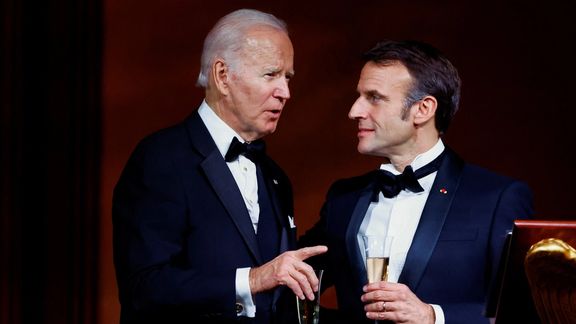
US President Joe Biden and France's President Emmanuel Macron making a toast, as the Bidens host the Macrons for a State Dinner at the White House, in Washington, December 1, 2022

A joint statement marking French President Emmanuel Marcon’s visit to the White House expressed “respect for the Iranian people, in particular women and youth.”

With an array of celebrities at a red-carpeted state dinner Thursday, Secretary of State Antony Blinken told France 2 TV he would support the French team if the United States were knocked out of the World Cup. The joint presidential statement called France the US’s oldest ally.

The two countries were at one in supporting global human rights and in Middle East policy, the presidents’ statement said. This included a “just solution to the Syrian conflict,” where US troops remain in the north east, backing the Abrahamic Accords, by which some Arab states have recognized Israel ahead of Palestinian statehood, and a determination that “Iran can never develop or acquire a nuclear weapon.”

While the statement expressed commitment to “democratic values,” respect for international law, and international cooperation to address Iran’s “nuclear escalation,” the Washington political mood is increasingly polarizing the US and western Europe on one side, against Iran, China, and Russia on the other.

Republicans and Democrats are vying to push harder. Senator Mario Rubio, an advocate of more US weapons for Israel, Wednesday demanded that President Joe Biden look into whether the Chinese tech company Tiandy’s involvement in Iran “raises serious questions about whether its products are being used against peaceful Iranian protesters.”

‘Barbaric treatment’

In a 20-minute interview for CNN, former secretary of state Hillary Rodham Clinton envisaged US foreign policy as a struggle for women’s rights. Highlighting violations by Russia, Iran and the Afghan Taliban, Clinton called for an “absolute rejection of using sexual attack as a weapon of war,” for holding leaders accountable for “barbaric treatment,” and for stepping up sophisticated arms supplies to Ukraine, including from Israel, whose new government needed to understand “Iran and Russia have made an alliance.”

Clinton explained her approach as secretary of state to protests in Iran after the disputed 2009 presidential election as due to intelligence assessments that “overt American support would actually hurt” and that “behind the scenes” activity was better. “Now it’s very different, what’s happening now deserves our full-throated support,” she said.

“I would not be negotiating with Iran on anything right now, including the nuclear agreement,” Clinton continued. With the US withdrawal in 2018 from the 2015 Iran nuclear agreement, “that horse is out of the barn,” she said, while the International Atomic Energy Agency (IAEA) had lost its “eyes” on Iran’s nuclear program as Tehran reduced the agency’s access in response to US sanctions and attacks on its atomic sites.

Clinton suggested that maintaining US ‘maximum pressure’ sanctions was to force “regime change” but rather to spark “internal discussions” in Iran, “not just [within] the government … but [within] the clerics.” This tied in with Rob Malley, the White House special envoy for Iran, telling Foreign Policy magazine in an interview this week that “the Iranian system is divided.”

‘Active diplomatic track’

The Biden administration’s approach is not without critics. Much of the ‘global south’ is increasingly wary of US ‘exceptionalism,’ accusing the US of hypocrisy and double standards. The US-France presidents’ statement expressed support for the International Criminal Court, which Washington has refused to join. Both India and Pakistan abstained on the recent US-sponsored resolution condemning Iran at the IAEA governing board. South Africa and Brazil are among those refusing to take sides over Nato and Ukraine.

Nor is opposition to talks with Iran unanimous, in the US or Europe. In the Washington Post Thursday, Ellie Geranmayeh, of the European Council on Foreign Relations, argued for “an active diplomacy track to reverse Iran’s nuclear conduct before it is too late.” Rejecting the case for more and more sanctions, she argued there was “little evidence” they had worked, since Iran had “escalated its behavior” in response.

“It is irresponsible to risk everything on the hope that a peaceful transition of power will place Iran’s nuclear program under democratic and safe control anytime soon,” Geranmayeh wrote.

But the issue now is not just nuclear escalation. It is also the deadly violence the Islamic Republic is using against antigovernment protesters, which leaves little room for sanctions relief. More than 450 protesters have been killed since mid-September while several have been sentenced to death.
Most Viewed

Ghalibaf defends Iran-US talks amid hardline backlash
1
INSIGHT

Ghalibaf defends Iran-US talks amid hardline backlash

2
INSIGHT

100 days after carnage: Iran economy reels from war, inflation, unemployment

3
INSIGHT

A nation in limbo: 100 days after the massacre, has the world moved on?

4
ANALYSIS

From instability to influence: Pakistan’s pivotal role in US-Iran diplomacy

5
ANALYSIS

100 days on: why Iran’s January protests spread across social classes

Banner
Banner

Spotlight

  • War-hit homeowners feel abandoned as Iran’s reconstruction aid fades

    War-hit homeowners feel abandoned as Iran’s reconstruction aid fades

  • 100 days on: the anatomy of Iran’s January crackdown
    INSIGHT

    100 days on: the anatomy of Iran’s January crackdown

  • Ghalibaf defends Iran-US talks amid hardline backlash
    INSIGHT

    Ghalibaf defends Iran-US talks amid hardline backlash

  • 100 days on: why Iran’s January protests spread across social classes
    ANALYSIS

    100 days on: why Iran’s January protests spread across social classes

  • From instability to influence: Pakistan’s pivotal role in US-Iran diplomacy
    ANALYSIS

    From instability to influence: Pakistan’s pivotal role in US-Iran diplomacy

  • A nation in limbo: 100 days after the massacre, has the world moved on?
    INSIGHT

    A nation in limbo: 100 days after the massacre, has the world moved on?

•
•
•

More Stories

Iran Hires Criminals To Kidnap, Murder Opponents Abroad: Washington Post

Dec 1, 2022, 17:33 GMT+0

The Washington Post says the Islamic Republic of Iran is beefing up its plans to kidnap and kill opponents abroad with the help of gangsters and criminal groups.

The Washington Post said in an article on Thursday, that the expansion of the Islamic Republic's “terror and kidnapping plots” has worried officials in Western countries.

The article is based on government documents and interviews with 15 officials in Washington, Europe and the Middle East, who spoke on the condition of anonymity to discuss sensitive information.

It adds that the tempo of the plots has significantly increased in the past two years, and they are among the most ambitious and far-reaching in recent memory, according to the officials and documents.

The paper goes on to quote officials that the Islamic Republic’s intelligence and security services depend largely on proxies to carry out their plans, “offering hundreds of thousands of dollars to jewel thieves, drug dealers and other criminals in murder-for-hire schemes.”

The Revolutionary Guard Intelligence Organization and the IRGC Quds Force have been mentioned as two main actors in designing these plots.

The Iranians’ recruitment of agents appears as varied as the geographic distribution of their targets.

That hands-off approach probably caused some operations to fail, the officials said, as plots have been disrupted — and, in some cases, the hired hit men appear to have gotten cold feet and never carried out their orders.

Iran’s Judiciary Tries Damage Control Over Major Hacking Leak

Dec 1, 2022, 08:59 GMT+0
•
Iran International Newsroom

Despite repeated denials by IRGC's Fras news agency about a recent hack of its data servers, Iran's judiciary has started an investigation into damaging leaks.

Prosecutor General of Tehran Ali Alghasi-Mehr said on Wednesday that the probe into the cyberattack against Fars news, a cultural propaganda machine with close links to Iran’s Revolutionary Guard, is because a significant database of personal information of journalists and employees has been leaked.

However, it seems that the investigation has been launched because the authorities are not sure what has been hacked and what database has been breached.

A new word has been coined to refer to the large amount of data leaked from the hack: Farsgate.

A 123-page document, a copy of which Iran International obtained, is among the material the hacktivist group Black Reward uncovered. The document which includes both hearsay and excerpts from domestic and foreign-based Persian media was made in one copy only for the eyes of the IRGC chief commander Hossein Salami. Earlier in the week, Black Reward also released some audio files from a meeting between Qasem Qoreyshi, the deputy commander of the paramilitary Basij and media representatives.

Prosecutor General of Tehran Ali Alghasi-Mehr (file photo)
100%
Prosecutor General of Tehran Ali Alghasi-Mehr

Black Reward announced on Friday, November 25, that it had attacked the database of Fars News Agency claiming that it deleted nearly 250 terabytes of data from all the servers and computers of the website and obtained confidential bulletins sent by the news agency to the office of the Supreme Leader Ali Khamenei. The report revealed a lot of recent orders by Khamenei about the ongoing protests that have engulfed the country since mid-September following the death of the 22-year-old Mahsa (Jina) Amini in the custody of morality police. Now, after several batches of information were leaked to the media, the authorities have started a damage control campaign to seize back the narrative, as most of the data prove that the Islamic Republic is frustrated and weary over its inability to end the protests.

The secret reports also revealed that most Iranians are getting ready for a revolution in the country as the popularity of the regime has dwindled, even among those considered supporters of the Islamic Republic. According to the documents, the level of dissatisfaction is so high that Khamenei has ordered some fundamental change in the structure of the regime in order to prevent a collapse.

The reports came as the protests in the country show no sign of ending and the movement has been spreading at universities and turning into strikes of employees in the industrial and services sectors, such as truckers.

While Iranian universities have turned into a battleground for antigovernment protests, students and professors in more than 150 universities around the world held events in support of the protests in Iran.

Meanwhile in Iran, Rasoul Jalili, the president of Tehran’s Sharif University of Technology, said on Wednesday that the university has increased its security staff by recruiting forces from private security companies. The measure is probably aimed at silencing those who criticize the university for allowing government security forces – especially the IRGC’s Basij paramilitary forces – to enter the campus to crack down on student rallies and sit-ins. If the measure proves successful, it can serve as a model for other universities to clamp down on students.

While Iranians have planned to hold three days of nationwide protests next week – 5-7 December – strikes by employees of industrial factories and truckers have injected fresh blood to the uprising.

Truck drivers and owners in several cities such as Esfahan, Bandar Abbas, Qazvin, and Kermanshah as well as many other western cities refrained from moving goods in support of the protests and strikes by industrial workers. Many people on social media describe the strike by the truckers as a significant blow to the Islamic Republic since it has the potential to cripple the economy. Some people say, “the truckers are leading the revolutionary uprising.” 

Islamic Republic Admits Failure Of Trade Deals With Iraq

Nov 30, 2022, 22:58 GMT+0
•
Iran International Newsroom

Supreme Leader Ali Khamenei has stressed the need to implement agreements signed between Iran and Iraq, admitting that most of such deals were never implemented. 

During a meeting with visiting Iraqi Prime Minister Mohammed Shia' al-Sudani in the capital Tehran Tuesday, Khamenei said numerous deals or memorandums were inked between Tehran and Baghdad, but they were rarely implemented. He especially called for moving towards action on projects in the fields of trade cooperation, transit of commodities and railroad transport. 

The Islamic Republic is known to have announced signing deals and contracts whenever officials from other countries visit but most of such announcements are never followed up or result in any tangible operations. Many figures are usually announced but when scrutinized they turn out to be fake or mere estimations. 

On Wednesday, board director of the Iranian Oil, Gas and Petrochemical Products Exporters’ Association, Hamid Hosseini, announced Tehran and Baghdad have concluded a $4 billion contract in the field of exporting technical and engineering services. However, the official added that “In the eight months of this year [beginning on March 20], exports to Iraq, except for electricity, totaled $4.7 billion, down by $1.4 billion compared to the same period last year.” It is expected that Iran exports to Iraq will reach $8-9 billion, Hosseini claimed, in the remaining four months.

Iraq has been Iran’s second largest trading partner after China, importing natural gas, but US banking sanctions on the Islamic Republic have made it difficult for Tehran to receive payments. Every now and then, the Islamic Republic claims that it has received its funds from Iraq. Payments for Iran’s gas and electricity imports by Iraq go to a special account in the state-owned Trade Bank of Iraq. Iran can only use the money for humanitarian commodities. The amount of money frozen in Iraq banks was over $6 billion in September, most probably the amount has grown since then. 

Iraqi Prime Minister Mohammed Shia al-Sudani (left) and Iranian President Ebrahim Raisi speak in a joint press conference in Tehran, on November 29, 2022.
100%
Iraqi Prime Minister Mohammed Shia al-Sudani (left) and Iranian President Ebrahim Raisi speak in a joint press conference in Tehran, on November 29, 2022.

The Iranian Oil Ministry also announced Tuesday that it has opened an office in Iraq. Oil Ministry’s special envoy to Iraq Seyyed Abbas Beheshti said that the mission will help facilitate the implementation of joint energy projects between Iran and Iraq. “This office was opened in the city of Baghdad for the purpose of promoting cooperation and synergy, especially in the implementation of joint oil, gas and energy projects between the two brotherly countries,” he added. Two other Iranian Oil Ministry missions will also open in oil-rich regions of Basra in the south and in the semi-autonomous region of Kurdistan in northern Iraq, he said. 

According to a recent article by a newspaper in Tehran, Iran has lost $450 billion in oil revenues in a decade because of international and US sanctions. Aftab News website based its calculation of lost revenues on OPEC’s annual oil export numbers and estimated that UN Security Council sanctions that came into play a decade ago and lasted more than 3 years, followed by US sanctions since 2018 cost Iran dearly.

President Ebrahim Raisi and his oil minister claim that Iran has increased oil output and exports to pre-2018 levels when former US president Donald Trump withdrew from the 2015 nuclear deal with Iran and began imposing sanctions on Iranian oil exports.

Iraq’s oil ministry said earlier in the year that it exported $11 billion of oil in March, the highest level for half a century, as crude prices soared in the wake of Russia’s invasion of Ukraine. Iraq’s record shipment of crude caught the attention of several Iranian pundits who drew attention on social media to Baghdad’s success, while Iran is still hampered by United States sanctions. The ministry said that the country exported "100,563,999 barrels for revenues of $11.07 billion, the highest revenue since 1972". This makes Iraq’s daily shipments three times more than Iran’s clandestine exports.

Iraqi Prime Minister Mohammed Shia al-Sudani, ran’s Supreme Leader Ali Khamenei, Iranian President Ebrahim Raisi (November 29, 2022)
100%

Al-Sudani's accompanying delegation includes Foreign Minister Fuad Hussein, veteran oil minister Hayan Abdulghani and Qasim al-Araji, a former interior minister and current national security adviser. This is the first visit by the new premier, who assumed office late in October. The visiting Iraqi officials held several meetings Tuesday, including with President Ebrahim Raisi. Al-Sudani and his delegation traveled to the religious city of Mashhad Wednesday. 

The new prime minister has already visited to Jordan and Kuwait and is set to visit Saudi Arabia later in December. His visit to Iran was aimed at consolidating Baghdad’s ties with Tehran.

In September, the head of Iran-Iraq Joint Chamber of Commerce, Jahanbakhsh Sanjabi Shirazi revealed that contrary to the government's claim, Iran's exports to Iraq have decreased in the past five months, 8 percent in terms of value and 28 percent in terms of weight.

Lebanese Group Condemns Khamenei’s Comment To Expand Influence In Country

Nov 30, 2022, 21:27 GMT+0

A large group of Lebanese politicians have slammed claims by Iran’s Supreme Leader who said recently that Tehran’s influence in Lebanon must be expanded.

The National Council for Ending Iranian Occupation says such remarks are a clear sign of Islamic Republic's intervention in Lebanon.

On Saturday, Khamenei once again called Lebanon a territory in Iran’s orbit, saying the active policy of the Islamic Republic in Lebanon, Syria and Iraq has led to the failure of “US plots” in these countries.

The Lebanese government has not yet reacted to these statements. However, The National Council for the Ending Iranian Occupation in a press conference said that the Lebanese presidential election is being controlled by Iran.

“After seven unsuccessful attempts to elect the president, the signs of fatigue are visible on your faces. The reason for this failure is that Lebanon is occupied by Iran,” added the statement.

According to the Lebanese media, the “Axis of Resistance” is one of how Iran is expanding its strategic influence in the region.

The term Axis of Resistance refers to an anti-Western, anti-Israeli and anti-Saudi political and informal military alliance between Iran, Palestinian militant groups, the Syrian government and the Lebanese Hezbollah.

The National Council for the Ending Iranian Occupation was officially launched in January to break free from Hezbollah's armed hegemony over the country that has always been a threat to Lebanese sovereignty.

Envoy In Tehran Summoned Over French Resolution

Nov 30, 2022, 19:58 GMT+0

Iran has summoned the French ambassador to Tehran over comments made by the country’s foreign minister in the National Assembly against the Islamic Republic.

Nicolas Roche was summoned on Wednesday to Iran’s Foreign Ministry over what Tehran calls “unacceptable” remarks by Catherine Colonna which led to approval of a resolution in the assembly on human rights in Iran.

Iran says, “the instrumental and dual use of human rights by France and some other European countries causes great regret to the Islamic Republic Iran.”

Tehran also said these countries “lack the legitimacy to raise such human rights claims.”

On Monday, the French National Assembly unanimously adopted a resolution offering "support for the Iranian people" and condemning the restriction of women's freedoms and rights. This comes ahead of another meeting of EU foreign ministers to discuss new sanctions over Iran’s crackdown on protesters.

President Emmanuel Macron's Renaissance party deputy Hadrien Ghomi, himself a descendant of Iranian immigrants, said the 149 votes in favor of the motion in the National Assembly "sent a strong message" to the world. The resolution condemns in the "strongest terms the brutal and widespread repression" against "non-violent demonstrators".

Foreign minister Colonna said the situation "requires action, with responsibility", adding that after two packages of sanctions already imposed at a European level, new sanctions are being prepared for the next Council of Foreign Ministers on 12 December.

Iran constantly accuses the West of double standards and meddling in its domestic affairs but continues to use deadly violence against protesters.