• العربية
  • فارسی
Brand
  • Iran Insight
  • Politics
  • Economy
  • Analysis
  • Special Report
  • Opinion
  • Podcast
  • Iran Insight
  • Politics
  • Economy
  • Analysis
  • Special Report
  • Opinion
  • Podcast
  • Theme
  • Language
    • العربية
    • فارسی
  • Iran Insight
  • Politics
  • Economy
  • Analysis
  • Special Report
  • Opinion
  • Podcast
All rights reserved for Volant Media UK Limited
volant media logo

Islamic Republic Admits Failure Of Trade Deals With Iraq
Iran International Newsroom
Nov 30, 2022, 22:58 GMT+0Updated: 17:39 GMT+1
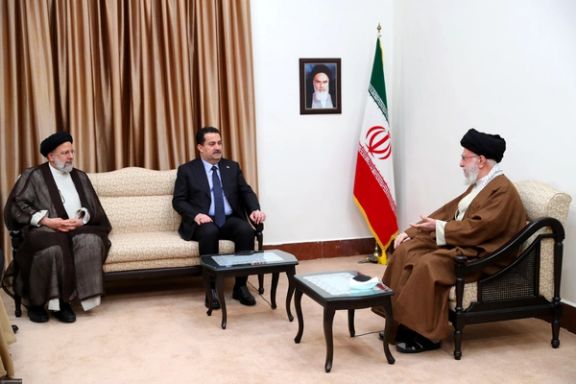
  Iraqi Prime Minister Mohammed Shia al-Sudani (center) and Iran’s Supreme Leader Ali Khamenei (right) and Iranian President Ebrahim Raisi on November 29, 2022
Iraqi Prime Minister Mohammed Shia al-Sudani (center) and Iran’s Supreme Leader Ali Khamenei (right) and Iranian President Ebrahim Raisi on November 29, 2022

Supreme Leader Ali Khamenei has stressed the need to implement agreements signed between Iran and Iraq, admitting that most of such deals were never implemented. 

During a meeting with visiting Iraqi Prime Minister Mohammed Shia' al-Sudani in the capital Tehran Tuesday, Khamenei said numerous deals or memorandums were inked between Tehran and Baghdad, but they were rarely implemented. He especially called for moving towards action on projects in the fields of trade cooperation, transit of commodities and railroad transport. 

The Islamic Republic is known to have announced signing deals and contracts whenever officials from other countries visit but most of such announcements are never followed up or result in any tangible operations. Many figures are usually announced but when scrutinized they turn out to be fake or mere estimations. 

On Wednesday, board director of the Iranian Oil, Gas and Petrochemical Products Exporters’ Association, Hamid Hosseini, announced Tehran and Baghdad have concluded a $4 billion contract in the field of exporting technical and engineering services. However, the official added that “In the eight months of this year [beginning on March 20], exports to Iraq, except for electricity, totaled $4.7 billion, down by $1.4 billion compared to the same period last year.” It is expected that Iran exports to Iraq will reach $8-9 billion, Hosseini claimed, in the remaining four months.

Iraq has been Iran’s second largest trading partner after China, importing natural gas, but US banking sanctions on the Islamic Republic have made it difficult for Tehran to receive payments. Every now and then, the Islamic Republic claims that it has received its funds from Iraq. Payments for Iran’s gas and electricity imports by Iraq go to a special account in the state-owned Trade Bank of Iraq. Iran can only use the money for humanitarian commodities. The amount of money frozen in Iraq banks was over $6 billion in September, most probably the amount has grown since then. 

Iraqi Prime Minister Mohammed Shia al-Sudani (left) and Iranian President Ebrahim Raisi speak in a joint press conference in Tehran, on November 29, 2022.
100%
Iraqi Prime Minister Mohammed Shia al-Sudani (left) and Iranian President Ebrahim Raisi speak in a joint press conference in Tehran, on November 29, 2022.

The Iranian Oil Ministry also announced Tuesday that it has opened an office in Iraq. Oil Ministry’s special envoy to Iraq Seyyed Abbas Beheshti said that the mission will help facilitate the implementation of joint energy projects between Iran and Iraq. “This office was opened in the city of Baghdad for the purpose of promoting cooperation and synergy, especially in the implementation of joint oil, gas and energy projects between the two brotherly countries,” he added. Two other Iranian Oil Ministry missions will also open in oil-rich regions of Basra in the south and in the semi-autonomous region of Kurdistan in northern Iraq, he said. 

According to a recent article by a newspaper in Tehran, Iran has lost $450 billion in oil revenues in a decade because of international and US sanctions. Aftab News website based its calculation of lost revenues on OPEC’s annual oil export numbers and estimated that UN Security Council sanctions that came into play a decade ago and lasted more than 3 years, followed by US sanctions since 2018 cost Iran dearly.

President Ebrahim Raisi and his oil minister claim that Iran has increased oil output and exports to pre-2018 levels when former US president Donald Trump withdrew from the 2015 nuclear deal with Iran and began imposing sanctions on Iranian oil exports.

Iraq’s oil ministry said earlier in the year that it exported $11 billion of oil in March, the highest level for half a century, as crude prices soared in the wake of Russia’s invasion of Ukraine. Iraq’s record shipment of crude caught the attention of several Iranian pundits who drew attention on social media to Baghdad’s success, while Iran is still hampered by United States sanctions. The ministry said that the country exported "100,563,999 barrels for revenues of $11.07 billion, the highest revenue since 1972". This makes Iraq’s daily shipments three times more than Iran’s clandestine exports.

Iraqi Prime Minister Mohammed Shia al-Sudani, ran’s Supreme Leader Ali Khamenei, Iranian President Ebrahim Raisi (November 29, 2022)
100%

Al-Sudani's accompanying delegation includes Foreign Minister Fuad Hussein, veteran oil minister Hayan Abdulghani and Qasim al-Araji, a former interior minister and current national security adviser. This is the first visit by the new premier, who assumed office late in October. The visiting Iraqi officials held several meetings Tuesday, including with President Ebrahim Raisi. Al-Sudani and his delegation traveled to the religious city of Mashhad Wednesday. 

The new prime minister has already visited to Jordan and Kuwait and is set to visit Saudi Arabia later in December. His visit to Iran was aimed at consolidating Baghdad’s ties with Tehran.

In September, the head of Iran-Iraq Joint Chamber of Commerce, Jahanbakhsh Sanjabi Shirazi revealed that contrary to the government's claim, Iran's exports to Iraq have decreased in the past five months, 8 percent in terms of value and 28 percent in terms of weight.


Most Viewed

Ideology may be fading in Iran, but not in Kashmir's ‘Mini Iran'
1
INSIGHT

Ideology may be fading in Iran, but not in Kashmir's ‘Mini Iran'

2
INSIGHT

Hardliners push Hormuz ‘red line’ as US blockade tests Iran’s leverage

3
VOICES FROM IRAN

Hope and anger in Iran as fragile ceasefire persists

4

Iran International says it won’t be silenced after London arson attack

5

US sanctions oil network tied to Iranian tycoon Shamkhani

Banner
Banner

Spotlight

  • Hardliners push Hormuz ‘red line’ as US blockade tests Iran’s leverage
    INSIGHT

    Hardliners push Hormuz ‘red line’ as US blockade tests Iran’s leverage

  • Ideology may be fading in Iran, but not in Kashmir's ‘Mini Iran'
    INSIGHT

    Ideology may be fading in Iran, but not in Kashmir's ‘Mini Iran'

  • War damage amounts to $3,000 per Iranian, with blockade set to add to losses
    INSIGHT

    War damage amounts to $3,000 per Iranian, with blockade set to add to losses

  • Why the $100 billion Hormuz toll revenue is a myth
    ANALYSIS

    Why the $100 billion Hormuz toll revenue is a myth

  • US blockade targets Iran oil boom amid regional disruption
    ANALYSIS

    US blockade targets Iran oil boom amid regional disruption

  • Iran's digital economy battered by prolonged blackout
    INSIGHT

    Iran's digital economy battered by prolonged blackout

•
•
•

More Stories

Lebanese Group Condemns Khamenei’s Comment To Expand Influence In Country

Nov 30, 2022, 21:27 GMT+0

A large group of Lebanese politicians have slammed claims by Iran’s Supreme Leader who said recently that Tehran’s influence in Lebanon must be expanded.

The National Council for Ending Iranian Occupation says such remarks are a clear sign of Islamic Republic's intervention in Lebanon.

On Saturday, Khamenei once again called Lebanon a territory in Iran’s orbit, saying the active policy of the Islamic Republic in Lebanon, Syria and Iraq has led to the failure of “US plots” in these countries.

The Lebanese government has not yet reacted to these statements. However, The National Council for the Ending Iranian Occupation in a press conference said that the Lebanese presidential election is being controlled by Iran.

“After seven unsuccessful attempts to elect the president, the signs of fatigue are visible on your faces. The reason for this failure is that Lebanon is occupied by Iran,” added the statement.

According to the Lebanese media, the “Axis of Resistance” is one of how Iran is expanding its strategic influence in the region.

The term Axis of Resistance refers to an anti-Western, anti-Israeli and anti-Saudi political and informal military alliance between Iran, Palestinian militant groups, the Syrian government and the Lebanese Hezbollah.

The National Council for the Ending Iranian Occupation was officially launched in January to break free from Hezbollah's armed hegemony over the country that has always been a threat to Lebanese sovereignty.

Envoy In Tehran Summoned Over French Resolution

Nov 30, 2022, 19:58 GMT+0

Iran has summoned the French ambassador to Tehran over comments made by the country’s foreign minister in the National Assembly against the Islamic Republic.

Nicolas Roche was summoned on Wednesday to Iran’s Foreign Ministry over what Tehran calls “unacceptable” remarks by Catherine Colonna which led to approval of a resolution in the assembly on human rights in Iran.

Iran says, “the instrumental and dual use of human rights by France and some other European countries causes great regret to the Islamic Republic Iran.”

Tehran also said these countries “lack the legitimacy to raise such human rights claims.”

On Monday, the French National Assembly unanimously adopted a resolution offering "support for the Iranian people" and condemning the restriction of women's freedoms and rights. This comes ahead of another meeting of EU foreign ministers to discuss new sanctions over Iran’s crackdown on protesters.

President Emmanuel Macron's Renaissance party deputy Hadrien Ghomi, himself a descendant of Iranian immigrants, said the 149 votes in favor of the motion in the National Assembly "sent a strong message" to the world. The resolution condemns in the "strongest terms the brutal and widespread repression" against "non-violent demonstrators".

Foreign minister Colonna said the situation "requires action, with responsibility", adding that after two packages of sanctions already imposed at a European level, new sanctions are being prepared for the next Council of Foreign Ministers on 12 December.

Iran constantly accuses the West of double standards and meddling in its domestic affairs but continues to use deadly violence against protesters.

Venezuela Today, Iran Tomorrow? Leeway To Sell Oil

Nov 30, 2022, 19:45 GMT+0
•
Iran International Newsroom

Is a United States decision to ease oil sanctions on Venezuela a precedent for dealing with Iran? Or does it reduce pressure to get more Iranian oil to market?

A move by administration of President Joe Biden to allow Chevron, the second biggest US oil company, to export Venezuelan oil followed talks beginning Saturday in Mexico between the government of President Nicolas Maduro and the opposition. Revenues currently frozen abroad will be ringfenced by the United Nations into ‘humanitarian spending.’

Battling high inflation, alongside food and medicine shortages, the Venezuelan government has said the “kidnapped” fund would go into helping stabilize the electric grid, improve education infrastructure, and improve the response to this year’s flooding. The UN will manage a fund for over $3 billion currently held by US and European banks fearful of punitive US measures.

But the decision has been criticized on several grounds. The Boston Herald in an editorial November 28 mocked Biden’s interest in “climate-destroying fossil fuels,” suggesting he was offering the Venezuelan government “a political reward” while appeasing US “eco-progressives” over US shale production, slowing as the release of US emergency reserves eases, while the December 5 deadline for tighter Russia sanctions looms.

Venezuelan president Maduro in Tehran meeting with his Iranian counterpart Ebrahim Raisi on June 11, 2022
100%
Venezuelan president Maduro in Tehran meeting with his Iranian counterpart Ebrahim Raisi on June 11, 2022

An investigation by the Reuters news agency, in a feature published Wednesday, highlighted close links between Venezuela and Iran in cooperating to evade Washington’s eagle eye on oil transports. Reuters reported super-tanker Young Yong disguising Venezuelan oil as Malaysian oil. The vessel belongs to a company owned by a Ukrainian national also sanctioned, and is one of three tankers designated November 3 by the US for forging documents to ship Tehran’s oil and so evade US sanctions on Iran.

Gaining an economic windfall

Links between Caracas and Tehran partly explain those arguing against relaxing US pressure on Maduro government and that a double standard is at play. Eddy Acevedo, an advisor at the Wilson Centre, has argued that “both rogue regimes are looking to extract concessions in hopes of gaining an economic windfall.”

Iran and Venezuela in June signed a 20-year cooperation agreement, three years after President Donald Trump in 2019 ramped up sanctions against Venezuela after Maduro won the disputed 2018 election and four years after Trump launched ‘maximum pressure’ against Iran as he withdrew the US from the 2015 Iran nuclear agreement.

Tomas Guanipa, leader of the opposition party "Primero Justicia", after the resumption of political talks between the Venezuelan government and the opposition in Caracas, November 30, 2022
100%
Tomas Guanipa, leader of the opposition party "Primero Justicia", after the resumption of political talks between the Venezuelan government and the opposition in Caracas, November 30, 2022

The Reuters report suggested Iran had “pioneered” the use of false documents to conceal the origins of cargoes. According to the news agency, around 200 tankers, including 82 super-tankers able to carry up to 2 million barrels, have been involved in servicing both Venezuela and Iran, with the south American country exporting over 360 million barrels in the face on US sanctions since 2019.

‘Smart’ sanctions?

Documentation in the Young Yong case were supplied to Reuters by advocacy group United Against Nuclear Iran, which has since 2013 tracked Iran’s oil traffic to “disrupt…[its] attempts to generate profits from oil sales and further isolate the regime economically.”

So, what are the implications of the Venezuela decision for US Iran policy, when Biden still aims to reach diplomatic agreement to revive the 2015 nuclear agreement? Some analysts in Tehran have argued that Europe’s need for energy in the wake of sanctions against Russia, coupled with upward pressure on US gasoline prices, increased the likelihood of Washington meeting the Iranian demands of ‘guarantees’ that have reportedly stymied talks to revive the 2015 agreement, the JCPOA (Joint Comprehensive Plan of Action).

A decision to replace blanket sanctions on Venezuela with ‘smarter’ measures could create a precedent over Iran. As the Venezuela decision loomed earlier in the month, Reuters suggested the US was looking to replace hidden oil trade, a response to sanctions, with transparent transactions. But at the same time, Venezuela pumping more oil could reduce pressure on Biden to compromise with Iran.

Iraqi PM Tells Raisi Baghdad Will Not Allow Threats From Its Territory

Nov 29, 2022, 15:18 GMT+0

While Iran’s IRGC has launched missile attacks on Iraq’s Kurdistan region, Iraqi Prime Minister says his government will not allow its territory to be used to “harm any side.”

Mohammed Shia' Al Sudani made the comments Tuesday in a meeting with Iranian President Ebrahim Raisi as part of his visit to the Iranian capital.

The Iraqi official said, “It is the policy of the Iraqi government that this country should not be the starting point for actions harming the countries of the region.”

In the meeting, Ebrahim Raisi claimed the Islamic Republic supports a united and strong government in Iraq.

Raisi said relations between Tehran and Baghdad must be expanded to establish more peace and stability in the region and the world.

Since the eruption of nationwide protests in Iran, regime officials have accused Kurdish opposition groups in northern Iraq of fueling the unrest, with the IRGC repeatedly launching deadly attacks on the neighboring country’s northern territories.

The latest round of shelling of Iraqi Kurdistan region drew condemnation by Western countries as well as the Iraqi government.

Iraqi Foreign Minister Fuad Hussein decried the attacks as a violation of Iraq's sovereignty and Kurdistan Region Prime Minister Masrour Barzani also condemned the “violations” of Iraq and its Kurdish region’s sovereignty.

The US also strongly condemned Iran’s “violations of Iraqi sovereignty”, calling on the Islamic Republic to stop attacking its neighbor.

Global Pressure On Iran Increases Incrementally As Protests Continue

Nov 29, 2022, 12:40 GMT+0

Many countries and international organizations have voiced support for protests in Iran by adopting resolutions and issuing condemnations of government violence, but people wonder about tangible actions. 

Many countries and international organizations have voiced support for protests in Iran by adopting resolutions and issuing condemnations of government violence, but people wonder about tangible actions. 

The United States Monday circulated a draft resolution on a measure to expel the Islamic Republic from the UN Commission on the Status of Women. The measure to remove Iran from the women's equality and empowerment body is scheduled to be voted on December 14. 

The Islamic Republic has just started a four-year term on the 45-member commission, which meets annually every March.

The document also denounces Iran's policies as "flagrantly contrary to the human rights of women and girls and to the mandate of the Commission on the Status of Women." Canada, New Zealand, Netherlands and the United States are behind the push.

The resolution would "remove with immediate effect the Islamic Republic of Iran from the Commission on the Status of Women for the remainder of its 2022-2026 term."

"The US and others have been actively working the phones to garner support to remove Iran from the UN Commission on the Status of Women," said a UN diplomat, speaking on condition of anonymity to Reuters. "It seems like they're making traction – including with some initially hesitant countries."

 A general view of a session of France's National Assembly in Paris (file photo)
100%
A general view of a session of France's National Assembly in Paris

Also on Monday, the French National Assembly unanimously adopted a resolution offering "support for the Iranian people" and condemning the restriction of women's freedoms and rights. This comes ahead of another meeting of EU foreign ministers to discuss new sanctions over the crackdown on protesters.

President Emmanuel Macron's Renaissance party deputy Hadrien Ghomi, himself a descendant of Iranian immigrants, said the 149 votes in favor of the motion in the National Assembly "sent a strong message" to the world. The resolution condemns in the "strongest terms the brutal and widespread repression" against "non-violent demonstrators".

French Foreign Minister Catherine Colonna said that the situation "requires action, with responsibility", adding that after two packages of sanctions already imposed at a European level, new sanctions are being prepared for the next Council of Foreign Ministers on 12 December.

But many Iranians ask if statements and resolutions are enough to pressure the theocratic regime in Tehran. More forceful steps, such as closing all European embassies in Iran or imposing more sanction to directly pressure the ruling elite are possible additional measures people mention in their social media posts.

These all came after the Geneva-based UN Rights Council last week voted to appoint an independent investigation into the Islamic Republic's deadly repression of protests, passing the motion to cheers of activists. Accused Western states of using the council to target Iran in an "appalling and disgraceful" move, Tehran said Monday that it will reject the investigation into the country's repression of antigovernment protests, like it refused to cooperate with UN human rights rapporteurs for 30 years.

Some Iranian officials have started to acknowledge some of its atrocities with Revolutionary Guards general Amirali Hajizadeh saying Tuesday that more than 300 people have been killed in the protests, acknowledging that innocent people have also been killed.

"Everyone in the country has been affected by the death of this lady [Amini]. I don't have the latest figures, but I think we have had perhaps more than 300 martyrs and people killed in this country, including children, since this incident," said Hajizadeh, head of the Guards' aerospace division.