• العربية
  • فارسی
Brand
  • Iran Insight
  • Politics
  • Economy
  • Analysis
  • Special Report
  • Opinion
  • Podcast
  • Iran Insight
  • Politics
  • Economy
  • Analysis
  • Special Report
  • Opinion
  • Podcast
  • Theme
  • Language
    • العربية
    • فارسی
  • Iran Insight
  • Politics
  • Economy
  • Analysis
  • Special Report
  • Opinion
  • Podcast
All rights reserved for Volant Media UK Limited
volant media logo

Iran’s Judiciary Tries Damage Control Over Major Hacking Leak
Iran International Newsroom
Dec 1, 2022, 08:59 GMT+0Updated: 18:12 GMT+1
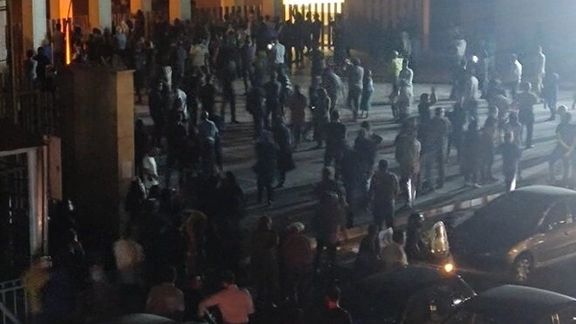
Security forces around Sharif University on October 2, 2022

Despite repeated denials by IRGC's Fras news agency about a recent hack of its data servers, Iran's judiciary has started an investigation into damaging leaks.

Prosecutor General of Tehran Ali Alghasi-Mehr said on Wednesday that the probe into the cyberattack against Fars news, a cultural propaganda machine with close links to Iran’s Revolutionary Guard, is because a significant database of personal information of journalists and employees has been leaked.

However, it seems that the investigation has been launched because the authorities are not sure what has been hacked and what database has been breached.

A new word has been coined to refer to the large amount of data leaked from the hack: Farsgate.

A 123-page document, a copy of which Iran International obtained, is among the material the hacktivist group Black Reward uncovered. The document which includes both hearsay and excerpts from domestic and foreign-based Persian media was made in one copy only for the eyes of the IRGC chief commander Hossein Salami. Earlier in the week, Black Reward also released some audio files from a meeting between Qasem Qoreyshi, the deputy commander of the paramilitary Basij and media representatives.

Prosecutor General of Tehran Ali Alghasi-Mehr (file photo)
100%
Prosecutor General of Tehran Ali Alghasi-Mehr

Black Reward announced on Friday, November 25, that it had attacked the database of Fars News Agency claiming that it deleted nearly 250 terabytes of data from all the servers and computers of the website and obtained confidential bulletins sent by the news agency to the office of the Supreme Leader Ali Khamenei. The report revealed a lot of recent orders by Khamenei about the ongoing protests that have engulfed the country since mid-September following the death of the 22-year-old Mahsa (Jina) Amini in the custody of morality police. Now, after several batches of information were leaked to the media, the authorities have started a damage control campaign to seize back the narrative, as most of the data prove that the Islamic Republic is frustrated and weary over its inability to end the protests.

The secret reports also revealed that most Iranians are getting ready for a revolution in the country as the popularity of the regime has dwindled, even among those considered supporters of the Islamic Republic. According to the documents, the level of dissatisfaction is so high that Khamenei has ordered some fundamental change in the structure of the regime in order to prevent a collapse.

The reports came as the protests in the country show no sign of ending and the movement has been spreading at universities and turning into strikes of employees in the industrial and services sectors, such as truckers.

While Iranian universities have turned into a battleground for antigovernment protests, students and professors in more than 150 universities around the world held events in support of the protests in Iran.

Meanwhile in Iran, Rasoul Jalili, the president of Tehran’s Sharif University of Technology, said on Wednesday that the university has increased its security staff by recruiting forces from private security companies. The measure is probably aimed at silencing those who criticize the university for allowing government security forces – especially the IRGC’s Basij paramilitary forces – to enter the campus to crack down on student rallies and sit-ins. If the measure proves successful, it can serve as a model for other universities to clamp down on students.

While Iranians have planned to hold three days of nationwide protests next week – 5-7 December – strikes by employees of industrial factories and truckers have injected fresh blood to the uprising.

Truck drivers and owners in several cities such as Esfahan, Bandar Abbas, Qazvin, and Kermanshah as well as many other western cities refrained from moving goods in support of the protests and strikes by industrial workers. Many people on social media describe the strike by the truckers as a significant blow to the Islamic Republic since it has the potential to cripple the economy. Some people say, “the truckers are leading the revolutionary uprising.” 

Most Viewed

Iran International says it won’t be silenced after London arson attack
1

Iran International says it won’t be silenced after London arson attack

2
VOICES FROM IRAN

Hope and anger in Iran as fragile ceasefire persists

3

Iran halts petrochemical exports to supply domestic market

4
INSIGHT

How Tehran bends its own red lines to boost state rallies

5

US arrests Iranian national over alleged Basij-linked visa fraud

Banner
Banner

Spotlight

  • Hardliners push Hormuz ‘red line’ as US blockade tests Iran’s leverage
    INSIGHT

    Hardliners push Hormuz ‘red line’ as US blockade tests Iran’s leverage

  • Ideology may be fading in Iran, but not in Kashmir's ‘Mini Iran'
    INSIGHT

    Ideology may be fading in Iran, but not in Kashmir's ‘Mini Iran'

  • War damage amounts to $3,000 per Iranian, with blockade set to add to losses
    INSIGHT

    War damage amounts to $3,000 per Iranian, with blockade set to add to losses

  • Why the $100 billion Hormuz toll revenue is a myth
    ANALYSIS

    Why the $100 billion Hormuz toll revenue is a myth

  • US blockade targets Iran oil boom amid regional disruption
    ANALYSIS

    US blockade targets Iran oil boom amid regional disruption

  • Iran's digital economy battered by prolonged blackout
    INSIGHT

    Iran's digital economy battered by prolonged blackout

•
•
•

More Stories

Iran Sentences Four To Death For ‘Ties With Mossad’

Nov 30, 2022, 14:27 GMT+0

The Islamic Republic has sentenced four people to death for what the judiciary calls “cooperating with the Israeli intelligence service and committing kidnappings.”

Iran’s Mizan News Agency, which is affiliated with the Judiciary, said Wednesday that the four, who had been arrested back in June, have been “destroying private and public property and obtaining fake confessions.”

The Islamic Republic has long accused arch-enemy Israel of carrying out covert operations on its soil. However, it has not provided evidence to prove its claims against those who received the death penalty. Iran’s judiciary never holds such trials transparently and it is not clear if such trials have indeed been held.

Throughout the years, due process has not been implemented during political and security trials while the Islamic Republic often accuses Israel and the West of having spies in the country.

This time the identities of the accused have been announced, alleging that “with guidance from the Israeli intelligence service, this network of thugs” were committing crimes.

Israeli is believed to have been behind assassinations and acts of sabotage against Iran’s nuclear facilities, but no one was ever put on trial for these incidents.

On Wednesday, three other people were handed prison sentences of between five and 10 years for alleged crimes such as acting against national security and possessing illegal weapons.

International community and human rights organizations have repeatedly expressed concerns about Islamic Republic’s detentions, sham trials, and the death sentence for people.

Iran Should Stop Providing Russia With Ammunition: NATO

Nov 30, 2022, 11:06 GMT+0

NATO has warned the Islamic Republic that it should not provide Moscow with arms and ammunition in its war against Ukraine.

At a meeting of foreign ministers of the defense alliance’s members in Bucharest on Tuesday, NATO Secretary-General Jens Stoltenberg said Russia has asked Iran to provide it with weapons because it was “running low on ammunitions.”

“We are saying very clearly that no country should support Russia’s illegal war, and therefore, Iran and no other country should provide Russia with missiles, drones or anything else that can help them to continue this brutal war of aggression against Ukraine,” added Stoltenberg.

He further noted that Iran and no other country should provide Russia with “missiles, drones or anything else that can help them to continue this brutal war of aggression against Ukraine.”

Elsewhere in his remarks, Stoltenberg stated that Vladimir Putin's brutal invasion of Ukraine is failing in Ukraine.

Russia has been using Iranian drones in its air attacks against the Ukrainians. In October and November, it targeted Ukraine’s civilian energy infrastructure, plunging it into blackouts as the winter cold has begun across the country. Amid international outcry over the Islamic Republic’s supply of drones for the Russian invasion, Ukrainian President Volodymyr Zelenskiy told a meeting of UN security council November 23, that the attacks are “an obvious crime against humanity” adding that Kyiv would put forward a resolution condemning “any forms of energy terror”.

Iran To Try 10 Underage Protesters On Death Penalty Charges

Nov 30, 2022, 09:32 GMT+0

A Revolutionary Court of the Islamic Republic will try ten adolescent protesters Wednesday on charges of “war against God, corruption on earth and murder” that can carry the death sentence.

The move has led to widespread objections as several activists and organizations have expressed deep concern.

A committee monitoring the situation of recent protest detainees said, “these children are not having their own defense teams and lawyers appointed by the judiciary are supposed to represent them.”

A law in Iran forbids those charged with political crimes to hire their own lawyers.

They are charged in the death of a Basij militia member during protests on November 3 in Karaj west of Tehran.

Mohsen Borhani, a lawyer, and professor at Tehran University, had earlier warned about the trial of several detained minors in revolutionary courts.

During the popular uprising in Iran, over 18,000 citizens have been arrested and some of them were accused of “corruption on earth” and “war against God” which may carry the death penalty.

On Tuesday, Amnesty International called on governments with embassies in Iran to send observers to ongoing trials where protesters are at risk of being sentenced to death.

Amnesty said in a tweet this includes a group trial starting November 30 of 11 people, before Branch 1 of Revolutionary Court in Alborz.

“Amnesty is also extremely concerned at reports indicating children are among those at risk of being sentenced to death in mass trials in connection with protests, which would be a flagrant violation of international law,” it added in a statement.

Iran’s Sunni Clerics Decry Repression, Renew Support For Abdolhamid

Nov 29, 2022, 17:17 GMT+0
•
Iran International Newsroom

A group of Sunni religious leaders in several Baluch cities across Sistan-Baluchestan province called on the Islamic Republic to stop its repression machinery used against protesters. 

In a joint video statement released on Monday, Friday prayer Imams and religious scholars from Khash, Taftan, Mijaveh and their neighboring towns decried the regime’s appalling attacks against the people of Kurdish majority cities, the killings on September 30 dubbed as ‘Bloody Friday’ in Zahedan, and a brutal crackdown of Khash residents on November 4, among others. 

Protesting Islamic Republic’s violations of human rights and dignity, they said religious leaders, elders and intellectuals in the province with a unified voice condemn government’s violent reaction to protests across the country and show their “national solidarity.”

The clerics said the attacks against the people at the Grand Makki Mosque -- the largest Sunni mosque in Iran located in the center of Zahedan – and Al-Khalil Mosque in Khash, where security forces arrested many people, and similar incidents across the province are aimed at fomenting fear among the people to dissuade them from attending prayers at mosques. They denounced the strategy by the Islami Republic as “Mosquephobia,” apparently because the mosques are places where Sunni people gather to listen to their community leaders criticize the regime. 

The signatories of the statement also called for "the release of all political prisoners in Iran, who were arrested during the recent protests." Noting that peaceful protest is the people's right, they also urged the authorities to address issues regarding women's rights. “The voices of the Iranian people should be heard," they added. 

Emphasizing that the relentless ethnic and religious discrimination that has persisted over four decades of the Islamic Republic, the Sunni clerics expressed support for “the wise positions” of Mowlavi Abdolhamid as the serious and legitimate demands of the people. 

Molavi Abdolhamid among supporters before the current protests began (file photo)
100%
Molavi Abdolhamid among supporters before the current protests began

Molavi Abdolhamid, officially known as Sheikh Abdolhamdid Esmailzehi, is the most prominent religious leader of Iran's largely Sunni Baluch population living in the province. Abdolhamid's popularity is largely because of his willingness to challenge the absolute authority of Supreme Leader Ali Khamenei. Earlier in November, the outspoken Sunni Imam said women, ethnic and religious groups, and minorities have faced discrimination after the establishment of the Islamic Republic in 1979. He was also brave enough to blame Khamenei for the attack on protesters in his hometown, Zahedan, known as the Bloody Friday. It took place September 30, when security forces killed about 100 people, and injured hundreds. Earlier in the month, he called for an internationally monitored referendum, saying by killing and suppression the government cannot push back a nation. 

The statement by the Sunni clergymen came a day after an audio file was leaked by the hacktivist group Black Reward, revealing the Islamic Republic’s plan to tarnish Abdolhamid’s reputation. The audio tape from a meeting between a Revolutionary Guard general and a group of media managers or representatives from outfits affiliated with the IRGC, revealed that Khamenei demanded Mowlavi Abdolhamid be warned over his comments. Qasem Qoreyshi, the deputy commander of IRGC’s paramilitary Basij forces, also said in the meeting that “We made a mistake about Abdolhamid. We first eliminated tribal leaders in the region to give more credit to Abdolhamid. However, he didn’t carry much weight [in the past].”

In a similar joint video statement released earlier in the month, Sunni religious leaders and Friday prayer Imams in Iran’s Kordestan province also called for a referendum under the supervision of international bodies. The Sunni clerics of Sanandaj and Dehgolan called for a plebiscite with the presence of religious and national leaders, as well as neutral international observers to “get out of the current situation.”

Iraqi PM Tells Raisi Baghdad Will Not Allow Threats From Its Territory

Nov 29, 2022, 15:18 GMT+0

While Iran’s IRGC has launched missile attacks on Iraq’s Kurdistan region, Iraqi Prime Minister says his government will not allow its territory to be used to “harm any side.”

Mohammed Shia' Al Sudani made the comments Tuesday in a meeting with Iranian President Ebrahim Raisi as part of his visit to the Iranian capital.

The Iraqi official said, “It is the policy of the Iraqi government that this country should not be the starting point for actions harming the countries of the region.”

In the meeting, Ebrahim Raisi claimed the Islamic Republic supports a united and strong government in Iraq.

Raisi said relations between Tehran and Baghdad must be expanded to establish more peace and stability in the region and the world.

Since the eruption of nationwide protests in Iran, regime officials have accused Kurdish opposition groups in northern Iraq of fueling the unrest, with the IRGC repeatedly launching deadly attacks on the neighboring country’s northern territories.

The latest round of shelling of Iraqi Kurdistan region drew condemnation by Western countries as well as the Iraqi government.

Iraqi Foreign Minister Fuad Hussein decried the attacks as a violation of Iraq's sovereignty and Kurdistan Region Prime Minister Masrour Barzani also condemned the “violations” of Iraq and its Kurdish region’s sovereignty.

The US also strongly condemned Iran’s “violations of Iraqi sovereignty”, calling on the Islamic Republic to stop attacking its neighbor.






