• العربية
  • فارسی
Brand
  • Iran Insight
  • Politics
  • Economy
  • Analysis
  • Special Report
  • Opinion
  • Podcast
  • Iran Insight
  • Politics
  • Economy
  • Analysis
  • Special Report
  • Opinion
  • Podcast
  • Theme
  • Language
    • العربية
    • فارسی
  • Iran Insight
  • Politics
  • Economy
  • Analysis
  • Special Report
  • Opinion
  • Podcast
All rights reserved for Volant Media UK Limited
volant media logo

Iran Politician Suggests Referendum On Foreign Policy Issues

Iran International Newsroom
Nov 28, 2022, 08:49 GMT+0Updated: 17:40 GMT+1
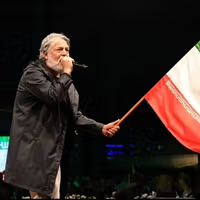
Iranian politician Ali Motahari

A former lawmaker in Iran has suggested that the government should put the future of the nuclear deal and support for Russia's war in Ukraine to a referendum.

In an interview with moderate conservative website Khabar Online, Ali Motahari blamed the Raisi administration for the country's economic problems without mentioning Supreme Leader Ali Khamenei's responsibility. However, when speaking on key issues such as reforming election law, negotiating with the United States to revive the JCPOA, and aligning with Russia in its war against Ukraine, he acknowledged that it is Khamenei who has the final say on key issues.

Motahari is a social conservative who has sometimes been an outspoken critic when the hardliner core of the regime has violated insider rules or taken steps leading to more international isolation.

Speaking on the ongoing protests in Iran, Motahari said that people's hopelessness about their future triggered the current wave of protests. Blaming the existing economic crisis and hard-line policies as the root causes of the protests, he agreed that creating a moderate political grouping might help resolve the country's current economic and political impasse.

He also maintained that the government's indecision about the nuclear deal, economic problems and even the ongoing protests has lent momentum to the popular uprising.

The idea of holding a referendum on major issues is not new. Former President Hassan Rouhani proposed the idea on several occasions, angering Khamenei and his followers.

In another development, in an article entitled "The government's Autumn hibernation," Khabar online criticized Raisi and his administration for being absent from the public scene and for their indifference in the face of recent UN and IAEA resolutions about Iran's human rights record and its nuclear program.

The article concluded that "Raisi's indecision and his government's absence in public arena to tackle problems has gradually turned cultural, foreign policy, economic and social issues into security problems" for the country and the nation.

At the same time, it criticized Raisi for failing to understand and prioritize the problems Iran is currently facing and for turning the issues that should normally have conventional solutions into unwanted crises. In other words, Raisi's absence has provided opportunities for forces outside the presidential administration to get involved in policy making behind-the-scenes and impose a high cost on the government.

Khabar Online did not name those forces, but it was presumably referring to influence by Khamenei's many offices, influential clerics and IRGC officers who intervene in the affairs of the state.

The article charged that since Raisi came to office, he has always avoided public appearances during crises. He has stopped his visits to provinces and has been silent about hardliner attempts to restrict social media and deprive thousands of Iranians from benefitting from their Internet-based businesses.

At the same time, the Raisi administration constantly contributed to crises by measures such as eliminating the preferential rate of exchange as well as acting passively regarding security forces restricting Internet access.

Khabar Online mentioned that Raisi's silence was eye-catching when security forces killed dozens of protesters in the provinces. He did not act or say anything about Tehran's police's brutality against peaceful protesters either. According to the website, Raisi's silence has provided opportunities for hardliners to push for policies, such as strengthening the ‘morality police’, that have enraged the people. Raisi did not even respond to clerics and political activists' letters about those developments.


Most Viewed

Ghalibaf defends Iran-US talks amid hardline backlash
1
INSIGHT

Ghalibaf defends Iran-US talks amid hardline backlash

2
INSIGHT

A nation in limbo: 100 days after the massacre, has the world moved on?

3
ANALYSIS

From instability to influence: Pakistan’s pivotal role in US-Iran diplomacy

4
ANALYSIS

100 days on: why Iran’s January protests spread across social classes

5

War-hit homeowners feel abandoned as Iran’s reconstruction aid fades

Banner
Banner

Spotlight

  • War-hit homeowners feel abandoned as Iran’s reconstruction aid fades

    War-hit homeowners feel abandoned as Iran’s reconstruction aid fades

  • 100 days on: the anatomy of Iran’s January crackdown
    INSIGHT

    100 days on: the anatomy of Iran’s January crackdown

  • Ghalibaf defends Iran-US talks amid hardline backlash
    INSIGHT

    Ghalibaf defends Iran-US talks amid hardline backlash

  • 100 days on: why Iran’s January protests spread across social classes
    ANALYSIS

    100 days on: why Iran’s January protests spread across social classes

  • From instability to influence: Pakistan’s pivotal role in US-Iran diplomacy
    ANALYSIS

    From instability to influence: Pakistan’s pivotal role in US-Iran diplomacy

  • A nation in limbo: 100 days after the massacre, has the world moved on?
    INSIGHT

    A nation in limbo: 100 days after the massacre, has the world moved on?

•
•
•

More Stories

Tensions Mount Over Iran Flag Ahead Of Match With US

Nov 27, 2022, 16:34 GMT+0

Tensions rise between Washington and Tehran before their national teams face each other in 2022 World Cup as US soccer federation temporarily showed Iranian flag on social media without emblem of the Islamic Republic.

“We wanted to show our support for the women in Iran with our graphic for 24 hours,” the federation says.

The move came as nationwide protests challenging Islamic Republic’s clerical rulers continue in Iran.

Iran's regime reacted by accusing the US of removing the name of God from their national flag, claiming the display violated FIFA’s ethics rules, which mandate a minimum 10-game suspension for racist behavior.

Iran’s IRGC-affiliated Tasnim news agency quoted Safiollah Faghanpour a legal adviser to the Iranian Football Federation, saying that FIFA will be asked to suspend the US men’s soccer team.

The symbol was later restored to the flag, but the hope of organizers to hold the World Cup far from the political moves once again failed.

The Islamic Republic emblem, designed in 1980, is four curves with a sword between them. It represents the Islamic motto: “There is no god but Allah.”

At the top and the bottom of the flag, there are 22 inscriptions of “God is Great” as well, which refers to the date on the Iranian calendar when the Islamic Revolution took place in 1979.

However, following the nationwide protests against the Iranian regime, pro-government supporters have waved it during the matches in the World Cup, but others have waved Iran’s historic flag which bears a lion and sun.

Iran Moves To Provide ‘Unrestricted Internet’ For ‘Digital Freelancers’

Nov 27, 2022, 15:48 GMT+0
•
Iran International Newsroom

Amid internet shutdown to prevent spread of information about the ongoing protests, the Islamic Republic plans to provide high-speed internet to "accredited” digital businesses. 

The frequent government shutdown of internet access has caused serious disruption for individuals and small businesses based on digital sales and marketing.

The new measure, dubbed “Regulations to support freelancers active in the country's digital economy," was ratified by the government’s digital economy taskforce on Saturday in 10 articles, which probably will lead to strict monitoring of online activities and ensuring that regime supporters have internet access.

The use of the term ‘freelancer’ might be misleading. The definition in the regulation points to individuals or companies that apply as active in digital economy and approved by the government.

Headed by Communications and Information Technology Minister Issa Zarepour, the taskforce was established last year to coordinate the government’s supervision on online activities among four ministries. 

It defines a freelancer and its range of services, includes instruction on how to create a database of digital ‘freelancers’, sets criteria on their accreditation and how government institutions should interact with them, as well as some insurance and financial matters.

The building of the Ministry of Information and Communications Technology (file photo)
100%
The building of the Ministry of Information and Communications Technology

According to the new regulations, the computer trade union has been tasked to set up a database of ‘freelancers’ and their activities within three months.

In its article 8, the Ministry of Information and Communications Technology has been tasked with providing the necessary infrastructure for “high-speed and stable Internet with appropriate level of access for accredited people," without clarifying on the “appropriate access” or who are the “accredited people.”

In another article, the government claims that in order to supervise the “fairness and transparency” of the contracts between freelancers and employers, instructions have been issued for monitoring software platforms. According to the document, the regulations for accreditation into the database will be announced by the ministry upon collaboration among Ministry of Information and Communications Technology, the country's computer trade union organization; Ministry of Cooperatives, Labour, and Social Welfare; Ministry of Culture and Islamic Guidance; the presidential office of Science and Technology and Knowledge-Based Economy; and last but definitely not least the Intelligence Ministry. 

Many Islamic Republic officials, such as member of the parliament Javad Hassanikia and former Information Minister Mohammad-Javad Azari Jahromi, have talked about providing internet access to university professors or journalists. The move can be a measure to justify replacing the country’s internet with an intranet for the general population who will be disconnected from the world wide web and controlled by the regime’s limited domestic access. Azari-Jahromi was one of the main supporters of the idea of stratifying Internet access inside the country. In an address to the parliament, he defended the idea saying it is not possible to provide the same type of internet to all jobs and ages in the country.

Like almost all measures by the Islamic Republic that sound innocent but pursue ulterior motives, the new move is titled “regulations to support freelancers” but is meant to suppress any critical voice and cajole those who want normal access to the internet to be on the regime’s side. It means that if you want to have access to the internet, the government should be able to monitor your work and make sure you do not engage in any activity or cooperate with anyone the regime deems hostile. 

Filmmakers In Iran Start Shooting Without Hijab After Protests

Nov 27, 2022, 08:51 GMT+0
•
Iran International Newsroom

Unconfirmed reports about Iranian filmmakers shooting movies and TV series with actresses without hijab have led to controversy in the country.

The story was first reported by movie director Vahid Vakilifar and Mohammad Reza Shafiei, a producer linked to the Islamic Republic’s inner circles, who criticized the filmmakers, saying that “the enemy's hybrid warfare” has clouded their understanding and judgement of the current developments. 

According to these reports, filmmakers are shooting the same scenes both with hijab and without, leaving the impression that they think the Islamic Republic’s mandatory dress code may be relaxed in future.

Later on, people on social media said that not only the movies are being filmed both with and without hijab, some series for home streaming services are also being shot both ways.

An official with the Islamic Republic’s Cinema Organization, a body that works under the Ministry of Culture and Islamic Guidance, denied the reports on November 23, and threatened if the news is true, the production of the films will be stopped at any stage. Bahman Habashi warned of “irreparable consequences for the creators.” He also called on investors, producers and directors to be careful about the consequences of any violation of the country's official laws on their reputation, credit and capital. 

It is not yet clear who are the filmmakers who are purportedly making such movies or how they are funded or whether the movies are being produced for screening inside the country. 

Some scenes from Kianoush Ayari’s movie "Couch" (file photo)
100%
Some scenes from Kianoush Ayari’s movie "Couch"

Kianoush Ayari’s movie "Couch," in which the actresses do not have headscarves, but instead wear wigs, is still banned, or another movie “The Killer and the Savage” by Hamid Nematollah, in which the main character is a woman with a shaved head has not given permission for screening.

Although producing movies or shows in two version seems costly and arduous, there are some very famous examples for it, such as The Message, a 1976 epic flick by Syrian-American Moustapha Akkad that chronicles the life of Islam’s Prophet Muhammad. Having consulted with Islamic clerics in a thorough attempt to be respectful towards Islam, Akkad simultaneously filmed two versions of the drama - one with an international cast in English and one an Arabic version with an Arab cast.

Iranian actress Leila Hatami in Hamid Nematollah’s movie “The Killer and the Savage”  (file photo)
100%
Iranian actress Leila Hatami in Hamid Nematollah’s movie “The Killer and the Savage”

However, there are some people on social media who believe these rumors were created by regime insiders to justify the crackdown on filmmakers. This may be true because there are a few government-backed companies which want to control all film and TV series production and distribution. They have an interest in banning films or arresting independent filmmakers. 

In recent weeks, a large number of actresses and female filmmakers as well as sports celebrities have posted photos of themselves without the Islamic Republic’s mandatory hijab as a show of solidarity with antigovernment protests, ignited by the death of 22-year-old woman Mahsa Amini in custody of the country’s hijab – or the so-called morality – police. 

Such acts of defiance by actresses have become extremely troubling for the Islamic Republic’s state broadcaster that has to remove them from TV series and movies they had appeared in or stop airing the shows altogether. 

The regime has also arrested several of the celebrities who have unveiled in public and has threatened many with bans on their works and leaving the country. However, such measures seem futile as the list of people who are getting banned are increasing day by day. Even if the production of movies with a veiled and unveiled cast is only a rumor, it shows that many people are imagining the country’s cinematic landscape free of the Islamic Republic. 


Khamenei Silent On Reform Leader's Plea To Stop Violence

Nov 26, 2022, 16:00 GMT+0
•
Iran International Newsroom

A senior aide to former reformist President Mohammad Khatami says his letter to Supreme Leader Ali Khamenei about the ongoing protests has not received a reply.

Mohammad Ali Abtahi, Khatami's chief of staff during his presidency in the late 1990s and early 2000s added that "There is no indication that the government has welcomed the reformists' suggestions for ending the ongoing violence” and bringing about a truce with protesters who have been fighting it in the streets for longer than two months now.

During the past week some conservatives and in particular the highly influential IRGC weekly publication Sobh-e Sadeq welcomed Khatami's ideas and characterized his suggestion of reforming the political system from within, which he called auto-reforms, as a step forward for Iran's reformists.

Khatami had also spoken against regime change, calling it "neither possible, nor desirable," although he regretted that "tens of people, many of whom are children and adolescents,” were killed during recent protests which he called "bitter events."

Abtahi said: "When the IRGC weekly characterized Khatami's statement as 'Good but not enough,' many took this as an invitation for Khatami to come forward and expound on his ideas. But nothing more has happened and the whole thing appears to be yet another article to sow discord in the society." Abtahi further reiterated that "Khatami's reformist views have not been accepted by the government."

Khatami's long-time confidant Mohammad Ali Abtahi. Undated
100%
Khatami's long-time confidant Mohammad Ali Abtahi

Abtahi also explained that Khatami has always distanced himself from both those who call for regime change and those who absolutely support the regime."

In the meantime, several reformist figures have held meetings with Judiciary Chief Gholamhossein Mohseni Ejei and security chief Ali Shamkhani, who has also held meetings with a few members of the families of the founder of the Islamic revolution Ayatollah Rouhollah Khomeini, and former president Akbar Hashemi Rafsanjani in a bid to seek their support for a move to pacify the people and put an end to the ongoing violence.

This comes while many in Iran doubt whether any of the two families have any influence on the protesters. Not only protesters have not expressed any support for the two dead clerics, but they have also criticized both for their role in suppressing human rights and civil liberties.

Mojtaba Khamenei (R) speaking with a high-level official at his father's office. Undated
100%
Mojtaba Khamenei (R) speaking with a high-level official at his father's office

Meanwhile, other reports say that Khamenei's son Mojtaba has a held a meeting with Rafsanjani's daughter Fatemeh Hashemi with the same purpose in mind.

Shamkhani's office later denied that he had sought help from the two families and very little has been said about Ms. Hashemi's meeting with Mojtaba Khamenei. However, according to an Aftab News report on November 25, reformist figures including former Reform Front leaders Bezad Nabavi and Javad Eman, former lawmaker Mahmoud Sadeghi and Executives of Construction Party leader Hossein Marashi were present at the meetings with the security chief and judiciary chief last week.

The spokesman for Reform Front, Ali Shakouri Rad, told the press that "They offered their analysis of the ongoing developments and called for stopping plainclothes security forces' violence against protesters. They also called for respecting the people's right to protest and avoiding branding protesters as rioters particularly in the universities." Meanwhile, the reformists called for legal and democratic treatment of the detained protesters, Shakouri Rad said.

Another reformist figure, Fatemeh Rakei, the deputy chairperson of the Reform Front, complained that the government not only did not listen to the people's demands and complaints, but it also refused to apologize for the deadly violence it has used against protesters. "It might be too late for a reconciliation, but we can still stop violence," she added.

Neither reformist figures, nor the media said anything about the government's response. There is no indication whatsoever that the government is willing at all to listen to anyone.

Hackers Publish Embarrassing Video Allegedly From Iranian News Agency

Nov 26, 2022, 11:15 GMT+0

A video showing a journalist at Iran’s hardline Fars News Agency who is apparently masturbating at the agency’s office has gone viral on Iranian social media.

Alleged security camera footage leaked by hackers who targeted the IRGC-affiliated Fars News Agency shows one of its employees in a compromising situation at work.

The group hacked the twitter account of Habib Torkashvand, one of the news agency’s managers and published the video on his account, captioning, “These are the freeloaders of Fars! At the beginning of every week, after coming to the office, they must check who has been at their desk the day before and jerked off!”

The agency has denied that the footage belongs to Fars News, however some users on Twitter have identified the person as one of the economic editors of the website.

The video shows the journo locking the door and then taking off his pants before playing a video to watch and masturbate.

His smoking and having potato chips while enjoying himself has become a fun topic for Iranian users on social media.

Since its creation, hardline Fars News has played a key role in promoting IRGC propaganda and waging psychological warfare against regime opponents.

The hacktivist group Black Reward announced on Friday [Nov. 25] that it had attacked the database of Fars News Agency claiming that it has deleted nearly 250 terabytes of data from all the servers and computers of the website.

Black Reward also said it has obtained the confidential bulletins and directives sent by the news agency to the office of Supreme Leader Ali Khamenei.

Based on the group’s statement, the hacked data includes all recorded calls, information on internal portals related to administrative conversations and news folders, image archives and financial documents of this news agency.

However, Fars says during the recent attack, hackers were only able to destroy the information and news from Friday, and other information and databases of the news agency were not hacked.

Various groups of anonymous hackers have targeted Iran’s government entities in recent years, publishing some confidential information or disrupting the state television’s programs and playing their own messages.

Back in October, Black Reward published a throve of documents from Iran’s nuclear program, after a 24-hour deadline it had given the government expired.

The group said it had hacked the email system of Iran’s Nuclear Power Production and Development company threatening that it will release the documents if the government did not stop its clampdown on protesters. It also said that a total of 50 GB data was obtained.

In the past weeks, Black Reward also hacked the e-mails of managers and employees of Press TV state channel, obtaining their personal information.

The hacker group, which says it is “part of the Iranian hacker community” and works “to confront the criminal clerical regime,” asked Press TV journalists to “be the voice of the people.”

Press TV claims it is the “voice of the voiceless” but it has recently been sanctioned by the European Union for “human rights violations.”

Black Reward had also hacked the emails of the employees of Al-Zahra University in Tehran and the Legal Medicine Organization of the country asking them to support the protesters.

After the start of anti-regime protests in mid-September, Black Reward, together with the hacker group called Tepandegan, sent millions of texts inviting people to participate in protest rallies.