• العربية
  • فارسی
Brand
  • Iran Insight
  • Politics
  • Economy
  • Analysis
  • Special Report
  • Opinion
  • Podcast
  • Iran Insight
  • Politics
  • Economy
  • Analysis
  • Special Report
  • Opinion
  • Podcast
  • Theme
  • Language
    • العربية
    • فارسی
  • Iran Insight
  • Politics
  • Economy
  • Analysis
  • Special Report
  • Opinion
  • Podcast
All rights reserved for Volant Media UK Limited
volant media logo

Research Finds It May Be Too Late To Quell Iran Uprising
Iran International Newsroom
Nov 23, 2022, 08:55 GMT+0Updated: 17:42 GMT+1
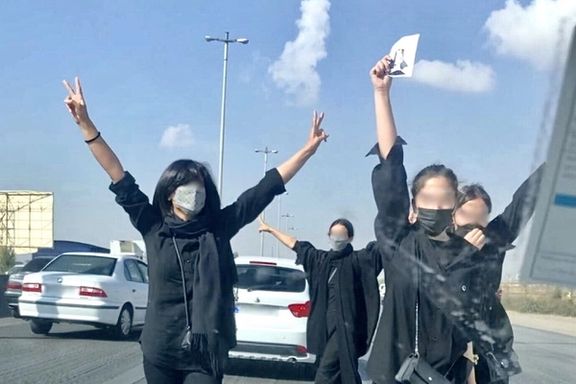
Young women protesting in Karaj, near Tehran on Nov. 3, 2022

A think tank close to Iran's security council has concluded that protests over the years have become more serious and more frequent as grievances went unanswered.

The research conducted by the National Security Monitor magazine for its September-October 2022 issue, says the current uprising is pluralist, has major objectives to change the bigger picture in Iran, is cyberspace-based, and does not seem to be backed by any institution.

The magazine is believed to be close to the Islamic Republic's Supreme National Security Council.

The research further found that collective reactions to events relating to the protests spread quickly although there seems to be no formal organization and leadership for the movement.

Other findings of the research include the fact that the uprising aims to bring about fundamental changes in Iran's political establishment, is backed by various layers of socio-political groups while also enjoying wholehearted support from the Iranian opposition abroad.

The government policy of suppressing protests by force and then failing to address the underlying problems has led to a worsening situation after each round of unrest and today, it might have become too late to come to peace with the disgruntled masses.

The study also found that although previously major protests occurred almost once in every decade [like the protests by the student movement in 1999 and the post-election unrest in 2009],during the past five or six years the interval between various protests have become shorter and they have occurred every one or two years. Soon, major protests may take place in Iran once in every two to three months, the study predicted.

Protesters in the central city of Arak torch a motorcycle used by security forces. Oct. 29, 2022
100%
Protesters in the central city of Arak torch a motorcycle used by security forces. Oct. 29, 2022

The conclusions corroborate the attestations of individual social scientists and political activists who have generally attributed the protest in Iran to promises that have not been met for a long time and demands that have been ignored by several governments during the past 40 years.

Meanwhile the study also observed that the driving force behind the current movement are youngsters born after the second half of the 1990s. This part of the findings also corroborate with what Iranian sociologists and political activists have said or written during the past two months.

The main problem of the new generation appears to be lack of social freedoms within an Islamic system and general hopelessness about the future.

As this study and several Iranian sociologists have observed, the disillusioned new generation of Iranians is fed up with senseless and inefficient bureaucracy and at the same time does not believe in the outdated and meaningless ideology the Islamic Republic has been propagating during the past four decades.

Generally, according to this research, the current movement in Iran is marked by a generation gap, fluctuating at times between activism and mutiny, not being mainly about economic demands, changing mood between anger and hope, using opportunities provided by events, and a horizontal steering structure [lack of formal leadership].

Meanwhile, according to the study the way the Iranian government has been handling the protests have not changed during the past four decade. It is common knowledge that the government's first and only solution to any crisis like the current uprising is handling it violently. At times, such as during the protests against rising fuel prices in 2019, Iranian government forces have killed hundreds to silence uprisings. But this way of handling crises, coupled with failure to address systemic problems is only a temporary solution and protests flare up as soon as another event triggers a new round of protests. What triggered the current wave of protests in Iran was the murder of a young woman in mid-September while she was in morality police custody.


Most Viewed

Iran negotiators ordered to return after internal rift over Islamabad talks
1
EXCLUSIVE

Iran negotiators ordered to return after internal rift over Islamabad talks

2
ANALYSIS

US blockade enters murky phase as tankers spoof signals and buyers hesitate

3
ANALYSIS

Why the $100 billion Hormuz toll revenue is a myth

4

US tightens financial squeeze on Iran, warns banks over oil money flows

5
ANALYSIS

US blockade targets Iran oil boom amid regional disruption

Banner
Banner

Spotlight

  • Hardliners push Hormuz ‘red line’ as US blockade tests Iran’s leverage
    INSIGHT

    Hardliners push Hormuz ‘red line’ as US blockade tests Iran’s leverage

  • Ideology may be fading in Iran, but not in Kashmir's ‘Mini Iran'
    INSIGHT

    Ideology may be fading in Iran, but not in Kashmir's ‘Mini Iran'

  • War damage amounts to $3,000 per Iranian, with blockade set to add to losses
    INSIGHT

    War damage amounts to $3,000 per Iranian, with blockade set to add to losses

  • Why the $100 billion Hormuz toll revenue is a myth
    ANALYSIS

    Why the $100 billion Hormuz toll revenue is a myth

  • US blockade targets Iran oil boom amid regional disruption
    ANALYSIS

    US blockade targets Iran oil boom amid regional disruption

  • Iran's digital economy battered by prolonged blackout
    INSIGHT

    Iran's digital economy battered by prolonged blackout

•
•
•

More Stories

Workers, Merchants In Iran Keep Up With Strikes Amid Protests

Nov 22, 2022, 23:26 GMT+0

Over two months after nationwide protests broke out against Iran’s clerical rulers, strikes by workers and business owners are spreading to more sectors.

Reports say workers of Masjed Soleyman (Masjid Suleiman) Petrochemicals Company stopped work to protest their low wages and living condition.

Meanwhile, workers of Bahman Motors car production company went on strike chanting slogans in protest to their living conditions and low wages.

A group of truck and pick-up drivers at a terminal in southern Tehran also held gatherings and went on strike. Videos on social media show the government deployed security forces to quell their protests.

Other videos show a nationwide strike by the businessmen in the Kurdish city of Saqqez in western Iran.

Popular protests in the cities of West Azarbaijan, Kordestan and Kermanshah provinces gained momentum after security forces attacked people in Mahabad on Saturday.

On Monday, security forces opened fire on mourners during the funeral ceremony of three people who were killed by regime forces in Javanroud and Piranshahr west of Iran. During the Monday attacks, over a dozen were reportedly killed and injured.

Strikes were instrumental in the overthrow of the monarchy during the 1979 revolution. This time around protesters have urged all groups — including merchants in the bazaars, teachers and workers in the oil sector — to stage strikes in the hope that this would turn the latest unrest into a revolution and lead to the overthrow of the theocracy.

Intl. Community Becoming More Vocal Over Crackdown In Iran

Nov 22, 2022, 23:26 GMT+0
•
Iran International Newsroom

About a week into the Islamic Republic’s military attacks on Kurdish regions in Iran and Iraq, the international community seems to have taken a stronger stance against the Tehran. 

Tuesday was another tension-filled day for residents of Kurdish-majority cities in western Iran while people in many other cities, including capital Tehran and its neighboring cities as well as others in the southwestern Khuzestan province and southeastern Sistan-Baluchestan province also held gatherings in support of their fellow Kurdish countrymen. 

In addition to Kurdish cities, people in the city of Shahr-e-Rey in Tehran province, Dezful and Andimeshk in Khuzestan, Zahedan in Sistan-Baluchestan, and Mehr County in Fars province as well as in several neighborhoods in Tehran held rallies, set fire to trash cans and chanted slogans against the regime’s clampdown. 

While the Islamic Republic has cut people's access to the Internet in Kurdish-majority cities and also disrupted to access in Tehran, videos are slow to surface online but according to reports protests started before noon at university campuses across the country. Workers in several industrial complexes and numerous businesses were also on strike on Tuesday, and by afternoon people started pouring into streets, chanting slogans against the government. 

As students continued to hold antigovernment rallies, members of the Iranian parliament presented a proposal to ban the protesting students from traveling abroad for ten years. 

While Iran's Revolutionary Guard has intensified attacks on Iraq’s Kurdistan region, the United States and Israel announced that they would hold a joint air exercise next week simulating scenarios against the Islamic Republic and its proxies in the region. The announcement came as Israeli officials warned in the past few days that the unabating protests across Iran may push the Islamic Republic to be more aggressive regionally. 

The head of Israel’s military intelligence, Maj. Gen. Aharon Haliva, Monday said, “The extremely exceptional protests… have moved to a civilian rebellion. The death toll, the attacks on national symbols, this is very troubling for the regime, in combination with sanctions,” adding that “as the pressure on Iran increases, including internal pressure, the Iranian response is much more aggressive, so we should expect much more aggressive responses in the region and in the world.” 

The global outcry over the crackdown on protests is gaining a new momentum following the European Parliament’s announcement on Monday that it would not keep direct contact with the Islamic Republic authorities. 

European Parliament member Charlie Weimers told a special session of EU Parliament on Iran Tuesday that "The Iranian protesters want a divorce from the Islamic Republic, not counselling," calling on EU countries to expel the Tehran’s diplomats, recall EU envoys, shut down Iran’s embassies and proscribe the Revolutionary Guard as a terror organization.

Also on Monday, European Parliament President Roberta Metsola said, “there will be no direct contact between the Parliament and Iranian officials until further notice,” adding that the Islamic Republic must stop its oppression of legitimate protests. In reaction to the death sentences imposed on protesters, Metsola urged Iranian authorities to “stop, here and now”.

White House Press Secretary Karine Jean-Pierre said on Tuesday that Washington is "gravely concerned" about the Islamic Republic's intensifying crackdown on peaceful protestors that has killed at least 400 people so far.

The UN’s Third Committee approved a draft resolution on Iran’s human rights situation last week, expressing concern at the alarmingly high frequency of the death penalty in the country. Moreover, the UN Human Rights Council will also adopt a resolution aimed at holding the Islamic Republic accountable on November 24.

Voicing concerns over the situation in Iran and especially Kurdish cities, the UN Human Rights council said at least 40 people were killed by security forces over the past week. “We urge your authorities to address the people's demands for equality, dignity and rights instead of using unnecessary or disproportionate force to suppress the protests,” said a spokesperson for UN human rights chief at a Geneva press briefing. 

UN human rights chief Volker Türk said that "The rising number of deaths from protests in Iran, including those of two children at the weekend, and the hardening of the response by security forces, underline the critical situation in the country."

Also on Tuesday, German MP Norbert Röttgen highlighted that "Since the weekend, the regime has been literally waging war against protesters in the Kurdish regions of Iran. The fact that the German Federal Government has so far been silent on this issue now borders on a political and moral failure on a historic scale."

Reported Use Of ‘Green Gas’ Against Protesters In Iran Raises Alarm

Nov 22, 2022, 18:11 GMT+0
•
Maryam Sinaiee

The reported government use of a “green gas” against protesters Kurdish cities of Javanrud and Piranshahr Monday has raised serious concerns among Iranians.

Two videos were posted on social media that showed thick green smoke wafting through the streets in Javanrud, a city of around 50,000 in the western province of Kermanshah, amid heavy clashes between stone-throwing protesters and security forces shooting at them. Reports also emerged on the same day of the use of a similar green gas in Piranshahr in West Azarbaijan Province.

The use of an unidentified gas that causes skin irritation, nausea and other symptoms has conjured up memories of Saddam Hussein’s chemical attack on the Kurdish border city of Sardasht, also in West Azarbaijan during Iran-Iraq War (1980-1988) in the minds of many, particularly people in Iran's Kurdish areas.

Saddam’s chemical attack during which mustard gas was used killed at least 130 people and injured 8,000 of the 12,000 inhabitants of the city in 1983. Many victims still struggle with respiratory and other health issues.

“The occupying regime [of the Islamic Republic] is using banned weapons in Kordestan,” a tweet accompanied with an image of CS gas canisters allegedly found in Piranshahr said. The tweet also said CS gas has been banned by the UN Chemical Weapons Convention (CWC) in 1993.

The canister is marked with the word “irritant” only, but posts shared on social media claim these are perceived as chemical weaponry that has been banned.

Iran's Kurdish cities have been at the forefront of the protests that started with the death is custody of the 22-year-old Mahsa Amini from the Kurdish city of Saqqez two months ago.

People in most Kurdish-populated areas in Kordestan, West Azarbaijan and Kermanshah provinces have relentlessly protested and defied government forces since Masha’s death. Security forces have killed and wounded dozens of protesters and bystanders including children in these provinces.

Some chemists and physicians have identified the green gas used in Javanrud and Piranshahr as hexachloroethane, others say it is adamsite (DM), a chemical used as a riot control agent.

Hexachloroethane has been used by the military in smoke compositions, such as smoke grenades worldwide. DM belongs to the group of chemical warfare agents known as vomiting agents or sneeze gases.

100%

Most western countries have abandoned the use of smoke grenades but some activists have accused police of using it against protesters in Portland, Oregon, in 2020.

US-based physician Dr. Mohammad-Kazem Attari told Iran International Tuesday that hexachloroethane is used widely in military exercises in open air but unlike extremely toxic Sarin, VN and other nerve gases, it does not cause death or permanent disabilities.

According to Dr. Attari hexachloroethane can cause serious skin irritation, partial paralysis of facial muscles and fogginess of mind but temporarily. The chemical is also considered as a carcinogen.

“It is mainly used on the streets [for crowd control] to inspire fear due to its color. It is characterized as a nerve gas but is not as dangerous as nerve gases used in wars,” he said and added that the use of this gas is not likely to scare people who are not afraid of firearms used by Iranian regime forces.

Tear gas itself is banned in war according to UN’s Chemical Weapons Convention (CWC) but its limited use is reportedly permitted for law enforcement purposes.

Iran Issues Indictment For Over 1,100 Protesters

Nov 22, 2022, 18:07 GMT+0

Iran’s judiciary says the Islamic Republic has issued indictments for over 1,100 protesters detained during the nationwide protests.

Judiciary Spokesman Masoud Setayeshi said Tuesday that among those arrested in the last two months in Tehran, “indictments have been issued for 1,118 people so far.”

In comments carried by Mizan Online news website, Setayeshi further threatened prominent figures who express solidarity with the people saying that the judiciary will deal with them.

Hengameh Ghaziani and Katayoun Riahi are the latest celebrities arrested by the regime on Sunday. They both are famous Iranian actresses who supported the protest movement.

Last week, the spokesperson of the Judiciary had announced that the policy of the Judiciary and the government is based on “tolerance” in the face of protests.

He did not give any detail about the total number of arrests, but noted that “so far, 2,432 people have received a preliminary verdict.”

The revolutionary court in Tehran has already handed down six death sentences over the protests after convicting the accused of being "enemies of God" or "corrupt on Earth", both capital offences in Iran.

Setayeshi further noted that forty foreign nationals implicated in the recent “riots” have been arrested, but he did not elaborate on the nationalities of those detained.

Iranian officials have repeatedly accused Western governments of stoking the protests over Amini's death.

Khamenei Adviser Warns Uprising May Reoccur If Problems Not Solved

Nov 22, 2022, 15:51 GMT+0
•
Iran International Newsroom

A former IRGC Commander says even if the current unrest comes to an end, protests and uprisings may reoccur if the government fails to solver Iran's problems.

Yahya Rahim-Safavi, who is now military adviser to Supreme Leader Ali Khamenei, reassured the nation that the unrest will come to end, however, he warned that it might not be the last one. He asked: "Cannot the IRGC and the Basij militia sort out what we are currently seeing in this country?" The general was talking about the violent uprising that has entered its third month.

Rahim-Safavi spoke on the same day that reformist commentator and political activist Hamid Reza Jalaeipour said: "Iran has not yet entered a revolutionary situation, but if the current unrest continues, the country will move toward a revolutionary phase."

This comes while many in Iran and abroad, including French President Emmanuel Macron have attested that the uprising in Iran has already turned into a revolution.

According to Ettela'at newspaper, Jalaeipour said that protesters in the streets of Iranian cities are demanding "structural changes," which is Iranian politicians' euphemism for "regime change." This is evident, he said in the slogans heard in the streets and at the universities.

He added that when society moves toward revolutionary conditions and governments try to stop the revolution, it means that those governments have already lost legitimacy, efficiency, and many other things.

Hamidreza Jalaeipour, 'reformist' commentator in Tehran
100%
Hamidreza Jalaeipour, 'reformist' commentator in Tehran

He argued that in such societies the opposition has been successful in winning the protesters trust. However, Jalaeipour argued that protesters do not trust the Iranian opposition, without saying who that opposition is in his view.

It is possible that he mentioned lack of trust in opposition to protect himself against censure by the government. Self-censorship is an important tool for pundits in Iran who are quoted in government-controlled media.

The popular protests, however, have no known leaders, although some figures in the diaspora do appear as possible influencers, especially in a transition period.

Jalaeipour went on to say that around 80 percent of Iranians are unhappy with the government's performance, stressing that the current situation is worrying.

Protesters in the religious city of Mashhad setting fire to a police car on Nov. 16, 2022
100%
Protesters in the religious city of Mashhad setting fire to a police car on Nov. 16, 2022

The commentator added that the bazaars in Tehran, Rasht and some other cities are on strike and if this continues and spreads to other cities, this means that part of the Iranian society that has been silent so far has been activated and is going toward a revolutionary situation.

Meanwhile, another reformist activist, Gholam Ali Rajaei has said that "A change in approach is in the interest of the government, the regime and the country." Rajai added: "It is getting late for a change."

Rajaei added: "So far there has been no sign to indicate that the message of the ongoing protests has been heard, and I think it is getting late for that."

Other analysts have maintained that it is Khamenei who has to listen to the solutions politicians offer for Iran's problems. Nonetheless, pundits like Rajaei shy away from naming Khamenei or simply fear the repercussions.

Rajaei added: "I even doubt that the government [Khamenei] would even bother to read the message of reconciliation." He reiterated that "reforms are the best solution but not the kind of reforms advocated by political parties." Once again, Rajaei stopped short of naming Khamenei as the individual who should listen to the people and change his autocratic way of running the country.

In the meantime, most of the insulting slogans chanted in the streets call for Khamenei's removal.