• العربية
  • فارسی
Brand
  • Iran Insight
  • Politics
  • Economy
  • Analysis
  • Special Report
  • Opinion
  • Podcast
  • Iran Insight
  • Politics
  • Economy
  • Analysis
  • Special Report
  • Opinion
  • Podcast
  • Theme
  • Language
    • العربية
    • فارسی
  • Iran Insight
  • Politics
  • Economy
  • Analysis
  • Special Report
  • Opinion
  • Podcast
All rights reserved for Volant Media UK Limited
volant media logo

EU Summit Zones In On Alleged Iran-Russia Weapons Links
Iran International Newsroom
Oct 21, 2022, 13:45 GMT+1Updated: 17:40 GMT+1
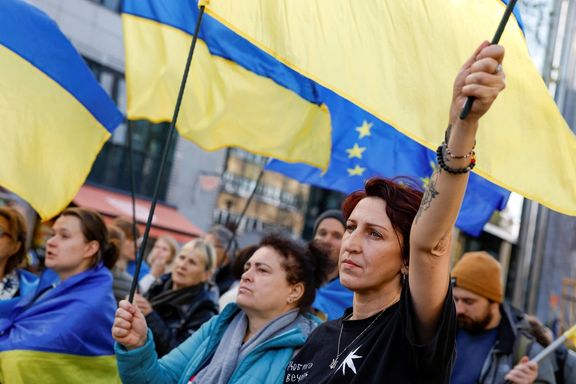
People take part in a protest against Russia's military operation in Ukraine during a European Union leaders summit in Brussels, Belgium October 21, 2022

European Union leaders are expected to focus on China and Iran’s military involvement in Ukraine in today’s discussion of ‘external’ relations.

The October 20-21 meeting of the European Council, the EU policy-making body made up of its 27 heads of state, will review Iran’s involvement in the Ukraine war after disagreements yesterday over proposals to price-cap Russian energy exports in the face of spiraling prices.

Among ideas circulating is a proposal made Friday by Estonian Prime Kaja Kallas to establish as special tribunal to consider Russian “aggression.” But it is unclear if the EU will take further action against Iran or Russia over the alleged supply of Iranian drones (UAVs, unmanned aerial vehicles).

After Josep Borrell Monday said the EU needed evidence before acting, a closed-door United Nations Security Council (UNSC) meeting Wednesday reviewed available information.

The EU and the United Kingdom Thursday sanctioned three Iranian military commanders and a defense company over allegedly supplying drones to Russia. This followed the US imposition of sanctions in September on four companies it said were either involved in supplying Russia or in copying US and Israeli drones.

US, French and British officials have argued that any supply of Iranian drones to Russia violates UNSC Resolution 2231, which endorsed the 2015 Iran nuclear deal, the JCPOA (Joint Comprehensive Plan of Action). While the US left the JCPOA in 2018 and while State Department spokesman Ned Price said Thursday the agreement’s revival was “largely academic at the moment,” the US argues that Resolution 2231 precludes Iran from exporting drones until October 2023. Price said Thursday that Washington considered it “important that the UN and every responsible UN member state stand by the various Security Council resolutions.”

The engine of an alleged Iranian drone shot down in Ukraine. October 6, 2022
100%
The engine of an alleged Iranian drone shot down in Ukraine. October 6, 2022

‘All means…to confront’

US officials argued Thursday not just that Iran had sent military personnel to train Russia in using Iranian-made drones. In a separate media briefing, John Kirby, the White House national security spokesman, said Russian military personnel remotely piloting drones used in Ukraine were based in Crimea. Kirby said the US would use “all means” to “confront Iran’s provision of these munitions against the Ukrainian people.”

“We assess that Iranian personnel, Iranian military personnel, were on the ground in Crimea and assisted Russia in these operations,” Price said at a separate media briefing. “Russia has received dozens of these UAVs…. some of ..[the] proof was put on display before the UN Security Council yesterday.”

Price claimed that Moscow “may also seek to acquire advanced conventional weapons from Iran that includes potentially surface-to-air missiles.” He also warned China it would incur “costs” if it chose to provide security assistance, military assistance, or otherwise to systematically help Russia evade sanctions.”

Ukraine can use the issue of Iranian drones to ask for more Western military assistance, so far totaling around $17 billion from the US, including 1,400 Stinger missiles, and $3.1 billion from the EU, including howitzers. Washington has refused to supply more advanced weapons so as not to escalate the conflict, believing its current approach can drain Russia’s ability to conduct the war. Drones, while of limited military value, are far cheaper than missiles.

Ukrainian Foreign Minister Dmytro Kuleba tweeted Thursday he had discussed with Israeli Prime Minister Yair Lapid a request for missile defense assistance. Israel has so far refused to aid Ukraine militarily so as not to upset its relations with Russia.


Most Viewed

US blockade enters murky phase as tankers spoof signals and buyers hesitate
1
ANALYSIS

US blockade enters murky phase as tankers spoof signals and buyers hesitate

2
INSIGHT

Ideology may be fading in Iran, but not in Kashmir's ‘Mini Iran'

3
INSIGHT

Hardliners push Hormuz ‘red line’ as US blockade tests Iran’s leverage

4
VOICES FROM IRAN

Hope and anger in Iran as fragile ceasefire persists

5

US sanctions oil network tied to Iranian tycoon Shamkhani

Banner
Banner

Spotlight

  • Hardliners push Hormuz ‘red line’ as US blockade tests Iran’s leverage
    INSIGHT

    Hardliners push Hormuz ‘red line’ as US blockade tests Iran’s leverage

  • Ideology may be fading in Iran, but not in Kashmir's ‘Mini Iran'
    INSIGHT

    Ideology may be fading in Iran, but not in Kashmir's ‘Mini Iran'

  • War damage amounts to $3,000 per Iranian, with blockade set to add to losses
    INSIGHT

    War damage amounts to $3,000 per Iranian, with blockade set to add to losses

  • Why the $100 billion Hormuz toll revenue is a myth
    ANALYSIS

    Why the $100 billion Hormuz toll revenue is a myth

  • US blockade targets Iran oil boom amid regional disruption
    ANALYSIS

    US blockade targets Iran oil boom amid regional disruption

  • Iran's digital economy battered by prolonged blackout
    INSIGHT

    Iran's digital economy battered by prolonged blackout

•
•
•

More Stories

Exclusive - Fire At Evin Prison Intended To Move, Kill Prisoners

Oct 21, 2022, 10:48 GMT+1
•
Iran International Newsroom

Eyewitnesses have told Iran International that a mysterious blaze in Tehran’s Evin prison last week was a government scheme to fake a jail break to kill prisoners.

In an exclusive report on Thursday, our correspondent also cited several witnesses as saying that the number of prisoners killed in this incident was way more than eight people officials claimed.

One of the witnesses, identified as Mosayyeb Raisi Yeganeh -- a political prisoner who was imprisoned in Ward 8 of Evin prison on charges of insulting the Supreme Leader and propaganda against the regime – said he saw with his own eyes that in one case, 10 to 15 young prisoners of Ward 7 under the age of 25 were gunned down during the night.

According to him, the authorities had plotted to use the fire as a pretext to pretend that prisoners were trying to escape and kill whoever they wanted during the mayhem, adding that several of the prisoners who were reported to be hospitalized in the jail’s infirmary are not there at all.

He also claimed that Hassan Mirkazemi -- one of the regime’s insiders and one of those who led the crackdown on people during 2009 protests, and was serving a term for economic corruption – was transferred from the prison before the chaotic night.

Evin prison before and Fter (L) the blaze on October 15, 2022
100%
Evin prison before and Fter (L) the blaze on October 15, 2022

Following the blaze, some journalists and people on social media accused the Islamic Republic of setting the prison on fire intentionally, citing an early and extended furlough to Mehdi Hashemi Rafsanjani, son of former Iranian president Akbar Hashemi Rafsanjani, as evidence to support their claim. The prison authorities had furloughed several other important and well-connected prisoners in the days leading to the fire. The son of senior conservative lawmaker Mostafa Mir-Salim – imprisoned over connections with exiled Albania-based opposition group Mujahedin-e Khalq (MEK) organization -- was also let out before the incident.

Two other witnesses, who spoke on condition of anonymity for security reasons, said the government planned the fire and the fake escape plan of prisoners to suppress the protests that have been growing in solidarity with the nationwide protests, that convulsed Iran since mid-September when 22-year-old Mahsa Amini died in custody of hijab police.

The interior of the hall that was engulfed by falmes at Evin Prison. Oct. 15, 2022
100%
The interior of the hall that was engulfed by falmes at Evin Prison. Oct. 15, 2022

Six sources told Reuters on Thursday that two days before the fire ripped through a section of the notorious prison, a riot police unit arrived at the compound and began to patrol the corridors, shouting "God is Greatest" and banging batons on cell doors.

The patrols at the jail began without any apparent provocation by inmates, the sources said. These patrols continued from Thursday to Saturday when some prisoners reacted by shouting for the downfall of the Supreme Leader. "Then we heard shots and chants of 'Death to Khamenei' by prisoners in other wards," said an inmate inside Ward 8.

According to unconfirmed reports, three busloads of political prisoners were also taken to a prison near Tehran, known to be a slaughterhouse for prisoners.

Tasnim news agency affiliated with the Revolutionary Guard quoted a judicial official after midnight on October 15 that a riot had started in the wards where common criminals were kept and sections holding political prisoners were separate.

The prison has been the main site for holding prominent Iranian political prisoners as well as foreigners and dual nationals. It also holds inmates convicted of ordinary crimes and is now receiving a stream of dissidents arrested in the continuing wave of unrest sweeping the country. The prison is known as "Evin University" because of the many antigovernment intellectuals and academics held there.

EU, UK Sanction Iranian Generals Over ‘Drones Used By Russia’

Oct 20, 2022, 21:45 GMT+1
•
Iran International Newsroom

The European Union and the United Kingdom Thursday sanctioned three Iranian military commanders and a defense company over allegedly supplying drones to Russia.

The decisions introduce travel bans and asset freezes on Major-General Mohammad Hossein Bagheri, chief of staff of Iran’s armed forces, General Seyed Hojjatollah Qureishi, a senior defense official, and Brigadier-General Saeed Aghajani, the head of “UAV command” (unmanned aerial vehicle) in the Revolutionary Guards Aerospace Force. The sanctioned company Shahed Aviation Industries makes Shahed-136 drones.

An EU statement said Bagheri supervised Iran’s drone program, played a “fundamental role in Iran’s defence cooperation” with Russia, including supplying Mohajer-6 drones “for their use in the war of aggression against Ukraine.” Qureishi, the statement said, headed logistics at the Ministry of Defense and had negotiated with Russia over drone supply, while Aghajani headed “the backbone” of Iran’s drone program.

Major-General Mohammad Hossein Bagheri, chief of staff of Iran’s armed forces
100%
Major-General Mohammad Hossein Bagheri, chief of staff of Iran’s armed forces

A statement from British foreign secretary James Cleverly said the UK was acting against “those who have supplied the drones used by Russia to target Ukrainian civilians and that there was “clear evidence of Iran’s destabilising role in global security.” The British foreign office said the three individuals were “personally responsible” for providing drones used by Russia in Ukraine.

The EU decisions follows discussions going on since a foreign ministers meeting Monday. Arriving in Luxemburg for that gathering, Josep Borrell, the EU foreign policy chief, had said Europe was seeking “concrete evidence” that Russia had used Shahed-136 drones in recent weeks.

A CNN correspondent tweeted Tuesday that the network had been given “exclusive access to an Iranian-made Mohajer-6 drone, shot down a few weeks ago by Ukrainian forces in Southern Ukraine.” The drone, with the marking ER-860, appeared in excellent condition.

‘Dangerous new phase’

The Wall Street Journal reported Thursday that US and European sanctions against Iran would complement additional military aid to Ukraine. The Journal cited “officials,” presumably American, suggesting Russia’s use of drones “takes the war in Ukraine into a dangerous new phase.”

Photo of an electronic part said to belong to an Iranian drone after it was shot down by Ukraine on Oct. 6, 2022
100%
Photo of an electronic part said to belong to an Iranian drone after it was shot down by Ukraine on Oct. 6, 2022

The US has sent Ukraine over $17 billion in aid, mainly in weapons, and the EU this week added $500 million to the $2.5 billion already sent in military supplies. Washington, which is so far denying Ukraine more advanced weapons so as to avoid escalation, says it wants to degrade Russian capacity as its diminishing stocks of Cruise and other missiles, which have inflicted far more damage than drones, which carry less explosives and are relatively easy to shoot down. Both the US and Turkey have supplied Ukraine with drones.

Iran has developed its drone program due to its lack of an effective air-force given international sanctions. The Shahed-129, an earlier version, may have been a copy of the Hermes 450, a drone made by Israel, which along with Turkey leads Middle East drone production.

US will ‘surge security assistance’

A US statement Wednesday said it had raised, alongside France and the UK, the alleged drone transfer at the United Nations Security Council (UNSC). The statement said Washington would “continue to surge unprecedented security assistance to Ukraine” and reiterated the claim, made also by European officials, that any Iranian supply of drones would violate UNSC Resolution 2231, passed in 2015 to endorse the Iranian nuclear agreement, the JCPOA (Joint Comprehensive Plan of Action). The US said this week that Iran had also supplied drones to Ethiopia in 2021.

Ukraine’s ambassador to the UN Sergiy Kyslytsya claimed Wednesday that Iranian drones allegedly used by Russia “meet the parameters” of UNSC Resolution 2231 “because they are capable of a range of equal to or greater than 300 kilometers (186 miles).” However, there is no mention of drones in the resolution, and its restrictions on Iran lasting to October 2023 refer only to “any activity related to ballistic missiles designed to be capable of delivering nuclear weapons…”

The US in September sanctioned several Iranian companies it said were involved in producing drones supplied to Russia, but it was unclear how the measures would add in practice to existing US ‘maximum pressure’ sanctions, which have since Washington left the JCPOA in 2018 threatened punitive action against any entity worldwide dealing with Iran.

Iran’s Foreign Minister Visits Armenia Following Military Drills At Border

Oct 20, 2022, 19:02 GMT+1

Iranian Foreign Minister Hossein Amir-Abdollahian, heading a delegation, has traveled to the Armenian capital Yerevan on Thursday amid tensions in the region.

In his first visit to Armenia, Amir-Abdollahian is scheduled to meet with his counterpart Ararat Mirzoyan as well as some other officials in the country to discuss the latest regional developments.

This week, Iran’s Revolutionary Guards (IRGC) held a large-scale military drill in the northwestern region of Aras along the borders of Armenia and Azerbaijan.

In mid-September, Iran warned that it would not tolerate any seizure of territory from Armenia by Azerbaijan after military clashes broke out between its two northern neighbors.

100%

Armenia accuses Azerbaijan of attacking its towns to avoid negotiations over the status of the mainly Armenian-populated enclave of Nagorno-Karabakh in Azerbaijan, an enclave which is inside Azerbaijan but populated mainly by ethnic Armenians.

Iran has to an extent supported Armenia in the conflict with Azerbaijan and has warned that it would not allow any seizure of territory from Armenia proper by Baku. Tehran in the past has also expressed alarm at alleged Israeli military presence in Azerbaijan.

Iran’s ally Russia, itself engaged in the military invasion of Ukraine, is a key power broker in the region and an ally of Yerevan through the Moscow-led Collective Security Treaty Organization (CSTO). Turkey backs Azerbaijan.

Iran Launches Pontoon Bridge Near Azerbaijan Border Signaling Threat

Oct 19, 2022, 18:05 GMT+1
•
Iran International Newsroom

Iran’s Revolutionary Guard in a provocative move has launched a pontoon bridge on the northwesternmost river of Aras near the border with Azerbaijan Republic.

A video published by the IRGC-affiliated website Tasnim shows on Wednesday the ground forces set up pontoon bridges on the river for the armored vehicles and tanks to pass.

It has also been said in the video that installing these bridges have a message and the target audience will receive and understand.

The IRGC special forces also conducted heliborne operations with Mil Mi-17 helicopters on the third day of their wargames in the Aras region.

On the sidelines of the maneuvers Commander of the IRGC Hossein Salami threatened the neighbors that “Iran’s fraternity policy continues as long as there is no plot hatched by the enemies.”

“We have interests in this region, so if something happens in any corner of it, our interests will be jeopardized, then we won’t remain neutral and will defend our interests,” said Salami.

In the meantime, the IRGC has also published a tweet in Arabic saying, “When we split the waters and rescue you!”

Some social media activists have interpreted this tweet as a threat aimed at Azerbaijan Republic saying that since its establishment in 1979 the Islamic Republic has always tried to create crises outside its borders to make up for its inability to deal with domestic problems.

“That’s why the Islamic regime launched a war with Iraq to crack down on its opposition inside Iran back in the 1980’s,” says a video tweeted by a user.

In mid-September, Iran warned that it would not tolerate any seizure of territory from Armenia by Azerbaijan after military clashes broke out between its two northern neighbors.

Azerbaijani troops entered Armenia’s southern region in a move that seemed aimed at seizing territory and cutting off Armenia from Iran. Tehran has warned that it will not tolerate losing its land connection with Yerevan.

Armenia accuses Azerbaijan of attacking its towns to avoid negotiating over the status of the mainly Armenian-populated enclave of Nagorno-Karabakh inside Azerbaijan.

Tehran in the past has also expressed alarm at alleged Israeli military presence in Azerbaijan.

The provocative launch of pontoon bridge and Iran’s message to its neighbors come at a time that the clerical regime has received the strong message from protesters who now shout, “Death to Khamenei” and “Death to Dictator” every day and night to topple the regime.

EU To Sanction 8 Iranians, Entities Over Drone Supply To Russia

Oct 19, 2022, 16:28 GMT+1

European Union governments have provisionally agreed to impose sanctions on eight people and entities over Iran’s supply of drones to Russian to be used against Ukraine.

Three diplomats said that sanctions experts from the 27 EU members agreed to the list in a meeting on Wednesday. It will be further discussed by national ambassadors at a meeting scheduled for later in the day.

EU governments have until Thursday morning to decide whether to approve the sanctions, the goal being to agree the package before leaders convene in Brussels for a summit starting later in the day.

Ukraine has reported a spate of Russian attacks using Iranian-made Shahed-136 drones in recent weeks, while Tehran and Kremlin deny the supply of drones to Russia.

A European Commission spokesperson said there was consensus on foreign ministers meeting in Luxembourg October 17, that the EU should react swiftly. "Now that we have gathered our own sufficient evidence, work is ongoing in the Council with view to a clear, swift and firm response," the spokesperson told the EU's executive's daily news conference.

In addition to supplying drones, Iran has promised to send its own Fateh-110 and Zolfaghar surface-to-surface missiles to Russia for strikes on Ukrainian cities and troops. A deal was agreed on October 6 when Iran's First Vice President Mohammad Mokhber, two senior officials from Iran's Revolutionary Guards and an official from the Supreme National Security Council visited Moscow for talks with Russia about weapons deliveries.

Iranian Foreign Minister Hossein Amir-Abdollahian announced on Wednesday that four institutions and 15 foreign officials that had a hand in the sanctions against the Islamic Republic would be added to the country’s blocklist.