• العربية
  • فارسی
Brand
  • Iran Insight
  • Politics
  • Economy
  • Analysis
  • Special Report
  • Opinion
  • Podcast
  • Iran Insight
  • Politics
  • Economy
  • Analysis
  • Special Report
  • Opinion
  • Podcast
  • Theme
  • Language
    • العربية
    • فارسی
  • Iran Insight
  • Politics
  • Economy
  • Analysis
  • Special Report
  • Opinion
  • Podcast
All rights reserved for Volant Media UK Limited
volant media logo

Iran Launches Pontoon Bridge Near Azerbaijan Border Signaling Threat
Iran International Newsroom
Oct 19, 2022, 18:05 GMT+1Updated: 17:36 GMT+1
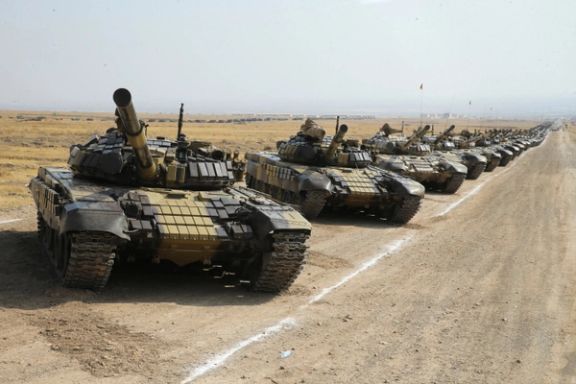
Iranian tanks near Azerbaijan's border during wargames, on October 17, 2022

Iran’s Revolutionary Guard in a provocative move has launched a pontoon bridge on the northwesternmost river of Aras near the border with Azerbaijan Republic.

A video published by the IRGC-affiliated website Tasnim shows on Wednesday the ground forces set up pontoon bridges on the river for the armored vehicles and tanks to pass.

It has also been said in the video that installing these bridges have a message and the target audience will receive and understand.

The IRGC special forces also conducted heliborne operations with Mil Mi-17 helicopters on the third day of their wargames in the Aras region.

On the sidelines of the maneuvers Commander of the IRGC Hossein Salami threatened the neighbors that “Iran’s fraternity policy continues as long as there is no plot hatched by the enemies.”

“We have interests in this region, so if something happens in any corner of it, our interests will be jeopardized, then we won’t remain neutral and will defend our interests,” said Salami.

In the meantime, the IRGC has also published a tweet in Arabic saying, “When we split the waters and rescue you!”

Some social media activists have interpreted this tweet as a threat aimed at Azerbaijan Republic saying that since its establishment in 1979 the Islamic Republic has always tried to create crises outside its borders to make up for its inability to deal with domestic problems.

“That’s why the Islamic regime launched a war with Iraq to crack down on its opposition inside Iran back in the 1980’s,” says a video tweeted by a user.

In mid-September, Iran warned that it would not tolerate any seizure of territory from Armenia by Azerbaijan after military clashes broke out between its two northern neighbors.

Azerbaijani troops entered Armenia’s southern region in a move that seemed aimed at seizing territory and cutting off Armenia from Iran. Tehran has warned that it will not tolerate losing its land connection with Yerevan.

Armenia accuses Azerbaijan of attacking its towns to avoid negotiating over the status of the mainly Armenian-populated enclave of Nagorno-Karabakh inside Azerbaijan.

Tehran in the past has also expressed alarm at alleged Israeli military presence in Azerbaijan.

The provocative launch of pontoon bridge and Iran’s message to its neighbors come at a time that the clerical regime has received the strong message from protesters who now shout, “Death to Khamenei” and “Death to Dictator” every day and night to topple the regime.


Most Viewed

State media slam Araghchi's Hormuz tweet, say it let Trump claim victory
1

State media slam Araghchi's Hormuz tweet, say it let Trump claim victory

2

Iran International says it won’t be silenced after London arson attack

3
INSIGHT

How Tehran bends its own red lines to boost state rallies

4
OPINION

The Hormuz get out of jail card turned to a grave

5

Iran halts petrochemical exports to supply domestic market

Banner
Banner

Spotlight

  • Too early to tell who is winning Iran war, experts say
    PODCAST

    Too early to tell who is winning Iran war, experts say

  • How Tehran bends its own red lines to boost state rallies
    INSIGHT

    How Tehran bends its own red lines to boost state rallies

  • Iran blackout cripples freelancer, small business incomes
    VOICES FROM IRAN

    Iran blackout cripples freelancer, small business incomes

  • Ideology may be fading in Iran, but not in Kashmir's ‘Mini Iran'
    INSIGHT

    Ideology may be fading in Iran, but not in Kashmir's ‘Mini Iran'

  • US blockade enters murky phase as tankers spoof signals and buyers hesitate
    ANALYSIS

    US blockade enters murky phase as tankers spoof signals and buyers hesitate

  • Why the $100 billion Hormuz toll revenue is a myth
    ANALYSIS

    Why the $100 billion Hormuz toll revenue is a myth

Tweet unavailable

•
•
•

More Stories

EU To Sanction 8 Iranians, Entities Over Drone Supply To Russia

Oct 19, 2022, 16:28 GMT+1

European Union governments have provisionally agreed to impose sanctions on eight people and entities over Iran’s supply of drones to Russian to be used against Ukraine.

Three diplomats said that sanctions experts from the 27 EU members agreed to the list in a meeting on Wednesday. It will be further discussed by national ambassadors at a meeting scheduled for later in the day.

EU governments have until Thursday morning to decide whether to approve the sanctions, the goal being to agree the package before leaders convene in Brussels for a summit starting later in the day.

Ukraine has reported a spate of Russian attacks using Iranian-made Shahed-136 drones in recent weeks, while Tehran and Kremlin deny the supply of drones to Russia.

A European Commission spokesperson said there was consensus on foreign ministers meeting in Luxembourg October 17, that the EU should react swiftly. "Now that we have gathered our own sufficient evidence, work is ongoing in the Council with view to a clear, swift and firm response," the spokesperson told the EU's executive's daily news conference.

In addition to supplying drones, Iran has promised to send its own Fateh-110 and Zolfaghar surface-to-surface missiles to Russia for strikes on Ukrainian cities and troops. A deal was agreed on October 6 when Iran's First Vice President Mohammad Mokhber, two senior officials from Iran's Revolutionary Guards and an official from the Supreme National Security Council visited Moscow for talks with Russia about weapons deliveries.

Iranian Foreign Minister Hossein Amir-Abdollahian announced on Wednesday that four institutions and 15 foreign officials that had a hand in the sanctions against the Islamic Republic would be added to the country’s blocklist.

British MP Calls On FIFA To Throw Out Iran From World Cup

Oct 18, 2022, 20:32 GMT+1

A British member of parliament says international football (soccer) governing body FIFA should stop Iran from participating in the World Cup for its supply of weaponry for the Russian invasion of Ukraine. 

Labor MP Chris Bryant, the chair of the All-Party Parliamentary Group on Russia and former Foreign Office minister, told Telegraph Sport on Monday that any country founded to have “provided military support” for Russian President Vladimir Putin’s invasion should be banished from world sport. 

He called on FIFA to make a move before Iran’s national football team’s opening match against England.

Referring to FIFA and UEFA’s decisions to throw Russia out of the international football events in the wake of Putin’s invasion of Ukraine, including from March’s World Cup play-offs and the entire 2024 European Championship, he said, “Sporting authorities around the world and in every sport should be looking very carefully at Iran’s direct engagement and support for Putin in his illegal invasion of Ukraine.”

“Dictatorial regimes relish sporting success. We should deny them that opportunity,” he noted.

Since March, many Iranians themselves have been urging FIFA to ban Team Melli from the World Cup for forcibly barring women from entering stadiums to watch matches. Under FIFA pressure, Iranian authorities started to let in a cherrypicked group for women so they would not face bans and penalties. However, since the start of the current uprising across Iran and a lackluster support from the national squad, the calls on FIFA to ban Iran have become stronger.


Ukraine Signals Cut In Ties With Iran, Asks Israel Military Aid

Oct 18, 2022, 15:50 GMT+1
•
Iran International Newsroom

Foreign Minister Dmytro Kuleba said Tuesday he had called on President Volodymyr Zelenskyy to break off Ukraine’s diplomatic relations with Iran.

Kuleba said Kyiv was willing to share a “bag of evidence” with the European Union that Russia had used Iranian-made military drones in the current conflict. The EU is currently considering sanctions against Iran should the Ukrainian claims be proved.

Russia used dozens of ‘kamikaze’ drones in attacks Monday that Ukraine says were Shahed-136s, killing four people in Kyiv. “Tehran bears full responsibility for the destruction of relations with Ukraine”, Kuleba told a news conference.

While Iran has denied supplying drones to Russia, analysts point out they could be a cheap if less effective alternative to Russia’s diminishing stocks of missiles. The State Department’s Vedant Patel Monday backed up Ukraine’s claims, saying there was “extensive proof” Russia was using Iranian-made drones.

Iran has been a close military ally of Russia in the Syrian war, where Moscow supplies air power and Tehran tens of thousands of militia ground troops to defeat the opponents of Bashar al Assad's government.

Iran's Supreme Leader Ali Khamenei also backed Vladimir Putin in July by praising the Russian leader's "initiative in in invading Ukraine.

‘Pressure on Israel’

In his press conference, Kuleba also said Kyiv would send an official note to Israel seeking military aid including air defense supplies. Disappointed at Israel’s refusal to supply weapons, Ukrainian officials have sought to highlight Iran’s relationship with Russia.

Ukraine and Iran have maintained diplomatic relations despite disagreements and an exchange of sharp language over the January 2020 shooting down by Iranian air defenses of a Ukrainian passenger plane, killing all 176 aboard, during heighted US-Iran tensions.

In an analysis Tuesday, the New York Times argued that a Tehran-Moscow “alliance” was “raising the pressure on Israel, Iran’s sworn enemy, to take Ukraine’s side in the war.”

On Sunday Nachman Shai, Israel’s Minister for Diaspora Affairs, argued for sending military aid to Kyiv on top of existing humanitarian relief. But Tuesday, before Kuleba’s remarks, Justice Minister Gideon Saar, who sits on Israel’s decision-making security cabinet, told national broadcaster Army Radio that Israel’s support for Kyiv “does not include weapons systems and weaponry - and there is no change to that position.”

‘Reckless’ supply

Dmitri Medvedev, deputy head of Russia’s Security Council, warned Monday that “reckless” supply of Israeli hardware would “destroy all interstate relations between our countries.” Around 15 percent of voters in Israel, where there is a general election November 1, are Russian-speakers. Israel has also had intelligence coordination with Russia in Syria, where both air-forces have operated during the decade-long conflict.

Ukraine has been successful gaining military aid from the European Union, whose foreign ministers’ meeting in Luxemburg Kuleba addressed virtually Tuesday “from the bomb shelter.” The foreign minister tweeted that he had asked the Europeans for “more air defense and ammunition” and for “sanctions against Iran for supplying the Russian Federation with drones.” The EU announced Tuesday a further €500-million ($492 million) military supplies to Ukraine, bringing the total to €3.1 billion ($3.01 billion). United States support is around $17 billion so far.

Argentina Calls For Iranian Vice President’s Arrest During Qatar Visit

Oct 18, 2022, 15:34 GMT+1

Argentina has called on Qatar to arrest visiting Iranian vice president Mohsen Rezaei over his alleged responsibility for the deadly 1994 bombing of a Buenos Aires Jewish center.

According to the official Telam news agency on Monday, special prosecutors have submitted a petition to Argentina's foreign ministry calling for all appropriate diplomatic levers to be pulled. 

The ministry "requested the collaboration of Interpol for the arrest," while Foreign Minister Santiago Cafiero "instructed the Argentine ambassador in Doha... to communicate urgently with the Qatari Foreign Ministry and report on the situation," a diplomatic source said. 

Ebrahim Raisi’s vice president for economic affairs, Revolutionary Guard’s commander Rezaei (Rezai) is wanted by Argentinian special prosecutors for alleged participation in the planning of the July 18, 1994 bombing of the Argentine Israelite Mutual Association, or AMIA, which killed 85 people and wounded 300.

In 2007, INTERPOL General Assembly upheld the unanimous decision made by the organization’s Executive Committee to publish six out of nine Red Notices requested in connection with the AMIA.

The notices were requested by the Argentinean National Central Bureau (NCB) for Imad Fayez Moughnieh, the number two in Iran-backed Hezbollah, Iran’s Former Intelligence Minister Ali Fallahian, Cleric Mohsen Rabbani – known as the chief architect of Iran's Latin American missionary network -- Iranian diplomat Ahmad Reza Asghari – aka Hamid-Reza Es’hagi and Moshen Ranjbaran -- and Revolutionary Guards commander and incumbent Interior Minister Ahmad Vahidi as well as Mohsen Rezaei.

Earlier in the year, Argentina condemned the presence of Rezaei in the inauguration of the new Nicaraguan president Daniel Ortega, describing it as an insult to the victims of the bombing of the Jewish center. 

Small Businesses, Farmers Bear Brunt Of Iran’s Internet Disruptions

Oct 18, 2022, 09:30 GMT+1
•
Maryam Sinaiee

Millions of Iranians who depended on social media advertising fear losing their livelihood as authorities block Internet access amid antigovernment protests.

Authorities argue that the stricter social media and internet restrictions are required due to what they call “riots” across the country over the past month. They blame protesters, who they invariably refer to as “rioters” for the perils of millions of people whose businesses, have been affected.

These small businesses, particularly those run from homes by women or small farms in rural areas, very heavily relied on Instagram for advertising and WhatsApp for communication with potential customers. The number of these businesses exponentially grew after the Covid pandemic.

Larger e-commerce companies such as online retailers, hotel and transportation bookings and food delivery services have lost large market shares.

The government has blocked access to Internet to prevent the spread of news and images about protests disrupt contact among protesters by blocking Instagram and WhatsApp. Last week they went one step further and even shut down the normal mobile messaging (SMS) services and resorted to jamming foreign-based Persian language satellite TV channels when activists called for one day of nationwide demonstrations.

These measure, many say, have largely failed as protesters persevere and post footage of protests as soon as they can connect to the internet through their mobiles or broadband.

“We have undergone the severest filtering and internet disruption over the past month but news [of the protests] have reached everyone, from the blaze at Evin Prison to the confiscation of passports of [dissident] artists,” one of the many tweets on this topic said.

“It just showed that government’s understanding of [the concepts of] media and cyberspace is very limited, and their measures have made no difference apart from damaging businesses. Moreover, Starlink is on the way too!” the tweet said.

Speaking at an event in Mazandaran Province in the north of Iran on the National E-Commerce Day on Sunday, Mahmoud Leiaei, deputy communications minister said during his visit to the province people had complained to him about the filtering of Instagram.

Leiaei added that their complaints made him realize that even in rural areas people had depended on Instagram for selling their produce. He blamed these people whose businesses are suffering because, he said, they should have heeded authorities’ warnings and migrated from foreign social media and messaging platforms to those developed in Iran.

Social media users in Iran have largely shunned domestically developed social media platforms and applications such as Wisgoon and Nazdika, designed to replace Instagram, and Rubika, a messaging application. People know that security services control the domestic apps and can spy on them.

Experts also warn that these platforms are very vulnerable to censorship and there are serious safety and privacy concerns.

For years, many in Iran have relied on VPNs and anti-filtering software to navigate through government censorship and blocked social media and websites. But authorities have been regularly shutting down mobile internet which completely stops any kind of access. The use of VPNs surged by 30-fold following the recent nationwide protests.

All Iranian mobile carriers now only offer their internet services when permitted by authorities who are imposing a curfew style control. Access to mobile internet is much more important than broadband which only 10 percent of Iranians subscribe to. The government has also cut off access to the global web and limited online activities to those allowed by a very heavily controlled intranet, called the National Information Network (NIN).