• العربية
  • فارسی
Brand
  • Iran Insight
  • Politics
  • Economy
  • Analysis
  • Special Report
  • Opinion
  • Podcast
  • Iran Insight
  • Politics
  • Economy
  • Analysis
  • Special Report
  • Opinion
  • Podcast
  • Theme
  • Language
    • العربية
    • فارسی
  • Iran Insight
  • Politics
  • Economy
  • Analysis
  • Special Report
  • Opinion
  • Podcast
All rights reserved for Volant Media UK Limited
volant media logo

Argentina Calls For Iranian Vice President’s Arrest During Qatar Visit

Oct 18, 2022, 15:34 GMT+1
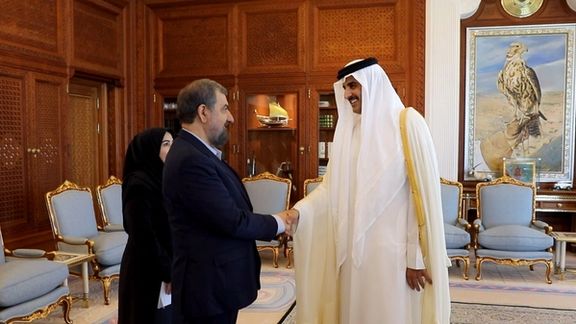
Iranian vice president for economic affairs Mosen Rezaei (left) in a meeting with Emir of Qatar Tamim bin Hamad Al Thani on October 17, 2022

Argentina has called on Qatar to arrest visiting Iranian vice president Mohsen Rezaei over his alleged responsibility for the deadly 1994 bombing of a Buenos Aires Jewish center.

According to the official Telam news agency on Monday, special prosecutors have submitted a petition to Argentina's foreign ministry calling for all appropriate diplomatic levers to be pulled. 

The ministry "requested the collaboration of Interpol for the arrest," while Foreign Minister Santiago Cafiero "instructed the Argentine ambassador in Doha... to communicate urgently with the Qatari Foreign Ministry and report on the situation," a diplomatic source said. 

Ebrahim Raisi’s vice president for economic affairs, Revolutionary Guard’s commander Rezaei (Rezai) is wanted by Argentinian special prosecutors for alleged participation in the planning of the July 18, 1994 bombing of the Argentine Israelite Mutual Association, or AMIA, which killed 85 people and wounded 300.

In 2007, INTERPOL General Assembly upheld the unanimous decision made by the organization’s Executive Committee to publish six out of nine Red Notices requested in connection with the AMIA.

The notices were requested by the Argentinean National Central Bureau (NCB) for Imad Fayez Moughnieh, the number two in Iran-backed Hezbollah, Iran’s Former Intelligence Minister Ali Fallahian, Cleric Mohsen Rabbani – known as the chief architect of Iran's Latin American missionary network -- Iranian diplomat Ahmad Reza Asghari – aka Hamid-Reza Es’hagi and Moshen Ranjbaran -- and Revolutionary Guards commander and incumbent Interior Minister Ahmad Vahidi as well as Mohsen Rezaei.

Earlier in the year, Argentina condemned the presence of Rezaei in the inauguration of the new Nicaraguan president Daniel Ortega, describing it as an insult to the victims of the bombing of the Jewish center. 

Most Viewed

US blockade enters murky phase as tankers spoof signals and buyers hesitate
1
ANALYSIS

US blockade enters murky phase as tankers spoof signals and buyers hesitate

2

US tightens financial squeeze on Iran, warns banks over oil money flows

3
INSIGHT

Ideology may be fading in Iran, but not in Kashmir's ‘Mini Iran'

4
INSIGHT

Hardliners push Hormuz ‘red line’ as US blockade tests Iran’s leverage

5
VOICES FROM IRAN

Hope and anger in Iran as fragile ceasefire persists

Banner
Banner

Spotlight

  • Hardliners push Hormuz ‘red line’ as US blockade tests Iran’s leverage
    INSIGHT

    Hardliners push Hormuz ‘red line’ as US blockade tests Iran’s leverage

  • Ideology may be fading in Iran, but not in Kashmir's ‘Mini Iran'
    INSIGHT

    Ideology may be fading in Iran, but not in Kashmir's ‘Mini Iran'

  • War damage amounts to $3,000 per Iranian, with blockade set to add to losses
    INSIGHT

    War damage amounts to $3,000 per Iranian, with blockade set to add to losses

  • Why the $100 billion Hormuz toll revenue is a myth
    ANALYSIS

    Why the $100 billion Hormuz toll revenue is a myth

  • US blockade targets Iran oil boom amid regional disruption
    ANALYSIS

    US blockade targets Iran oil boom amid regional disruption

  • Iran's digital economy battered by prolonged blackout
    INSIGHT

    Iran's digital economy battered by prolonged blackout

•
•
•

More Stories

Questions Abound On Iranian Climber Who Competed Unveiled

Oct 18, 2022, 13:45 GMT+1

There are conflicting reports over the fate of Iranian athlete Elnaz Rekabi who competed at the Asian Climbing Competitions finals in Seoul without wearing hijab.

Disobeying the Islamic Republic's restrictions for female athletes, she made history by representing Iran unveiled in support of anti-hijab and antigovernment protests that have been raging across the country since mid-September, when 22-year-old Mahsa Amini was killed in custody of hijab police.

Worried that she would be arrested upon arrival, people had organized a huge gathering to welcome her early on Wednesday morning when she was scheduled to arrive back in the country. But, reports came late on Monday that her travel documents were confiscated by officials, who are part of all Iranian sport delegations abroad to monitor and control the behavior of athletes. For some hours, unconfirmed reports said she was prevented from leaving the hotel where the Iranian delegation were staying in Seoul. 

The latest on her whereabouts was a post on her Instagram page, in which she said she is on her way back home as scheduled, explaining that she had to appear for the final without head covering due to miscalculations of the final schedule. People on social media do not seem to believe such claims as they are accustomed to fabricated justifications and forced confessions extracted by the Islamic republic’s authorities. 

Emphasizing that they are monitoring the case of the Iranian rock climber, the International Federation of Sport Climbing (IFSC) said, "There is a lot of information in the public sphere regarding Elnaz Rekabi and as an organization we have been trying to establish the facts. We have also been in contact with Ms. Rekabi and the Iranian Climbing Federation.”

In 2019, boxer Sadaf Khadem attended a boxing match with the Iranian flag and without a headscarf. She had to cancel her return flight to Tehran after a warrant was issued for her arrest.


Right Groups Urge UN Human Rights Council To Convene On Iran

Oct 17, 2022, 19:08 GMT+1

A group of 43 civil and human rights organizations and NGOs have called on UN Human Rights Council to hold a special session on ongoing rights violations in Iran.

In a joint statement on Monday, they expressed deep concerns about the Iranian authorities’ mobilization of their well-honed machinery of repression to ruthlessly crackdown on the current uprising, sparked by the death in custody of 22-year-old Mahsa Amini.

Stressing the urgency for the establishment of an independent, investigative and accountability mechanism, they said The United Nations Human Rights Council should act promptly considering the gravity of crimes under international law and other serious human rights violations committed in Iran and the prevailing systemic impunity.

According to evidence gathered by a number of the signatories of the statement, there is a harrowing pattern of Iranian security forces deliberately and unlawfully firing live ammunition and metal pellets, including birdshot, at protesters and bystanders including children.

Voicing concerns over the growing numbers of protesters and bystanders killed, they said the number of casualties is likely to be much higher than the reported 200 deaths, including at least 23 identified children.

Since 18 September 2022, over one thousand protesters, human rights defenders, civil society activists, journalists, university students and school children have been arbitrarily arrested and detained, some already charged with “acting against national security,” describing the “cycle of deadly repression” alarmingly similar to previous waves of mass protests including in December 2017-January 2018, November 2019, July 2021, November 2021 and May 2022.

Europe-Iran Tensions Grow As EU Foreign Ministers Gather

Oct 17, 2022, 13:57 GMT+1
•
Iran International Newsroom

Iran-European Union relations have soured with claims Tehran has supplied Russia with armed drones used in Ukraine, although the EU is not yet expected to agree new sanctions.

Arriving in Luxemburg Monday for a meeting of EU foreign ministers, Josep Borrell, the EU foreign policy chief, said Europe would look for “concrete evidence” over reports that Russia had used Shahed-136 drones in recent weeks. The Washington Post backed up Ukrainian claims Sunday citing US and “allied” officials speaking anonymously.

The Washington Post cited “an intelligence assessment shared in recent days with Ukrainian and US officials [that] contends Iran’s armaments industry is preparing a first shipment of [surface-to-surface] Fateh-110 and Zolfagher missiles…” Reuters reported Monday its reporter had seen pieces of a drone bearing the words ‘For Belgorod,’ presumably referring to Saturday’s gunning down of 11 Russian trainee soldiers 40km north of the Ukraine border.

There have been differences within the 27-member EU over the Russia-Ukraine conflict over the extent of sanctions against Moscow, which continues to supply gas and oil to many European states. Denmark’s Foreign Minister, the Social Democrat Jeppe Kofod, called Monday for the EU to take “concrete steps” in response to Russian attacks on Kyiv Monday morning, with Reuters reporting at least three deaths. “Iranian drones are used apparently to attack in the middle of Kyiv, this is an atrocity,” Kofod said.

France has argued that Iran supplying drones to Russia would violate United Nations Security Council Resolution 2231, which endorsed the 2015 Iran nuclear agreement. Paris bases its case on the non-binding, informal Missile Technology Control Regime (MTCR) agreed by 35 states including Russia.

As signatories to the JCPOA, both France and Germany have been involved in the talks aimed at reviving the agreement, which the US left in 2018 prompting Iran to expand its nuclear program beyond JCPOA limits. The leeway for new European sanctions has been reduced by decline of Europe-Iran trade given European companies’ fear of US action against them under the ‘maximum pressure’ sanctions Washington introduced on leaving the JCPOA. Nonetheless, Luxembourg’s Foreign Minister Jean Asselborn Monday it was “no longer” enough just to extended the existing list of sanctioned Iranian individuals.

Iran denies supplying weapons to Russia. Foreign Minister Hossein Amir-Abdollahian said Saturday – in comments made by telephone to Portuguese foreign minister Joao Gomes Cravinho – that Tehran believed “the arming of each side of the crisis will prolong the war.” The US has sent Ukraine $16.8 billion in aid, mainly in weapons, and the EU $2.5 billion, although Washington is denying Ukraine more advanced weapons so as to avoid escalation. Washington has said it wants to degrade Russian capacity as its stocks of Cruise and other missiles diminish.

‘Inconsistent behavior’

Comments made Monday by Iran’s Foreign Ministry spokesman Nasser Kanaani reflected a deteriorating tone in EU-Iran relations. Kanaani highlighted what he said was “inconsistent behavior” by the French in suggesting there was “good and bad terrorism” and in condemning “disturbances” and “labor strikes” in France but welcoming them in Iran.

Kanaani portrayed Iran as an “anchor of stability” in a region where many countries – he cited Afghanistan, Iraq and Syria – “fell into chaos and were exposed to terrorism and foreign attacks.” The spokesman said that an arson attack on an Iranian school in Hamburg Thursday showed a failure to provide security for “Iranian diplomatic places.” He said there was a “bitter irony that the countries that export millions of dollars of arms to one side of the war [had] started a propaganda war against Iran.”

Kanaani stressed that while new EU sanctions would lead to “reciprocal reactions” from Iran, “the path of negotiations” was separate. The EU has coordinated efforts to revive the 2015 agreement, both in meetings April 2021-March 2022 in Vienna of all JCPAO signatories (China, France, Germany, Iran, Russia, the United Kingdom, with the United States taking part indirectly) and in subsequent bilateral contacts between Iran and the US. Kanaani also said Monday a prisoner exchange with the US was being held up by Washington’s insistence that the 2015 agreement be revived first.
Iran’s Guards Launch War Games Along Armenia, Azerbaijan Border

Oct 17, 2022, 12:24 GMT+1

Iran’s Revolutionary Guards (IRGC) has launched a large-scale military drill in the northwestern region of Aras along the borders of Armenia and Azerbaijan.

The IRGC on Monday kicked off its three-day military exercise -- codenamed “IRGC Ground Force’s Might” -- in areas striding the northern sectors of East Azarbaijan and Ardabil provinces.

IRGC Ground Force Commander Brigadier-General Mohammad Pakpour said the war game is part of an annual routine aimed at boosting the force’s combat preparedness.

Heliborne parachute operations, night raids, helicopter combat ops, and suicide drone operations were carried out during the first day of the exercises. Construction of a temporary bridge over the Aras River which separates Iran from Azerbaijan and Armenia, seizure and control of supply roads and heights, and offensive as well as destructive operations against designated targets constitute other parts of the drill.

In mid-September, Iran warned that it would not tolerate any seizure of territory from Armenia by Azerbaijan after military clashes broke out between its two northern neighbors.

Armenia accuses Azerbaijan of attacking its towns to escape negotiating over the status of the mainly Armenian-populated enclave of Nagorno-Karabakh in Azerbaijan.

Tehran in the past has also expressed alarm at alleged Israeli military presence in Azerbaijan.

In Addition To Drones, Iran Sending Missiles To Russia

Oct 16, 2022, 20:31 GMT+1

In addition to supplying drones, Iran plans to send its own Fateh-110 and Zolfaghar surface-to-surface missiles to Russia for strikes on Ukrainian cities and troops.

In a report on Sunday, The Washington Post cited US and allied security officials as saying that the Islamic Republic is strengthening its commitment to supply arms for Russia’s assault on Ukraine. 

The report claims that the increased flow of weapons from Tehran could help offset steep Russian weapons losses and rebuild the dwindling supply of precision-guided munitions for Moscow’s military. 

The Post said that, according to officials from a US-allied country that closely monitors Iran’s weapons activity, Tehran dispatched officials to Russia on September 18 to finalize terms for additional weapons shipments. 

The paper quoted two officials briefed about an intelligence assessment shared in recent days with Ukrainian and US officials as saying that Iran’s armaments industry is preparing a first shipment of Fateh-110 and Zolfaghar missiles, two short-range ballistic missiles capable of striking targets at distances of 300 and 700 kilometers, respectively. It would be the first delivery of such missiles to Russia since the start of the war in February. 

In August, the same officials identified Iranian drones, the Shahed series and the Mohajer-6, that Tehran was supplying to Russia. The remains of both types have been recovered, analyzed and photographed by Ukrainian forces in recent weeks.

The European Union is mulling over punitive measures against Iran for its supply of drones to Russia, but despite numerous reports, the 27-nation bloc is still trying to find independent evidence for the use of the drones.







