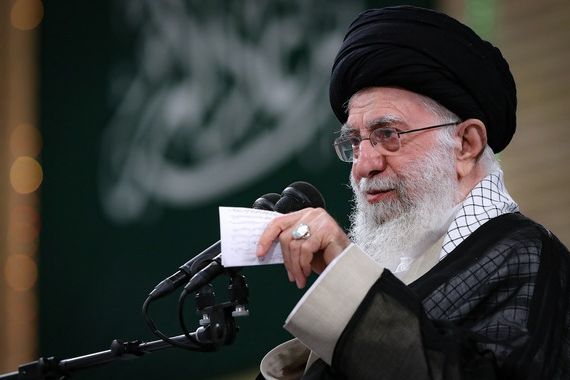
Supreme Leader’s Instagram post about a 7th century Imam’s peace with his enemy has caught media attention in Tehran as a possible sign of a nuclear compromise.
The post which was published on Ali Khamenei’s Persian Instagram Monday was an excerpt from a speech in April 1990 in which he discussed the reasons for the decision of the second Shiite Imam, Hassan ibn Ali, for making peace with his enemy, the founder and first caliph of the Umayyad Caliphate, Muawiya after ten years of war.
“Imam Hassan’s act was based on a logical argument which could not be disobeyed,” he had said in his speech and stressed that no one, even the first Imam, Ali ibn Abi Talib, who had not compromised with Muawiya’s father Abu Sufyan, would have chosen to take a different path under the circumstances of the time.
He also argued that Imam Hassan had taken the decision together with his brother, Hussein ibn Ali, the third Imam, who was later killed in a war with Muawiya’s forces in Karbala in 680 AD. Unlike Imam Hassan, the third Imam, is well known in Shiite history for being uncompromising toward the enemy, the Umayyads.
Khamenei also used the phrase “heroic flexibility” in the context of Iran's relations with the outside world in a very high-profile speech in September 2013 to Revolutionary Guard (IRGC) commanders.
Khamenei greeting IRGC commanders in January 2020 after the death of Qasem Soleimani
In his speech he stressed that he was not opposed to “proper political moves in diplomacy”. The phrase came from Iraqi Shia scholar Razi Ale Yasin’s book, Sulh-ul Hassan, which Khamenei translated into Persian under the title “Imam Hasan’s Peace: The most Magnificent Heroic Flexibility in History” in 1969.
Iranian Shiite clerics and officials often use references to the early Islamic history, particularly the life and actions of the prophet and the twelve Imams, as well as the Quran and other religious texts, when they discuss current affairs which requires interpretation of their statements.
“I believe in what was dubbed as ‘heroic flexibility’ many years ago [in the book],” Khamenei told the IRGC, adding that flexibility in certain circumstances could be positive and even required. He also argued that showing flexibility for “technical reasons,” while not forgetting “who the opponent and enemy is” can help a wrestler manoeuvre in his match to win, in the same way that the Imam's decision saved him and his followrs.
The media in Tehran have highlighted the Instagram post without any comments or interpretation on Tuesday, seeing its possible significance in the current political and international climate. But unlike 2013, when they immediately picked up the mention of “heroic flexibility” in the Leader’s speech and interpreted it as a sign of his consent to a nuclear deal, this time they have refrained from commenting.
Khamenei withheld his blessing to make a deal to restore the 2015 agreement between Iran and the world powers from the administration of President Hasan Rouhani, apparently fearing that credit for removal of US sanctions could help Rouhani and his allies to win in the June 2021 presidential elections against their hardliner rivals.
Rouhani has repeatedly claimed his government could have restored the deal if its path had not been blocked by powerful centres of power such as the hardline dominated parliament which passed legislation in December 2020 requiring the expansion of Iran’s nuclear program.
The head of the Atomic Energy Organization of Iran, Mohammad Eslami
While Iran’s insistence on its demands has cast doubts on a quick revival of the 2015 deal, the country’s nuclear chief spoke of building more nuclear energy plants.
Addressing a conference on the exchange of modern energy technologies on Tuesday, the head of the Atomic Energy Organization of Iran (AEOI) said Tehran pursues the “open door policy” and seeks to become a hub for designing and building nuclear power plants.
Mohammad Eslami added that “We intend to provide various services in the field of nuclear technology, including the development of nuclear power plants and nuclear power generation,” the he said, claiming that the country plans to convert 20 percent of its energy portfolio into nuclear power.
Eslami had earlier said that Iran plans to invest $50 billion for building new nuclear power plants, noting that the new power plants will be able to generate 10,000 megawatts of electricity, still far from the country’s total need.
For decades, Iran has neglected investment in other sources of power, especially renewables, making it almost impossible to bounce back in the foreseeable future, considering its isolation in the global community. Currently Russia is the only country cooperating with Iran in the nuclear industry.
Commissioned by Russia in 2011, Iran's Bushehr power plant has one operational unit that generates 1,000 megawatts, providing less than two percent of the country’s electricity. In July. Eslami said construction projects for phase two and three of the Bushehr Nuclear Power Planthave accelerated since a few months ago.
Russia says it received the needed assurances from the United States that sanctions for its invasion of Ukraine should not impact implementation of a revived nuclear deal, the JCPOA. If finalized, the renewed deal lets Russia cash in on a $10-billion contractto build atomic reactors in Iran.
Senators Lindsey Graham (L) and Bob Menendez, Undated
In opposing revival of the 2015 Iran nuclear deal, United States senators Lindsey Graham and Robert Menendez have demanded Tehran end any uranium enrichment.
Graham and Menendez have been in Israel as part of a senate delegation. Menendez, a Democrat and consistent opponent of the 2015 Iran nuclear deal, chairs the Senate Foreign Relations committee, whereas Graham is a staunch supporter of Donald Trump and has recently spoken of “riots in the streets” should the former president be prosecuted.
The US pressed that Iran end uranium enrichment at the time of Europe-Iran talks 2003-05. While Tehran at that time suspended enrichment as a ‘goodwill gesture,’ it refused to give up a ‘right’ it said was enshrined in the Nuclear Non-Proliferation Treaty.
When Trump in 2018 withdrew the US from the 2015 deal – the JCPOA, Joint Comprehensive Plan of Action – ending uranium enrichment was one of 12 demands stated as aims of ‘maximum pressure’ sanctions.
Washington’s links with Europe
While Iran greatly expand its nuclear program since February 2021, the administration of President Joe Biden has sought to mend Washington’s links with Europe, damaged under Trump, and to take a joint approach over Iran with the three European JCPOA signatories – France, Germany and the United Kingdom, the ‘E3.’
While the US reviving a demand for zero enrichment could strain relations with the E3, and for sure with Russia and China, the Biden administration has found itself in talks with an Iran emboldened by surviving ‘maximum pressure’ and by its nuclear expansion. And while nuclear policy is set collectively under supreme leader Ali Khamenei, the President Ebrahim Raisi, who took office in August 2021, is less inclined to compromise than Hassan Rouhani, president when the JCPOA was signed in 2015.
JCPOA opponents in the US, as well as some observers, have highlighted what they see as shortfalls in the proposed text – with the slow pace of talks encouraging both speculation and leaks.
Laurence Norman, correspondent for the Wall Street Journal, highlighted in a Monday tweet a claim that the draft agreement would give the International Atomic Energy Agency (IAEA) only 60 days, between agreement being signed and ‘Reimplementation Day,’ to examine 18 months of data that the agency has not seen since Iran restricted IAEA access in February 2021.
The US-E3 position is that technical IAEA issues are separate from the ’political’ revival of the JCPOA. But Iranian leaders have publicly demanded an IAEA probe into unexplained uranium traces be dropped before the 2015 nuclear deal is restored, so the US and Iran have apparently struggled to find a suitable form of words to bridge the gap.
Menendez said at the press conference Monday he was unsure if a Congressional review of a revived JCPOA, which is required under the 2015 Iran Nuclear Agreement Review Act, could lead to any agreement being blocked. Menendez said the foreign relations committee would have hearings, but whether a vote in the Senate and House of Representatives would meet “the threshold under the law to nullify that agreement is another question.”
Liz Truss outside the Conservative Party headquarters, after being announced as Britain's next Prime Minister, in London, September 5, 2022.
Liz Truss’ record of pragmatism in politics has not stopped some commentators thinking or hoping she will take a harder line than predecessor Boris Johnson.
In September 2021, Truss, just appointed foreign secretary, sat down quietly with her Iranian counterpart Hossein Amir-Abdollahian on the sidelines of the United Nations general assembly. Truss reportedly assured Amir-Abdollahianthat London was serious about repaying the £400 million debt owed by Britain since the 1970s for undelivered weapons.
Truss had told senior civil servants on promotion to the foreign office days earlier, moved by Prime Minister Boris Johnson from international trade secretary, that her “number one priority” was securing the release of three Britons detained in Iran – Nazanin Zeghari-Ratcliffe, Anoosheh Ashoori and Morad Tahbaz.
Richard Ratcliffe, husband of Zeghari-Ratcliffe who was freed along with Ashoori March 2002, praised Truss in a July newspaper article. “Despite me camping angrily on her doorstep, and our sometime fractious relationship, she delivered on her promise to us to get Nazanin home,” Ratcliffe wrote. “After five foreign secretaries, that matters. She did the one thing everyone knew would work: she paid the UK’s debt.”
Not everyone was pleased. Mike Pompeo, who as secretary of state under President Donald Trump launched maximum pressure as the US left the 2015 Iran nuclear deal condemned the £400 million ($460 million) payment as “blood money.”
Truss has a long record of pragmatism. President of the Oxford University Liberal Democrats when a student, she was opposed the UK leaving the European Union (EU) during the 2016 referendum but later became a ‘Brexiteer.’
‘Not dealing with a perfect world’
Pressed in a House of Commons committee in June, Truss fielded a question on human rights in the Arab Gulf states. “We are not dealing with a perfect world,” she said. “We are dealing in a world where we have to make difficult decisions…”
As foreign secretary, Truss has worked along with the Biden administration in line with the British and European policy of reviving the 2015 nuclear deal, the JCPOA (Joint Comprehensive Plan of Action). Along with French and German counterparts, she has increasingly placed the onus to Iran to make compromises as the talks have become US-Iran contacts, mediated by the European Union, since Vienna multilateral meetings between Iran and six world powers paused in March.
Liz Truss with European Union foreign policy chief Josep Borrell on December 11, 2021
Hopes for the talks have risen and fallen in recent weeks. In comments made Monday to reporters in Brussels, Josep Borrell, head of EU foreign policy, said he was “less confident today than 28 hours before on the convergence of the negotiation process,” and that without convergence, “the whole process is in danger.”
Borrell: Nuclear talks ‘in danger’
While France and Germany, and the European Union, may look to Truss to hold the UK’s current position, Monday’s news that Truss had been elected leader of the British Conservative Party and therefore prime minister designate, prompted celebrations among many conservative commentators.
“To leave the past few years of Chamberlain Conservatism and reclaim Churchill’s mantle, Truss must act boldly from day one to break the FCO’s [foreign office] hold on No 10 [the prime minister’s residence],” tweeted Richard Goldberg, senior advisorto the Federation for Defense of Democracies. In calling Johnson an ‘appeaser,’ Goldberg referred to Neville Chamberlain, British prime minister 1937-40, who explored options for stopping Nazi Germany short of war.
‘No need to tread on eggshells’
Nile Gardiner, director of the Margaret Thatcher Centre for Freedom at Heritage Foundation and frequent contributor to Fox News, wrote August 31 that Truss would challenge the Biden administration over aspects of US foreign policy, “such as its weakness on Iran.” Truss, wrote Gardiner, would “not be afraid to take on the liberal establishment at home and abroad.”
The Daily Telegraph ran a leader August 28 headlined ‘Truss must bloc Iran deal,’ which it said was “likely to offer at best nothing more than a trivial delay to the ayatollahs’ atomic ambitions, even as it unlocks cash likely to fund attacks against the very Western governments which sign up.” With Zeghari-Ratcliffe freed, the paper opined, “there is no need to tread on eggshells.”
Towards the end of the Conservative leadership election, United Against Nuclear Iran speculated in the US that her rival Rishi Sunak’s “domestic emphasis on Britain’s finances might sway him toward a pro-trade rationale and attendant support for the JCPOA…A Sunak government would suggest a continuation of his former boss’s [Boris Johnson] Iran policy: ongoing support for the JCPOA as a ‘least bad’ option to restrain and possibly moderate Iran in the long term.”
Among other JCPOA opponents, Israel Prime Minister Yair Lapid congratulated Truss as “my new friend, a true friend of Israeli.” The Jerusalem Post, highlighting Lapid and Truss overlapping as foreign ministers, cited “sources close” to the Israeli prime minister that Truss “has shown an understanding of the threat Tehran poses to the Jewish state and is closer to Israel’s view on Iran’s prevarications in the talks.”
Qatar’s foreign minister Mohammed bin Abdulrahman Al Thani (left) and Iran’s Foreign Minister Hossein Amir-Abdollahian
Iran’s foreign minister held a phone call with his Qatari counterpart to discuss the latest developments regarding the agreement to revive the 2015 nuclear deal.
Hossein Amir-Abdollahian and Qatar’s Mohammed bin Abdulrahman Al Thani talked on Sunday night to review bilateral relations and some consular issues as well as the latest status of the negotiations to restore the Joint Comprehensive Plan of Action – or JCPOA.
According to Qatari sources, Al Thani reiterated Doha’s hope for Iran and the US to reach a consensus to revive the nuclear deal and reaching a fair agreement for all, taking into consideration the concerns of all parties. Al Thani also stressed that this agreement is in the interest of the security and stability of the region.
This was the second phone conversation between Amir-Abdollahian and Al Thani as the agreement on the JCPOA revival seems at a critical stage as Iran has hardened its position in recent days with insisting on demands, such as compensation if the US leaves the agreement or a pledge not to reinstate sanctions, but the Biden Administration has responded that it can only offer assurances to Tehran for the duration of its current term.
On Monday, Iran’s foreign ministry spokesman Nasser Kanaani reiterated Tehran’s harder position in the nuclear talks, insisting on guarantees and an end to a probe into its past activities, that Tehran has once again transmitted its latest to the European Union, which acts as a mediator, and is awaiting a response from Washington.
Iran’s foreign ministry Monday reiterated Tehran’s harder position in the nuclear talks, insisting on guarantees and an end to a probe into its past activities.
The ministry’s spokesman Nasser Kanaani told reportersthat Tehran has once again transmitted its latest to the European Union, which acts as a mediator, and is awaiting a response from Washington.
Kanaani said that Iran’s demands regarding guarantees from the United States had some success in terms of “strengthening” the existing draft agreement text circulated by the EU. He stressed that the foreign ministry’s most important task is to secure guarantees.
Iran has been asking for US guarantees not to leave a new nuclear agreement, as it did in 2018 when former President Donald Trump withdrew from the Joint Comprehensive Plan of Action, JCPOA. Reports in recent weeks have indicated a variety of Iranian demands, such as compensation if the US leaves the agreement or a pledge not to reinstate sanctions, but the Biden Administration has responded that it can only offer assurances to Tehran for the duration of its current term.
Almost all Republicans in the US Congress and many Democrats have serious reservations about a new nuclear deal with Iran that would lift sanctions and provide hundreds of billions of dollars to a government that they believe poses a danger to US interests and its regional allies. Republicans have vowed to “tear up” any agreement President Joe Biden concludes with Iran short of a complete dismantling of its nuclear program and a major shift in its regional policies.
Kanaani also highlighted another demand that Tehran has put forth in recent weeks. He insisted that a probe by the International Atomic Energy Agency (IAEA) should be shelved before a deal is implemented. The IAEA is investigating uranium particles its inspection uncovered at three Iranian nuclear sites used prior to 2003, when Tehran was pursuing an undeclared research and development program.
Iran’s public pronouncements in the past two weeks have been shifting between emphasizing ‘guarantees’ and stopping the IAEA investigation as pre-conditions for a deal.
The foreign ministry spokesman also emphasized another argument being pushed by Iranian officials that Europe is facing an energy crisis this winter and is desperate for a nuclear deal with Iran. Presumably, if US sanctions are lifted Iran can supply energy to Europe in the wake of the crisis created by Russia’s invasion of Ukraine.
However, this is a false proposition built on the premises that Iran can supply natural gas to Europe in the near future.
First, Iran’s gas production is not enough even for its domestic consumption, because of a lack of Western technology and capital. Natural gas output is gradually declining while domestic consumption is rising.
Second, even if Iran had additional gas to export to Europe, there are no land pipelines ready and no LNG infrastructure to ship the gas via the sea.
Kanaani claimed that Europe has asked Iran for help to resolve the energy crisis and also mediate with Russia to stop the war in Ukraine, but so far there have been no statements by European officials in these regards.