• العربية
  • فارسی
Brand
  • Iran Insight
  • Politics
  • Economy
  • Analysis
  • Special Report
  • Opinion
  • Podcast
  • Iran Insight
  • Politics
  • Economy
  • Analysis
  • Special Report
  • Opinion
  • Podcast
  • Theme
  • Language
    • العربية
    • فارسی
  • Iran Insight
  • Politics
  • Economy
  • Analysis
  • Special Report
  • Opinion
  • Podcast
All rights reserved for Volant Media UK Limited
volant media logo

What Approach Will New British Prime Minister Take On Iran?
Iran International Newsroom
Sep 5, 2022, 18:58 GMT+1Updated: 17:43 GMT+1
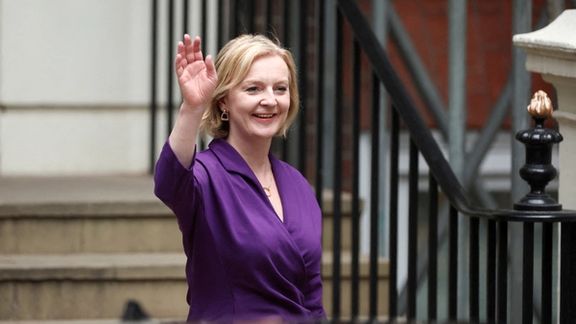
Liz Truss outside the Conservative Party headquarters, after being announced as Britain's next Prime Minister, in London, September 5, 2022.

Liz Truss’ record of pragmatism in politics has not stopped some commentators thinking or hoping she will take a harder line than predecessor Boris Johnson.

In September 2021, Truss, just appointed foreign secretary, sat down quietly with her Iranian counterpart Hossein Amir-Abdollahian on the sidelines of the United Nations general assembly. Truss reportedly assured Amir-Abdollahianthat London was serious about repaying the £400 million debt owed by Britain since the 1970s for undelivered weapons.

Truss had told senior civil servants on promotion to the foreign office days earlier, moved by Prime Minister Boris Johnson from international trade secretary, that her “number one priority” was securing the release of three Britons detained in Iran – Nazanin Zeghari-Ratcliffe, Anoosheh Ashoori and Morad Tahbaz.

Richard Ratcliffe, husband of Zeghari-Ratcliffe who was freed along with Ashoori March 2002, praised Truss in a July newspaper article. “Despite me camping angrily on her doorstep, and our sometime fractious relationship, she delivered on her promise to us to get Nazanin home,” Ratcliffe wrote. “After five foreign secretaries, that matters. She did the one thing everyone knew would work: she paid the UK’s debt.”

Not everyone was pleased. Mike Pompeo, who as secretary of state under President Donald Trump launched maximum pressure as the US left the 2015 Iran nuclear deal condemned the £400 million ($460 million) payment as “blood money.”

Truss has a long record of pragmatism. President of the Oxford University Liberal Democrats when a student, she was opposed the UK leaving the European Union (EU) during the 2016 referendum but later became a ‘Brexiteer.’

‘Not dealing with a perfect world’

Pressed in a House of Commons committee in June, Truss fielded a question on human rights in the Arab Gulf states. “We are not dealing with a perfect world,” she said. “We are dealing in a world where we have to make difficult decisions…”

As foreign secretary, Truss has worked along with the Biden administration in line with the British and European policy of reviving the 2015 nuclear deal, the JCPOA (Joint Comprehensive Plan of Action). Along with French and German counterparts, she has increasingly placed the onus to Iran to make compromises as the talks have become US-Iran contacts, mediated by the European Union, since Vienna multilateral meetings between Iran and six world powers paused in March.

Liz Truss with European Union foreign policy chief Josep Borrell on December 11, 2021
100%
Liz Truss with European Union foreign policy chief Josep Borrell on December 11, 2021

Hopes for the talks have risen and fallen in recent weeks. In comments made Monday to reporters in Brussels, Josep Borrell, head of EU foreign policy, said he was “less confident today than 28 hours before on the convergence of the negotiation process,” and that without convergence, “the whole process is in danger.”

Borrell: Nuclear talks ‘in danger’

While France and Germany, and the European Union, may look to Truss to hold the UK’s current position, Monday’s news that Truss had been elected leader of the British Conservative Party and therefore prime minister designate, prompted celebrations among many conservative commentators.

“To leave the past few years of Chamberlain Conservatism and reclaim Churchill’s mantle, Truss must act boldly from day one to break the FCO’s [foreign office] hold on No 10 [the prime minister’s residence],” tweeted Richard Goldberg, senior advisor to the Federation for Defense of Democracies. In calling Johnson an ‘appeaser,’ Goldberg referred to Neville Chamberlain, British prime minister 1937-40, who explored options for stopping Nazi Germany short of war.

‘No need to tread on eggshells’

Nile Gardiner, director of the Margaret Thatcher Centre for Freedom at Heritage Foundation and frequent contributor to Fox News, wrote August 31 that Truss would challenge the Biden administration over aspects of US foreign policy, “such as its weakness on Iran.” Truss, wrote Gardiner, would “not be afraid to take on the liberal establishment at home and abroad.”

The Daily Telegraph ran a leader August 28 headlined ‘Truss must bloc Iran deal,’ which it said was “likely to offer at best nothing more than a trivial delay to the ayatollahs’ atomic ambitions, even as it unlocks cash likely to fund attacks against the very Western governments which sign up.” With Zeghari-Ratcliffe freed, the paper opined, “there is no need to tread on eggshells.”

Towards the end of the Conservative leadership election, United Against Nuclear Iran speculated in the US that her rival Rishi Sunak’s “domestic emphasis on Britain’s finances might sway him toward a pro-trade rationale and attendant support for the JCPOA…A Sunak government would suggest a continuation of his former boss’s [Boris Johnson] Iran policy: ongoing support for the JCPOA as a ‘least bad’ option to restrain and possibly moderate Iran in the long term.”

Among other JCPOA opponents, Israel Prime Minister Yair Lapid congratulated Truss as “my new friend, a true friend of Israeli.” The Jerusalem Post, highlighting Lapid and Truss overlapping as foreign ministers, cited “sources close” to the Israeli prime minister that Truss “has shown an understanding of the threat Tehran poses to the Jewish state and is closer to Israel’s view on Iran’s prevarications in the talks.”


Most Viewed

100 days after carnage: Iran economy reels from war, inflation, unemployment
1
INSIGHT

100 days after carnage: Iran economy reels from war, inflation, unemployment

2
INSIGHT

Ghalibaf defends Iran-US talks amid hardline backlash

3
INSIGHT

A nation in limbo: 100 days after the massacre, has the world moved on?

4
ANALYSIS

From instability to influence: Pakistan’s pivotal role in US-Iran diplomacy

5
ANALYSIS

100 days on: why Iran’s January protests spread across social classes

Banner
Banner

Spotlight

  • War-hit homeowners feel abandoned as Iran’s reconstruction aid fades

    War-hit homeowners feel abandoned as Iran’s reconstruction aid fades

  • 100 days on: the anatomy of Iran’s January crackdown
    INSIGHT

    100 days on: the anatomy of Iran’s January crackdown

  • Ghalibaf defends Iran-US talks amid hardline backlash
    INSIGHT

    Ghalibaf defends Iran-US talks amid hardline backlash

  • 100 days on: why Iran’s January protests spread across social classes
    ANALYSIS

    100 days on: why Iran’s January protests spread across social classes

  • From instability to influence: Pakistan’s pivotal role in US-Iran diplomacy
    ANALYSIS

    From instability to influence: Pakistan’s pivotal role in US-Iran diplomacy

  • A nation in limbo: 100 days after the massacre, has the world moved on?
    INSIGHT

    A nation in limbo: 100 days after the massacre, has the world moved on?

•
•
•

More Stories

Iran Confirms Bid To Buy Russian Su-35 Fighter Jets

Sep 5, 2022, 15:42 GMT+1

The Commander of the Iranian Army’s Air Force has confirmed that the Islamic Republic is seeking to purchase Sukhoi Su-35 fighter jets from Russia. 

Brigadier General Hamid Vahedi said on Monday that buying Su-35s is on the agenda of the Air Force but the country has no plans to buy Sukhoi Su-30s, both developed from Sukhoi Su-27 which was a Soviet-origin twin-engine supermaneuverable fighter aircraft. Su-35 is single-seat but Su-30 is a two-seat, multi-role fighter. 

According to reports, the Army’s Air Force needs at least 64 aircraft, 24 of which will come from Egypt's order which remained undelivered due to US pressure on Cairo. 

Tehran-Moscow deals for drones, satellites and other aviation equipment have been increasing in recent months. Russia not only launched a satellite for Iran in August, but its personnel were also reportedly sent to train on Iranian military drones to use in Ukraine.

As tensions remain high between Washington and Tehran, the United States military said earlier in the day that it flew a pair of nuclear-capable B-52 long-distance bombers over the Middle East in a show of force, the latest such mission in the region as tensions remain high between Washington and Tehran.

The bombers took off from the Royal Air Force base at Fairford, England, and flew over the eastern Mediterranean, the Arabian Peninsula and the Red Sea on Sunday in training missions together with Kuwaiti and Saudi warplanes. Three Israeli F-16 fighter jets accompanied the American bombers “through Israel’s skies on their way to the Persian Gulf,” the Israeli military said, describing the country’s cooperation with the US military as key to “maintaining aerial security in Israel and the Middle East.”

Iranian, Qatari FMs Discuss Latest Status Of Nuclear Talks

Sep 5, 2022, 10:35 GMT+1

Iran’s foreign minister held a phone call with his Qatari counterpart to discuss the latest developments regarding the agreement to revive the 2015 nuclear deal. 

Hossein Amir-Abdollahian and Qatar’s Mohammed bin Abdulrahman Al Thani talked on Sunday night to review bilateral relations and some consular issues as well as the latest status of the negotiations to restore the Joint Comprehensive Plan of Action – or JCPOA.

According to Qatari sources, Al Thani reiterated Doha’s hope for Iran and the US to reach a consensus to revive the nuclear deal and reaching a fair agreement for all, taking into consideration the concerns of all parties. Al Thani also stressed that this agreement is in the interest of the security and stability of the region.

This was the second phone conversation between Amir-Abdollahian and Al Thani as the agreement on the JCPOA revival seems at a critical stage as Iran has hardened its position in recent days with insisting on demands, such as compensation if the US leaves the agreement or a pledge not to reinstate sanctions, but the Biden Administration has responded that it can only offer assurances to Tehran for the duration of its current term.

On Monday, Iran’s foreign ministry spokesman Nasser Kanaani reiterated Tehran’s harder position in the nuclear talks, insisting on guarantees and an end to a probe into its past activities, that Tehran has once again transmitted its latest to the European Union, which acts as a mediator, and is awaiting a response from Washington. 

The United States on August 31 called Iran’s latest response “not constructive”, as soon as it was delivered on the same day.

Iran Insists On 'Guarantees', Shelving IAEA Probe For Nuclear Deal

Sep 5, 2022, 10:07 GMT+1

Iran’s foreign ministry Monday reiterated Tehran’s harder position in the nuclear talks, insisting on guarantees and an end to a probe into its past activities.

The ministry’s spokesman Nasser Kanaani told reporters that Tehran has once again transmitted its latest to the European Union, which acts as a mediator, and is awaiting a response from Washington.

United States on August 31 called Iran’s latest response “not constructive”, as soon as it was delivered on the same day.

Kanaani said that Iran’s demands regarding guarantees from the United States had some success in terms of “strengthening” the existing draft agreement text circulated by the EU. He stressed that the foreign ministry’s most important task is to secure guarantees.

Iran has been asking for US guarantees not to leave a new nuclear agreement, as it did in 2018 when former President Donald Trump withdrew from the Joint Comprehensive Plan of Action, JCPOA. Reports in recent weeks have indicated a variety of Iranian demands, such as compensation if the US leaves the agreement or a pledge not to reinstate sanctions, but the Biden Administration has responded that it can only offer assurances to Tehran for the duration of its current term.

Almost all Republicans in the US Congress and many Democrats have serious reservations about a new nuclear deal with Iran that would lift sanctions and provide hundreds of billions of dollars to a government that they believe poses a danger to US interests and its regional allies. Republicans have vowed to “tear up” any agreement President Joe Biden concludes with Iran short of a complete dismantling of its nuclear program and a major shift in its regional policies.

Kanaani also highlighted another demand that Tehran has put forth in recent weeks. He insisted that a probe by the International Atomic Energy Agency (IAEA) should be shelved before a deal is implemented. The IAEA is investigating uranium particles its inspection uncovered at three Iranian nuclear sites used prior to 2003, when Tehran was pursuing an undeclared research and development program.

Iran’s public pronouncements in the past two weeks have been shifting between emphasizing ‘guarantees’ and stopping the IAEA investigation as pre-conditions for a deal.

The foreign ministry spokesman also emphasized another argument being pushed by Iranian officials that Europe is facing an energy crisis this winter and is desperate for a nuclear deal with Iran. Presumably, if US sanctions are lifted Iran can supply energy to Europe in the wake of the crisis created by Russia’s invasion of Ukraine.

However, this is a false proposition built on the premises that Iran can supply natural gas to Europe in the near future.

First, Iran’s gas production is not enough even for its domestic consumption, because of a lack of Western technology and capital. Natural gas output is gradually declining while domestic consumption is rising.

In fact, Iran might soon be forced to import gas if it does not invest $50 billion in its production fields, which need technology only Western countries can provide.

Second, even if Iran had additional gas to export to Europe, there are no land pipelines ready and no LNG infrastructure to ship the gas via the sea.

Kanaani claimed that Europe has asked Iran for help to resolve the energy crisis and also mediate with Russia to stop the war in Ukraine, but so far there have been no statements by European officials in these regards.

Israel Pressuring US Against Iran Deal But Not to Point Of Rupture

Sep 4, 2022, 17:39 GMT+1

Israeli Prime Minister Yair Lapid says the country is leading “an intensive campaign” meant to prevent the signing of “a dangerous” nuclear deal between Iran and world powers. 

At the start of Sunday’s cabinet meeting, Lapid said Israel will continue to pressure the US but not to the point that it will cause a crisis in relations. “The correct policy is the one that we have been leading in the past year: To continue the pressure, without causing a rupture, to present credible intelligence, to be part of the process without destroying the special relationship with the US.”

Lapid said to “those who say that we are not shouty enough or blunt enough” should recall that, in 2015, when then-prime minister Benjamin Netanyahu “insisted on an unnecessary confrontation [with the US], it was an utter failure. The Americans simply stopped listening to us.

“The reservations we presented to the US were taken into account. We also spoke to other partners and presented demands [they should make of] Iranians. We can’t say everything, but not everything should be subject to fights and speeches,” he added. 

President Joe Biden told Israeli Prime Minister Yair Lapid last week that the United States will never allow Iran to acquire a nuclear weapon. Israel opposes a return to the 2015 deal, which would lift sanctions on Iran and would limit its nuclear program for a few years.

Lapid made the remarks one day before the Mossad chief is set to depart for Washington to attend closed door classified meetings of House and Senate intelligence committees about the Iranian threat and the dangers of a nuclear deal. 

Iran Spokesman Again Links Europe’s Natural Gas Need To Nuclear Talks

Sep 4, 2022, 16:38 GMT+1

Mohammad Marandi, who acts as de facto spokesman for Iran's nuclear negotiating team, has tried to link energy needs in Europe to ongoing talks for reviving the 2015 agreement.

Marandi published a series of tweets from his interview with Al Jazeera news channel on Saturday, saying, “Iran will be patient. The US under Obama systematically violated the deal and under Trump/Biden it imposed maximum pressure against innocent citizens... Winter is approaching and the EU is facing a crippling energy crisis.”

Emphasizing that “Iran won't accept ambiguities or loopholes in the text,” he said, “There should be no loopholes that can be used to undermine a deal. There are problems with a few words and the US can easily fix them.”

“The US domestic situation is a key reason why a nuclear deal has been allusive (elusive). While some EU governments have already asked Iran about oil as well as natural gas exports, Biden is fearful that foes will depict him and certain allies as weak,” he added.

Tehran is trying to sell the agreement as beneficial to Europe's energy crunch, regardless of the fact that even with no sanctions or restrictions on Iran’s exports, the country is unable to provide European countries with natural gas. 

Iranian media repeatedly talks about ‘Europe’s freezing winter” while it has almost nothing to do with Tehran’s crude oil exports, except generally helping to bring down oil prices. Europe’s need to replace Russian gas is a specific issue on its own that Iran cannot help with due to its own shortages. A nuclear agreement now cannot impact Iran’s ability to export natural gas for the foreseeable future mainly due to Iran’s huge domestic need.