• العربية
  • فارسی
Brand
  • Iran Insight
  • Politics
  • Economy
  • Analysis
  • Special Report
  • Opinion
  • Podcast
  • Iran Insight
  • Politics
  • Economy
  • Analysis
  • Special Report
  • Opinion
  • Podcast
  • Theme
  • Language
    • العربية
    • فارسی
  • Iran Insight
  • Politics
  • Economy
  • Analysis
  • Special Report
  • Opinion
  • Podcast
All rights reserved for Volant Media UK Limited
volant media logo

Hardliner Whistle-Blower Sentenced To Jail In Iran Warns His Peers
Iran International Newsroom
Jul 24, 2022, 22:29 GMT+1Updated: 17:25 GMT+1
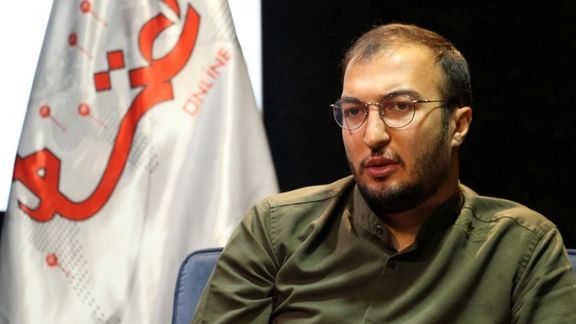
Hardliner political activist Vahid Ashtari

A whistle-blower who had exposed wrongdoing and violations by a few senior conservative political figures in Iran has been handed a jail sentence for two years.

Vahid Ashtari, a young man who is a member of Edalat Khahan [Justice Seekers], a political group of mainly university students who are loyal to Iran's Supreme Leader Ali Khamenei, released a video on social media on Sunday, July 24, to warn others that whistle-blowing could be costly.

Ashtari also posted a court ruling based on which he has been sentenced to two years in jail for "spreading lies and disturbing the public's peace of mind." However, he said that he was never officially indicted.

In April this year, Ashtari revealed that the family of Majles (parliament) Speaker Mohammad Bagher Ghalibaf had visited to Turkey to buy baby clothes and accessories for Ghalibaf's daughter who was pregnant at the time. He also claimed that Ghalibaf’s wife, daughter and son-in-law arrived at Tehran’s Imam Khomeini airport from Istanbul with apparently a large layette set they bought from Turkey. People at the airport didn’t recognize them at first but when a photo of the family circulated on social media, their identity was revealed.

The accusations were followed by a barrage of criticism, and resurfacing of other alleged corruption cases against the family including spending hefty amounts on purchasing properties in Istanbul. Ghalibaf's family and some of the country's officials and political figures initially denied the report but after a while they gradually confirmed Ashtari's account.

Earlier, Ashtari and his colleagues in the Justice Seekers group had made revelations about the role of one of President Ebrahim Raisi's relatives, Meysam Nili, in giving government jobs to people close to them, and called the case "Meysam Gate."

Ghalibaf chairing a parliament session on May 25, 2022
100%
Ghalibaf chairing a parliament session on May 25, 2022

In his video and social media posts on Sunday, Ahtari welcomed his arrest and questioning at police stations, security organizations and courtrooms and said "It is good that young hardliners go to these places and find out what happens to activist workers and teachers and see the true nature of the religious political system 43 years after the 1979 Islamic revolution."

He called on Hezbollahis [hardline political activists who support the Islamic Republic and its leader] to pay special attention to this case and read the ruling.

Ashtari said: "Even after reading it, you may still not understand it because it is not a court ruling. It is a political editorial. But if your objective is to reform the appearance of the religious political system, you can see for yourself the true nature of the regime and how Islam works in the Judiciary and security system."

He "suggested to the devoted youths who blindly defend everything in the regime to find out what is going on behind the façade of Islam, sanctities and martyrs the officials take advantage of." However, he promised that "the situation in Iran will not remain like this."

The court ruling shows that Ashtari has also been accused of "discrediting state officials and mudslinging against them, portraying the country in a bad light and ridiculing a headline in Khamenei's official website."

Iranian analyst Ehsan Mehrabi told Iran International TV in London that although an official indictment has not been issued and Ashtari is entitled to an appeal, the reason why he has been given the jail sentence is that powerful officials wanted to send a message to all that no one, even a well-known conservative figure devoted to Khamenei, can get away with levelling accusations against regime insiders.


Most Viewed

Iran International says it won’t be silenced after London arson attack
1

Iran International says it won’t be silenced after London arson attack

2
VOICES FROM IRAN

Hope and anger in Iran as fragile ceasefire persists

3
INSIGHT

How Tehran bends its own red lines to boost state rallies

4

Iran halts petrochemical exports to supply domestic market

5

US arrests Iranian national over alleged Basij-linked visa fraud

Banner
Banner

Spotlight

  • Too early to tell who is winning Iran war, experts say
    PODCAST

    Too early to tell who is winning Iran war, experts say

  • How Tehran bends its own red lines to boost state rallies
    INSIGHT

    How Tehran bends its own red lines to boost state rallies

  • Iran blackout cripples freelancer, small business incomes
    VOICES FROM IRAN

    Iran blackout cripples freelancer, small business incomes

  • Ideology may be fading in Iran, but not in Kashmir's ‘Mini Iran'
    INSIGHT

    Ideology may be fading in Iran, but not in Kashmir's ‘Mini Iran'

  • US blockade enters murky phase as tankers spoof signals and buyers hesitate
    ANALYSIS

    US blockade enters murky phase as tankers spoof signals and buyers hesitate

  • Why the $100 billion Hormuz toll revenue is a myth
    ANALYSIS

    Why the $100 billion Hormuz toll revenue is a myth

•
•
•

More Stories

Iran Appoints New Ambassador To United Nations Headquarters

Jul 24, 2022, 17:24 GMT+1

The Islamic Republic appointed Sunday Saeed Iravani, a former deputy of the country’s top security official Ali Shamkhani, as Iran’s new ambassador to the United Nations. 

Iravani, who will replace Majid Takht-Ravanchi, served as a deputy of Shamkhani, the secretary of Iran's Supreme National Security Council (SNSC), for nine years. Majid Takht-Ravanchi was among the last officials appointed by former foreign minister Mohammad Javad Zarif, who led the Iranian negotiations with P5+1 countries which produced the 2015 nuclear deal – or the Joint Comprehensive Plan of Action. 

Iravani also served as Iran’s chargé d'affaires in Iraq and secretary of Iran’s Strategic Council on Foreign Relations. He has career overlaps with current lead nuclear negotiator Ali Bagheri-Kani – as both served as SNSC deputies. He is the first Iranian ambassador to the UN with extensive SNSC experience. Iravani's diplomatic assignments -- spearheading the Saudi-Iranian dialogue in Baghdad and his experience as chargé d'affaires -- have been more regionally focused than his predecessors to date. 

100%

President Ebrahim Raisi also appointed new ambassadors to six countries – Georgia, India, Lebanon, Czech Republic, Poland, and Sierra Leone -- on Sunday, practically cleansing the diplomatic roster of appointees from the administration of former president Hassan Rouhani. A cleric, Khalil Sadati Amiri, was named as Iran's ambassador to Sierra Leone. 

Moreover, Raisi appointed Ali Bahraini as Tehran’s permanent representative to the UN Office and other international organizations in Geneva. 

Iran Bans Women From Appearing In Advertisements

Jul 24, 2022, 15:19 GMT+1

The Islamic Republic has imposed a ban on any use of female images or actors in all types of Iranian commercials and advertisements, a viral photo of the order shows.

The Ministry of Culture and Islamic Guidance announced in a letter to Iran's art and cinema schools that according to the so-called "hijab and chastity rules”, the presence of women in advertisements is prohibited from now on.

According to the letter the ban is in accordance with the rulings by the Supreme Council of the Cultural Revolution, and based on the country’s laws and regulations of commercial advertising, which forbids any "instrumental use" of women, men and children. 

The ban has actually always been in place but the interpretation of "instrumental use" varies according to political and religious inclinations of particular presidential administrations. 

The recent announcement of the ban comes following a controversial video of an ice-cream ad, which used close-up shots of an Iranian woman biting the chocolate-coated dessert. 

The body responsible for “enjoining right and forbidding evil” in the Islamic Republic recently filed a lawsuit against the ice-cream manufacturer Domino over two controversial commercials, which it said were “against public decency” and “insult women’s values.”

The whole controversy is taking place on the backdrop of a heated debate over Iran’s enforcement of Islamic dress code or hijab in public, while many Iranian women, who wear the hijab by choice, have joined new social media campaigns this week against street patrols to force women to follow strict laws.

Raisi’s Claim Of Inheriting An Empty Treasury Prove Unfounded

Jul 24, 2022, 08:59 GMT+1
•
Maryam Sinaiee

Iranian president Ebrahim Raisi has tried to defend his dismal economic performance by blaming his predecessor, but that tactic seems to have run its course.

Former President Hassan Rouhani and his aides are increasingly challenging Raisi’s claims that he inherited an empty treasury with no foreign currency reserves and a mountain of unpaid bills.

In a speech to former government officials and aides in his office in Tehran July 18, Rouhani claimed that there were billions of US dollars in cash in the Central Bank of Iran when his is administration handed over the treasury to the new administration in August last year.

It should be noted that Iran had already increased its oil exports from the end of 2020, after the incoming Biden administration signaled its intention to return to the 2015 nuclear agreement, the JCPOA, which would mean lifting sanctions imposed by President Donald Trump in 2018. Therefore, the Rouhani administration had about 8 months of higher oil sales when it handed over the treasury.

Economy minister Ehsan Khandouzi finally admitted to reporters on July 20 that the country had a “good cash reserve” of foreign currency when the current administration took over but also claimed that the cash reserves were earmarked for “paying for services” and could not be used for importing goods and “solving the country’s’ trade problems”.

The economy minister’s admission contradicted claims by various government officials during the past year that the Rouhani administration had handed over an empty treasury.

Two months before handing over the government, former vice president Es’haq Jahangiri, had told reporters that the incoming administration would be in possession of the “most unprecedented foreign currency and gold reserves”.

Officials of the Raisi administration claim that his government has not resorted to printing money and has even succeed in reducing the monetary base by 0.5 percent in the three-month period ending June 21 in comparison with the same period the previous year.

Monetary base (MO) is the total amount of a currency that is either in general circulation in the hands of the public or in the form of commercial bank deposits held in the central bank's reserves.

In a tweet Thursday, the former governor of the Central Bank of Iran (CBI), Abdolnaser Hemmati, responded that the Raisi administration’s repeated assertions of not having borrowed money from the CBI to offset its budget deficit were not true as the administration had withdrawn from the accounts of government-owned companies to make payments.

“Tweaking statistics doesn't solve problems and [their effects] come to light within a few months. The outcome of the government’s financial and monetary policies should reveal itself in people’s lives,” he wrote.

In the same speech Rouhani claimed that his administration could have removed US sanctions in 2021 had the hardline parliament not passed the ‘Strategic Action to Eliminate Sanctions and Defend Iranian Nation's Interests’ bill on December 1, 2020, which prevented his government from concluding an agreement with world powers to restore the 2015 nuclear deal known as the Joint Comprehensive Plan of Action (JCPOA).

The Raisi administration has so far failed to restore the deal and lift the US sanctions which considerably affect the country’s crude oil exports and squeeze the government for foreign currency. US Secretary of State Antony Blinken recently said the Biden administration would keep using its authorities to target Iran's exports of energy products.

Conservatives In Iran Concerned Over Crisis, Public Anger

Jul 23, 2022, 22:44 GMT+1
•
Iran International Newsroom

Iran’s conservatives face a dilemma of how to deal with the failures of a government they brought to power and supported - criticize, defend or keep silent.

As a result, some come up with far-fetched conspiracy theories, as one ultraconservative politician said that inflation (at 55 percent) is a plot being directed from outside the country.

Hassan Beyadi, the secretary general of the ultraconservative political group Abadgaran Javan [Young Developers], told Etemad Online news website on July 22, that he has no doubt about "some Iranian gangs" cooperating with foreign-based circles that direct price increases in Iran.

The pro-government politician, however, did not offer any explanation about how he thinks prices could be manipulated from abroad.

The comment by Bayadi was in sharp contrast with a report on the government owned news agency ISNA that explained price rises in Iran are coordinated with President Ebrahim Raisi and endorsed by him before they are announced.

In a report about the government's pricing policy, ISNA, the Iranian Students News Agency quoted the chairman of the Organization Protecting the Rights of Consumers and Producers, Hossein Farhid Zadeh as saying that price increases are first confirmed by special offices at the Ministries of Industry and Agriculture as well as the government's Economic Commission and finally endorsed by President Ebrahim Raisi.

Meanwhile, in an interview with the conservative Nameh News website, Beyadi said that based on feedbacks people are not happy with the performance of the "revolutionary" government and the parliament.

Ultra-conservative politician Hassan Beyadi
100%
Ultra-conservative politician Hassan Beyadi

Explaining Iranian conservatives' assessment of the two bodies' performance, Beyadi added that the executive and legislature lack coordination and fail to take interests of people into account. He argued that the divide between the people and the Iranian establishment is widening in a dangerous and warned that popular dissatisfaction is a threat to the country's security.

Beyadi whose political organization played a key part in bringing former President Mahmoud Ahmadinejad to power in 2005 and 2009, charged that solving people's problems is not the priority of any government ministries.

Beyadi said that not only the people no longer believe what the officials say, but they believe the opposite of official statements. He added that prices are rising in Iran because no government organization is controlling them.

Beyadi’s remarks are an example of unfounded statements Iranian politicians often make. Almost every economist argues Iran’s economy is too much controlled by the government and over-regulated.

Another conservative commentator, Mohammad Mohajeri told Etemad Online that even conservative politicians find it difficult to defend the government. He added that they so confused by the government's weakness they can neither defend, nor support it, or even keep silent.

Mohajeri explained: "Conservatives cannot defend the government because they know that its performance is not defendable, and the public will not accept such a defense. At the same time, they cannot criticize it because they are part of it and share the responsibility for the current situation. The third solution for them is to keep silent."

However, the public is not likely to accept silence as a response. Mohajeri noted, "As we get closer to the [2024 parliamentary] elections, the conservatives in the parliament will intensify their criticism of the government to garner the voters' support." He added: "The elections in 2020 and 2021 were extremelylow-turnout. If the government does not change its behavior, the next election in 2024 will be even more lackluster."

Brother Of Collapsed Building’s Owner Shot Dead In Iran

Jul 23, 2022, 16:09 GMT+1

The brother of Hossein Abdolbaghi, whose poorly-constructed building recently collapsed in southern Iran and killed dozens of people, was shot dead by unknown assailants Saturday. 

A video from a CCTV camera was released on media showing a car, which apparently was following Majid Abdolbaghi’s vehicle as it went into the parking lot, stopped in front of a building, as one man started shooting with a handgun from the front seat and another one got out of the car and started shooting from behind the car. According to reports Abdolbaghi succumbed to injuries after he was taken to hospital.

The Metropol twin towers collapsed on May 23 burying more than 80 people under the rubble, with about 42 bodies recovered. Soon after the collapse it became apparent that the owner and builder, Hossein Abdolbaghi, was a powerful and politically well-connected businessman who had disregarded regulations and building codes, backed by officials, who might have had their own financial interests.

Following the incident, Iranian media initially reported that Abdolbaghi, who was reportedly connected to Iran’s top security official Ali Shamkhani, had been arrested, but the government later announced that he had died in the collapse. The public did not believe the claim and many said that he escaped and corrupt officials, who had allowed him to violate building regulations, wanted him to disappear.

Hossein Abdolbaghi (file photo)
100%
Hossein Abdolbaghi

In June, reports came out that a physician who refused to cooperate in the alleged coverup had died mysteriously.

Earlier in the week, Iran’s prosecutor general issued an indictment against 20 people accused in the case of the Metropol incident.