• العربية
  • فارسی
Brand
  • Iran Insight
  • Politics
  • Economy
  • Analysis
  • Special Report
  • Opinion
  • Podcast
  • Iran Insight
  • Politics
  • Economy
  • Analysis
  • Special Report
  • Opinion
  • Podcast
  • Theme
  • Language
    • العربية
    • فارسی
  • Iran Insight
  • Politics
  • Economy
  • Analysis
  • Special Report
  • Opinion
  • Podcast
All rights reserved for Volant Media UK Limited
volant media logo

Back From Iran, Turkey’s Erdogan Mulls Syria Offensive
Iran International Newsroom
Jul 20, 2022, 18:53 GMT+1Updated: 17:25 GMT+1
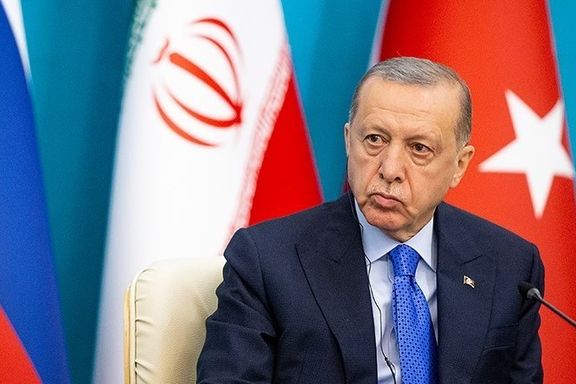
Turkish president Erdogan in Tehran on July 19, 2020

Turkey’s President Tayyip Erdogan has returned from the three-way summit in Tehran with the option of an offensive against Syrian Kurds firmly on his agenda.

Erdogan told reporters on the return flight that the leaders of Russia and Iran shared Turkey’s concern with confronting ‘terrorism.’ While Erdogan, President Vladimir Putin and Iranian leader Ali Khamenei all agreed that the United States should withdraw its troops from north-easy Syria, where they control some oil-fields, both Putin and Khamenei cautioned the Turkish president against an attack on Kurdish forces.

According to a text released by the presidential office, Erdogan continues to insist that an offensive against the main Kurdish group, the PYD (Democratic Union Party), remains possible as long as Turkey’s ‘security’ concerns are not met.

Russia, Turkey, and Iran have worked to coordinate their various interests in Syria through the Astana process, which began in 2019. But with 3.5 million refugees in Syria and a swathe along the border under Kurdish control renamed ‘Rojava,’ Erdogan reiterated Tuesday the option of establishing a ‘safe zone’ inside Syria.

The PYD is linked to the Kurdistan Workers Party (PKK), which has been active mainly in Turkey since the 1980s, and to Pejak, which operates in Iranian Kurdistan. The three share the ultimate aim of one Kurdistan uniting areas from Turkey, Iraq, Syria, and Iran.

But if Ankara and Tehran share antipathy to Kurdish autonomy, they have taken opposite sides in the Syrian war, with Iran alongside Russia backing President Bashar al-Assad and Turkey aiding mainly Sunni rebels.

The PYD has long played an on-off game with Assad, given a general Kurdish antipathy towards mainly Arab Sunni militants. Erdogan Tuesday accused the PYD of “draining” Syria petrol and selling it to Assad’s government. The PYD has also been aided by the US, ostensibly because of its role fighting the Islamic State group (Isis).

Words ‘not enough’

The trilateral summit in Tehran, which dealt with issues including food supplies arising from the Ukraine crisis, showed Erdogan’s dissatisfaction with what is becoming a settled situation in northern Syria.

“You say you understand Turkey’s concerns and we thank you for this,” Erdogan reportedly told Putin and Raisi. “But words alone are not enough.”

But the summit was also an opportunity for Erdogan to meet Putin who for the first time left the former Soviet space. The Turkish president also made Putin wait nearly one minute in an awkward situation before he appeared and greeted him for a bilateral meeting. Many saw this as a payback for all the occasions when the Kremlin boss has made Erdogan and others wait for him.

Iran’s formal position is that all concerned should respect international borders. Khamenei warned Tuesday that ‘terrorism’ in Syria was not limited to one group and that any Turkish intervention would “benefit terrorists,” destabilize the region, and “impede Syria’s political actions.” Iran may be concerned that a Turkish military operation, and the possible return to Syria of radicalized Sunni refugees, could willingly or otherwise strengthen Islamists opposed to Assad.

“We emphasised that the Syrian government must have control over all areas in the country,” Iranian President Ebrahim Raisi told a press conference following the summit.


Most Viewed

Ideology may be fading in Iran, but not in Kashmir's ‘Mini Iran'
1
INSIGHT

Ideology may be fading in Iran, but not in Kashmir's ‘Mini Iran'

2
INSIGHT

Hardliners push Hormuz ‘red line’ as US blockade tests Iran’s leverage

3
VOICES FROM IRAN

Hope and anger in Iran as fragile ceasefire persists

4

Iran International says it won’t be silenced after London arson attack

5

US sanctions oil network tied to Iranian tycoon Shamkhani

Banner
Banner

Spotlight

  • Hardliners push Hormuz ‘red line’ as US blockade tests Iran’s leverage
    INSIGHT

    Hardliners push Hormuz ‘red line’ as US blockade tests Iran’s leverage

  • Ideology may be fading in Iran, but not in Kashmir's ‘Mini Iran'
    INSIGHT

    Ideology may be fading in Iran, but not in Kashmir's ‘Mini Iran'

  • War damage amounts to $3,000 per Iranian, with blockade set to add to losses
    INSIGHT

    War damage amounts to $3,000 per Iranian, with blockade set to add to losses

  • Why the $100 billion Hormuz toll revenue is a myth
    ANALYSIS

    Why the $100 billion Hormuz toll revenue is a myth

  • US blockade targets Iran oil boom amid regional disruption
    ANALYSIS

    US blockade targets Iran oil boom amid regional disruption

  • Iran's digital economy battered by prolonged blackout
    INSIGHT

    Iran's digital economy battered by prolonged blackout

•
•
•

More Stories

Hijab Incidents Continue In Iran As Some Deny Police Action

Jul 20, 2022, 16:24 GMT+1
•
Maryam Sinaiee

A high-profile hardliner has denied the existence of hijab patrols in Iran, saying the opposition is highlighting isolated cases as “psychological warfare”.

“I will not give an interview because I believe we don't have morality police for hijab… there are only exceptional cases … Speaking of these is psychological and political warfare,” Abdollah Ganji, the former editor of the IRGC-linked Javan newspaper who is now chief editor of Tehran municipality’s Hamshahri newspaper, told reformist Etemad daily.

Meanwhile an incident on July 19 shocked many Iranians. A patrol van arrested a young woman who was in the street with her mother. She launched herself again the vehicle as it tried to move, throwing her body on the hood. The van kept moving forward trying to scare her to let go.

Other hardliners proudly defend strict hijab enforcement, while even some ‘reformists’ loyal to the Islamic Republic coyly defend it.

The Islamic Republic has launched an extensive campaign this summer to force women to fully comply with hijab rules. Hardliners often say defiance of hijab is a plot by “enemies” of the Islamic Republic and “cultural onslaught”.

Such campaigns aren't unprecedented, but activists say this year there is more public debate and more defiance by women due to a campaign against compulsory hijab launched last week quickly picking up through the social media and more confrontations between anti-hijab women and hijab enforcers.

On July 12, following a call by women’s rights activists for civil disobedience social media exploded with dozens of videos and photos of women unveiling in public with the hashtag of ‘No2Hijab’. Women’s rights activists say forcing women to follow a certain dress code is a violation of their human rights.

Government enforcers and even every member of the public has the right to warn women whose appearance does not conform with the government’s prescribed rules of hijab.This kind of warning, called “Enjoining the Good and Forbidding the Evil", however, increasinglu leads to confrontations in public.

Sepideh Rashno, a 28-year-old artist, writer and editor who got into a quarrel on a bus with another woman who ordered her to cover her hair, was arrested on Saturday for her defiance. The quarrel became so frantic that other passengers intervened and kicked the hijab enforcer out of the bus. Members of the public have similarly come to the aid of women berated or threatened by hijab enforcers and helped rescue them in similar recent incidents.

In the past few weeks authorities have also shut down some businessessuch as cafes and restaurants and detained their female patrons for ‘improper hijab’ and arrested nature touristsfor flouting their hijab, dancing, and drinking in the depths of northern forests.

Some politicians and activists say the government is using more strict enforcement of hijab rules this summer to distract people’s attention from more fundamental issues such as the current economic crisis that has affected the majority of lower income and even middle-class Iranians.

“I believe they want to sweep the fundamental issues under the carpet so that we would not take heed of people’s fundamental problems and concerns, particularly those of the lower-income classes,” former reformist lawmaker Parvaneh Salahshouri said in an interview with reformist Etemad newspaper published July 18.

Salahshouri also opined that the ruling hardliners are more heavy-handed in dealing with hijab issues because they have to satisfy their supporters who strongly advocate enforcement of hijab rules.

Tehran, Damascus Warn Against Turkish Military Incursion Into Syria

Jul 20, 2022, 14:18 GMT+1

Iran’s foreign minister has called for maintaining the territorial integrity and respecting sovereignty of Syria, expressing concern about a possible Turkish military incursion into Syrian territory. 

In a joint press conference with Syrian Foreign Minister Faisal Mekdad in Tehran on Wednesday, Hossein Amir-Abdolahian said that the trilateral meeting in Tehran on Tuesday sought to prevent war and militarism between Syria and Turkey and solve the issues in a political way. 

Turkey’s President Recep Tayyip Erdogan and Russia’s Vladimir Putin were in Tehran July 19 for talks within the Astana mechanism, focused on the constitutional system, political transition, security and resettlement in Syria.

The Iranian FM said during the meeting with Turkey and Russia, the withdrawal and cleansing of terrorist groups from Syria was emphasized. 

Describing the Astana format summit in Tehran as successful, Mekdad said "Syria is positive about the results of the trilateral summit in Tehran," thanking Iran for preparing "a balanced statement on results of the summit, reaffirming the need to preserve the territorial integrity of Syria."

"It is necessary to deprive Turkey of any pretext to invade the Syrian territory," he said, adding "Ankara's intention to create a border security zone north of Aleppo will lead to an armed conflict. We oppose Turkey's aggressive plans, Ankara's policy of Turkification and support for terrorist groups."

A few hours after their joint presser on Wednesday, Turkish warplanes and artillery attacked areas populated by tourists and villagers in Duhok, Iraqi Kurdistan, killing at least 10 people and injuring 25 others.

Iran Spokesman Does Not Deny Possibility Of Drones For Russia

Jul 20, 2022, 11:15 GMT+1
•
Iran International Newsroom

Iran commenting on possible delivery of military drones to Russia said Wednesday that Tehran’s “technical cooperation” with Moscow predates the Ukraine war, .

In his weekly press conference, foreign ministry spokesman Naser Kanaani was asked about reports that Iran might sell military drones to Russia for its war effort in Ukraine, which he did not deny. Instead, he said, “Iranian and Russian technological cooperation predates developments in Ukraine. Any linkage between our cooperation with Russia with developments in Ukraine is intentionally biased.”

He went on to reiterate that Iran pursues “political solutions for this crisis.”

The US National Security Adviser Jake Sullivan recently said that Russian officers visited Iran in June and July to review possible drone purchases.

US Special Envoy for Iran Robert Malley told CNN on Tuesday that any drone shipment from Iran was “of course of concern” and would “bolster Russia’s ability to wreak havoc.” He said it “speaks volumes” that Iran would be in a position where it sold drones to Russia “against its professed position of neutrality in the conflict.” Without giving details, Malley said the US would “use the tools at our disposal” to sanction any supply of weapons to Russia.

Kanaani in his briefing said, however, “Russian and Iranian ties are bilateral, based on the interests of the two countries and do not concern the American government, which cannot comment about the relationship.”

Kanaani also said that he cannot confirm if Ukraine was discussed between presidents Vladimir Putin, Recep Tayyip Erdogan and Iran Ebrahim Raisi when they met in Tehran on Tuesday, although “naturally international issues are discussed in multilateral meetings,” he added.

However, Iran’s Supreme Leader Ali Khamenei in his meeting with Putin clearly backed Russia’s “initiative” in attacking Ukraine, saying that if Moscow had not taken that step, NATO would have started a war anyway.

“Nato is a dangerous creature,” Khamenei said, “[that] didn’t recognize any limits or borders. If you cannot stand up to them in Ukraine, then a little while later, with the excuse of Crimea, they would have started this war anyway,” Khamenei told Putin.

Speaking about Iran’s talks with the United States to restore the 2015 nuclear agreement known as JCPOA, Kanaani rejected US statements that the latest meeting in Doha in June failed. “As a matter of fact, these were good talks,” he insisted.

He went on to speak with optimism that the diplomatic process is well and alive and the European Union is pursuing discussions with the two sides.

Kanaani reiterated Iran’s position that it needs “serious guarantees” about the US commitment to a new agreement and “verification” that Washington carries out its obligations.

Eleven months of talks in Vienna to revive the JCPOA came to a stop in March as Iran demanded the lifting of all sanctions introduced by the US after former President Donald Trump withdrew from the agreement in 2018.

Kanaani also repeated remarks by Khamenei and Raisi on Tuesday that the United States should withdraw its troops from Syria.

Biden Signs Order For ‘Bringing Home Hostages’ From Iran And Elsewhere

Jul 20, 2022, 09:07 GMT+1

US President Joe Biden signed Tuesday an executive order empowering government departments and bodies to impose sanctions over Americans detained overseas.

A statement from the United States State Department said the presidential order, dubbed ‘Bolstering Efforts to Bring Hostages and Wrongfully Detained United States Nationals Home’ was intended to “deter and disrupt hostage-taking and wrongful detentions” by creating “new ways to impose costs on terrorist organizations, criminal groups, and other malicious actors.”

Pressure on the Biden administration from families of detainees has been gaining more publicity since February’s arrest in Russia of basketball star Brittney Griner on drugs charges, which has provoked debate in the US.

While the government has no official figures for Americans detained abroad, the James W Foley Legacy Foundation, named after the journalist captured and killed by the Islamic State group (Isis) in Syria in 2014, has identified 64 US citizens and lawful long-term residents it says are unjustly detained in 18 countries.

These include Emad Shargi, and Siamak and Baqer Namazi in Iran, as well as detainees in Saudi Arabia, Russia, Pakistan, China, Turkey, Cuba, and Nicaragua. Rights groups have suggested Iran has held as bargaining chips other dual nationals, including Swedish-Iranian doctor Ahmadreza Djalali and British-Iranian environmentalist Morad Tahbaz. Tehran in March released British-Iranians Nazanin Zegari-Ratcliffe and Anoosh Ashoori the day after London honored a 40-year-old debt of £400 million ($480 million).

While directing government officials to work more closely with detainees’ families, Biden’s executive order gives an option of imposing financial and travel sanctions on those deemed “responsible for unjustly holding US nationals, whether their captor is a terrorist network or a state actor,” Secretary of State Antony Blinken said in a statement. The State Department will also add a new category to travel advisories that warn of countries where it says there is greater risk of wrongful detention, beginning immediately with Myanmar, China, Iran, North Korea, Russia, and Venezuela.

‘Nothing constructive on our hostages’

Relatives of detainees have criticized US successive governments for what they see as inertia. Following a video call between officials and family members Tuesday, Neda Shargi, sister of American-Iranian businessman Emad Shargi, jailed in Tehran since 2018, said she had heard “nothing constructive on our hostages.”

Several detainee relatives taking part in the video call said they felt the executive order was aimed more at deterring the future detentions of Americans than at securing releases of those currently jailed.

A prisoner swap with Russia in April saw Washington exchange former US marine Trevor Reed for Russian pilot Konstantin Yaroshenko, whose sentence for drug-smuggling Biden commuted. The swap came despite high tension between Moscow and Washington with the Ukraine war, which encouraged families of other detainees.

The US has conducted talks with Iran over a possible prisoner swap in parallel to but independent from – according to both sides – year-long talks to revive the 2015 Iran nuclear agreement, the Joint Comprehensive Plan of Action.

Khamenei Backs Moscow On Ukraine, Says Iran And Russia Must Cooperate

Jul 19, 2022, 20:21 GMT+1
•
Iran International Newsroom

After Iranian leader Ali Khamenei met Russian President Putin Tuesday afternoon, Iran’s main news agency found the two moving closer with the Ukraine crisis.

IRNA headlined its account of the meeting with a call, endorsed by both Khamenei and Putin, for United States forces to be driven out of north-east Syria, “east of the Euphrates [river]…an area rich in oil and agriculture,” where American troops, first deployed in 2015, have remained since 2018 to ‘secure’ Syria’s main oil-fields.

But perhaps a more notable part of IRNA’s report was Khamenei’s clearest expression yet of support for Russian action in Ukraine. While describing war as “brutal and hard,” Iran’s leader suggested that had Russia not “taken the initiative, the other side, with its own initiative would have created a war anyway.”

Iran’s leader cited the 2014 Ukraine “coup” – when protests overthrew Moscow-inclined Ukrainian President Viktor Yanukovich and prompted Russia’s seizure of Crimea – and the expansion of Nato, which has expanded to take in 14 eastern European countries since 1999. “Nato is a dangerous creature,” Khamenei said, “[that] didn’t recognize any limits or borders. If you cannot stand up to them in Ukraine, then a little while later, with the excuse of Crimea, they would have started this war anyway.”

World events, Khamenei said, had increased the need for “reciprocal cooperation” between Iran and Russia, meaning that “many agreements and contracts, including in oil and gas…must be pursued…and become operational.” This was a “necessity…especially after western sanctions” against Russia over Ukraine, Iran’s leader said. Russian energy giant Gazprom and the National Iranian Oil Company signed a $40-billion energy memorandum-of-understanding Tuesday morning.

Khamenei and Putin meeting in the afternoon of July 19, 2022
100%
Khamenei and Putin meeting in the afternoon of July 19, 2022

The effect of US Middle East policies – including in Syria, Iraq, Lebanon and Palestine – was becoming more limited, Khamenei said. The American presence in north-east Syria should end with their expulsion. President Ebrahim Raisi also referred to the US troop presence in Syria Tuesday to Iranian state television, arguing that it destabilized the country.

Cooperation between Moscow and Tehran would reach its “zenith” in the coming period, Khamenei said, stressing the need alongside other countries of continuing to expand trade away “step by step” from the dollar as the world “lost trust” in the US currency. Both Russia and China – whose dollarized bilateral trade fell below 50 percent in 2020 – are encouraging other countries to follow suit, including through groupings like the Shanghai Cooperation Organization (SCO), which Iran joined last year.

US ‘deceitful’

“Americans were both bullies and deceitful,” Khamenei said, as had been shown by their role in the dissolution of the Soviet Union, presumably in fostering nationalism in the Soviet republics.

Putin, IRNA reported, had said that while nobody wanted war, the West’s behavior had left the Kremlin “no choice but to react.” The Russian president said, according to IRNA, that some European countries had opposed talk of Ukraine joining Nato but had been cajoled by the US, revealing their lack of effective sovereignty.

The West did not consider Ukraine as a suitable candidate for NATO membership before the Russian invasion in February.

Putin described the US killing 2020 of Iranian general Qasem Soleimani “as another example of US evil.” He pointed out that sanctions against Russia over Ukraine had punished the west and others through higher energy prices and a food crisis.



