• العربية
  • فارسی
Brand
  • Iran Insight
  • Politics
  • Economy
  • Analysis
  • Special Report
  • Opinion
  • Podcast
  • Iran Insight
  • Politics
  • Economy
  • Analysis
  • Special Report
  • Opinion
  • Podcast
  • Theme
  • Language
    • العربية
    • فارسی
  • Iran Insight
  • Politics
  • Economy
  • Analysis
  • Special Report
  • Opinion
  • Podcast
All rights reserved for Volant Media UK Limited
volant media logo

Tehran, Damascus Warn Against Turkish Military Incursion Into Syria

Jul 20, 2022, 14:18 GMT+1Updated: 15:38 GMT+1
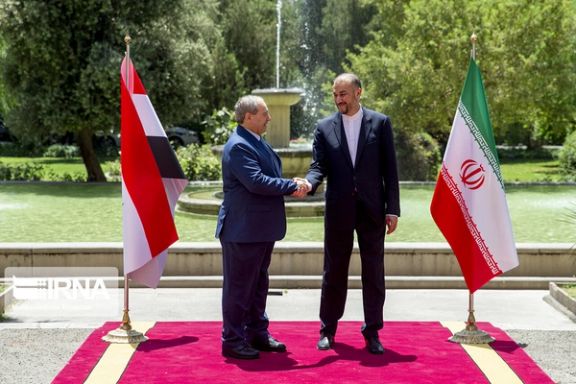
Syrian Foreign Minister Faisal Mekdad (left) and Iran’s Foreign Minister Hossein Amir-Abdolahian in Tehran on July 20, 2022

Iran’s foreign minister has called for maintaining the territorial integrity and respecting sovereignty of Syria, expressing concern about a possible Turkish military incursion into Syrian territory. 

In a joint press conference with Syrian Foreign Minister Faisal Mekdad in Tehran on Wednesday, Hossein Amir-Abdolahian said that the trilateral meeting in Tehran on Tuesday sought to prevent war and militarism between Syria and Turkey and solve the issues in a political way. 

Turkey’s President Recep Tayyip Erdogan and Russia’s Vladimir Putin were in Tehran July 19 for talks within the Astana mechanism, focused on the constitutional system, political transition, security and resettlement in Syria.

The Iranian FM said during the meeting with Turkey and Russia, the withdrawal and cleansing of terrorist groups from Syria was emphasized. 

Describing the Astana format summit in Tehran as successful, Mekdad said "Syria is positive about the results of the trilateral summit in Tehran," thanking Iran for preparing "a balanced statement on results of the summit, reaffirming the need to preserve the territorial integrity of Syria."

"It is necessary to deprive Turkey of any pretext to invade the Syrian territory," he said, adding "Ankara's intention to create a border security zone north of Aleppo will lead to an armed conflict. We oppose Turkey's aggressive plans, Ankara's policy of Turkification and support for terrorist groups."

A few hours after their joint presser on Wednesday, Turkish warplanes and artillery attacked areas populated by tourists and villagers in Duhok, Iraqi Kurdistan, killing at least 10 people and injuring 25 others.

Most Viewed

Ghalibaf defends Iran-US talks amid hardline backlash
1
INSIGHT

Ghalibaf defends Iran-US talks amid hardline backlash

2
VOICES FROM IRAN

Bread shortages, soaring prices strain households in Iran, residents say

3
ANALYSIS

From instability to influence: Pakistan’s pivotal role in US-Iran diplomacy

4
ANALYSIS

100 days on: why Iran’s January protests spread across social classes

5

War-hit homeowners feel abandoned as Iran’s reconstruction aid fades

Banner
Banner

Spotlight

  • Is Iran entering its Gorbachev moment?
    INSIGHT

    Is Iran entering its Gorbachev moment?

  • Iran crackdown reaches cemeteries as graves of slain protesters defaced
    EXCLUSIVE

    Iran crackdown reaches cemeteries as graves of slain protesters defaced

  • Iran diplomacy wobbles as factions compete to avoid looking soft on US
    INSIGHT

    Iran diplomacy wobbles as factions compete to avoid looking soft on US

  • The politics of pink: how Iran uses cuteness to rebrand violence
    ANALYSIS

    The politics of pink: how Iran uses cuteness to rebrand violence

  • Bread shortages, soaring prices strain households in Iran, residents say
    VOICES FROM IRAN

    Bread shortages, soaring prices strain households in Iran, residents say

  • Ghalibaf defends Iran-US talks amid hardline backlash
    INSIGHT

    Ghalibaf defends Iran-US talks amid hardline backlash

•
•
•

More Stories

Tehran Reacts To Russian Envoy’s Provocative Comments

Jul 20, 2022, 13:02 GMT+1

Iran's Foreign Ministry criticized on Wednesday recent remarks by Russian envoy in Tehran about Iran owing a lot of Money to Russia and the West promoting homosexuality in Iran.

Ministry spokesman Naser Kanaani said, “We definitely expect that respected foreign ambassadors residing in Tehran do not comment and intervene on Iran's internal issues.”

Iranian media have often perceived Levan Dzhagaryan's (Jagarian) controversial behavior as intervention in Iran's internal affairs or as flat insults although he does not seem to be bothered by the accusations.

Kanaani added that the foreign ministry is absolutely sensitive to these issues and will act based on its inherent responsibility.

“We must refrain from fueling issues that cause unnecessary problems in our relations with our neighbors,” he emphasized. “We must read Dzhagaryan's statements carefully and see how much his opinion is consistent with his statements.”

On social media and recently in Tehran media, however, Iranians have been demanding an answer to the ambassador's outrageous and provocative remarks. 

“Where are the government and the foreign ministry?" Khabar Online, a moderate conservative news outlet in Tehran asked on Sunday, July 17, after Dzhagarian told Sharq newspaper a day earlier that "We have always been on Iran's side, but the West want to bring their absurd values such as homosexuality and other dirty things to Iran but we object to that!"

Many Iranians on social media reminded the ambassador that Russia is a large producer of pornography in the world.

Putin's Trip To Iran Proves Isolation Of Moscow - White House

Jul 20, 2022, 11:51 GMT+1

The White House says Russian President Vladimir Putin's trip to Iran on July 19 shows how isolated Moscow has become in the wake of its invasion of Ukraine.

John Kirby, the White House's chief National Security Council spokesman, told reporters on Tuesday, “I would say three things about this trip. One it shows the degree to which Mr. Putin and Russia are increasingly isolated. Now they have to turn to Iran for help.”

“Two, it shows the degree to which his own defense industrial base is having a hard time keeping up with his unprovoked war in Ukraine,” he went on, highlighting Russia’s troubles regarding precision guided munitions and advanced systems, tanks, even aircraft, particularly with the microelectronics due to the sanctions and export controls. He said the pace of operations in Ukraine has also become a challenge. 

Kirby said the third thing is Russia “has absolutely no intention of stopping the war” and negotiating a settlement with Ukraine, because he wants to buy several hundred UAVs from Iran “to continue to kill Ukrainians.” Putting prefers to turn to Iran rather than just doing the right thing... and ending the war, he added. 

However, Kirby said there is no indication yet that the sale has actually occurred, and that Iran has started training Russian forces to use armed drones, referring to remarks by Jake Sullivan, the US National Security Adviser, who said last week that Tehran planned to supply “several hundred UAVs, including weapons-capable UAVs, on an expedited timeline.”

He said the US is watching the situation closely, as “the Iranians have a domestic production capability of drones and those drones have lethal capabilities. We've seen that for ourselves in the attacks that they have perpetrated in Iraq and in Syria against our own troops and against our own facilities there.”

Iran Spokesman Does Not Deny Possibility Of Drones For Russia

Jul 20, 2022, 11:15 GMT+1
•
Iran International Newsroom

Iran commenting on possible delivery of military drones to Russia said Wednesday that Tehran’s “technical cooperation” with Moscow predates the Ukraine war, .

In his weekly press conference, foreign ministry spokesman Naser Kanaani was asked about reports that Iran might sell military drones to Russia for its war effort in Ukraine, which he did not deny. Instead, he said, “Iranian and Russian technological cooperation predates developments in Ukraine. Any linkage between our cooperation with Russia with developments in Ukraine is intentionally biased.”

He went on to reiterate that Iran pursues “political solutions for this crisis.”

The US National Security Adviser Jake Sullivan recently said that Russian officers visited Iran in June and July to review possible drone purchases.

US Special Envoy for Iran Robert Malley told CNN on Tuesday that any drone shipment from Iran was “of course of concern” and would “bolster Russia’s ability to wreak havoc.” He said it “speaks volumes” that Iran would be in a position where it sold drones to Russia “against its professed position of neutrality in the conflict.” Without giving details, Malley said the US would “use the tools at our disposal” to sanction any supply of weapons to Russia.

Kanaani in his briefing said, however, “Russian and Iranian ties are bilateral, based on the interests of the two countries and do not concern the American government, which cannot comment about the relationship.”

Kanaani also said that he cannot confirm if Ukraine was discussed between presidents Vladimir Putin, Recep Tayyip Erdogan and Iran Ebrahim Raisi when they met in Tehran on Tuesday, although “naturally international issues are discussed in multilateral meetings,” he added.

However, Iran’s Supreme Leader Ali Khamenei in his meeting with Putin clearly backed Russia’s “initiative” in attacking Ukraine, saying that if Moscow had not taken that step, NATO would have started a war anyway.

“Nato is a dangerous creature,” Khamenei said, “[that] didn’t recognize any limits or borders. If you cannot stand up to them in Ukraine, then a little while later, with the excuse of Crimea, they would have started this war anyway,” Khamenei told Putin.

Speaking about Iran’s talks with the United States to restore the 2015 nuclear agreement known as JCPOA, Kanaani rejected US statements that the latest meeting in Doha in June failed. “As a matter of fact, these were good talks,” he insisted.

He went on to speak with optimism that the diplomatic process is well and alive and the European Union is pursuing discussions with the two sides.

Kanaani reiterated Iran’s position that it needs “serious guarantees” about the US commitment to a new agreement and “verification” that Washington carries out its obligations.

Eleven months of talks in Vienna to revive the JCPOA came to a stop in March as Iran demanded the lifting of all sanctions introduced by the US after former President Donald Trump withdrew from the agreement in 2018.

Kanaani also repeated remarks by Khamenei and Raisi on Tuesday that the United States should withdraw its troops from Syria.

Biden Signs Order For ‘Bringing Home Hostages’ From Iran And Elsewhere

Jul 20, 2022, 09:07 GMT+1

US President Joe Biden signed Tuesday an executive order empowering government departments and bodies to impose sanctions over Americans detained overseas.

A statement from the United States State Department said the presidential order, dubbed ‘Bolstering Efforts to Bring Hostages and Wrongfully Detained United States Nationals Home’ was intended to “deter and disrupt hostage-taking and wrongful detentions” by creating “new ways to impose costs on terrorist organizations, criminal groups, and other malicious actors.”

Pressure on the Biden administration from families of detainees has been gaining more publicity since February’s arrest in Russia of basketball star Brittney Griner on drugs charges, which has provoked debate in the US.

While the government has no official figures for Americans detained abroad, the James W Foley Legacy Foundation, named after the journalist captured and killed by the Islamic State group (Isis) in Syria in 2014, has identified 64 US citizens and lawful long-term residents it says are unjustly detained in 18 countries.

These include Emad Shargi, and Siamak and Baqer Namazi in Iran, as well as detainees in Saudi Arabia, Russia, Pakistan, China, Turkey, Cuba, and Nicaragua. Rights groups have suggested Iran has held as bargaining chips other dual nationals, including Swedish-Iranian doctor Ahmadreza Djalali and British-Iranian environmentalist Morad Tahbaz. Tehran in March released British-Iranians Nazanin Zegari-Ratcliffe and Anoosh Ashoori the day after London honored a 40-year-old debt of £400 million ($480 million).

While directing government officials to work more closely with detainees’ families, Biden’s executive order gives an option of imposing financial and travel sanctions on those deemed “responsible for unjustly holding US nationals, whether their captor is a terrorist network or a state actor,” Secretary of State Antony Blinken said in a statement. The State Department will also add a new category to travel advisories that warn of countries where it says there is greater risk of wrongful detention, beginning immediately with Myanmar, China, Iran, North Korea, Russia, and Venezuela.

‘Nothing constructive on our hostages’

Relatives of detainees have criticized US successive governments for what they see as inertia. Following a video call between officials and family members Tuesday, Neda Shargi, sister of American-Iranian businessman Emad Shargi, jailed in Tehran since 2018, said she had heard “nothing constructive on our hostages.”

Several detainee relatives taking part in the video call said they felt the executive order was aimed more at deterring the future detentions of Americans than at securing releases of those currently jailed.

A prisoner swap with Russia in April saw Washington exchange former US marine Trevor Reed for Russian pilot Konstantin Yaroshenko, whose sentence for drug-smuggling Biden commuted. The swap came despite high tension between Moscow and Washington with the Ukraine war, which encouraged families of other detainees.

The US has conducted talks with Iran over a possible prisoner swap in parallel to but independent from – according to both sides – year-long talks to revive the 2015 Iran nuclear agreement, the Joint Comprehensive Plan of Action.

US Envoy Says Iran Can Choose A Better Future Or Side With Russia

Jul 19, 2022, 23:07 GMT+1
•
Iran International Newsroom

Reacting to Vladimir Putin’s visit to Tehran, US envoy Robert Malley said Tuesday Iran has a stark choice between a nuclear deal or more isolation with Moscow.

In an interview with CNN, Malley, the United States special envoy for Iran, said, “It can opt for a position of relative dependency on Russia, which itself is isolated internationally…or it can choose to come back into the deal that’s been negotiated...and have normal economic relations with its neighborhood and with Europe and the rest of the world.”

The special envoy suggested that not “getting back into the deal” would mean Iran “having to turn to Russia, having to sell on drones to Russia, a choice that is not a particularly attractive one…”

The US recently alleged that Russian officers visited Iran in June and July to review possible drone purchases. Malley said any drone shipment from Iran was “of course of concern” and would “bolster Russia’s ability to wreak havoc.” He said it “speaks volumes” that Iran would be in a position where it sold drones to Russia “against its professed position of neutrality in the conflict.” Without giving details, Malley said the US would “use the tools at our disposal” to sanction any supply of weapons to Russia.

Iran’s supreme leader Ali Khamenei, meeting President Vladimir Putin, gave Tuesday the clearest expression yet of support for Russia over Ukraine, which had “taken the initiative” while “the other side, with its own initiative would have created a war anyway.”

But Russia and Iran have long had some military cooperation, especially supporting President Bashar al-Assad in Syria, during the operation of the 2015 nuclear deal (the JCPOA, Joint Comprehensive Plan of Action) until President Donald Trump withdrew the US in 2018, prompting Iran to begin exceeding JCPOA limits in 2019.

Malley again called Trump’s decision to leave the agreement “catastrophic,” while reiterating that the onus to revive the JCPOA, which has been the subject of year-long negotiations between Iran and world powers, lay in Tehran.

‘A few weeks’

Malley dismissed a suggestion Iran might be responding to US actions, being pushed towards Russia for example not just by US ‘maximum pressure’ but by Biden’s statement during his recent trip to Israel and Saudi Arabia that the US would not leave a regional “vacuum” to be filled by Russia, China, and Iran.

Iran’s leaders have argued with President Joe Biden continuing Trump’s sanctions, has refused as part of JCPOA restoration to lift them all, including listing Iran’s Revolutionary Guards as a ‘foreign terrorist organization,’ and to give assurances it would not impede Iran in benefiting from the agreement.

Malley refused to give a deadline for JCPOA talks.He said Tehran was “a few weeks” from creating enough fissile material for a bomb, “if it chooses to enrich at that level,” although the weaponization “would take longer.”

“Every day” made JCPOA restoration and the return of Iran’s nuclear program to a “safe box” less likely, Malley argued. Terms for reviving the deal had been agreed, he suggested, by all parties in talks other than Iran – including Russia as well as the US, China, France, Germany and the United Kingdom.