• العربية
  • فارسی
Brand
  • Iran Insight
  • Politics
  • Economy
  • Analysis
  • Special Report
  • Opinion
  • Podcast
  • Iran Insight
  • Politics
  • Economy
  • Analysis
  • Special Report
  • Opinion
  • Podcast
  • Theme
  • Language
    • العربية
    • فارسی
  • Iran Insight
  • Politics
  • Economy
  • Analysis
  • Special Report
  • Opinion
  • Podcast
All rights reserved for Volant Media UK Limited
volant media logo

Iran’s Ahmadinejad Spurns Raisi’s Policies As Failures Add Up

Iran International Newsroom
May 17, 2022, 14:00 GMT+1Updated: 17:40 GMT+1
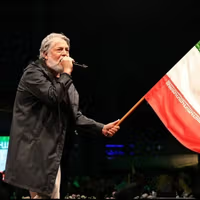
Ahmadinejad speaking in souther Iranian port city of Busheher, on May 6, 2022

Former President Mahmoud Ahmadinejad has been distancing himself from President Ebrahim Raisi’s policies as his economic failures become obvious and dangerous.

Ahmadinejad has been recently criticizing Raisi’s economic and foreign policies. He has particularly lashed out at Raisi’s decision to eliminate food subsidies which has brought thousands of Iranians into the streets in many cities in several provinces.

Meanwhile, media and pundits in Tehran have noted that many of Raisi’s ministers including his ministers of labor, agriculture, economy and industry, and housing as well as his Vice Presidents for planning and budget and Vice President for executive affairs were officials in Ahmadinejad’s government or members of the ultraconservative Paydari Party, representing people associated with the former president.

During the past nine months one of the recurrent criticisms of the Raisi was that he is using Ahmadinejsd’s men in his economic team that is believed to be responsible for the failure of his declared policies about the economy, housing and employment.

According to moderate news website, Rouydad24, Ahmadinejad has been more visibly active after Raisi took office last August. He has been travelling around Iranian provinces, meeting with relatively large groups of people and many Iranians take their grievances to Ahmadinejad’s doorstep at Narmak neighbourhood in eastern Tehran.

During this period Ahmadinejad has also traveled abroad paying eye-catching visits to Turkey and the United Arab Emirates where he was welcomed by groups of Iranian expats and foreign-based Persian-speaking media. He has also continued writing long letters to political and religious dignitaries all over the world. In one of his latest letters, he warned Russian President Vladimir Putin that remaining in power for too long will lead to a dictatorship which is not in his or in Russia’s interest.

Ahmadinejad’s criticism of Raisi’s policies at times looks odd as both political observers and the man in the street notice the resemblance between Ahmadinejad and Raisi’s populist policies. Both talk about social justice and serving the nation in an identical way regardless of how genuine their statements are.

Critics liken Raisi’s policy of throwing money at problems regardless of long-term economic consequences much like Ahmadinejad did during his presidency. The significant difference is that the former president had much higher oil revenues than Raisi. However, Ahmadinejad has charged that the cash subsidy he started to pay to almost all Iranians regardless of their financial footing was about 40 dollars per person per month, while now Raisi cannot afford it because Iran’s currency has fallen 30-fold in the past 15 years.

He has also critiqued the elimination of food subsidies, saying to a crowd in Bushehr southern Iran: “You cannot do whatever you wish only because you are the boss! The nation will not allow anyone to do anything against the people’s will.”

The former President also lashed out at Raisi for “appointing small men to big jobs.” Meanwhile, he has harshly criticised Raisi administration’s policy about Afghanistan and the war in Ukraine. “Who gave you the permission to support Russia’s invasion of Ukraine?” Ahmadinejad asked.


Most Viewed

US blockade enters murky phase as tankers spoof signals and buyers hesitate
1
ANALYSIS

US blockade enters murky phase as tankers spoof signals and buyers hesitate

2

US tightens financial squeeze on Iran, warns banks over oil money flows

3
INSIGHT

Ideology may be fading in Iran, but not in Kashmir's ‘Mini Iran'

4
INSIGHT

Hardliners push Hormuz ‘red line’ as US blockade tests Iran’s leverage

5
VOICES FROM IRAN

Hope and anger in Iran as fragile ceasefire persists

Banner
Banner

Spotlight

  • Hardliners push Hormuz ‘red line’ as US blockade tests Iran’s leverage
    INSIGHT

    Hardliners push Hormuz ‘red line’ as US blockade tests Iran’s leverage

  • Ideology may be fading in Iran, but not in Kashmir's ‘Mini Iran'
    INSIGHT

    Ideology may be fading in Iran, but not in Kashmir's ‘Mini Iran'

  • War damage amounts to $3,000 per Iranian, with blockade set to add to losses
    INSIGHT

    War damage amounts to $3,000 per Iranian, with blockade set to add to losses

  • Why the $100 billion Hormuz toll revenue is a myth
    ANALYSIS

    Why the $100 billion Hormuz toll revenue is a myth

  • US blockade targets Iran oil boom amid regional disruption
    ANALYSIS

    US blockade targets Iran oil boom amid regional disruption

  • Iran's digital economy battered by prolonged blackout
    INSIGHT

    Iran's digital economy battered by prolonged blackout

•
•
•

More Stories

Iranian Intelligence Intensifies Media Censorship Over Protests

May 16, 2022, 11:18 GMT+1
•
Iran International Newsroom

Iran's intelligence ministry has tightened censorship rules for government-controlled media in covering ongoing protests, Iran International has learned.

The intelligence ministry has also summoned several journalists to demand explanations about their coverage, although the media has largely been silent about the protests that began on May 5.

Iran International has learned that on Sunday the intelligence ministry had convened a meeting with representatives of Government-controlled media to issue new restrictions. The authorities asked media managers to highlight a narrative that public property “is being destroyed by troublemakers and elements of foreign influence.”

Parallel with intimidating newspapers and websites, that are already under government control, authorities have disrupted internet access in at least 15 provinces. Security organs routinely slow down or shut off access during popular protests to prevent the people from sharing images and news in the absence of media coverage. Authorities are concerned about the outside world finding out details about protests and witness the use of force by security forces. They also do not want different regions of the country to find out about protests elsewhere.

Along with control of traditional and social media, the government has been jamming Persian-language television stations beaming news and programs into the country. The Voice of America, Iran International, Radio Farda, Manoto TV and BBC Persian are closely followed in Iran, where most households have satellite receivers to watch these stations.

Iran has developed technology to jam the satellite signal close to the ground with special mobile jammers that move into areas where the government does not want people to get independent news and information. In recent days, the government is focusing its jamming in areas where there are protests.

The intelligence ministry’s new restrictions do not just apply to the coverage of protests but also more broadly to the issue of economic policies that triggered the ongoing protests.

The government of President Ebrahim Raisi announced in early May that it would end special food import subsidies in place since 2018, when the United States pulled out of the nuclear agreement known as JCPOA and imposed serious economic sanctions.

Immediately following the announcement food prices jumped, with some items doubling or tripling in a matter of hours. The shock came as the income of ordinary Iranians has lost most of its purchasing power after four years of 30-40 percent inflation and a steep loss in the value of the national currency.

On Saturday, Iran International had reported that the government told the media not to use certain words and terminology when reporting on protests. These included words such as "economic surgery", "violent confrontation", "clashing with people" and "sit-in", threatening media outlets with judicial penalties.

“Economic surgery” is a term used by many government officials, including first deputy prime minister Mohammad Mokhber, to refer to the elimination of food import subsidies. Later, an unnamed security official denied that such a directive was issued.

IRGC General Says Some Blame Khamenei For Iran’s Economic Woes

May 15, 2022, 18:27 GMT+1

As street protests enter their second week, Iranian politicians and military men are offering their insights about the economic crisis and rapid price hikes.

Food prices that doubled and tripled in recent days triggered the unrest that have turned into fierce anti-government protests in many parts of the country.

Most of the explanations target the previous government or President Ebrahim Raisi's lack of an economic policy. But in a different analysis to explain the crisis that has brought thousands into the streets, the deputy commander of the Revolutionary Guard (IRGC) Yadollah Javani lashed out at government's critics, saying that some people are gradually blaming Supreme Leader Ali Khamenei for the economic problems, because he does not allow negotiations with the United States.

This is the first time an official of Javani's calibre acknowledges the debate about Khamenei's responsibility for the diplomatic deadlock, which has led to the country's biggest economic problems in modern history.

However, during the past weeks Javani happened to lose a lot of his credibility after he was implicated in an alleged espionage or infiltration case involving a foreign woman who had penetrated Khamenei's inner circle and even posted two dozen articles on his official website. Therefore, his comments will be likely taken as an attempt to appease Khamenei to redeem his trust.

Better Diplomacy

Over the weekend, Hassan Khomeini, a grandson of Rouhollah Khomeini, the founder of the Islamic Republic criticized the Raisi administration for failing to tackle the diplomatic impasse that has been preventing an economic breakthrough since the 2018 US pull-out from JCPOA, the nuclear deal with Iran.

The young Khomeini, an aspiring political figure who has often been criticized for wasting trillions of rials on developing a large complex housing his grandfather's tomb, said a good team of diplomats should have been able to solve the problem with the United States or at least open a new path “within 24 hours.”

Lack of trust

Former communication minister and presidential election hopeful Mohammad Gharazi said the root-cause of the unrest is that Iranians do not trust the government. Gharazi added that President Ebrahim Raisi knows better than everyone else that Iran's economic problems have worsened since he took office in August 2021.

Gharazi argued that the Raisi administration has not been able to convince the Iranian society that he is doing the right thing to help them.

Raisi, who recently stopped an annual $15-20 billion food import subsidy, argues that he is reforming the economy to prevent corruption, and there will be no gain without pain.

Nonetheless, some of Raisi's supporters such as conservative lawmaker Reza Taghipour, a former aide of President Mahmoud Ahmadinejad keep blaming former President Hassan Rouhani for country's current problems without mentioning why the new government has not been able to fix the problems after 10 months.

Famine on the way

In another development, reformist politician Mohammad Ali Abtahi criticized state-owned media for justifying the Raisi administration's failure, saying that "It is wrong to pretend that the entire Iranian society is happy about the way the administration has manipulated the subsidy system." Abtahi said that state-owned media's approach during the past week has been provocative.

During the week, the state-owned television and Khamemnei-affiliated Kayhan newspaper have been supporting Raisi's policy and not only ignoring, but also attacking and belittling the protests.

In the meantime, conservative political analyst Mehdi Ayati said in an interview with Nameh News, close to former Intelligence Minister Mostafa Pourmohammadi that "a famine will be on its way in Iran if food rationing does not start as soon as possible."

Iran’s Reformists – ‘Reforms Are Dead, Long Live Reforms!’

May 15, 2022, 14:44 GMT+1
•
Iran International Newsroom

Same time last year, a month before the June 2021 presidential election, Iran's 'reformists' were still hopeful that one of them might win the election.

It took them only a few days to find out that that the Guardian Council, or in other words Supreme Leader Ali Khamenei, has other plans for the country's future.

The Council under Khamenei’s supervision rejected almost all reformist and even moderate-conservative candidates, all but ensuring the election of the preferred hardliner candidate, Ebrahim Raisi.

Although two of the final candidates, former Central bank Governor Abdolnasser Hemmati and former Governor General of Khorasan Province Mohsen Mehralizadeh, liked to be characterized as "reformist," few politicians, let alone voters would recognize them as such. Some reformists even thought about forming coalitions with moderate conservative figures such as dormer Majles (parliament) Speaker Ali Larijani and former lawmaker Ali Motahari.

Today, after a year, some of them still occasionally get some press coverage while some others are absolutely silent and do not wish to be remembered as former candidates.

Former foreign minister Mohammad Javad Zarif. FILE PHOTO
100%
Former foreign minister Mohammad Javad Zarif

The reformists' first choice for the post, former Foreign Minister Mohammad Javad Zarif never registered as a candidate. Since then, he has been seen at two Ramadan banquets at the Presidential office and Khamenei's headquarters. Currently, he teaches at the University of Tehran and his political career appears to have come to an end after he charged in a leaked tape in April 2020 that former Qods Force Commander Qasem Soleimani got his orders from Russia.

One of the most likely candidates, former Vice President Es'haq Jahangiri who lost his popularity after his brother was indicted and jailed for financial corruption, became a target of attacks by hardliners in the new government and Majles who blamed him for economic problems. He never became a candidate either.

Former deputy interior minister Mostafa Tajzadeh was extremely vocal against the government ahead of the election and welcomed by younger reformists. However, at the end, he decided that neither him nor anyone else should run for president in protest to the Guardian Council's unilateral and widespread disqualification of pro-reform candidates.

Former deputy minister Mosatfa Tajzadeh who has turned into a critic of Iran's rulers
100%
Former deputy minister Mosatfa Tajzadeh who has turned into a staunch critic of hardliners

Massoud Pezeshkian, a lawmaker from Tabriz and a vocal critic of former President Hassan Rouhani and Raisi, was disqualified by the Guardian Council. He currently runs Ensaf News website.

Mohammad Reza Aref who was harshly criticized for his aloofness and silence as the leader of the reform faction in the previous Majles, did not run and has kept silent after the 2021 election. Mohsen Hashemi, the chairman of Tehran City Council, appears to have quit his political career and is currently editing his father’s, former President Akbar Hashemi Rafsanjani's memoirs. Last week he complained that the Culture Ministry has censored a large part of the latest volume.

Mostafa Kavakebian, the leader of the very small reformist party Mardom Salari, continues publishing his newspaper under the same name but appears undecided between criticizing Raisi or appeasing him in the hope of receiving some favors.

Regardless of strict opposition by clerics and hardliners to women running for president, former vice presidents Shahindokht Molaverdi and Zahra Shojaee were nominated for the post but were disqualified by the Guardian Council. Molaverdi currently works as a notary public and Shojaee is in bed with cancer. Both were active in trying to expand women’s rights.

Mohammad Sadeq Kharrazi, a relative of Khamenei, a former senior diplomat and the leader of Neda Party has quit politics without any explanation.

However, part of the reform camp, mainly right of center Kargozaran Party, does not seem to be affected by disillusionment and despair. As the party's leader Hossein Marashi has said in a recent interview: "We know that there are limitations, but there is no way for us other than political struggle." Marashi is famous for his motto: "Reforms are dead, long live the reforms!"

US Lawmakers Call On Elon Musk To Ban Sanctioned Iranians From Twitter

May 13, 2022, 18:12 GMT+1

Several members of the US House of Representatives have called on Elon Musk, the new would-be owner of Twitter, to ban US-sanctioned Iranian officials and organizations from the platform.

In a Thursday letter, led by the representative Claudia Tenney (R-NY) and House Republican Conference Chair Elise Stefanik joined by seven of their colleagues, lawmakers urged the world’s richest man and incoming interim CEO of Twitter to ensure it complies with US law, while restoring it as a platform that protects and champions free speech.

“It is unacceptable that US designated foreign entities freely use Twitter, despite laws and regulations that prohibit the provision of goods and services to them,” the letter said.

Iran’s Supreme Leader Ali Khamenei and others sanctions by the US still use many accounts on Twitter.

They added, “The Iranian Regime uses Twitter to upend free societies and threaten violence, which is exactly why the regime has been designated a State Sponsor of Terrorism and why many of its officials are on the SDN (Specially Designated Nationals) list today".

Tenney and her House colleagues emphasized, “Allowing designated individuals and entities to continue using Twitter to incite violence against American officials and citizens, call for the eradication of the Jewish State (Israel) and its people, and promote its terrorist proxies, in in flagrant violation not only of Twitter's longstanding policies, but most importantly of US law."

France Condemns Nationals’ Arrests As EU Envoy Holds Iran Nuclear Talks

May 12, 2022, 16:31 GMT+1
•
Iran International Newsroom

As teachers protested across Iran amid government allegations of foreign influence in their campaign, France Thursday condemned the arrest of two French citizens.

France’s Ministry for Europe and Foreign Affairs told Iran International in a communiqué Thursday it had summoned the Iranian charge d'affaires in Paris after Iran detained two French nationals on charges that they fomented teachers’ demonstrations. The ministry said the ambassador in Tehran had requested consular access to the detainees.

The Iranian Intelligence Ministry claimed Wednesday that the two had met with members of the Coordination Council of Iranian Teachers’ Trade Associations, which has organized nation-wide teachers’ protests since last year. Iran International Wednesday named those arrested as Cécile Kohler, head of the biggest federation of French teachers' unions, and her husband.

The couple arrived in Tehran's Imam Khomeini Airport April 29, stayed in Tehran for two days, and then went to Kashan and Esfahan. They were due to return home May 8, the day of their arrest. An intelligence ministry statement said Wednesday that the two went to Iranwith the aim of changing “popular” demand into “chaos, social disorder and destabilization of society.”

On Thursday, Iranian teachers took to streets for the third time in under two months despite the education ministry’s threat to fire them. According to videos posted to social media, teachers demanded better working conditions and the release of colleagues arrested in previous protests.

‘Reckless and cowardly’

The Coordination Council of Iranian Teachers’ Trade Associations said later in the day said that several people had been arrested after security forces used force to disperse the protesters in some cities, including Ahvaz, Khuzestan province, which Wednesday saw protests over increased food prices.

In a resolution published at the end of the Thursday’s rallies, protesting teachers condemned a "reckless and cowardly” attempt to attribute “decades” of their protests to foreign hands. In Tehran, police cordoned off streets leading to parliament, where teachers had gathered in previous protests. 

The protests and the arrest of French nationals occurred as Enrique Mora, the senior European Union official chairing talks to revive the 2015 Iran nuclear deal (the JCPOA, Joint Comprehensive Plan of Action), was in Tehran in an effort to restart the stalled negotiations. Republican Senator James Risch, a JCPOA opponent, said Wednesday that Iran’s detention of European nationals while Mora was in Tehran “should be the final nail in the coffin for any bad deal with Iran”.