• العربية
  • فارسی
Brand
  • Iran Insight
  • Politics
  • Economy
  • Analysis
  • Special Report
  • Opinion
  • Podcast
  • Iran Insight
  • Politics
  • Economy
  • Analysis
  • Special Report
  • Opinion
  • Podcast
  • Theme
  • Language
    • العربية
    • فارسی
  • Iran Insight
  • Politics
  • Economy
  • Analysis
  • Special Report
  • Opinion
  • Podcast
All rights reserved for Volant Media UK Limited
volant media logo

IRGC General Says Some Blame Khamenei For Iran’s Economic Woes
May 15, 2022, 18:27 GMT+1
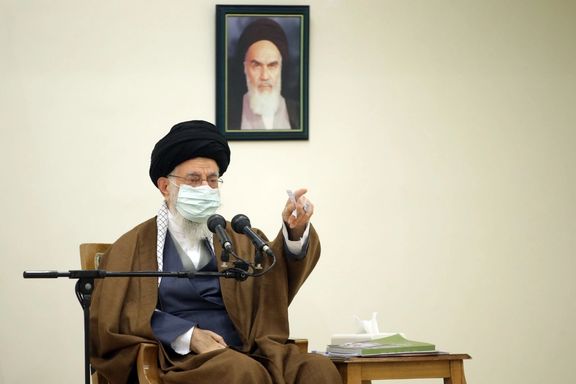
Iran's Supreme Leader Ali Khamenei on January 1, 2022

As street protests enter their second week, Iranian politicians and military men are offering their insights about the economic crisis and rapid price hikes.

Food prices that doubled and tripled in recent days triggered the unrest that have turned into fierce anti-government protests in many parts of the country.

Most of the explanations target the previous government or President Ebrahim Raisi's lack of an economic policy. But in a different analysis to explain the crisis that has brought thousands into the streets, the deputy commander of the Revolutionary Guard (IRGC) Yadollah Javani lashed out at government's critics, saying that some people are gradually blaming Supreme Leader Ali Khamenei for the economic problems, because he does not allow negotiations with the United States.

This is the first time an official of Javani's calibre acknowledges the debate about Khamenei's responsibility for the diplomatic deadlock, which has led to the country's biggest economic problems in modern history.

However, during the past weeks Javani happened to lose a lot of his credibility after he was implicated in an alleged espionage or infiltration case involving a foreign woman who had penetrated Khamenei's inner circle and even posted two dozen articles on his official website. Therefore, his comments will be likely taken as an attempt to appease Khamenei to redeem his trust.

Better Diplomacy

Over the weekend, Hassan Khomeini, a grandson of Rouhollah Khomeini, the founder of the Islamic Republic criticized the Raisi administration for failing to tackle the diplomatic impasse that has been preventing an economic breakthrough since the 2018 US pull-out from JCPOA, the nuclear deal with Iran.

The young Khomeini, an aspiring political figure who has often been criticized for wasting trillions of rials on developing a large complex housing his grandfather's tomb, said a good team of diplomats should have been able to solve the problem with the United States or at least open a new path “within 24 hours.”

Lack of trust

Former communication minister and presidential election hopeful Mohammad Gharazi said the root-cause of the unrest is that Iranians do not trust the government. Gharazi added that President Ebrahim Raisi knows better than everyone else that Iran's economic problems have worsened since he took office in August 2021.

Gharazi argued that the Raisi administration has not been able to convince the Iranian society that he is doing the right thing to help them.

Raisi, who recently stopped an annual $15-20 billion food import subsidy, argues that he is reforming the economy to prevent corruption, and there will be no gain without pain.

Nonetheless, some of Raisi's supporters such as conservative lawmaker Reza Taghipour, a former aide of President Mahmoud Ahmadinejad keep blaming former President Hassan Rouhani for country's current problems without mentioning why the new government has not been able to fix the problems after 10 months.

Famine on the way

In another development, reformist politician Mohammad Ali Abtahi criticized state-owned media for justifying the Raisi administration's failure, saying that "It is wrong to pretend that the entire Iranian society is happy about the way the administration has manipulated the subsidy system." Abtahi said that state-owned media's approach during the past week has been provocative.

During the week, the state-owned television and Khamemnei-affiliated Kayhan newspaper have been supporting Raisi's policy and not only ignoring, but also attacking and belittling the protests.

In the meantime, conservative political analyst Mehdi Ayati said in an interview with Nameh News, close to former Intelligence Minister Mostafa Pourmohammadi that "a famine will be on its way in Iran if food rationing does not start as soon as possible."


Most Viewed

Ghalibaf defends Iran-US talks amid hardline backlash
1
INSIGHT

Ghalibaf defends Iran-US talks amid hardline backlash

2
INSIGHT

A nation in limbo: 100 days after the massacre, has the world moved on?

3
ANALYSIS

From instability to influence: Pakistan’s pivotal role in US-Iran diplomacy

4
ANALYSIS

100 days on: why Iran’s January protests spread across social classes

5

War-hit homeowners feel abandoned as Iran’s reconstruction aid fades

Banner
Banner

Spotlight

  • War-hit homeowners feel abandoned as Iran’s reconstruction aid fades

    War-hit homeowners feel abandoned as Iran’s reconstruction aid fades

  • 100 days on: the anatomy of Iran’s January crackdown
    INSIGHT

    100 days on: the anatomy of Iran’s January crackdown

  • Ghalibaf defends Iran-US talks amid hardline backlash
    INSIGHT

    Ghalibaf defends Iran-US talks amid hardline backlash

  • 100 days on: why Iran’s January protests spread across social classes
    ANALYSIS

    100 days on: why Iran’s January protests spread across social classes

  • From instability to influence: Pakistan’s pivotal role in US-Iran diplomacy
    ANALYSIS

    From instability to influence: Pakistan’s pivotal role in US-Iran diplomacy

  • A nation in limbo: 100 days after the massacre, has the world moved on?
    INSIGHT

    A nation in limbo: 100 days after the massacre, has the world moved on?

•
•
•

More Stories

Iran’s Reformists – ‘Reforms Are Dead, Long Live Reforms!’

May 15, 2022, 14:44 GMT+1
•
Iran International Newsroom

Same time last year, a month before the June 2021 presidential election, Iran's 'reformists' were still hopeful that one of them might win the election.

It took them only a few days to find out that that the Guardian Council, or in other words Supreme Leader Ali Khamenei, has other plans for the country's future.

The Council under Khamenei’s supervision rejected almost all reformist and even moderate-conservative candidates, all but ensuring the election of the preferred hardliner candidate, Ebrahim Raisi.

Although two of the final candidates, former Central bank Governor Abdolnasser Hemmati and former Governor General of Khorasan Province Mohsen Mehralizadeh, liked to be characterized as "reformist," few politicians, let alone voters would recognize them as such. Some reformists even thought about forming coalitions with moderate conservative figures such as dormer Majles (parliament) Speaker Ali Larijani and former lawmaker Ali Motahari.

Today, after a year, some of them still occasionally get some press coverage while some others are absolutely silent and do not wish to be remembered as former candidates.

Former foreign minister Mohammad Javad Zarif. FILE PHOTO
100%
Former foreign minister Mohammad Javad Zarif

The reformists' first choice for the post, former Foreign Minister Mohammad Javad Zarif never registered as a candidate. Since then, he has been seen at two Ramadan banquets at the Presidential office and Khamenei's headquarters. Currently, he teaches at the University of Tehran and his political career appears to have come to an end after he charged in a leaked tape in April 2020 that former Qods Force Commander Qasem Soleimani got his orders from Russia.

One of the most likely candidates, former Vice President Es'haq Jahangiri who lost his popularity after his brother was indicted and jailed for financial corruption, became a target of attacks by hardliners in the new government and Majles who blamed him for economic problems. He never became a candidate either.

Former deputy interior minister Mostafa Tajzadeh was extremely vocal against the government ahead of the election and welcomed by younger reformists. However, at the end, he decided that neither him nor anyone else should run for president in protest to the Guardian Council's unilateral and widespread disqualification of pro-reform candidates.

Former deputy minister Mosatfa Tajzadeh who has turned into a critic of Iran's rulers
100%
Former deputy minister Mosatfa Tajzadeh who has turned into a staunch critic of hardliners

Massoud Pezeshkian, a lawmaker from Tabriz and a vocal critic of former President Hassan Rouhani and Raisi, was disqualified by the Guardian Council. He currently runs Ensaf News website.

Mohammad Reza Aref who was harshly criticized for his aloofness and silence as the leader of the reform faction in the previous Majles, did not run and has kept silent after the 2021 election. Mohsen Hashemi, the chairman of Tehran City Council, appears to have quit his political career and is currently editing his father’s, former President Akbar Hashemi Rafsanjani's memoirs. Last week he complained that the Culture Ministry has censored a large part of the latest volume.

Mostafa Kavakebian, the leader of the very small reformist party Mardom Salari, continues publishing his newspaper under the same name but appears undecided between criticizing Raisi or appeasing him in the hope of receiving some favors.

Regardless of strict opposition by clerics and hardliners to women running for president, former vice presidents Shahindokht Molaverdi and Zahra Shojaee were nominated for the post but were disqualified by the Guardian Council. Molaverdi currently works as a notary public and Shojaee is in bed with cancer. Both were active in trying to expand women’s rights.

Mohammad Sadeq Kharrazi, a relative of Khamenei, a former senior diplomat and the leader of Neda Party has quit politics without any explanation.

However, part of the reform camp, mainly right of center Kargozaran Party, does not seem to be affected by disillusionment and despair. As the party's leader Hossein Marashi has said in a recent interview: "We know that there are limitations, but there is no way for us other than political struggle." Marashi is famous for his motto: "Reforms are dead, long live the reforms!"

Iranian Footbal Star Shames Government For Handling Of Protests

May 15, 2022, 12:36 GMT+1

A popular Iranian footballer has rebuked the Islamic Republic’s authorities for their handling of recent protests that was sparked by a sudden rise in prices.

Veria Ghafouri, the captain of Tehran's Esteghlal football (soccer) club, said on the sidelines of a match against Foulad club on Saturday that “It is the right of the Iranian people to live a happy life".

The national team player, who has time and again spoken out against the government and in support of people protesting social and economic issues, added, "I do not know, are the officials not ashamed to see this situation?"

Ghafouri said that when it comes to social and civic issues, football is no longer his priority, and he uses his position to express the demands of his fans.

Following days of unrest across Iran, the match between Esteghlal and Foulad was held without spectators in Ahvaz, the provincial capital of Khuzestan that was the hotbed of the protests which then spread to several other cities.

Other celebrities are also reacting to the protests and the clamp down by security forces.

Iranian actor Ali Nassirian tacitly criticized the current situation of the country during a ceremony at Tehran’s City Theater on Saturday night, saying that holding such celebrations is beyond the people’s patience and spirit. "In such circumstances, we should not celebrate when our people are not in a good mood, we could talk instead of playing music," he added.

Iranian dissident director Jafar Panahi recently said violence is the solution of despots, describing the poverty in Iran as a result of “incompetent rulers”.

Two More Reported Shot Dead As More Small Towns Join Iran Protests

May 15, 2022, 12:09 GMT+1
•
Maryam Sinaiee

Reports say security forces killed two more protesters in Iran's ongoing anti-government protests that spread to more small towns and cities on Saturday.

So far three of the five protester deaths have been reported in small towns of the largely rural Chahar Mahal and Bakhtiari in western Iran. Protests of this scale are unprecedented in three small towns of the province which is one Iran's least developed and poorest.

One of the deaths was reported in Babaheydar, a town of around 11,000 on Saturday evening when security forces opened fire on dozens of protesters. According to social media reports, people who chanted against the rule of clerics, attacked the Revolutionary Guards (IRGC) local Basij militia headquarters in Babaheydar during their protests. Photos of a father of two, Behrouz Eslami, has been circulating on social media with reports that he was shot in the chest by a local IRGC officer.

A young man, Saadat Hadipour, was also reportedly killed by security forces in Hafshajan, a town of 22,000 in the same province. According to social media reports he was shot from the local Basij Militia building in the town which protesters attacked and tried to enter.

The third protester killed earlier in the province was Hamid Ghasempour. He was a resident of Farsan, a town of 30,000. There is a video that allegedly shows him after being shot in the head while other protesters chant "We Will Kill Those Who Killed Our Brother".

Protests that began in the southwestern province of Khuzestan over a week ago against a massive hike in food prices first spread to Iran's western provinces and on Saturday to the east as unrest was reported in Neyshabour.

Economic chaos continues in the wake of a government decision to stop subsidizing food imports. Long queues in front of bakeriesthat sell the traditional flatbreads and at supermarkets and shops for chicken and cooking oil are now a common sight in many cities. In some cases, bakeries have restricted the number of bread loaves they sell to meet the demand as they say their flour supplies are limited.

The government says it will compensate for the price increases by paying 90 percent of Iranians a monthly cash subsidy for the time being and will later substitute it with ration cards for cheap staples. The first instalment of the monthly 400,000 rial ($13) subsidy has already been paid into people's bank accounts.

The price of oil used in production of canned foods, for instance, has risen by sixfold and affected many foods. The tenfold increase in the price of flour has also pushed up the cost of pasta, a staple food for many lower-income families who cannot afford to buy rice.

Some protestswere reported Saturday evening in southeast Tehran in Shahrak-e Karevan (Razavieh) district where protesters also chanted anti-government slogans. The area is largely inhabited by lower-income families. In the rest of the capital Tehran and most other large cities heavy presence of security forces kept a heavy presence in the streets.

Three Killed As Anti-Government Protests Continue in Iran

May 14, 2022, 19:01 GMT+1
•
Maryam Sinaiee

At least 3 protesters have been killed in Iran's recent anti-government protests triggered by a new economic policy which led to a massive hike in food prices.

Speaking to the Iranian Labour News Agency (ILNA) Saturday, Ahmad Avaei, the representative of Dezful in Iran's parliament, said the protester killed in Khuzestan was a resident of Andimeshk. Avaei claimed that those who protested soaring prices, which he said weren't more than seventy people, were not locals and had come from other places.

‘1500 Tasvir’, an opposition Twitter account, reported Friday that security forces shot Omid Soltani, a 21-year-old protester, Thursday evening in Andimeshk in Khuzestan Province. He appears to be the protester whose killing Avaei confirmed.

Dissident activist Hossein Ronaghi on Saturday named two more protester deaths in Dezful in Khuzestan and Farsan in Chahar Mahal and Bakhtiari province.

According to social media reports Pish-Ali Ghalebi, a middle-aged man, was shot in the head Friday while standing in front of the window inside his house and watching the protests. A video published by 1500 Tasvir on Twitter shows him on the floor inside his house as other men and woman at the scene wail and cry.

Social media reports have named the third victim as Hamid Ghasempour, a young man, who was also shot on the street on Friday evening and died in hospital. A video published on social media apparently shows him on the ground after being also shot in the head.

The three victims killed by security forces in Iran. May 2022
100%
The three victims killed by security forces in Iran.

There are also videos and reports of tens of arrests in Khuzestan and other provinces. Khakzadegan, a Telegram channel has published the names of forty arrested in Khuzestan where mobile Internet has been hugely disrupted for ten days. An activists tweeted that people have removed passwords from their wi-fis to allow access to others to use the Internet.

Footage of protests in the past few days on social media is scarce as the government has slowed down or completely shut off Internet access in areas where protests have been taking place to prevent videos to be uploaded to social media.

On Saturday as anti-government protests prompted by rising prices sweep across Iran, the global Internet freedom watchdog NetBlocks which on May 11 reported a disruption in mobile internet in Iran said an Internet disruption had been registered on Saturday with high impact to provider MobinNet, one of the country's major networks which was restored later.

On Saturday the Twitter account of Cloudflare Radar also reported outage for multiple Iranian network operators' internet services starting at 13:00 UTC.

Iranian media have largely avoided any report of the protests. Informed sources told Iran International Saturday that the intelligence ministry has banned the media from using certain descriptions in their reports including 'violent confrontation', 'clashing with people' when referring to security forces and "sit-in" as well as 'economic surgery', a term used by government officials to refer to the removal of subsidies for food imports which triggered the massive hike in prices overnight.

Protesters have been chanting slogans against clerics including Supreme Leader Ali Khamenei and President Ebrahim Raisi amid heavy presence of security forces and riot police in most areas where protests have taken place.

On Saturday, protests and arrests were also reported in Neyshabur in the eastern province of Khorasan-e Razavi, east Tehran's Narmak neighborhood, and Yazd, the capital of the eastern province of Yazd.

Proteststhat began in the southwestern province of Khuzestan over a week ago spread to Ardabil in northwest, Gilan in the north as well as several cities in the western provinces of Lorestan, Kohgiluyeh and Boyer Ahmad, and Chahar Mahal and Bakhtiari.

Iran Bans Certain Words In Domestic Media’s Coverage Of Current Unrest

May 14, 2022, 15:53 GMT+1

Iran’s Intelligence Ministry has warned domestic media against using several words in their reporting on rising prices and ongoing anti-government protests in the country.

According to information received by Iran International on Saturday, the ministry has prohibited the media from using words such as "economic surgery", "violent confrontation", "clashing with people" and "sit-in", threatening them with judicial penalties.

“Economic surgery” is a term used by many government officials, including first deputy prime minister Mohammad Mokhber, to refer to the elimination of food import subsidies by President Ebrahim Raisi’s administration that has led to a rapid rise in prices and an explosive social situation. The phrase has been used by some critics of the government in political cartoons and articles.

Recently, an audio message was sent to all producers and presenters of Radio Farhang, telling them to avoid reporting economic woes and the government's responsibility and threatening them that mistakes will not be forgiven because these issues are now "viewed as [national] security matters."

Supreme Leader Ali Khamenei who charts the country's macro-policies, including the economy, takes no personal responsibility for the failures and has on several occasions publicly blamed the government of President Ebrahim Raisi's predecessor, Hassan Rouhani, for economic troubles.

Anti-government unrest in Iran triggered by a sudden rise in food prices spread further on Friday, with officials blaming foreign-based Persian-speaking media.