• العربية
  • فارسی
Brand
  • Iran Insight
  • Politics
  • Economy
  • Analysis
  • Special Report
  • Opinion
  • Podcast
  • Iran Insight
  • Politics
  • Economy
  • Analysis
  • Special Report
  • Opinion
  • Podcast
  • Theme
  • Language
    • العربية
    • فارسی
  • Iran Insight
  • Politics
  • Economy
  • Analysis
  • Special Report
  • Opinion
  • Podcast
All rights reserved for Volant Media UK Limited
volant media logo

Iran's Bread Crisis Stirs Heated Debate Amid Political Chaos
Iran International Newsroom
May 8, 2022, 18:45 GMT+1Updated: 17:35 GMT+1
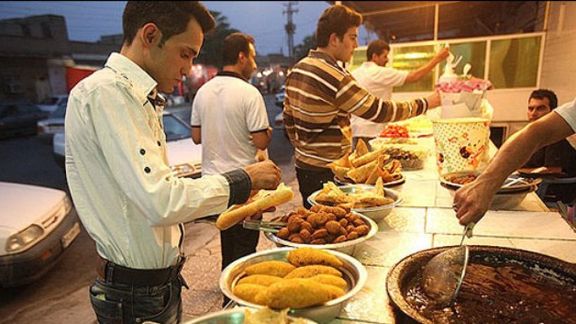
With rising price of bread, reports say people share falafel sandwitches in Iran.

The controversy surrounding an unusual rise in bread prices in Iran led to confusion and heated debates at the Iranian parliament, Majles, Sunday morning.

The Majles held a session behind closed door to probe into the cause of the problem, but the parliament's presidium member Alireza Salimi told the press that as questions put to Economy Minister Ehsan Khandouzi and Agriculture Minister Javad Sadatijejad dragged on and on, the Majles continued the debate in an open session.

The political scene appeared to be in chaos as parliament scrambled to appear active, demanding answers from the government, while officials seemed unable to present coherent explanations.

According to Salimi, the ministers told the parliament that reasons behind the recent flour price increase include the war in Ukraine, the draught in the region and Iran's problems in importing wheat as protests took place over the weekend in the oil-rich Khuzestan province.

Salimi added that lawmakers called on the government to clearly name the senior officials responsible for economic decisions. This was because of discrepancies in government statements about the cause the rising price of bread and about how to sort out the problem.

Meanwhile, Majles Speaker Mohammad Bagher Ghalibaf told ISNA news websitethat price increases were unacceptable and the government should have first issued electronic coupons for underprivileged citizens to make sure they could still buy bread at a subsidized rate. Ghalibaf also revealed that the government will be issuing electronic coupons for other commodities such as cheese.

President Raisi trying to offer explanations on the economic chaos. May 7, 2022
100%
President Raisi trying to offer explanations on the economic chaos. May 7, 2022

Ghalibaf said the way the government dealt with the rising prices of pasta and bread caused serious concern as people thought this was the beginning of more widespread price increases.

He also criticized first vice president Mohammad Mokhber for not showing up in parliament to offer explanations to lawmakers.

In a belated explanation on the state television late on Saturday night, Mokhber said that "The subsidy on bread and medicine will not be cut off." He added: "We have allocated a subsidy to traditional bread which according to legislation will be paid via electronic coupons. Subsidies have also been considered for other essential commodities to compensate for rising prices." Mokhber reiterated that these subsidies will be paid into the accounts of the heads of families before government raises prices."

While the vice president spoke about government assistance plans, bread prices have already risen fivefold in the past few days.

Mokhber's remarks convinced few people as others including Vice President for Economic Affairs Mohsen Rezaei offered a different explanation. Rezaei said on state TV that everyone in Iran will be getting 2 to 3 million rials (8-12 dollars) in cash handout from the government every month. However, he had to immediately return to the TV studio and deny his own statement on national television.

Remarks by Ghalibaf and Mokhber indicated that bread rationing is part of the government's plan to tackle rising prices, but officials disagreed about the size of the ration.

During Sunday, Iran International TV showed footage of Iranian Lawmakers at the Majles angrily reacting to the government's chaotic policy on pricing and distribution of bread.

According to Didban Iran website lawmaker Ahmad Hossein Fallahi charged that the ministers who reported to the Majles on Sunday had nothing new to say about the problem or its solution. The website quoted lawmaker Hojjatollah Firouzi as saying that the situation has given rise to concerns at the parliament, and another lawmaker Ebrahim Azizi criticized the government for not offering explanations to the people before the price rise.

Iranian journalist Solmaz Ikdar told Iran International that lawmakers have realized Raisi is unpopular, and his policies have failed, so they try to distance themselves from his administration.


Most Viewed

State media slam Araghchi's Hormuz tweet, say it let Trump claim victory
1

State media slam Araghchi's Hormuz tweet, say it let Trump claim victory

2
OPINION

The Hormuz get out of jail card turned to a grave

3

Iran International says it won’t be silenced after London arson attack

4
INSIGHT

How Tehran bends its own red lines to boost state rallies

5

Iran halts petrochemical exports to supply domestic market

Banner
Banner

Spotlight

  • Too early to tell who is winning Iran war, experts say
    PODCAST

    Too early to tell who is winning Iran war, experts say

  • How Tehran bends its own red lines to boost state rallies
    INSIGHT

    How Tehran bends its own red lines to boost state rallies

  • Iran blackout cripples freelancer, small business incomes
    VOICES FROM IRAN

    Iran blackout cripples freelancer, small business incomes

  • Ideology may be fading in Iran, but not in Kashmir's ‘Mini Iran'
    INSIGHT

    Ideology may be fading in Iran, but not in Kashmir's ‘Mini Iran'

  • US blockade enters murky phase as tankers spoof signals and buyers hesitate
    ANALYSIS

    US blockade enters murky phase as tankers spoof signals and buyers hesitate

  • Why the $100 billion Hormuz toll revenue is a myth
    ANALYSIS

    Why the $100 billion Hormuz toll revenue is a myth

•
•
•

More Stories

Tell People The Nuclear Deal Is Dead, Iranian Lawmaker Says

May 8, 2022, 09:26 GMT+1

An Iranian lawmaker has called on the authorities to tell the people that the Vienna talks to restore the 2015 nuclear deal will yield no results. 

Mahmoud Ahmadi-Bighash, who is a member of the parliament's National Security and Foreign Policy committee, said on Saturday that there is no news about the revival of the Joint Comprehensive Plan of Action (JCPOA) because it has reached a dead-end. 

He said the fate of the JCPOA is entangled with the lives of people and they are subconsciously invested in the talks, therefore “if we tell people the truth about the JCPOA... they will know what to do”.

“‌Our differences with the United States and the Europeans are fundamental”, he noted, saying that “the Americans believe that we should give up our principles while we want them to give up their arrogant and bullying behavior”.

Ahmadi-Bighash added, “We cannot give up our revolutionary principles because they are inherent in our religious obligations”, claiming that the issue of the Revolutionary Guard being listed by the as a terrorist organization by the US is just an excuse. 

He praised relations with Russia and China and emphasized the Islamic Republic's motto of "self-reliance", but except Israel, the lawmaker said, Iran should have relations with all counties.

Negotiations, which started in Vienna in April 2021 to revive the Obama-era nuclear deal, JCPOA, have been on a protracted pause since March 11, as the Islamic Republic demanded removing its Revolutionary Guard (IRGC) from a US list of terrorist organizations.

Prominent Critic Calls On Raisi To Step Down Amid Economic Crisis

May 8, 2022, 01:17 GMT+1
•
Iran International Newsroom

The editor of one of Tehran's leading pro-regime newspapers has called on President Ebrahim Raisi to step down if he cannot solve Iran's economic problems.

While rising bread prices have turned even some of Raisi's supporters against him, Massih Mohajeri, the editor of Jomhouri Eslami (Islamic Republic) newspaper who usually criticizes the administration's policies wrote in an editorial on Saturday, "Now that it has become clear that you cannot solve the problems, step down bravely and leave the job to those who can do it and save the people from this dangerous quagmire."

The editorial charged that "Media close to the administration label those who criticize you for the problems you have created as counter-revolutionaries who work for Israel and the United States." It went on to say that some of Raisi’s supporters are also protesting the government's policies.

Mohajeri further asked, "The president should say how much time does he need to understand that problems cannot be solved by just talking and the government cannot be run in this way." He added: "Blaming all shortages on smugglers is not a solution,” and if that is the problem, why the government does not stop them.

Ukraine and nuclear talks with the US

"If the problem of flour shortage is caused by the war in Ukraine, why you don’t condemn Russia's aggression against Ukraine and not try to stop Vladmir Putin from continuing the invasion, which threatens the livelihood of a major part of the world?" Mohajeri asked Raisi.

He also asked Raisi why he does not do anything to reach an agreement with the United States. "You said you will not tie the country's fate to the [nuclear] negotiations, but by not doing anything, you have created new problems for the nation."

Raisi receiving his presidential seal of approval from Khamenei n August 3, 2021.
100%
Raisi receiving his presidential seal of approval from Khamenei n August 3, 2021.

Many in Iran know it is Supreme Leader Ali Khamenei who decides key foreign policy and other state matters, but semi-official media would not dare to blame the economic crisis directly on Khamenei.

Mohajeri addressed Raisi that "If the instability of the government and the current dangerous situation have not been created by infiltrators, then they must be attributed to the poor management of your economic ministers."

He reminded that the price of bread in Iran did not rise even during the war with Iraq in the 1980s. He warned that raising the price of flour and rationing bread are like setting fire to gunpowder. Further warning that there are several individuals affiliated with the deviant group [jargon referring to those close to former President Mahmoud Ahmadinejad], Mohajeri charged that these elements could be attempting to unseat the current government and asked Raisi to take this warning seriously.

Economic crisis main topic of media

On Saturday, most newspapers in Tehran which are usually silent about economic problems, covered the shortage of these items in extensive stories, although the government's own newspaper, Iran, and the hardline daily Khorasan claimed that people were happy about the situation and "over 62 percent of Iranians said they were happy about the government's performance in a poll that was conducted before the unusual bread price rise."

At the same time, Mostafa Hashemi Taba, a former presidential candidate, said in an interview published by Didban Iran website that "the Raisi Administration has totally lost its social capital." He said the government wants to be portrayed as a revolutionary government abroad, but it wishes to adopt liberal economic policies inside the country. He said there are only two solutions to the problem: Either the government should be able to distribute all of the people's needs, or it has to resort to rationing essential commodities.

Meanwhile, economist Hossein Raghfar told Khabar Online website that the government's policy over bread is not transparent. He dismissed the official statements about flour being smuggled out of Iran as "fabrication" and maintained that the problem is the falling value of the currency, which he said rose from 10,000 rials per dollar to 35,000 rials in 2011, and from 30,000 rials in Janyary 2018 to 320,000 rials in January 2021. He charged that rich people in power benefitted from all of these changes while they ignored the interests of the ordinary Iranians.

Iran's Capital Faces Water Shortage As Less Water Flows Into Dams

May 7, 2022, 23:39 GMT+1

Water inflow into Tehran dams has decreased by about 27 percent since the start of the wet season, in Iran which started in November.

Mohammad-Reza Bakhtiari, the managing director of Tehran province Water and Wastewater Company, said on Saturday that input of the five dams around the capital has decreased to over 620 million cubic meters, while the figure was about 855 million cubic meters in the same period last year.

He added that the current volume of water reserve in Amir Kabir, Latian, Lar, Taleghan and Mamlu dams is 97, 60, 67, 232 and 71 million cubic meters, respectively.

According to Bakhtiari, rainfall was also down 31 percent from the beginning of the wet season to 164.1 millimeters, down from 218.9 millimeters in the same period last year.

Head of Iran's Geological Survey and Mineral Explorations Organization, Alireza Shahidi, has recently said that the country is in a 30-year drought cycle, noting that the dry spell started about 10 to 20 years ago and now its effects are more observable.

In 2021, large-scale water protests took place in two important provinces, Khuzestan and Esfahan, with several people killed and hundreds injured by security forces.

As drought persists, more underground water is exploited for irrigation, depleting natural reservoirs formed during thousands of years. However, politicians and experts say that there are no consistent government plans to deal with the water crisis, which can result in mass migration of millions of people in the next ten years.

Iran's Currency Falls To Four-Month Low, Amid Bread Crisis

May 7, 2022, 17:06 GMT+1
•
Iran International Newsroom

Iran’s currency, rial hit a four-month low on Saturday against the US dollar, as soaring bread prices created political and economic uncertainty in the country.

The US dollar rose to 285,000 rials in Tehran, the highest point since early January, when the currency was marginally recovering from previous lows on optimism over nuclear negotiations with the West. After talks in Vienna came to a standstill in mid-March, the currency began gradually losing its value again.

The rial has fallen almost ninefold since late 2017 when signs emerged that former US president Donald Trump intended to withdraw from the 2015 nuclear agreement, JCPOA, and impose economic sanctions on Iran.

Trump eventually pulled the United States out of the Obama-era agreement in May 2018 and imposed oil export and other sanctions that began to squeeze Iran’s oil-dependent economy. High double-digit inflation and a falling currency followed, leading to at least two years of a deep recession.

The falling currency makes everything else more expensive for people who earn depreciated rials. Key foodstuff, such as cooking oil, and 15 million tons of wheat are imported annually. In addition, animal feed is also imported and a falling currency makes meat and poultry more expensive. Most Iranians have stopped buying meat according to industry people in Iran.

This week the government finally acted on an earlier decision to stop a subsidy in the form of cheap dollars for imports of essential commodities, such as flour and animal feed. Immediately, cooking oil disappeared from supermarket shelves and flour prices increased fivefold, leading to a bread crisis.

The government’s handing of the price jump has been haphazard, claiming to be ready to provide cash assistance to citizens for buying bread but offering contradictory information on how the process would work. Pundits and citizens have reacted by saying that apparently the government failed to prepare for the eventuality.

There were reports on Friday of bread protests breaking out in the oil-rich Khuzestan province

President Ebrahim Raisi and his oil minister Javad Owji have been insisting that Iran’s illicit oil exports and revenues have risen in the past year, with evidence that Iran has been exporting anywhere between 750,000 to one million barrels per day. However, the economic impact of higher oil revenues is nowhere to be seen.

The key to lifting US sanctions and getting a reprieve form economic pressure is reaching an agreement with the United States over the nuclear issue, but talks in Vienna have stopped since mid-March.

As bread prices shot up almost fivefold in two days, economy minister Ehsan Khandouzi promised Saturday that the government will start a system of cash assistance to buy bread, but his statement was vague as to who what income groups would be eligible to receive the cash subsidy.

Meanwile, Hamshahri newspaper reported that the government is also planning to hike the price of cooking oil and gasoline, to begin reducing decades of subsidies paid by oil export income.

A gasoline price hike in November 2019 led to nationwide protests in which security forces shot dead at least 1,500 people and arrested 8,000.

Prices for all these commodities are very low in Iran compared to other countries, but so are wages. An Iranian worker earns an average of $150 per month and when one flatbread costs one dollar, the family can only afford to buy 3-4 breads a day, and nothing else.

Iran Burning Natural Gas From Oil Wells For Lack Of Investments

May 6, 2022, 23:21 GMT+1
•
Dalga Khatinoglu

Iran’s gas flaring levels increased by 32% year-on-year to 17.4 billion cubic meters (bcm) in 2021, according to a new report, released by Word Bank.

Iran ranked third globally after Russia and Iraq in terms of gas flaring levels during last year.

The country has failed to develop and install needed equipment to collect associated gas, produced from oil fields during last two decades.

According to the Oil Ministry’s estimates, some $5 billion is needed for curbing gas flaring, which sonstitutes about 7% of the country’s total gas production, while the annual worth of such a volume is more than $5 billion in regional markets. For comparison, it is equal to 30% of Turkey’s total gas consumption in 2021 or Iran’s total gas exports to Iraq and Turkey during last year.

Iran has failed to make significant investments in its oil and gas sectors for at least 10 years as international sanctions (2011-2015) and US oil export sanctions since 2018 have limited the country’s financial resources. In November, oil minister Javad Owji said that at least $160 billion in investments is needed to revitalize the sectors.

In 2017, a French company signed a deal with Iran to help install technology to trap natural gas escaping from oil producing wells, but the reimposition of US sanctions in May 2018 scuttled all such projects.

The Word Bank says the ratio of the flared gas to produced oil in Iran is 15.36 cubic meters per one barrel, the highest level in the world after Venezuela and Algeria.

Gas flaring also shares 8% of Iran’s greenhouse gas emissions. Iran, with 745 million tons of greenhouse gas emissions, ranked 6th globally in 2020, of which 60 million tons came from gas flaring, according to the Global Carbon Atlas’s latest statistics.

There is no new report about Iran’s greenhouse emissions level, but regarding the 32% growth in flaring gas volume, as well an end to Covid-related quarantines, it should be continuing to rise.

Iran’s greenhouse gas emissions increased by 18% since 2015, when the international community, including Iran, decided to decrease emissions, based on the Paris Climate Agreement.

Word Bank said the global flaring gas level stood at 144 bcm in 2021, almost unchanged year-to-year, and resulted in 328 million tons of carbon dioxide emission.

Last year, total greenhouse gas emissions in the world hit a historic record, reaching above 36 billion tons, which was about 2 billion tons more than in 2020, according to the International Energy Agency.