• العربية
  • فارسی
Brand
  • Iran Insight
  • Politics
  • Economy
  • Analysis
  • Special Report
  • Opinion
  • Podcast
  • Iran Insight
  • Politics
  • Economy
  • Analysis
  • Special Report
  • Opinion
  • Podcast
  • Theme
  • Language
    • العربية
    • فارسی
  • Iran Insight
  • Politics
  • Economy
  • Analysis
  • Special Report
  • Opinion
  • Podcast
All rights reserved for Volant Media UK Limited
volant media logo

Fast Rising Prices Overshadow All Issues In Iranian Politics
Iran International Newsroom
May 3, 2022, 21:59 GMT+1Updated: 17:32 GMT+1
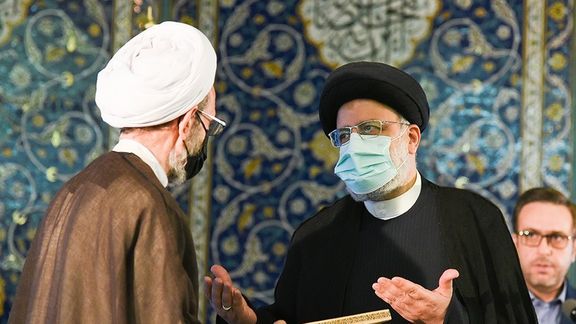
President Ebrahim Raisi handing out Quran awards last week, while critics demand management of the economy.

As food prices continue to rise in Iran prompting general anger, Tehran’s conservative prayer Imam on Tuesday had to acknowledge that people want solutions.

While Conservative President Ebrahim Raisi took office last August, claiming to be able to quickly control inflation, price rises have accelerated in the past 8 months. Attempts by him and his supporters to blame his predecessor for the crisis increasingly sound hollow. Even many conservatives and regime loyalists have begun asking for solutions.

Prices for essential food itams such as sugar, oil, flour, bread and pasta have dramatically increased in the past few weeks.

"Last year, the average price for each kilogram of pulses was between 500,000 and 750,000 rials (or $2 to $3),” said Abdi Eftekhari, secretary of Iran’s Pulses Union. He put current prices 70 to 120 percent higher.

Eftekhari noted a rise in global inflation due mainly to the Russia-Ukraine conflict, given the two countries’ role as major exporters of agricultural produce, including wheat.

The head of the directing board of Iran’s Pasta Factories Association, Mehrdad Nouri, recently said that 70 percent of the cost of producing pasta depended on the cost of flour. Recent years, he explained, had seen a decline in Iran’s cultivation of durum wheat − also called pasta wheat or macaroni wheat − from which semolina flour is made, even though private producers have encouraged farmers by paying above the government-approved rate.

But the main reason for soaring prices is an economy in crisis, with ballooning liquidity, above 40-percent inflation, and a government unwilling to make a nuclear deal with the United States to lift criplling sanctions.

Hoarded vegetable oil

Abolhassan Khalili, chairman of Iran's Vegetable Oil Trade Union, has attributed the rising price of vegetable oil to both the Ukraine crisis and hoarding by producers and brokers expecting further price hikes. Raw vegetable oil, which is imported, has risen 60 percent due to the Ukraine crisis, Khalili said.

First vice-President Mohammad Mokhber said Monday that the government’s elimination of a lower dollar rate for essential food imports had led to price rises for some items, although there was “abundance of basic goods in the country.” He said prices had risen 70 percent globally, apparently referring to the Ukraine crisis. Officials have generally claimed Iran has adequate stores of sugar, oil and other necessities.

Consumer price inflation in Iran has been above 30 percent since the United States imposed ‘maximum pressure’ sanctions in 2018. But food prices have risen faster, with government figures showing 60 percent year-on-year inflation in 2021.

Rice price

In an interview with ILNA published Sunday, Shahriar Haydari, a member of the parliament's National Security and Foreign Policy Committee, claimed high inflation was not due to international factors but to a lack of integrated management. “The increase in the price of eggs, yogurt, buttermilk and meat has nothing to do with the United States and sanctions,” he said.

Prices for most essential goods are nominally fixed by the government, but the private sector often disregards the guidelines. In recent months, prices for rice, the main staple, have fluctuated widely, but are now 1,000,000 rials (about $4) per kilogram, enough for a meal for five to eight people. The average salary, according to the Ministry of Labor, is the equivalent of $150 a month.


Most Viewed

Iran negotiators ordered to return after internal rift over Islamabad talks
1
EXCLUSIVE

Iran negotiators ordered to return after internal rift over Islamabad talks

2
ANALYSIS

US blockade enters murky phase as tankers spoof signals and buyers hesitate

3
ANALYSIS

Why the $100 billion Hormuz toll revenue is a myth

4

US tightens financial squeeze on Iran, warns banks over oil money flows

5
INSIGHT

Ideology may be fading in Iran, but not in Kashmir's ‘Mini Iran'

Banner
Banner

Spotlight

  • Hardliners push Hormuz ‘red line’ as US blockade tests Iran’s leverage
    INSIGHT

    Hardliners push Hormuz ‘red line’ as US blockade tests Iran’s leverage

  • Ideology may be fading in Iran, but not in Kashmir's ‘Mini Iran'
    INSIGHT

    Ideology may be fading in Iran, but not in Kashmir's ‘Mini Iran'

  • War damage amounts to $3,000 per Iranian, with blockade set to add to losses
    INSIGHT

    War damage amounts to $3,000 per Iranian, with blockade set to add to losses

  • Why the $100 billion Hormuz toll revenue is a myth
    ANALYSIS

    Why the $100 billion Hormuz toll revenue is a myth

  • US blockade targets Iran oil boom amid regional disruption
    ANALYSIS

    US blockade targets Iran oil boom amid regional disruption

  • Iran's digital economy battered by prolonged blackout
    INSIGHT

    Iran's digital economy battered by prolonged blackout

•
•
•

More Stories

Iran Has Never Been So Dependent On Grain Imports – Official

May 3, 2022, 19:59 GMT+1

The head of the Flour Producers Association says this year Iran must import 20 million tons of grain, noting that the country has never been so dependent on imports.

Mohammad-Reza Mortazavi said on Monday that grain imports will include 6 to 7 million tons of wheat, as Iranian state media rejected rumors on Tuesday that bread prices will increase following the elimination of subsidies.

According to data by Iran’s Ports and Maritime Organization grain imports stood at 16.5 million tons last year, about half of which was wheat while the rest were barley, corn and rice.

Referring to a five-fold increase in flour prices by the Agriculture Ministry, was expected, but “it would be better if the government first examined its effect on prices of other commodities”. Pasta prices officially increased as much as threefold on Monday.

He added that most of the country's wheat imports this year will come from “Russia or the Baltic states and even Europe”, highlighting that the Russian invasion of Ukraine has led to a global rise in wheat prices as well as almost all other agricultural produce. Ukraine and Russia account for more than a quarter of global wheat exports and nearly a fifth of corn.

In March, Nour News, affiliated with the secretary of Iran's Supreme National Security Council (SNSC), Ali Shamkhani, reported that Iran has signed a deal with Russia to import 20 million tons of basic goods, including vegetable oil, wheat, barley and corn.

Iran Worst Country In Press Freedom Index After Eritrea, North Korea

May 3, 2022, 13:14 GMT+1
•
Iran International Newsroom

The 20th World Press Freedom Index by Reporters Without Borders (RSF) has put Iran at the rock bottom of the list, only better than Eritrea and North Korea.

Iran has ranked 178th out of 180 countries in the table, which is four places worse compared with the previous report published in 2021. In the 2022 index, even Turkmenistan, Myanmar and China rank better than the Islamic Republic.

The RSF calling 2021 for Iran “another tough year for press freedom” as “the two main leaders accused of abuses and crimes committed against journalists for 30 years, Ebrahim Raisi and Gholam Hossein Mohseni-Ejei, became, respectively, president of the republic and head of the Iranian judicial system. The result: an increase in arbitrary arrests and convictions, and journalists imprisoned and denied medical care”

Reza Moini, head of RSF's Iran-Afghanistan desk, told Radio Farda on Tuesday, "Unfortunately, this year Iran has reached the point where we call it the hell gate countries”.

Iran has jailed hundreds of journalists, writers and bloggers in the past three decades, accusing many of endangering national security for expressing their opinions. Some have died in prison, such as Baktash Abtin who died under custody on January 8, after being denied timely medical care for Covid-19.

The Index is a snapshot of the level of press freedom enjoyed by journalists and media during the calendar year (January-December) prior to its publication but when the press freedom situation changes dramatically in a country between the end of the year assessed and publication, the data is updated to take account of the most recent events, such as a major attack on journalists, or the sudden introduction of an extreme repressive policy.

Iran also has restricted access to internet for more than two decades, with thousands of websites blocked. Access is also blocked to major social media networks such as Facebook and You Tube.

Mohammaed Mosaed, a persecuted Iranian journalist who won the 2020 press freedom award of the US-based Committee to Protest Journalists told the award ceremony last year “Telling the truth in Iran is a crime.”

"Speaking the truth is dangerous in my country because the government fears not only the truth itself but also the audacity behind telling the truth and this has turned speaking the truth into a crime in my country," he said.

Mosaed was jailed had received a four-year sentence when he exposed corruption in the government.

The RSF called on the United Nations last week to take swift action to ensure Iran followed “international human rights law” over the treatment of jailed journalists.

Press freedom is defined by the RSF as “the ability of journalists as individuals and collectives to select, produce, and disseminate news in the public interest independent of political, economic, legal, and social interference and in the absence of threats to their physical and mental safety.”

Pentagon Silent On Alleged Iranian Plot To Kill US General

May 3, 2022, 11:36 GMT+1
•
Maryam Sinaiee

The Pentagon has declined to comment on Israeli claims over foiling Iranian plans to assassinate a US general in Germany, as Iran has also remained silent.

When asked about the identity of the target and when the alleged plot had been foiled at a press briefing Monday, the Pentagon Press Secretary John Kirby said he would not talk about it.

"I would just tell you a couple of things without getting into the specific anecdotes you cited there and I'm not going to talk about intelligence," he told reporters, adding that nobody in the Pentagon is "oblivious to the fact that Iran continues to be a malign actor in the region."

"They continue to support terrorist groups; they continue to develop a ballistic missile program. They obviously, even as they sit in negotiations, continue to develop certain nuclear capabilities. And they are harassing shipping and clearly pose a threat in the maritime domain," Kirby said.

Diplomatic sources told Iran International last week that an operative of Iran's IRGC's Qods Force held in a European, or possibly other Western country, had admitted to plotting assassinations in Turkey, Germany and France.

Iran officials and media, particularly state-run media, have not reported the incident or commented on it. However, in a commentary Monday, Nour News called the reports over the alleged plot "fabrication of the Zionists."

Nour News, a website affiliated to the secretary of Iran's Supreme National Security Council (SNSC), Ali Shamkhani, also accused the BBC's Persian channel of "running the show" and trying to "divert the attention of the public" from "Israeli crimes against Palestinians" and helping the Israeli government overshadow its domestic problems with "crude lies".

A photo said to show Mansour Rasouli during his interrogation. Undated
100%
A photo said to show Mansour Rasouli during his interrogation. Undated

Within a short time, Israeli media released a short audio recording with a photo of a man introduced as 52-year-old Iranian national Mansour Rasouli confessing to involvement in the plot. Israeli television channels including Channel 12 which broadcast the recording, without providing a source, claimed it was made by Mossad operatives posing as Iranian secret service at Rasouli's home inside Iran but did not abduct him after the interrogation.

A statement from Israeli Prime Minister's Office said Monday the Mossad had "foiled" alleged IRGC plots to assassinate a US general in Germany as well as a journalist in France, and an Israeli diplomat in Turkey.

The alleged plots were ordered and funded by Iran's leadership and were to be carried out by the IRGC, the statement said.

Sarbaz-e Iran, a little-known Twitter account claimed on Sunday, without offering evidence, that Rasouli hailed from a village in Iran's West Azarbaijan Province. Sarbaz-e Iran claimed his information came from Rasouli's brother. The account said fearing being found out by the IRGC, Rasouli fled to Australia after the alleged Mossad interrogation and later arrested.

The Twitter account also claimed that Rasouli was recruited by the IRGC to carry out the operations but was not a part of the IRGC's Qods (Quds) Force himself. Citing Israeli officials, some Israeli media such as Walla news site have claimed that the incident took place a year ago and the man interrogated by the Mossad had connections to drug-smuggling networks.

The Pentagon spokesman also told reporters that the Department of Defense supports the efforts to restore the Iran nuclear deal as "no problem in the Middle East is easier to solve with Iran having a nuclear weapon," but still maintains a robust presence in the Middle East to protect its own security interests and those of its allies and partners in the region.

What We Know About Iran And Al-Qaeda

May 3, 2022, 01:00 GMT+1
•
Katerina Tiliakou

On May 1, 2011, then-President Barack Obama announced to the world the death of Osama bin Laden during a US commando operation in Pakistan called Neptune Spear.

In 2012, Nelly Lahoud was teaching at West Point when the CIA declassified the first 17 documents captured during the raid. She was asked to lead the analysis of those documents for West Point's Combatting Terrorism Center.

In an interview with 60 minutes on CBS, Lahoud, senior fellow in New America's International Security program and expert on al-Qaeda (AQ) and the ‘Islamic State’ (ISIS/ISIL), explained that in November of 2002, U.S. intelligence officials warned al Qaeda might be planning, "spectacular attacks" that could cause "mass casualties."

However, Lahoud also revealed that bin Laden wanted to replicate the 9/11 attacks in the US. “Bin Laden writes that rather than hijack a plane, operatives should charter one for their next attack on the US.” He adds if that's too difficult, they should target US railways.

During the 21-years period after 9/11, Iran maintained a relationship with al-Qaeda and its operatives, mainly driven by an anti-America agenda.

After two decades, the relationship between Iran and the terrorism network , which began in the early 1990s, is still being argued within the counterterrorism community and government officials, according to Asfandyar Mir, senior expert in the Asia Center at the United States Institute of Peace, and Colin P. Clarke, senior research fellow at The Soufan Center.

A poster from 2019 of Bin Laden's son Hamza
100%
A poster from 2019 of Bin Laden's son Hamza

At the time, al-Qaeda and Iran made a deal that included al-Qaeda members training with Iranian intelligence operatives in Iran and Lebanon’s Bekaa Valley.

However, Tallha Abdulrazaq, an academic with expertise in Middle Eastern security affairs, explains that Iran has provided shelter to numerous Al Qaeda operatives over the years.

Bin Laden’s son Hamza is believed to be among those to have been harbored in Iran.

Even though mainly Shia Iran claims to be fighting extremism, Tehran has supplied both Sunni and Shia terrorist organizations with advanced weapons such as rockers and improvised explosive devices.

A picture of Bin Laden at a pro-US rally in India in 2001
100%
A picture of Bin Laden at a pro-US rally in India in 2001

After bin laden moved from Sudan to Afghanistan in 1996, Iran provided al-Qaeda operatives logistical and travel support, as the US bipartisan report from the 9/11 Commission concluded.

“Intelligence indicates the persistence of contacts between Iranian security officials and senior al Qaeda figures after Bin Ladin's return to Afghanistan,” the report said, adding that evidence suggested “8 to 10 of the 14 Saudi "muscle" operatives traveled into or out of Iran between October 2000 and February 2001.”

By 2003, the relationship between Iran and al-Qaeda had grown turbulent, probably due to the terrorist network’s growing presence in Iran.

By 2010, during hard diplomacy and lots of assurances al-Qaeda secured the release of key members and their families in detention, while Iran achievedrelease of Heshmatollah Attarzadeh Niyaki, the commercial attache at Iran's consulate in Peshawar after his kidnap in Pakistan.

Tehran continued to allow al-Qaeda to transfer money via Iran, as well as to transit personnel and resources across conflict zones such as Afghanistan and Syria, according to the 2019 US State Department’s country terrorism report.

Iran’s geographic position neighboring Afghanistan and Pakistan also critically helped al-Qaeda to move across key battlefields when under direct US pressure there.

While Iran’s assistance enabled al-Qaeda to continuously challenge the United States and its allies, including Saudi Arabia, the Sunni terrorist group in return refrained from committing attacks inside Iran or against Shia populations in other countries in the region.

Moon Not Sighted By Iran Ayatollah To Declare End Of Fasting

May 2, 2022, 18:59 GMT+1
•
Maryam Sinaiee

Most Islamic countries on Monday celebrated the end of Ramadan but Iranians were told to fast one more day as the Supreme Leader had not sighted the new moon.

The office of Supreme Leader Ali Khamenei and other Iranian grand ayatollahs on Sunday evening said the crescent moon had not been sighted so the first of the month of Shawwal, the tent month in the Islamic lunar calendar, and the Eid would fall on Tuesday.

The Islamic month of Ramadan, therefore, became thirty days in Iran this year and twenty-nine days in other Islamic calendars. In Iran the lunar Islamic calendar is used only for religious purposes while the official calendar is an accurate solar one. Differences in the length of the month of Ramadan in Islamic countries can cause confusion.

On several occasions in the past, as in 2013 and 2020, there has been disagreement among Iran's grand ayatollahs, also called marja (source of emulation) over the sighting of the new moon with followers of each grand ayatollah holding separate Eid prayers.

The difference in marjas’ verdicts reflects their notions for "viewing the new moon". Some marjas require the crescent of the new moon to be seen with naked eye while others including Khamenei allow the use of instruments such as telescopes.

Secular Iranians, and some devout Muslims with more progressive views, often criticize traditional leaders for insisting to see the crescent when science can easily and precisely show the position of the cycle of the moon in the sky.

Iran's Supreme Leader Ali Khamenei praying during Eid Fitr. FILE PHOTO
100%
Iran's Supreme Leader Ali Khamenei praying during Eid Fitr. FILE PHOTO

Khamenei appointed a special body called the "Moon-Sighting Taskforce" after taking office. The taskforce is responsible for stationing "trusted observers" across the country on the final days of Ramadan to report the sighting of the new moon to him. The taskforce receives a budget from the government for its work.

Khamenei's declaration of the viewing of the new moon, and its acceptance by other grand ayatollahs, is politically and religiously significant as it is considered as evidence of his position as the supreme authority among all Iranian marjas.

Iran's devout Shiites are free to choose which marja to follow in religious matters but not to make a public show of their marja's difference of opinion with Khamenei by holding prayer congregations other than those held by the state.

On the day of Eid, Khamenei usually leads the prayers in Tehran and delivers one of his most significant sermons of the year. In recent years the authorities have insisted that Eid prayers be held throughout the country on the day designated by Khamenei.

Two years ago, Khamenei's office announced the sighting of the new moon and a public holiday but two high-ranking marjas – Ayatollah Naser Makarem Shirazi and Ayatollah Hossein Vahid Khorasani – held on for a few hours before changing their minds and following Khamenei's lead.

Iran's Arab neighbors including Saudi Arabia, Kuwait, Qatar, the United Arab Emirates, and Iraq which unlike the others has a majority Shiite population, all celebrated the Eid al-Fitr on Monday. Iraq's Grand Ayatollah Ali Sistani, however, has also declared Tuesday as Eid. The Sunni Taliban in Iran's east said Saturday evening that they had sighted the crescent moon so the Eid fell on Sunday.

According to an undeclared law, authorities expect not only Shiite leaders, but also the religious leaders of the minority Sunnis to follow Khamenei's lead about the declaration of Eid. This year, as in several instances before when the Eid was celebrated on different days in Shiite Iran and Sunni countries, the Sunni imam of Zahedan in south-eastern Iran, Molavi Abdolhamid, held his Eid prayers on Monday in tandem with other Sunni countries.






