The sources who spoke to Iran International on condition of anonymity said the accused who is currently in detention in a European country has admitted to receiving $150,000 for organizing the assassinations with one million promised to be paid to him after the completion of the operations.
The alleged operative has confessed, the sources said, that he was ordered to organize the assassination of an Israeli national who worked at the Israeli consulate in Istanbul, an American general in Germany, and a French journalist.
The identities of the alleged targets and the reason for them being targeted have not been revealed.
Israel’s Haaretz reported following the disclosure by Iran International that Mossad played a role in preventing the assassination of its consulate worker in Turkey.
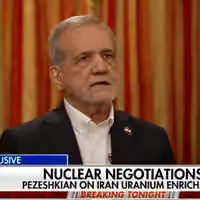
The revelation comes at a sensitive time when talks to restore the 2015 Iran nuclear deal, JCPOA, have stalled becuase of Tehran's demand that the United States shoudl remove the IRGC from its list of terrorist organizations.
IRGC working with drug cartels
Mohsen Sazegara, a United States-based journalist and political activist, told Iran International that there is a possibility the plots were connected to the Islamic Republic's promise to take revenge against the United States for the 2020 assassination of Qods (Quds) Force Commander Ghasem (Qasem) Soleimani, given that one of the targets of the alleged plots is said to have been an American general.
Soleimani was killed in a targeted US drone strike as he arrived at Baghdad airport on January 3, 2020. Iranian officials have repeatedly vowed to avenge his death.
The sources also said the accused has admitted that he had orders to use drug trafficking contacts to carry out the assassination missions.
Sazegara who was among the founders of the IRGC in 1979 and served in several high government positions in the early years of the Islamic Republic also said that Iranian operatives' use of drug traffickers to carry out operations abroad is not new. "For a long time, the Islamic Republic has worked with drug traffickers. The network of drug trafficking-terrorism extends from Kabul to Caracas," he said.
A special IRGC unit
Diplomatic sources who spoke to Iran International also said the man in charge of the alleged assassination plots was a member of the secretive Unit 840 of the Qods Force. The unit’s mission is to conduct operations against Western targets and Iranian opposition groups and individuals.
There is no mention of Unit 840 in Iranian media. The existence of a such a unit has only been reported by Israeli media which in November 2020 reported that Israeli Defense Forces (IDF) had accused Unit 840 of placing explosives on Syrian border.
Ali Afshari, political analyst based in the United States, told Iran International that in his view the IRGC has evolved into a "gangster, mafia-like organization" from an originally "idealistic Shia Islamic fundamentalist entity."
"The IRGC uses drug traffickers and criminal gangs to be able to avoid being held directly responsible for its terrorist operations," Afshari said.
In December 2020 Turkish intelligence said it had discovered a terror network tied to Iran’s Intelligence Ministry that would abduct or assassinated Iranian dissidents. According to Turkish government's official TRT channel, the network and its 11 operatives were behind the abduction of Farajollah Chaab, the former leader of an Iranian Arab separatist Movement.
Iranian intelligence allegedly lured Chaab to Turkey, abducted him, and with the help of an international Turkey-based drug cartel known as the Zindashti Cartel whisked him to Iran where he was later put on trial.
In 2013 the United States sentenced Iranian-American Manssor Arbabsiar to 25 years in prison. Arbabsiar, a car dealer, admitted to plotting the assassination of the Saudi ambassador to Washington on orders from Iranian military officials. Arbabsiar was arrested after the FBI and US Drug Enforcement Agency became suspicious of his visits to Mexico and contacts with a Mexican drug cartel.