• العربية
  • فارسی
Brand
  • Iran Insight
  • Politics
  • Economy
  • Analysis
  • Special Report
  • Opinion
  • Podcast
  • Iran Insight
  • Politics
  • Economy
  • Analysis
  • Special Report
  • Opinion
  • Podcast
  • Theme
  • Language
    • العربية
    • فارسی
  • Iran Insight
  • Politics
  • Economy
  • Analysis
  • Special Report
  • Opinion
  • Podcast
All rights reserved for Volant Media UK Limited
volant media logo

Washington Reiterates, Onus Of A Nuclear Deal 'Squarely On Iran'

Maryam Sinaiee
Maryam Sinaiee

Iran International

Apr 5, 2022, 10:34 GMT+1Updated: 17:28 GMT+1
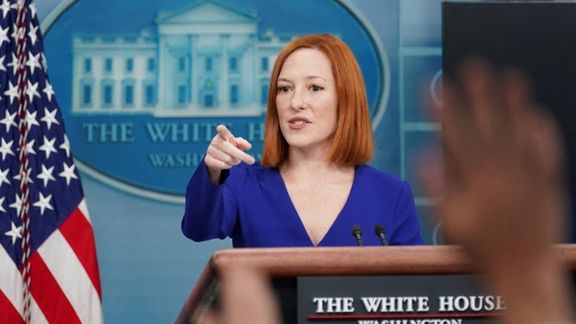
White House Press Secretary Jen Psaki fields a question during a press briefing at the White House in Washington, U.S., April 1, 2022.

The United States has defended its approach to the Iran nuclear talks after criticism from Tehran that it is hamstrung by domestic politics.

"Anyone involved in the talks knows precisely who has made constructive proposals, who has introduced demands that are unrelated to the JCPOA, and how we reached this current moment," State Department spokesman Ned Price said.

In a press briefing Monday, Price also did not rule out reaching agreement in year-long Vienna talks between Iran and world powers to revive the 2015 Iran nuclear deal, the JCPOA (Joint Comprehensive Plan of Action).

Iran's Foreign ministry Spokesman Saeed Khatibzadeh said Monday that Washington was responsible for the pause in talks as it had failed to reach a political decision as its approach to outstanding issues had become “hostage to its own domestic issues."

Opponents of the JCPOA in Washington have stepped up criticism of the Biden administration, both over reported discussions within the administration of reversing former president Donald Trump’s decision to add Iran’s Revolutionary Guards to the US list of ‘foreign terrorist organizations’ (FTO) and the prospect of Russia gaining financially from work to develop Iran’s nuclear program within a revived JCPOA.

On Monday the pro-Republican Washington Free Beacon reported that congressional Republicans were preparing draft legislation to require Congressional approval to lift the FTO designation of the IRGC, which is subject to a range of other sanctions and is the only example of a sovereign state’s armed forces listed as a ‘foreign terrorist organization.’

Iran has also criticized recent sanctions levied by the US on Iranian individuals and companies as unhelpful. Foreign Minister Hossein Amir-Abdollahian recently said that Washington’s "maximalist demands" were dragging out the talks.

In his briefing Monday, Price recognized that the expansion of Iran’s nuclear program since the US left the JCPOA in 2018 had brought it closer to the capacity to make a crude atomic weapon. "Iran has been able to shrink that breakout time from where it started to a point where we can measure it weeks rather than months,” Price said. “To us, that is unacceptable as a long-term proposition.”

White House Spokeswoman Jen Psaki Monday put the onus for reaching agreement on JCPOA revival "squarely on Iran." In a joint briefing with National Security Advisor Jake Sullivan, Psaki said Iran had “raised a number of issues that has [sic] nothing to do with the mutual compliance under the nuclear deal” and was “seeking to open issues outside the Vienna context or casting blame…on others for a pause in the talks.”

Ali Bigdeli, political analyst in Tehran, told the Iranian Labour News Agency (ILNA) Tuesday that JCPOA revival could benefit both US President Joe Biden and the Iranian leadership. "Biden needs to show a winning card to the Congress" to improve his own circumstances, Bigdeli said, while lifting US ‘maximum pressure’ sanctions, imposed by Trump and continued by Biden, would ease Iran’s economic problems.

Bigdeli said Washington would agree to lifting IRGC sanctions if Iran moderated its regional policies. "This is the Gordian knot in the talks," Bigdeli said, suggesting that Amir-Abdollahian had insisted on removing all sanctions on the IRGC. Bigdeli argued that under pressure at home and from regional allies, presumably Israel and Saudi Arabia, Biden could not lift IRGC sanctions “without preconditions.”


Most Viewed

State media slam Araghchi's Hormuz tweet, say it let Trump claim victory
1

State media slam Araghchi's Hormuz tweet, say it let Trump claim victory

2
OPINION

The Hormuz get out of jail card turned to a grave

3

Iran International says it won’t be silenced after London arson attack

4
INSIGHT

How Tehran bends its own red lines to boost state rallies

5

Iran halts petrochemical exports to supply domestic market

Banner
Banner

Spotlight

  • Too early to tell who is winning Iran war, experts say
    PODCAST

    Too early to tell who is winning Iran war, experts say

  • How Tehran bends its own red lines to boost state rallies
    INSIGHT

    How Tehran bends its own red lines to boost state rallies

  • Iran blackout cripples freelancer, small business incomes
    VOICES FROM IRAN

    Iran blackout cripples freelancer, small business incomes

  • Ideology may be fading in Iran, but not in Kashmir's ‘Mini Iran'
    INSIGHT

    Ideology may be fading in Iran, but not in Kashmir's ‘Mini Iran'

  • US blockade enters murky phase as tankers spoof signals and buyers hesitate
    ANALYSIS

    US blockade enters murky phase as tankers spoof signals and buyers hesitate

  • Why the $100 billion Hormuz toll revenue is a myth
    ANALYSIS

    Why the $100 billion Hormuz toll revenue is a myth

•
•
•

More Stories

Iran Lawmaker Says Parliament Hasn’t Seen Any Draft Nuclear Agreement

Apr 4, 2022, 22:03 GMT+1

An Iranian lawmaker says there is no draft based on a final agreement of the Vienna negotiations to restore the 2015 nuclear deal between Iran and world powers.

Ebrahim Azizi, the deputy chairman of the Iranian Parliament's National Security and Foreign Policy Committee, said on Monday, “A draft that is the basis of the final agreement has not yet been prepared because the talks are still in the final stage and not completely over”.

He made the remarks in reaction to several Iranian lawmakers, including Ali Khezrian, who had claimed last week they had seen a 27-page final draft of an agreement between Iran and the United States, adding that Iran’s red lines were not considered in the draft.

Azizi added that no drafts have been submitted to the parliament but Foreign Minister Hossein Amir-Abdollahian and top negotiator Ali Bagheri-Kani have briefed different committees about the issues raised in the talks and the views of the negotiation parties.

European Union Foreign Policy chief Josep Borrell said in March that a draft text is "essentially ready", but hampered by "external factors".

Earlier in the day, Iran's foreign ministry spokesman Saeed Khatibzadeh said, "America is responsible for the halt of these talks and dragging it in coming days. The solution is in the White House. [The US] must give a logical response to Iran's request so that we can return to Vienna".

Khatibzadeh acknowledged for the first time in late February that a draft agreement is “97-98 percent ready”.

Iran Says Nuclear Talks 'Hostage' To US Domestic Politics

Apr 4, 2022, 08:59 GMT+1
•
Maryam Sinaiee

Iran's foreign ministry said Monday the United States was responsible for the halt in the Vienna nuclear talks by failing to make a "political decision".

"America is responsible for the halt of these talks and dragging it in coming days. The solution is in the White House. [The US] must give a logical response to Iran's request so that we can return to Vienna," Saeed Khatibzadeh told a weekly news conference in Tehran.

The spokesman did not say what was Iran’s proposal, but in recent weeks it has become clear that Tehran is asking Washington to remove the Revolutionary Guard from its list of foreign terrorist organizations.

Khatibzadeh reiterated that a deal to restore the 2015 nuclear deal, Joint Comprehensive Plan of Action (JCPOA), is within reach "if America realizes and knows for sure that we will not cross our red lines and demand," he told reporters adding that Tehran would "not wait forever" for the pact to be revived.

The Trump administration added the Revolutionary Guards (IRGC) to the US list of Foreign Terrorist Organizations (FTO), which is the only example of a sovereign state’s armed forces being so designated. Iran insists that delisting the IRGC is a requirement and 'red line' for a deal that it will not give up on.

US Special Envoy for Iran Robert Malley attending a conference in Doha last week said that he is not confident a nuclear deal between Western powers and Iran was imminent, adding that Washington would not remove the IRGC from its terror list.

"What happens in Vienna [talks] stems from the US approach which is trying to take the [solution of the] remaining issues hostage to its own domestic issues. Iran and Iranians can't remain patient forever," Khatibzadeh said referring to the delisting of the IRGC and strong opposition in the US Congress from Republicans and some Democrats.

Khatibzadeh’s remark about US “domestic issues” might be a reference to strong Congressional opposition to delisting the IRGC. Almost all Senate Republicans and many of their colleagues in the House of Representatives, as well as some Democrats oppose any concession on the issue.

Commenting on the European Union envoy in Vienna talks, Enrique Mora's, recent visit to Tehran the spokesman said Mora had received Iran's message and response to US demands. "We are still waiting for a response from the other party."

Mora met with foreign minister Hossein Amir-Abdollahian and top negotiator Ali Bagheri-Kani on March 27 to discuss the unresolved issues in the talks.

In a phone call with his Omani counterpart Sayyid Badr Albusaidi on Sunday, Amir-Abdollahian said Washington is directly responsible for the delay in reaching a nuclear deal.

Amir-Abdollahian criticized recent sanctions imposed by the US on some Iranian persons and companies, saying that Tehran is ready for a “good and lasting” agreement but the “American side has some maximalist demands and is directly responsible for the prolongation of the [nuclear] talks.”

Khatibzadeh also criticized the US for refusing entry to an Iranian vocalist last week to perform at an Iranian cultural event, presumably on the grounds that he had served his compulsory military service in the IRGC three decades ago.

Khatibzadeh also said that Iran does not tie regional issues to the nuclear talks and said Iran is prepared to resume talks with its regional rival, Saudi Arabia. "There is need for a clear agenda for the talks. We have offered our views to the Saudi side in written form. Our differences are clear and despite these differences we should seek to normalize our relations," he said.

Iran FM Says US 'Directly Responsible' For Delay In Nuclear Deal

Apr 3, 2022, 20:51 GMT+1

Washington is directly responsible for the delay in reaching a nuclear deal, Iran’s foreign minister told his Omani counterpart in a conversation late on Sunday.

Sayyid Badr Albusaidi, Oman’s foreign minister and Hossein Amir-Abdollahian discussed regional developments in a phone call, including a ceasefire that went into effect in Yemen on Saturday and nuclear talks between Iran and the United States, the government news website IRNA reported.

Officials of Muslim countries have been making calls on Sunday, on the occasion of Ramadan that started on Saturday in many Sunni countries and on Sunday in Iran.

Amir-Abdollahian criticized recent sanctions imposed by the US on some Iranian persons and companies, saying that Tehran is ready for a “good and lasting” agreement but the “American side has some maximalist demands and is directly responsible for the prolongation of the [nuclear] talks.”

Washington sanctioned an Iran-based network on March 30 for its role in procurements boosting Iran’s ballistic missile program, seen by many regional countries and the United States as a threat.

Although nearly one year of negotiations in Vienna were said to have reached its final stage, Tehran has demanded that the US remove its Revolutionary Guard from its list of ‘foreign terrorist organizations’. The Biden administration has apparently not made a decision yet, amid rising opposition by Republicans and some Democrats in Congress.

Trump Calls Biden Admin 'Stupid' For Letting Russia, China Lead Iran Talks

Apr 3, 2022, 11:15 GMT+1

Former President Donald Trump has criticized the Biden administration for allowing Russia and China to negotiate on behalf of the United States to revive the 2015 Iran deal.

Addressing a crowd of his supporters in Washington Township, Michigan, on Saturday, Trump said Biden is not even reviewing the new nuclear deal and has let Russia and China to lead the Vienna talks, calling it “stupid”.

"So, we have Russia negotiating the deal – with China as a backup – how stupid is this country. They are so stupid”, he said, adding that “the deal is turning out to be a disaster. Nobody can even believe it. But we're giving everything away – all the things that we fought for with Iran."

Trump, who in 2018 withdrew from the Obama-era deal -- officially known as the Joint Comprehensive Plan of Action (JCPOA) -- and imposed ‘maximum pressure’ sanctions, added that his administration would have made a new agreement. "Within one week after we took office, they would have made a deal. They were so ready to make a deal."

He slammed Biden’s policy toward Iran, saying, “We had all the cards. We still have cards – if they knew how to play them, they still have cards”.

Most of the Republicans and former administration officials denounce Biden’s policies regarding the Middle East and particularly Iran, however, Biden’s administration says Trump’s decision to abandon the JCPOA led Iran to intensify its nuclear program and aggressive actions in the region.

UN's Guterres Congratulates Iran On Yemen Ceasefire, Discusses JCPOA Talks

Apr 3, 2022, 10:58 GMT+1

UN Secretary General Antonio Guterres called Iran’s Foreign Minister Hossein Amir-Abdollahian to congratulate Yemen’s ceasefire and discuss talks to revive the 2015 nuclear deal.

Guterres was quoted by the government news website IRNA as saying that the two-month ceasefire announced for Yemen on Friday “a mutual success”, achieved through efforts by all involved parties.

Amir-Abdollahian in turn thanked Guterres for his role and insisted that now is the time to take “fundamental steps” toward peace and stability in Yemen, specially removing sanctions that impact humanitarian aid.

Referring to a Security Council resolution condemning aggression by the Houthi rebels, Iran’s foreign minister expressed his disappointment. Tehran has been supporting the Houthis who have been fighting Yemen’s legitimate government and a coalition led by Saudi Arabia that has intervened in Yemen since 2015.

Speaking about nuclear negotiations with world powers in Vienna, Amir-Abdollahian told Guterres that “we are close to an agreement and have submitted our proposals over remaining issues through the European Union’s negotiator to the American side and now the ball is in their court.”

After one year of indirect negotiations with Washington, Tehran’s last major demand is for the US to remove the Revolutionary Guard from its foreign terrorist list. The Biden administration has not made a decision yet on the issue as opposition to such a move has been gaining ground among American lawmakers.