• العربية
  • فارسی
Brand
  • Iran Insight
  • Politics
  • Economy
  • Analysis
  • Special Report
  • Opinion
  • Podcast
  • Iran Insight
  • Politics
  • Economy
  • Analysis
  • Special Report
  • Opinion
  • Podcast
  • Theme
  • Language
    • العربية
    • فارسی
  • Iran Insight
  • Politics
  • Economy
  • Analysis
  • Special Report
  • Opinion
  • Podcast
All rights reserved for Volant Media UK Limited
volant media logo

US And Iran Deadlocked Over IRGC Terror Sanctions
Iran International Newsroom
Mar 27, 2022, 08:53 GMT+1Updated: 17:24 GMT+1
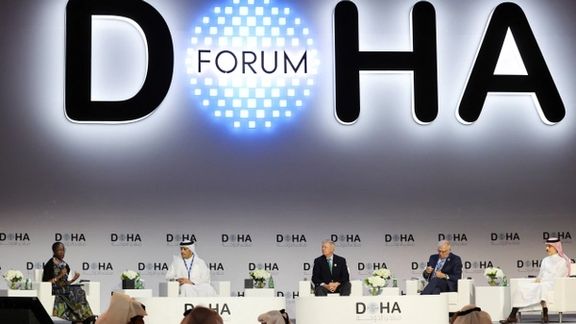
The Doha Forum holding a session on March 26, 2022

More than two weeks after Iran’s nuclear talks in Vienna came to a halt, Tehran sounds more optimistic about the eventual outcome than the Biden Administration.

A senior advisor to Iran's Supreme Leader said on Sunday that a nuclear deal between Tehran and world powers was imminent but could only happen if the United States showed political will.

"Yes, it's imminent. It depends on the political view of the United States," Kamal Kharrazi said at the Doha Forum international conference.

Kharrazi said it was vital for Washington to remove the foreign terrorist organization (FTO) designation against its Islamic Revolutionary Guard Corps (IRGC).

"IRGC is a national army and a national army being listed as a terrorist group certainly is not acceptable," he said.

The Biden Administration has hesitated over the issue, possibly because of its domestic backlash. If the administration takes such a step and days or weeks later the IRGC or its militant proxies in the region attack a country, President Joe Biden will be held responsible and blamed for being soft on Iran and miscalculating Tehran's intentions.

There are plenty of recent examples of Iranian aggressions. The IRGC lobbed 12 ballistic missiles at Erbil, in Iraqi Kurdistan this month claiming it targeted a secret Israeli base there. Houthi rebels armed and trained by IRGC attacked Saudi oil installations on Friday causing large fires.

Removing the biggest cross-border military, intelligence group controlling dozens of militant groups in the region from a terror list does not guarantee they will change their behavior. On the contrary, critics say such a move will embolden them.

Already, bipartisan opposition is growing against the Vienna talks, especially any notion of removing the IRGC from the US terrorist designation.

After 11 months of negotiations with Iran, the Biden Administration now finds itself caught between the hammer and the anvil and has become more cautious about the possible outcome of the talks.

US Special Envoy for Iran Robert Malley attending the Doha conference said that he is not confident a nuclear deal between Western powers and Iran is imminent.

"The sooner we get back into the deal, which is in our interest, and presumably Iran's interest, the more faithfully we implement it, and the more we can build on it to address the other issues between us and Iran and between Iran and the region," Malley said on Sunday.

He also made clear that the United States is negotiating to revive the 2015 nuclear agreement, and this is not “intending to address other issues” like Iran’s regional policy and other sanctions – a possible reference to Tehran’s demand over IRGC’s terror sanctions.

When former president Donald Trump withdrew from the JCPOA in 2018, his administration imposed nearly 1,500 sanctions until the very end of his presidency. The most painful economic sanctions are related to Iran’s nuclear program and will be lifted if the agreement is revived. But the US has consistently said terrorism, human rights and other sanctions will not be lifted. Iran, on the other hand, has always demanded the removal of all sanctions.

The US hopes to use the remainder to negotiate with Tehran over its aggressive regional policies and ballistic missile program. However, critics have been saying that once Iran is free of the major economic sanctions, it would have little incentive to moderate its behavior or make concession over the missile issue.


Most Viewed

US blockade enters murky phase as tankers spoof signals and buyers hesitate
1
ANALYSIS

US blockade enters murky phase as tankers spoof signals and buyers hesitate

2
INSIGHT

Ideology may be fading in Iran, but not in Kashmir's ‘Mini Iran'

3
INSIGHT

Hardliners push Hormuz ‘red line’ as US blockade tests Iran’s leverage

4
VOICES FROM IRAN

Hope and anger in Iran as fragile ceasefire persists

5

US sanctions oil network tied to Iranian tycoon Shamkhani

Banner
Banner

Spotlight

  • Hardliners push Hormuz ‘red line’ as US blockade tests Iran’s leverage
    INSIGHT

    Hardliners push Hormuz ‘red line’ as US blockade tests Iran’s leverage

  • Ideology may be fading in Iran, but not in Kashmir's ‘Mini Iran'
    INSIGHT

    Ideology may be fading in Iran, but not in Kashmir's ‘Mini Iran'

  • War damage amounts to $3,000 per Iranian, with blockade set to add to losses
    INSIGHT

    War damage amounts to $3,000 per Iranian, with blockade set to add to losses

  • Why the $100 billion Hormuz toll revenue is a myth
    ANALYSIS

    Why the $100 billion Hormuz toll revenue is a myth

  • US blockade targets Iran oil boom amid regional disruption
    ANALYSIS

    US blockade targets Iran oil boom amid regional disruption

  • Iran's digital economy battered by prolonged blackout
    INSIGHT

    Iran's digital economy battered by prolonged blackout

•
•
•

More Stories

Iran Says IRGC Sanctions A Main Issue In Nuclear Talks

Mar 26, 2022, 18:24 GMT+0
•
Maryam Sinaiee

Iran's foreign minister on Saturday said removing the Revolutionary Guard (IRGC) from the list of US sanctions is one of the main issues in nuclear talks.

In an interview with state television Saturday, Hossein Amir-Abdollahian said that removing individuals and entities from "the US red list and list of unilateral sanctions, such as certain holdings and state entities, as well as the IRGC" is one of Iran's main issues in the Vienna talks to restore the 2015 nuclear deal, Joint Comprehensive Plan of Action (JCPOA).

Some had suggested that perhaps Washington would agree to remove the IRGC from its Foreign Terrorist Organization (FTO) list but keep existing sanctions on individuals and entities affiliated with. But the Iranian foreign minister’s remarks show Tehran also wants companies, banks and persons to be removed from any sanction’s designation.

Amir-Abdollahian also accused the US of making "excessive demands" which, he said, have hindered the negotiations. He said he has discussed these issues with the EU foreign policy chief, Josep Borrell, and told him that Iranians could also "make demands".

"Regarding the IRGC, what is important is to acknowledge the standing and the central role of the IRGC in our security and defense. [Negotiators] relayed some messages to the US," he said.

Amir-Abdollahian also claimed that senior Revolutionary Guard officials always tell the government that it should do whatever it deems necessary to secure the country's national interests and not to prioritize the issue of the IRGC. "This is self-sacrifice on the part of the IRGC."

He added that despite having the "permission" from the IRGC authorities not to pursue the matter, the government continues to consider the removal of the military force from the US list of terror organizations a "major issue" in the talks.

This was the first time Amir-Abdollahian clearly referred to IRGC terror listing as a main issue in the talks. At a meeting with the Lebanese Parliament Speaker Nabih Berri in Beirut.

On Thursday the foreign minister said Iran would not surrender its "redlines" in the Vienna talks. But he did not explain what the redlines were and made no mention of the issue of the IRGC issue.

The Trump administration listed the IRGC as a terrorist organization as part of his ‘maximum pressure’ after he withdrew from the JCPOA in 2018.

Prospects of delisting the IRGC have raised many objections in the US and the tone in Washington is no longer as optimistic as before regarding the success of the talks. Friday’s large-scale and destructive Houthi drone and missile attacks on Saudi Arabia’s oil facilities in Jeddah is bound to make it less likely for the Biden Administration to entertain the idea of making concessions regarding the IRGC.

Amir-Abdollahian reiterated that the talks have made great progress on lifting the US sanctions and that an agreement is within reach if the Washington "adopts a realistic approach".

Referring to recent controversies over Russia's demand to be exempted from US sanctions over Ukraine in its economic dealings with Iran, Amir-Abdollahian said China and Russia are "for an agreement".

Deputy EU Foreign Policy Chief Enrique Mora arrived in Tehran Saturday for talks to explore possible solutions to remaining disagreements. He will reportedly visit Washington after later to confer with US officials.

In a Twitter post Friday, Mora said he would hold talks with Iran’s lead negotiator Ali Bagheri-Kani during his visit to Tehran as part of efforts towards “closing the remaining gaps” in the Vienna talks. "We must conclude this negotiation. Much is at stake," he wrote.

Rubio Calls On Biden Not To Make Deals With Iran, Venezuela

Mar 26, 2022, 17:00 GMT+0

Florida’s Republican Senator Marco Rubio has urged President Joe Boden not to pursue deals with anti-American and authoritarian regimes in Venezuela and Iran.

In a letter on Friday, Rubio called on the president to support energy projects in democratic nations in the Western Hemisphere, such as in Guyana, a democratic nation in South America.

Rubio criticized the Biden Administration for choosing not to lend to a project in Guyana, saying it would have helped address rising energy prices in the United States by supporting an expansion of Guyana’s capacity to produce and export more oil.

“Instead of supporting common sense projects that would strengthen our relationship with our allies and help the energy crisis at home, your administration is working behind closed doors to lift sanctions on the fossil fuel industries controlled by the Maduro regime in Venezuela and the Ayatollahs in Iran”, he said.

“I urge you, before seeking to convince bloodthirsty dictators to enter into misguided deals, explore supporting projects in democratic countries that actually want to work closer with us. Doing so will require no moral compromise on our part, while still reaping benefits for the American people”, the letter concluded.

Republicans and some Democrats have been criticizing the Biden team for their drawn-out talks with Iran to restore the 2015 nuclear agreement, JCPOA, arguing that it is an expiring agreement for which the US has to lift sanctions imposed on an anti-American regime.

As Mora Heads To Tehran, Borrell Says JCPOA Needed For Stability

Mar 26, 2022, 15:31 GMT+0

Speaking at the Doha Forum international conference Saturday, Josep Borrell, the European Union (EU) foreign policy chief, said Iran and world powers were “very close” to reviving the 2015 nuclear deal.

Borrell reportedly discussed with Qatari Foreign Minister Mohammed bin Abdulrahman bin Jassim Al-Thani the humanitarian impact of Russia's invasion of Ukraine, which has sent the cost of food items spiraling across the Middle East and North Africa, whereone in three peoplewere short of food in 2020.

Borrell said he hoped a successful conclusion to 11-month talks in Vienna aimed at reviving the 2015 nuclear deal, the JCPOA (Joint Comprehensive Plan of Action) was possible as an “as important element of wider stability and security.”

Enrique Mora, the senior EU official chairing the Vienna talks, tweeted Friday that he would travel to Tehran Saturday to meet Ali Bagheri-Kani, lead Iranian negotiator in the Vienna talks. “Working on closing the remaining gaps…Much is at stake,” Mora wrote.

Speculation over delays in the Vienna talks has focused on Russia’s requests that any sanctions over Ukraine not affect Moscow's role in JCPOA and its trade relations with Iran and reported US-Iran deadlock over lifting a ‘foreign terrorist organization’ designation attached to Iran’s Revolutionary Guards by former president Donald Trump after leaving the JCPOA in 2018 and imposing ‘maximum pressure’ sanctions.

Iran Denies Secret Offer To Help Russia Evade Sanctions

Mar 26, 2022, 11:26 GMT+0
•
Iran International Newsroom

Iran has denied a report about an alleged secret offer to help Russia evade Western sanctions in exchange for support in achieving a nuclear deal with the West.

Dismissing a March 23 report by the UK newspaper The Telegraph, an informed source with Iran’s Foreign Ministry said on Friday, “The claim by the Daily Telegraph that Iran and Russia have reached a secret agreement on the JCPOA and [Western] sanctions [on Russia] is merely an instance of news fabrication”.

The source, quoted by Iran's government-controlled media, added that such reports are made by Western security circles as part of their psychological warfare. It is worth noting that Iran's belated denial is not official.

On March 23, The Telegraph cited security sources about Iran’s secret offer to help Russia evade the impact of Western sanctions in return for getting “Moscow’s backing for a new nuclear deal”.

Diplomatic efforts in Vienna to revive the 2015 Iran nuclear deal, officially known as the Joint Comprehensive Plan of Action (JCPOA), broke up earlier this month after Russia demanded guarantees that any future business it conducts with Iran be exempt from Western sanctions imposed after the invasion of Ukraine.

It seems the Biden Administration has agreed with a Russian demand, which besides facilitating the restoration of the JCPOA, would involve lucrative deals for Moscow to expand Tehran’s civilian nuclear program. This would include the expansion of the Bushehr power plant with two additional nuclear reactors.

Russia announced on March 15, ten days after demanding the exemption that the Biden administration had agreed to waive Ukraine sanctions, noting that “Additions were made to the text of the future agreement on JCPOA restoration to ensure that all the JCPOA-related projects, especially with Russian participation, as well as Bushehr Nuclear Power Plant, are protected from negative impact of anti-Russian restrictions by US and EU”.

Still expressing optimism over the Vienna nuclear talks on Thursday, the Iranian foreign minister reiterated that Tehran would not surrender its "redlines", understood as the demand to remove the Revolutionary Guard from the US list of terrorist organizations.

Iran is believed to have already established a clandestine banking and finance system to handle tens of billions of dollars in annual trade banned under US-led sanctions while there are also reports that Tehran and Moscow are in talks over the possible recognition of the Russian payment system MIR.

The Telegraph article claimed security officials believe Iran has offered to use its sanctions-evading structure to help Russia sell its oil on international markets once the nuclear deal is signed, and sanctions have been lifted against Tehran.

“Russia is actively looking for ways to evade sanctions, and Iran has offered to help,” said a senior Western security official. “In return, Iran wants Russia to make sure the new nuclear deal is agreed so that sanctions are lifted against Tehran.”

EU's Mora To Visit Tehran Saturday To Discuss Nuclear Talks

Mar 25, 2022, 20:04 GMT+0

The European Union coordinator for Iran nuclear talks, Enrique Mora, will travel to Tehran on Saturday to discuss unresolved issues, he tweeted late Friday.

“Travelling to Tehran tomorrow to meet Bagheri Kani. Working on closing the remaining gaps in the Vienna talks on the JCPOA. We must conclude this negotiation. Much is at stake,” Mora said.

The nuclear talks that started almost one year ago in Vienna ended inconclusively earlier in March, after Russia demanded exemption from Ukraine sanctions in its dealings with Iran. However, there are still unresolved issues between Tehran and Washington.

Iran is reportedly demanding that the United States remove the Revolutionary Guard, IRGC, from its terrorism list and the Biden Administration appears hesitant.

The prospect of such a move has galvanized opposition among US lawmakers, especially Republicans, who were skeptical or opposed to the revival of the 2015 nuclear agreement, JCPOA. Former president Donald Trump withdrew from the agreement arguing that it will not stop Iran from acquiring nuclear weapons.

US National Security advisor Jake Sullivan travelling in Europe said on Friday that if diplomacy with Iran fails, Washington is ready to increase pressure on Tehran in coordination with its European allies.

As the current stalemate continues, Iran-backed Houthi forces in Yemen launched drone and missile attacks against oil installations in Saudi Arabia on Friday, causing damage.