• العربية
  • فارسی
Brand
  • Iran Insight
  • Politics
  • Economy
  • Analysis
  • Special Report
  • Opinion
  • Podcast
  • Iran Insight
  • Politics
  • Economy
  • Analysis
  • Special Report
  • Opinion
  • Podcast
  • Theme
  • Language
    • العربية
    • فارسی
  • Iran Insight
  • Politics
  • Economy
  • Analysis
  • Special Report
  • Opinion
  • Podcast
All rights reserved for Volant Media UK Limited
volant media logo

US Says Iran Nuclear Deal Is Neither Imminent Nor Certain
Mar 22, 2022, 08:59 GMT+0
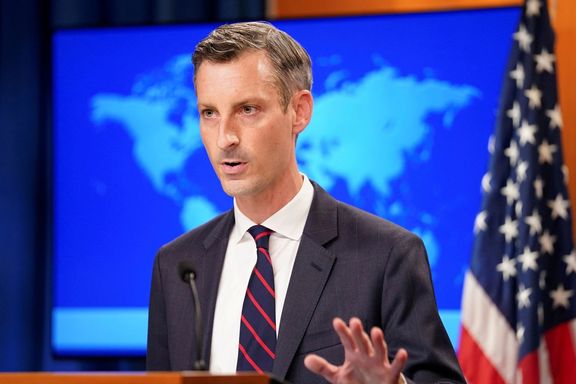
US State Department Spokesman Ned Price

US State Department said Monday that a nuclear deal with Iran “is neither imminent nor is it certain”, as talks in Vienna have paused for more than ten days.

The department’s spokesman Ned Price in his daily briefing said, “there has been significant progress in recent weeks, but I want to be clear that an agreement is neither imminent nor is it certain.”

The statement came as National Security Advisor Jake Sullivan slammed Iran’s support for Yemen’s Houthis as the rebel force launched multiple attacks against Saudi Arabia over the weekend. Sullivan repeated US accusations that Tehran is supplying missiles and drones to the Houthis, violating a United Nations arms embargo.

It is clear that one major remaining issue in the Vienna talks is Iran’s demand to remove sanctions imposed by the Trump administration on the Revolutionary Guard, IRGC. Multiple reports have indicated the Biden Administration is weighing its options regarding the Iranian demand.

Opposition both in the United States and abroad has been strong against taking such a step. Both Republican and Democratic lawmakers have expressed concern over the possibility of removing the IRGC from the US Foreign Terrorist Organization (FTO) list.

Israel’s prime minister and foreign minister forcefully and publicly opposed the notion in a statement on March 18, while the United Arab Emirates is reportedly “shocked” at the notion.

The Jerusalem Post reported that some in Abu Dhabi “are in great shock,” and their views on the issue are similar to Israel’s.

Media reports have said that the Biden administration has an option to remove the FTO designation in exchange for a promise by Tehran not to use the IRGC and its proxy forces in the region to harm US interests. Both Israel and its Arab friends in the region view a possible reliance on Tehran’s promises as a naïve and dangerous notion.

It is not clear when and if the Vienna talks will resume. Price on Monday said he can offer no information and urged Tehran to free “innocent Americans and others” held in Iran, which is Washington’s “top priority.”

Both Saudi Arabia and the UAE have had difficulties in their dealings with Washington, which last year took steps distancing itself from Persian Gulf allies. The Biden team removed the Houthis from its terror designation and restricted weapons sales to the Saudi coalition fighting in Yemen.

Saudi Arabia and the UAE which had close relations with the Trump administration have not responded to Biden’s calls for more oil supplies in the wake of Russia’s invasion of Ukraine and have taken a neutral posture toward Moscow.

Price tired to minimize disagreements with the UAE when asked about the visit of Syrian president Bashar al Assad to the Emirates this week, which the administration has criticized.

Our Emirati partners, they are a partner of ours, and they will continue to be and are an important partner of the United States. We share a number of interests, including the security interests, our shared interest in bringing to a close this conflict in Yemen. We have a shared interest in terms of regional stability, in terms of pushing back on Iran, in terms of helping our Emirati partners defend themselves against the attacks that have emanated from Yemen, from the Houthis. And of course, we are committed to all of that,” the spokesman said.


Most Viewed

US blockade enters murky phase as tankers spoof signals and buyers hesitate
1
ANALYSIS

US blockade enters murky phase as tankers spoof signals and buyers hesitate

2
INSIGHT

Ideology may be fading in Iran, but not in Kashmir's ‘Mini Iran'

3
INSIGHT

Hardliners push Hormuz ‘red line’ as US blockade tests Iran’s leverage

4
VOICES FROM IRAN

Hope and anger in Iran as fragile ceasefire persists

5

US sanctions oil network tied to Iranian tycoon Shamkhani

Banner
Banner

Spotlight

  • Hardliners push Hormuz ‘red line’ as US blockade tests Iran’s leverage
    INSIGHT

    Hardliners push Hormuz ‘red line’ as US blockade tests Iran’s leverage

  • Ideology may be fading in Iran, but not in Kashmir's ‘Mini Iran'
    INSIGHT

    Ideology may be fading in Iran, but not in Kashmir's ‘Mini Iran'

  • War damage amounts to $3,000 per Iranian, with blockade set to add to losses
    INSIGHT

    War damage amounts to $3,000 per Iranian, with blockade set to add to losses

  • Why the $100 billion Hormuz toll revenue is a myth
    ANALYSIS

    Why the $100 billion Hormuz toll revenue is a myth

  • US blockade targets Iran oil boom amid regional disruption
    ANALYSIS

    US blockade targets Iran oil boom amid regional disruption

  • Iran's digital economy battered by prolonged blackout
    INSIGHT

    Iran's digital economy battered by prolonged blackout

•
•
•

More Stories

Politician Says Iran Lost Billions As Nuclear Talks Dragged On

Mar 21, 2022, 21:59 GMT+0
•
Iran International Newsroom

A former senior lawmaker, who has been warning about Russia's intentions in Iran’s nuclear talks, says he is now more optimistic about a deal with Washington.

Heshmatollah Falahatpisheh has written several articles and given many interviews during the past four weeks warning about Russia's obstruction of Iran’s nuclear talks with the West and calling on the Iranian government to adopt an independent approach. He has also warned the authorities not to fall in Russia’s trap and avoid becoming hostage to over-reliance on Moscow and Beijing.

This comes while Iranian Supreme Leader Ali Khamenei who delivered two speeches in the past two days has not mentioned the nuclear talks and a possible deal with America. As Iran watcher Jason Bradsky observed in a series of tweets , Khamenei "gave a long, tedious lecture on the need for a knowledge-based economy. Khamenei stressed the need of not tying the economy to U.S. sanctions, but he hedged as usual."

Brodsky quoted Khamenei as saying: "of course this doesn't mean we are not seeking ways to lift these sanctions and those who are active in these fields should follow up on that," and added that this was all Khamenei had to say about the negotiations. However, Brodsky noted, "That doesn't mean the establishment isn't interested in a deal, but it is only interested in one on its terms," and that is "lifting the sanctions."

Former influential Iranian lawmaker Heshmatollah Falahatpisheh. FILE PHOTO
100%
Former influential Iranian lawmaker Heshmatollah Falahatpisheh

In his interview, Falahatpisheh, the former head of the Iranian parliament's National Security and Foreign Policy Committee, regretted that the talks were delayed for at least four years due to factional infighting among politicians in Iran. He observed that as a result, Iran's oil exports dropped to as little as 300 thousand barrels per day during the Trump administration.

He said that during the Biden administration, the figure rose to around 1.3 million barrels, however, Iran lost billions of dollars in oil revenues as it sold its output at a discounted price. He estimated that during the past 11 months Iran lost around $40 million a day, or at least $13.5 billion.

The conservative politician said Iran's first mistake was to hand over decision making to Russian negotiator Mikhail Ulyanov, and its second mistake was holding talks with all the JCPOA member states while it needed only to talk with the United States, a country that could have lifted all the barriers on the way of international trade for Iran.

Falahatpisheh opined that by winning a deal with the United States, Iranian leaders can move the country away from international tensions. He added that Iran needs to reduce tensions at the national, regional and international levels.

Meanwhile, he claimed that Iran's winning card was the resistance of its people against sanctions hinting that people carried the economic hardships without causing major unrest. But he failed to mention that their silence was largely the result of the regime's heavy-handed and violent suppression of dissent.

Two other winning cards, Falahatpisheh said, was Iran’s ability to advance in nuclear technology against all odds, and Tehran's self-reliance in defense. The latter, he said was what prevented the country from experiencing a fate similar to that of Ukraine.

Some Democrats Skeptical Of Biden Effort To Revive Iran Nuclear Deal

Mar 21, 2022, 18:08 GMT+0

Some Democrats in Congress express concern that renewing the 2015 Iran nuclear deal would be of less value as the United States has lost time and leverage, The Hill reported.

In the report published on Monday, The Hill also noted a complaint from Congresspeople that they were unaware of details in the Vienna nuclear talks.

Former president Donald Trump pulled the US from the agreement, the JCPOA in 2018, imposing ‘maximum pressure’ sanctions and prompting Tehran from 2019 to boost its nuclear program beyond JCPOA limits.

The Hill added that JCPOA opponents were also arguing that Russian involvement in re-implementing the deal, including removing enriched uranium, would see Tehran paying fees to Russia when the US is sanctioning Moscow over Ukraine.

“There’s been a little bit of insight as to how things are going but there’s no bigger picture insight,” said Senate Foreign Relations Committee Chairman Bob Menendez – one of four Democrats who in 2015 backed an unsuccessful anti-JCPOA Republican resolution. “It’s hard to judge.”

Menendez said that “if Iran is going to roll back its nuclear program, if it’s finally going to come clean on its efforts to achieve nuclear weapons and give access to the IAEA [International Atomic Energy Agency] …if Iran is going to constrain its missile program…those are good things.” But Menendez argued that “if what we may have…is just a rolling back of time, you can’t roll back knowledge.”

Tehran has refused calls for limiting its ballistic missile program and ending its aggressive regional interventions.

Washington Slams Iran's Support For Houthis After Attacks On Saudi Ally

Mar 21, 2022, 09:45 GMT+0
•
Iran International Newsroom

US National Security Advisor Jake Sullivan has accused Iran of enabling Yemen’s Houthis to launch missile and drone attacks against Saudi Arabia.

Reacting to multiple attacks over the weekend, Sullivan issued a statement condemning the aggression against Saudi civilian infrastructure, including oil and gas, as well as water treatment facilities.

Notably, the national security advisor also pointed his finger at Iran for “enabling” the Houthis to launch such attacks.

“The Houthis launch these terrorist attacks with enabling by Iran, which supplies them with missile and UAV components, training, and expertise,” the statement read. He noted that this violates UN Security Council resolutions “prohibiting the import of weapons into Yemen.”

Sullivan’s statement came amid news reports that Washington is contemplating to remove Iran’s Revolutionary Guard (IRGC) designation as a Foreign Terrorist Organization (FTO). The Guards with their extraterritorial Qods (Quds) Force are in charge of arming and guiding Tehran’s militant affiliates and proxies in the Middle East and beyond.

US National Security Advisor Jake Sullivan. FILE PHOTO
100%
US National Security Advisor Jake Sullivan

After almost a year of talks between Iran and the West in Vienna to revive the Obama-era nuclear deal known as JCPOA, it appears that the last hurdle is Tehran’s demand to have the IRGC sanctions removed. The US is reportedly seeking a guarantee that Iran would curtail the activities of its military-intelligence force in the region.

Many are skeptical about the value of any assurances by Tehran when the Islamic Republic’s core values are based on spreading its Shiite influence in the region.

Israel has voiced strong public opposition in recent days to IRGC’s ‘delisting’ as a step that would create more instability in the region. Persian Gulf Arab states are believed to have sent the same message to Washington, albeit quietly.

The Biden administration removed the Houthis from its list of terrorist organization a year ago and it did not help peace efforts for Yemen. Sullivan in his statement drew attention to Houthi intransigence.

“Saudi Arabia and the Yemeni Government have endorsed multiple UN calls for ceasefires and de-escalation over the last year. The Houthis have rejected these calls, responding instead with new offensives in Yemen and terrorist acts,” the national security advisor said.

It is noteworthy that the State Department had not issued a statement on Houthi attacks at the time of this publication.

The Wall Street Journal reported on Monday that the United States has transferred “a significant number of Patriot antimissile interceptors” to Saudi Arabia after repeated appeals by Riyadh to replenish its arsenal. The missiles have been effective in destroying most Houthi projectiles and drones.

After Russia’s invasion of Ukraine, the Biden administration has been scrambling to have Arab states supply more oil to world markets, which apparently, they still hold back. Arab producers cling to OPEC+ agreements in capping oil exports and they have not broken from Russia in their cooperation to manage supplies and prices.

One reason is also their dismay at the US policy of signing a limited new nuclear deal with Iran, which they believe will not contain Tehran’s aggressive behavior in the region.

The transfer of Patriots could be an attempt to improve the administration’s relations with Riyadh, at the same time adopting a tougher position against Houthis and Iran’s military support for them.

Lavrov Says Moscow Never Betrays Tehran In Politics

Mar 20, 2022, 10:44 GMT+0

Foreign Minister Sergei Lavrov says Russia never betrays Iran and does not pursue selfish interests in the reinstatement of the 2015 nuclear deal despite a possible boost to world oil supplies.

Lavrov made the remarks on Saturday in response to a question whether restoring the Joint Comprehensive Plan of Action (JCPOA) was advantageous to Russia, considering that it would resume Iranian oil supply to the global market.

"We never betray our friends in politics. Venezuela is our friend, and Iran is a state that is very close to us. Secondly, we do not pursue selfish interests, unlike the Americans", he told finalists in the Leaders of Russia competition.

"You can see what they [the Americans] are actually doing, trying to spite Russia and teach it a lesson,” Lavrov added by considering adding Iranian, Venezuelan and other oil supplies to the international market.

"So, the Americans have been contacting Saudi Arabia, the Emirates and Qatar regarding oil and gas. All of those countries, just like Venezuela and Iran, clearly said: when we discuss issues pertaining to the appearance of new actors in the oil market, all of us are committed to the OPEC+ format, where quotas for every actor are discussed and agreed upon by consensus", he said, noting that "For now, I see no reason to believe that this mechanism may somehow be dismantled. No one is interested in that”.

Houthis Attack Saudi Arabia Amid Talk Of US Delisting Iran's IRGC

Mar 20, 2022, 09:14 GMT+0

Yemen's Iran-backed Houthis have launched missile and drone strikes on energy and water desalination facilities in Saudi Arabia causing some material damage.

The Saudi-led coalition on Sunday said the attacks were aimed at a water desalination plant in Al-Shaqeeq, an Aramco distribution station in Jizan, a power station in Dhahran al Janub, a gas facility in Khamis Mushait and an Aramco liquefied natural gas plant in Yanbu.

"These hostile attacks and debris resulting from interceptions caused some material damage at the facilities and civilian cars and houses. There was no loss of life as of now," said the statement carried on state media.

The attack came amid talk that Washington is contemplating removing Iran’s Revolutionary Guard (IRGC) from its ‘foreign terrorist designation’, FTO, designation to ink a nuclear agreement with Tehran.

Israel, Saudi Arabia and its Arab allies in the Persian Gulf have serious misgivings about the Biden administration’s quest to revive the 2015 nuclear deal, JCPOA, by making such concessions to Iran.

The Houthis have received sophisticated weapons from IRGC, through its extraterritorial Qods Force. Houthi missiles and drones have Iranian origin, the United States and UN arms experts have maintained.

It is not clear specify which facilities incurred damages. Saudi State media posted images and videos of what appeared to be debris from the projectiles, damaged cars and structures and firefighters dousing flames.

Initial investigations showed the group fired Iranian-made cruise missiles at the desalination plant and state oil firm Aramco's Jizan distribution center, the coalition said.

It said Saudi air defenses intercepted and destroyed a ballistic missile and nine drones.

The Houthi military spokesman said the group would within hours announce a wide military operation on Saudi Arabia.

Houthis also launched drone and missile attacks at the United Arab Emirates in January, in what was seen as an escalation.

Riyadh leads a coalition that has been battling the Houthis for seven years in a conflict widely seen in the region as a proxy war between Saudi Arabia and Iran.

"These barbaric attacks are a dangerous escalation," coalition spokesman Brigadier General Turki al-Malki said, adding this constituted a Houthi rejection of planned Yemeni consultations in Riyadh later this month.

The Houthis have said they would only participate in discussions held in a neutral country and the priority should be lifting a coalition blockade on areas held by the group.

The movement ousted Yemen's Saudi-backed government from the capital, Sanaa, in late 2014, prompting the alliance to intervene months later. The Houthis say they are fighting a corrupt system and foreign aggression.

The war has killed tens of thousands of people and pushed millions to the verge of famine.






