• العربية
  • فارسی
Brand
  • Iran Insight
  • Politics
  • Economy
  • Analysis
  • Special Report
  • Opinion
  • Podcast
  • Iran Insight
  • Politics
  • Economy
  • Analysis
  • Special Report
  • Opinion
  • Podcast
  • Theme
  • Language
    • العربية
    • فارسی
  • Iran Insight
  • Politics
  • Economy
  • Analysis
  • Special Report
  • Opinion
  • Podcast
All rights reserved for Volant Media UK Limited
volant media logo

Politician Says Iran Lost Billions As Nuclear Talks Dragged On
Iran International Newsroom
Mar 21, 2022, 21:59 GMT+0Updated: 17:22 GMT+1
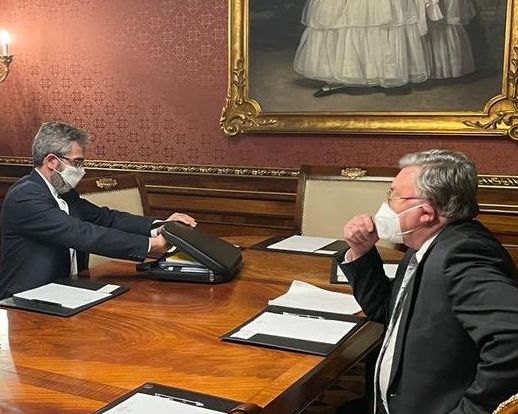
Russian and Iranian chief negotiators holding a separate meeting in Vienna. January 23

A former senior lawmaker, who has been warning about Russia's intentions in Iran’s nuclear talks, says he is now more optimistic about a deal with Washington.

Heshmatollah Falahatpisheh has written several articles and given many interviews during the past four weeks warning about Russia's obstruction of Iran’s nuclear talks with the West and calling on the Iranian government to adopt an independent approach. He has also warned the authorities not to fall in Russia’s trap and avoid becoming hostage to over-reliance on Moscow and Beijing.

This comes while Iranian Supreme Leader Ali Khamenei who delivered two speeches in the past two days has not mentioned the nuclear talks and a possible deal with America. As Iran watcher Jason Bradsky observed in a series of tweets , Khamenei "gave a long, tedious lecture on the need for a knowledge-based economy. Khamenei stressed the need of not tying the economy to U.S. sanctions, but he hedged as usual."

Brodsky quoted Khamenei as saying: "of course this doesn't mean we are not seeking ways to lift these sanctions and those who are active in these fields should follow up on that," and added that this was all Khamenei had to say about the negotiations. However, Brodsky noted, "That doesn't mean the establishment isn't interested in a deal, but it is only interested in one on its terms," and that is "lifting the sanctions."

Former influential Iranian lawmaker Heshmatollah Falahatpisheh. FILE PHOTO
100%
Former influential Iranian lawmaker Heshmatollah Falahatpisheh

In his interview, Falahatpisheh, the former head of the Iranian parliament's National Security and Foreign Policy Committee, regretted that the talks were delayed for at least four years due to factional infighting among politicians in Iran. He observed that as a result, Iran's oil exports dropped to as little as 300 thousand barrels per day during the Trump administration.

He said that during the Biden administration, the figure rose to around 1.3 million barrels, however, Iran lost billions of dollars in oil revenues as it sold its output at a discounted price. He estimated that during the past 11 months Iran lost around $40 million a day, or at least $13.5 billion.

The conservative politician said Iran's first mistake was to hand over decision making to Russian negotiator Mikhail Ulyanov, and its second mistake was holding talks with all the JCPOA member states while it needed only to talk with the United States, a country that could have lifted all the barriers on the way of international trade for Iran.

Falahatpisheh opined that by winning a deal with the United States, Iranian leaders can move the country away from international tensions. He added that Iran needs to reduce tensions at the national, regional and international levels.

Meanwhile, he claimed that Iran's winning card was the resistance of its people against sanctions hinting that people carried the economic hardships without causing major unrest. But he failed to mention that their silence was largely the result of the regime's heavy-handed and violent suppression of dissent.

Two other winning cards, Falahatpisheh said, was Iran’s ability to advance in nuclear technology against all odds, and Tehran's self-reliance in defense. The latter, he said was what prevented the country from experiencing a fate similar to that of Ukraine.


Most Viewed

Ghalibaf defends Iran-US talks amid hardline backlash
1
INSIGHT

Ghalibaf defends Iran-US talks amid hardline backlash

2
ANALYSIS

From instability to influence: Pakistan’s pivotal role in US-Iran diplomacy

3
ANALYSIS

100 days on: why Iran’s January protests spread across social classes

4

War-hit homeowners feel abandoned as Iran’s reconstruction aid fades

5

Iran says no decision yet on talks as Pakistan prepares to host US team

Banner
Banner

Spotlight

  • The politics of pink: how Iran uses cuteness to rebrand violence
    ANALYSIS

    The politics of pink: how Iran uses cuteness to rebrand violence

  • Bread shortages, soaring prices strain households in Iran, residents say
    VOICES FROM IRAN

    Bread shortages, soaring prices strain households in Iran, residents say

  • War-hit homeowners feel abandoned as Iran’s reconstruction aid fades

    War-hit homeowners feel abandoned as Iran’s reconstruction aid fades

  • 100 days on: the anatomy of Iran’s January crackdown
    INSIGHT

    100 days on: the anatomy of Iran’s January crackdown

  • Ghalibaf defends Iran-US talks amid hardline backlash
    INSIGHT

    Ghalibaf defends Iran-US talks amid hardline backlash

  • From instability to influence: Pakistan’s pivotal role in US-Iran diplomacy
    ANALYSIS

    From instability to influence: Pakistan’s pivotal role in US-Iran diplomacy

•
•
•

More Stories

Some Democrats Skeptical Of Biden Effort To Revive Iran Nuclear Deal

Mar 21, 2022, 18:08 GMT+0

Some Democrats in Congress express concern that renewing the 2015 Iran nuclear deal would be of less value as the United States has lost time and leverage, The Hill reported.

In the report published on Monday, The Hill also noted a complaint from Congresspeople that they were unaware of details in the Vienna nuclear talks.

Former president Donald Trump pulled the US from the agreement, the JCPOA in 2018, imposing ‘maximum pressure’ sanctions and prompting Tehran from 2019 to boost its nuclear program beyond JCPOA limits.

The Hill added that JCPOA opponents were also arguing that Russian involvement in re-implementing the deal, including removing enriched uranium, would see Tehran paying fees to Russia when the US is sanctioning Moscow over Ukraine.

“There’s been a little bit of insight as to how things are going but there’s no bigger picture insight,” said Senate Foreign Relations Committee Chairman Bob Menendez – one of four Democrats who in 2015 backed an unsuccessful anti-JCPOA Republican resolution. “It’s hard to judge.”

Menendez said that “if Iran is going to roll back its nuclear program, if it’s finally going to come clean on its efforts to achieve nuclear weapons and give access to the IAEA [International Atomic Energy Agency] …if Iran is going to constrain its missile program…those are good things.” But Menendez argued that “if what we may have…is just a rolling back of time, you can’t roll back knowledge.”

Tehran has refused calls for limiting its ballistic missile program and ending its aggressive regional interventions.

Lavrov Says Moscow Never Betrays Tehran In Politics

Mar 20, 2022, 10:44 GMT+0

Foreign Minister Sergei Lavrov says Russia never betrays Iran and does not pursue selfish interests in the reinstatement of the 2015 nuclear deal despite a possible boost to world oil supplies.

Lavrov made the remarks on Saturday in response to a question whether restoring the Joint Comprehensive Plan of Action (JCPOA) was advantageous to Russia, considering that it would resume Iranian oil supply to the global market.

"We never betray our friends in politics. Venezuela is our friend, and Iran is a state that is very close to us. Secondly, we do not pursue selfish interests, unlike the Americans", he told finalists in the Leaders of Russia competition.

"You can see what they [the Americans] are actually doing, trying to spite Russia and teach it a lesson,” Lavrov added by considering adding Iranian, Venezuelan and other oil supplies to the international market.

"So, the Americans have been contacting Saudi Arabia, the Emirates and Qatar regarding oil and gas. All of those countries, just like Venezuela and Iran, clearly said: when we discuss issues pertaining to the appearance of new actors in the oil market, all of us are committed to the OPEC+ format, where quotas for every actor are discussed and agreed upon by consensus", he said, noting that "For now, I see no reason to believe that this mechanism may somehow be dismantled. No one is interested in that”.

Iran Analysts Doubt Tehran Will Make Deal To Limit IRGC Activities

Mar 19, 2022, 21:38 GMT+0
•
Iran International Newsroom

Iranian analysts abroad say it is unlikely Tehran would limit activities of the Revolutionary Guard just to have its terror designation lifted by Washington.

Observers in Iran and abroad have been saying during the past weeks that the issue of the IRGC's designation as a foreign terrorist organization (FTO) is the main hinderance to a renewed nuclear agreement between Tehran and Washington.

Mehdi Mahdavi Azad in Germany and Houshang Hassanyari, a military analyst in Canada, expressed skepticism to Iran International TV on Saturday about Iran's willingness to seriously limit the role of IRGC and its Qods Force.

When on Friday reporters asked White House Press Secretary Jen Psaki how far the Biden administration is ready to go in its attempt to salvage the remains of the Obama-era nuclear deal with Iran, she evaded the question.

Psaki said negotiations were still ongoing and had nothing more to offer. Meanwhile, she refused to address their concern about whether secret negotiations with Iran "are turning into negotiations with terrorists."

Mahdavi termed the secret negotiations between Iran and the United States over the IRGC issue, "JCPOA-2". He pointed out that in fact this was the term Supreme Leader Ali Khamenei had used in a March 2016 speech. According to Mahdavi, Khamenei defined JCPOA-2 as a model the United States and other Western states had suggested for reducing tensions in the region. "Khamenei said at the time that if he accepted the idea, the Westerners would then ask for the disbanding of the IRGC Qods Force," Mahdavi said.

The analysts maintained that whatever the world knows as Iran's revolutionary foreign policy fully involves the IRGC and its Qods Force. If Tehran is negotiating with Washington over IRGC’s role, it simply wants to make sure that the terrorist designation is lifted.

Asked if this could change the Islamic Republic's foreign policy, Hassanyari said: "This would be the biggest retreat for the Islamic Republic and its leader Khamenei. The IRGC's role in the region has been one of the most important problems US officials are focused on." Hassanyari agreed with Mahdavi that it is the IRGC carries out the Tehran's regional policy.

Mahdavi said the reason the Islamic Republic has not admitted that talks are taking place about the role of the IRGC, is because people in Iran will ask why Khamenei had not done this during the past ten years and allowed a large part of the population to go into poverty. Naturally, if Khamenei has to negotiate with America, it has to be done secretly. Mahdavi added that the Iranian regime might have to undermine its credibility before its own supporters and give bigger concessions to the West if it feels that it is the only way out of problems it faces.

Hassanyari said that the fate of Iran's proxy groups in the region are also part of the negotiations. This will further humiliate the Islamic Republic both at home and in those countries where it has heavily invested to build influence.

In another part of the interview, Mahdavi said that the Obama administration ignored the demands of regional countries including Israel when it forged the 2015 agreement with Iran. However, the Biden administration is paying more attention to the growing concerns in Israel and Arab countries about a compromise with Tehran particularly as Iran has been launching attacks on some Arab countries and intervening in the affairs of other Arab states.

Israeli Cabinet Divided Over Scathing Statement On IRGC Delisting

Mar 19, 2022, 15:11 GMT+0
•
Maryam Sinaiee

Israel's Kan 11 television says defense minister Benny Gantz refused to join a statement, openly opposing the US over delisting of Iran's Revolutionary Guards.

Prime Minister Naftali Bennet and Foreign Minister Yair Lapid issued a statement on Fridaycriticizing what they said was US intentions to remove the Revolutionary Guards (IRGC) from the foreign terrorist organizations blacklist. They appealed to the United States not to delist the top military force of its arch-foe, which it considers as a threat to Israel's existence.

The state-owned Kan 11 on Friday said that Gantz refused to sign the scathing statement.

Gantz spoke with the US Defense Secretary Lloyd Austin hours after the statement issued and thanked the US Senate for approving a $4.8 billion defense aid package for Israel. According to a statement issued by the Defense Minister's office, Gantz and Austin "discussed the details of the emerging nuclear agreement and Israel's position regarding its components."

The delisting of the IRGC appears to be Iran's last condition for signing a deal after nearly a year of intense negotiations to restore the 2015 nuclear agreement, the Joint Comprehensive Plan of Action (JCPOA).

Kan 11 said Israel does not believe that Iran will abide by any commitments it may make in a new deal. Reports have said that US is seeking a guarantee from Tehran to curtail IRGC activities beyond Iran’s borders.

"The attempt to delist the Iran's Revolutionary Guards as a terrorist organization is an insult to the victims,' Israeli Prime Minister Bennett and Foreign Minister Lapid say in a joint statement Friday.

The statement comes after State Department spokesman Ned Price on Wednesday said Washington and Tehran were "close to a possible deal" but "not there yet". "We do think the remaining issues can be bridged," he added.

Under former President Donald Trump in 2019, the United States designated the IRGC as a "foreign terrorist organization" after unilaterally withdrawing from the JCPOA and imposing draconian sanctions on the Islamic Republic.

"Prime Minister Naftali Bennett and his ministers don’t make a habit of squabbling publicly with the Americans, but they have plenty of complaints about flaws in the new agreement, which they believe will leave Israel in a more dangerous position than after the original 2015 nuclear deal," a commentary in Israel's Haaretz on Friday said.

The White House Spokeswoman Jen Psaki said Thursday that there is "ongoing negotiation" over delisting the IRGC. "I’m not going to get into specifics of it.But I would just note that the status quo where we stand has done nothing to make us safer in any regard.In fact, the Islamic Revolutionary Guard has only been strengthened," she said.

Psaki also said the notion that the actions of the past administration pulling out of the Iran nuclear deal has reduced the actions or the escalatory behavior of the Iranian Revolutionary Guard "is inaccurate". "They’ve actually -- the Iranian government has actually doubled their budget or something like that," she added.

Iranian officials have not recently spoken of delisting the IRGC as a condition to signing an imminent deal but on March 9 a member of the parliament's National Security and Foreign Policy Committee, Hossein Noushabadi, said the issue of delisting the IRGC had repeatedly been discussed during the talks in Vienna with "promising results".

Delisting The Guards Will Put Iran And Israel On 'Collision Course'

Mar 18, 2022, 15:10 GMT+0
•
Iran International Newsroom

Israel’s prime minister and foreign minister have called on Washington to keep Iran’s Revolutionary Guards on its list of ‘foreign terrorist organizations.’

“The Revolutionary Guards are a terrorist organization that has murdered thousands of people, including Americans,” Naftali Bennett and Yair Lapid said in a statement. “We have a hard time believing that the United States will remove it from the definition of a terrorist organization.”

During negotiations since April 2021 to revive the 2015 nuclear deal, Tehran has made clear it expects the United States to lift a raft of ‘maximum pressure’ sanctions introduced after the Trump administration in 2018 withdrew the US from the deal, the JCPOA (Joint Comprehensive Plan of Action).

There has been speculation that one of the disagreements in not concluding a nuclear deal is over delisting the IRGC. Opponents of the JCPOA in the US and Israel are aware than not delisting the IRGC would make it harder to gain acceptance in Tehran for reimplementing the agreement, which limited Iran’s atomic program.

Shared global mission

The statement from Bennett and Lapid portrayed IRGC designation as part of a “global fight against terrorism…a shared mission of the entire world.” To remove the designation, they said, would mean the US abandoning “its closest allies in exchange for empty promises from terrorists.”

Former United States president Donald Trump added the IRGC to the list in 2019, the first time part of a state’s armed forces was included. Trump’s designation referred specifically to the 1983 bombing of a marine barracks in Lebanon, carried out by a Lebanese Shia group when the US intervened in the Lebanon war after the 1982 Israeli invasion, and the 1996 Khobar Tower bombing in Saudi Arabia, culpability for which has never been conclusively established.

IRGC commanders greet Supreme Leader Ali Khamenei in January 2020
100%
IRGC commanders greet Supreme Leader Ali Khamenei in January 2020

The Israeli statement portrayed the IRGC as controlling a range of groups across the Middle East. “The Iranian Revolutionary Guards are Hezbollah in Lebanon, they are Islamic Jihad in Gaza, they are the Houthis in Yemen, they are the militias in Iraq,” it said.

Promise not to harm Americans

Bennett and Lapid argued against the US listing groups as terrorists only on the grounds of a perceived threat to Americans: “The Revolutionary Guards took part in the murder of hundreds of thousands of Syrian civilians, they destroyed Lebanon, they are engaged in the murderous repression of Iranian civilians. They kill Jews because they are Jews, Christians because they are Christians, and Muslims because they do not surrender to them. We find it hard to believe that the definition of the Revolutionary Guards as a terrorist organization will be abolished in exchange for a ‘promise not to harm the Americans.'”

Not only that, the IRGC, for the Israeli leaders, is an “integral part of the murderous repression machine in Iran” whose “hands are stained with the blood of thousands of Iranians and the trampling of the soul of Iranian society.” Hence, argued Bennett and Lapid, removing the IRGC from the list would be “an insult to the victims and the erasure of a documented reality, with unequivocal evidence.”

Collision course

Reports say the Biden Administration is considering removing the IRGC from its ‘foreign terrorist’ list a part of agreement to revive the JCPOA limiting Iran’s nuclear program. But JCPOA opponents in Israel, the US and elsewhere have highlighted the IRGC recently firing a dozen ballistic missiles at Erbil in northern Iraq after an Israeli airstrike killed two Iranian soldiers in Syria. Iran claimed that it targeted an Israeli intelligence base, but Iraq and the US dismissed the claim.

Following a House Armed Services Committee hearing Thursday, Democrat congresswoman Elaine Luria, a naval veteran, tweeted that reviving the JCPOA would “put Iran and Israel on a collision course,” echoing remarks by Israel’s ambassador to the United States Michael Herzog.



