• العربية
  • فارسی
Brand
  • Iran Insight
  • Politics
  • Economy
  • Analysis
  • Special Report
  • Opinion
  • Podcast
  • Iran Insight
  • Politics
  • Economy
  • Analysis
  • Special Report
  • Opinion
  • Podcast
  • Theme
  • Language
    • العربية
    • فارسی
  • Iran Insight
  • Politics
  • Economy
  • Analysis
  • Special Report
  • Opinion
  • Podcast
All rights reserved for Volant Media UK Limited
volant media logo

Blaming Iran’s Problems On Rouhani Will Backfire, Says Pundit
Iran International Newsroom
Jan 18, 2022, 09:22 GMT+0Updated: 17:36 GMT+1
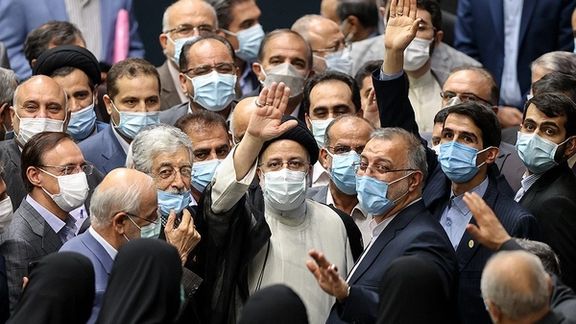
President Ebrahim Raisi surrounded by his supporters in parliament during his inauguration in August 2021.

A leading conservative commentator in Tehran says some statements by President Ebrahim Raisi's supporters to help him, might damage his popular support base.

In an interview with the conservative news website Nameh News, Mohammad Mohajeri said, "Some statements made by the government's supporters enrage the people," adding that "When people become angry their demands will increase, and this is costly for the government."

Hardliners recently often highlight multiple crises Iran faces, as a way to say that Raisi’s job is hard, and people should be patient. But the negative comments reflect badly on the regime itself, which many people see as incompetent.

Mohajeri was also talking about cases such as a lawmaker who told people not to listen to music or buy musical instruments and to leave the country if they don’t like the restriction. Other cases include statements by Labor Minister Hojjat Abdolmaleki who said he is not responsible for creating jobs.

Conservative pundit, Moammad Mohajeri. FILE PHOTO
100%
Conservative pundit, Moammad Mohajeri.

Other examples of outrageous statements by hardliners include Mashad Friday Prayers Imam Ahmad Alamolhoda saying those who criticize clerics in the government should be punished for throwing stones at the prophet or the cleric who said on the state television that every Iranian couple should have 14 children. Even Supreme Leader Khamenei's chief political adviser Ali Akbar Velayati said people in Iran should wear aprons like the Yemenis and eat nothing but dried out bread.

Mohajeri said: "Some of the government supporters want a change in the people's lifestyle to reduce pressures that are being exerted on Raisi to solve [the current economic] crisis. But theseremarks prompt the people to have a negative attitude toward the government."

"Some of those who make such statements about people's private life are the members of the ultraconservative Paydari party who say these things only to milk the government. They are telling the government indirectly: Give us our share [of wealth and power]!" and we will defend you, said Mohajeri.

Another group of supporters are Raisi's uneducated friends, he said. "They think they are helping the government by making those outlandish remarks, but they are not aware that these statements backfire and will make Raisi’s weak government even weaker," he said. "We know that Raisi was elected in a low-turnout election and enjoys very little social support."

The third group, said Mohajeri, are Raisi’s real supporters. "They make these comments deliberately as they think they are still campaigning in the elections. What they do is magnify problems they say the previous government created” and blame the Rouhani administration for the country's multiple crises. “What they ignore is that the Raisi has been in office for six months now and the people are more likely to lash out at his administration for shortcomings," Mohajeri argueded, adding that sometimes claims made by this group are not true in the first place.

The commentator added that these three groups have different intentions. Yet the outcome of what they say is the same because whatever they say will eventually weaken Raisi, while he may not realize this and think that they are exerting pressure on his political rivals.

"There is an expiration date for comments that blame the previous government for the country's problems. After a while, nobody will believe them,” Mohajeri noted, as people tend to demand solutions from those who are in charge.

"Blaming the previous government will only increase people’s anger. And when they are angry, they demand things more insistently, and this will be even more costly for the current administration," Mohajeri stressed.


Most Viewed

Ghalibaf defends Iran-US talks amid hardline backlash
1
INSIGHT

Ghalibaf defends Iran-US talks amid hardline backlash

2
INSIGHT

A nation in limbo: 100 days after the massacre, has the world moved on?

3
ANALYSIS

From instability to influence: Pakistan’s pivotal role in US-Iran diplomacy

4
ANALYSIS

100 days on: why Iran’s January protests spread across social classes

5

War-hit homeowners feel abandoned as Iran’s reconstruction aid fades

Banner
Banner

Spotlight

  • War-hit homeowners feel abandoned as Iran’s reconstruction aid fades

    War-hit homeowners feel abandoned as Iran’s reconstruction aid fades

  • 100 days on: the anatomy of Iran’s January crackdown
    INSIGHT

    100 days on: the anatomy of Iran’s January crackdown

  • Ghalibaf defends Iran-US talks amid hardline backlash
    INSIGHT

    Ghalibaf defends Iran-US talks amid hardline backlash

  • 100 days on: why Iran’s January protests spread across social classes
    ANALYSIS

    100 days on: why Iran’s January protests spread across social classes

  • From instability to influence: Pakistan’s pivotal role in US-Iran diplomacy
    ANALYSIS

    From instability to influence: Pakistan’s pivotal role in US-Iran diplomacy

  • A nation in limbo: 100 days after the massacre, has the world moved on?
    INSIGHT

    A nation in limbo: 100 days after the massacre, has the world moved on?

•
•
•

More Stories

Iranians Demand Fundamental Changes, Secularism, Says Official

Jan 17, 2022, 07:19 GMT+0

An Interior Ministry official has warned that Iranians are increasingly demanding "fundamental changes in the country," and a secular government and lifestyle.

Deputy Interior Minister Taghi Rostamvandi said in a conference in Tehran on Sunday, [January 16] that social trends in the country are largely alarming. Some of these trends indicate an interest in a secular government, he said.

"This will be extremely alarming if we find out that as a result of the incompetency of the government, people feel that the religious government is incapable of solving the country's problems and that a secular government can be effective," Rostamvandi added.

The official did not explain how four decades of Shiite clerical rule have made the people turn their backs to the Islamic Republic government

A study published in September showed that only 32 percent of Iranians identify themselves as "Shiite Muslim," and nearly half of the population have moved on from religiosity and are "atheists."

The official said that rising tendency toward immigration among Iranian of all walks of life indicates that there are too many reasons to leave the country. One of the main reasons, he said, was the difficult economic situation and the rise of unemployment.

Last January, a study conducted by the Iranian Immigration Monitoring Agency indicated that the number of Iranian students in Turkey has risen by 1,300 percent during the past few years. There were 438 Iranian students in Turkey in 2013, but the number rose to 6,099 in 2017, the agency said.

In December 2017, an adviser to the Roads and Transportation Minister said that 5.1 million Iranians, mainly educated individuals and skilled workers, were in the waiting list for immigration to Australia and Canada.

This comes while President Ebrahim Raisi (Raeesi) has said recently that "Western cultures and political systems are not attractive for the Iranian youths. No young Iranian would want to live in a Western cultural atmosphere.

According to Rostamvandi demand for fundamental changes in Iran are on the rise.

During the past years over 100 Iranian cities have been the scene of nationwide protests that were eventually violently suppressed by the security forces.

Expounding on the reasons for the rise in protests, the official said, "There has been a decline in the people's resilience during recent years as there has been a rise in economic and financial difficulties."

The Islamic Republic has described the protests in recent years as "riots" and has violently cracked down on civil rights and women activists. Interior Minister Ahmad Vahidi, an IRGC general, said last month that the most serious blow to the Islamic Revolution is likely to come from among the country's female population."

Highlighting Iranians’ defiance against the government and the clerical rule, the Interior Ministry official said while the consumption of Alkohol in Iran has been banned since the 1979 Islamic revolution, around 10 percent of the population between 15 to 64 years of age drink alcohol.This is more than five million people, he said.

Meanwhile the ban on alcoholic drinks in Iran has made smuggled and bootleg booze popular and every year dozens of drinkers lose their sight or their lives to contraband alcoholic drinks.

Parliament's Move Against Rouhani A Factional Ploy, Pundits Say

Jan 15, 2022, 20:51 GMT+0
•
Maryam Sinaiee

Iranian parliament's investigation of former President Hassan Rouhani may be a factionally motivated move by hardliners to divert attention from his successor's failings.

The parliament Tuesday voted to investigate the performance of Rouhani’s government, with 138 in favor, 28 against and 10 abstentions particularly the presidential office.

"The Raisi government and the hardline parliament's failings in controlling inflation and forex rates in these past few months … they want to overshadow such failings with theatrical and demagogic moves," Professor Sadegh Zibakalam, an outspoken commentator, told Aftab News Thursday. The news website is believed to be close to the pro-Rouhani Moderation and Development Party.

"It's quite clear that the main aim of such plans is merely serving political and factional interests rather than securing national interests, service to the country, and fight against corruption," Zibakalam alleged but said the move to investigate the Rouhani administration's performance could be positive as it could motivate Rouhani to also speak out about the issues raised by lawmakers.

Rouhani's responses, Zibakalam said, would show whether it was his opponents' insistence on hostility toward the United States and the Islamic Republic's regional policies, which led lie to the current economic crises, as hardliners allege, or Rouhani's performance. "Sadly, I don't think Rouhani will ever respond to such moves."

Iran’s nuclear program and aggressive regional policies are the domain of Supreme Leader Ali Khamenei. Neither Rouhani nor Raisi can alter these policies which have led to various sanctions and consequent economic crisis.

Rouhani's hardliner opponents who accuse his men of mismanagement, squandering billions of dollars of hard currency and gold, have long been demanding that parliament should launch an investigation into the conduct of Chief of Staff Hossein Fereydoun, former Vice-President Mohammad Nahavandian, and other members of Rouhani's economic team.

Fereydoun -- Rouhani's younger brother, confidante, and chief of staff – was involved in the nuclear negotiation with world powers between 2013-2015 that led to the conclusion of the nuclear deal known as the Joint Comprehensive Plan of Action (JCPOA) in 2015. Hardliners say his "meddling" in the negotiations bore "damaging consequences". Fereydoun who took part in the talks on the president's behalf has also been accused of influencing the appointment of officials of economic institutions and banks for personal gain.

In 2017, then Chief Justice Ebrahim Raisi who was running against Rouhani accused the incumbent president of preventing corruption investigation of "someone very close to him" and provided enough clues in televised debates to make it clear that he meant Rouhani's brother. Fereydoun was arrested on charges of corruption in 2018. He was sentenced to five years in prison and a cash fine in 2019 for "receiving bribes". He has beenserving his sentence at Tehran's Evin Prison since October 2019 but denies all wrongdoing.

Also speaking to Aftab News, political analyst Mohammad-Sadegh Javadihesar said the parliament's move to probe Rouhani administration was a "political move to influence the media atmosphere" in favor of the Raisi administration by making his failings appear to be his predecessor’s fault.

Stating former Vice President Es'hagh Jahangiri's description of Rouhani as the regime's "chest of secrets", Aftab News said pressures may incite Rouhani and his men to respond to allegations and "disclose some truths about the problems and impediments behind the closed curtains" during his two terms of presidency.

Former President Rafsanjani's Son Suggests He May Have Been Murdered

Jan 15, 2022, 15:21 GMT+0
•
Iran International Newsroom

Mohsen Hashemi, former Iranian President Akbar Hashemi Rafsanjani’s son, has called his father's death in 2017 "suspicious".

Rafsanjani who started his career in 1979 as an aide to Ruhollah Khomeini, the founder of the Islamic Republic held high offices until his death. He was the Speaker of Iran's parliament (1980-1989), became Iran's president (1989-1997) and was the Chairman of the country's Expediency Council (1989-2017), and the Assembly of Experts (2007-2011).

According to official reports he died of a heart attack while swimming in a pool in northern Tehran on January 8, 2017, after his bodyguards took him to a nearby hospital. He was 82 and suffering from diabetes at the time of his death.

In an interview published by reformist Etemad Online website on January 15, Mohsen Hashemi said that it was Islamic Republic's policy to say that his father died of natural causes. He added that the investigation carried out by the Supreme Council of National Security into Rafsanjani's death was "superficial".

This was the first time Mohsen Hashemi was speaking about his father's death to the media while his siblings have always insisted that Rafsanjani was "killed." According to commentator Mohammad Rahbar, who spoke to Iran International TV, the reason for Mohsen's silence during the past four years was that he held official positions and did not want to compromise his future, but now that he is holding no office, he has decided to disclose what he knows about his father's death.

Mohsen Hashemi in front of a portrait of his father. Undated
100%
Mohsen Hashemi in front of a portrait of his father.

Mohsen Hashemi, however, threaded carefully during the interview. He cautiously said that there is still no evidence to prove his father was killed, nor there is any evidence about a natural death. He said that there was no water in his lungs, which meant he did not drown. He added the family was never given access to CCTV footage. The fact that doctors at the hospital said he was "nearly" dead when he was brought in, was also "suspicious".

One of Rafsanjani's daughters, Fatemeh, had said in 2018 that the towel wrapped around her father's body was contaminated with radioactive material. Rafsanjani had reportedly told former IRGC commander and Supreme Leader Khamenei's military adviser General Yaya Rahim Safavi that he knew about a plot to kill him.

Rafsanjani had played a pivotal role in getting Ali Khamenei elected as Supreme Leader in 1989, but their relationship deteriorated by 2009. Rafsanjani was seen as an influential figure and possibly a threat to Khamenei’s increasingly authoritarian rule.

Mohsen Hashemi said in the interview that contrary to usual protocols, on the day of his death Rafsanjani was not accompanied by a medical team that usually went everywhere with him in an ambulance. But Hassan Ghazizadeh Hashemi, the health minister at the time, said Rafsanjani did not want the medical team to accompany him.

Hashemi also said that he has spoken to Khamenei and IRGC Intelligence Chief about a possible assassination attempt, but he was told that such a hypothesis was nonsense.

He added that against Rafsanjani's will, the IRGC had replaced the former President's bodyguards. He also accused an unnamed IRGC member of an arson in Rafsanjani's office in 2013.

Iran analyst Mehdi Mahdavi Azad told Iran International TV that "There is very little new information in the interview. His sisters had very openly talked about a murder plot." He added that "It is difficult to make a definite judgment based on the evidence available, but we are talking about a government under whose jurisdiction there have been so many suspicious murders. This is a government whose Intelligence Ministry officials have confessed to committing political murders in the past."

Mahdavi Azad concluded that "Based on the Islamic Republic's background, Akbar Hashemi Rafsanjani may have been killed, particularly because his death happened at a time Khamenei was perceiving him as a threat. Based on evidence, one can say that Rafsanjani's death was a murder on behalf of the ruling faction and Ali Khamenei."

'Big Jobs To Small People' Stirs Controversy In Iran

Jan 12, 2022, 14:01 GMT+0
•
Iran International Newsroom

A hardliner Iranian lawmaker has accused the labor minister of treating his ministry's resources as spoils of war and giving top jobs to his friends.

Naser Mousavi Largani said Labor Minister Hojat Abdolmaleki, a former state television showman, approaches his work as if it is a television game. He further accused the minister of employing individuals whose credentials have been rejected by the intelligence organizations.

According to Rouydad24 website, Largani said that as Abdolmaleki knew he could not officially employ those individuals, he appointed them as caretakers of various departments of the labor ministry.

The website wrote that "Surprisingly, instead of supporting their colleague, other lawmakers at tried to persuade Largani to drop the issue against the labor minister.

Meanwhile another scandal broke out on Tuesday as Iranians on social media slammed the appointment of former state TV chief Abdolali Aliasgari as the head of Iran's most important petrochemical plant that reportedly provides some 20 percent of Iran's much needed hard currency. Critics said he is neither an expert in industrial management nor in the petrochemical industry. Others argued: "Who else in Iran is in charge of anything based on education or expertise?"

Regarding the labor minister, activists on social media had disclosed a letter he wrote to the country's Administrative and Employment Office asking it to disregard the standards about employment and approve the hiring of 12 of his friends who would occupy top posts at the ministry. Meanwhile, the IRGC Intelligence Organization reportedly arrested one of those hired by Abdolmaleki on charges of financial corruption, but the minister intervened and promised to fire the man.

In August, when 191 lawmakers endorsed Abdolmaleki's credentials as minister, a few lawmakers, including Largani, warned that those who voted for the showman will regret their decision soon.Largani argued that "70 million people's livelihood depends on this ministry in one way or another as it is in charge of the national Pension Fund as well as being tasked with boosting employment in Iran." He added that the ministry owns several companies including the Isfahan Steel Mill and it cannot be run by a young man who lacks the necessary experience and expertise.

Other lawmakers including Hassan Lotfi, a member of the Social Affairs Committee of the Majles, have also criticized Abdolmaleki for nepotism and "giving big jobs to small people."

In Monday's session of parliament Largani said that not only Abdolmaleki has hired people who have no relevant skills or experience, he has also fired some of the experienced managers at the labor ministry. Meanwhile, Largani criticized Abdolmaleki for saying that as labor minister he is not responsible for creating jobs. "What you are doing is bad for the president's reputation," he said.

Largani said that the Minister was breaking the law and he, as a lawmaker, will oppose him with all that he has in his power.

Nepotism and giving big jobs to friends is also an issue in Tehran Municipality. According to ILNA, on Tuesday, Mehdi Eghrarian, a member of the Tehran City Council criticized Mayor Alireza Zakani for disorderly hirings. He particularly criticized the mayor for appointing individuals from his circle of friends and family as the head of the Municipality's Welfare, Social Services and Partnerships Organization. Eghrarian said that a series of employments have taken place at the Tehran Municipality that do not conform to rules and regulations.

"We cannot constantly talk about the importance of laws and violate the same laws at the same time," he added.

Again, in the same way that hardliner lawmakers stopped the debate about the labor minister, the Chairman of the Tehran City Council, Mehdi Chamran insisted that the discussion about illegal employments at the municipality should stop at once.

IRGC Official Discloses Details Of Confrontation With Rouhani

Jan 12, 2022, 11:45 GMT+0
•
Maryam Sinaiee

An IRGC commander has disclosed details of a "very frank and fierce meeting" with former President Hasan Rouhani in which commanders, including Ghasem Soleimani, issued a stark warning to him.

The interview with the IRGC Aerospace commander Amir-Ali Hajizadeh was published by the hardline Kayhan newspaper Wednesday and was focused on Soleimani, the slain commander of the IRGC Qods Force, who was killed in Baghdad by a US drone strike on January 3, 2020.

Hajizadeh told Kayhan that the meeting with the former president was held during his second term of presidency to warn him that the IRGC would not stay silent regarding his “transgressions.”

Hajizadeh was probably referring to Rouhani's meeting including Commander-in-Chief Mohammad-Ali Jafari and Soleimani on July 25, 2017, a few days before the confirmation of Rouhani’s re-election by Supreme Leader Ali Khamenei. Hajizadeh's account of the meeting is in stark contradiction to state media reports at the time which said Rouhani and the commanders had expressed support for each other without mention of any confrontation.

Summer of discontent

Tensions between Rouhani and the IRGC rose to new heights after his re-election on May 29, 2017. In a June 23 meeting with businessmen, Rouhani strongly criticized IRGC's business activities. "Part of the economy is controlled by an unarmed government, but we surrendered it to a government armed with guns," he said about IRGC's meddling in government affairs.

Rouhani was apparently referring to IRGC-affiliated business consortiums' taking over big companies such as the Iran Telecommunications Company in 2009 in the name of privatization during the presidency of Mahmoud Ahmadinejad. The Mobin Trust Consortium, largely owned by the IRGC Co-op Foundation, had won the tender for $7.8 billion along with two other state entities under irregular and suspicious circumstances.

In the interview with Kayhan, Hajizadeh did not make any mention of IRGC's economic activities and said the commanders offered to help Rouhani's government. "You saw in crises such as floods and earthquakes and other things the IRGC was really present," he said in the interview while accusing Rouhani of "assaulting friendly forces," meaning regime insiders.

"The Revolution, people, the ruling system, and the Leader are our redlines. Don't think you can always say these things and we will remain silent," Hajizadeh said the commanders in the meeting warned Rouhani while adding that Soleimani expressly warned Rouhani not to follow the same path as Ahmadinejad.

"Do you want to become like him? Why are you self-harming? Why are you constantly attacking us? Let's solve the problems," Soleimani told Rouhani according to Hajizadeh.

Do you want to become like Ahmadinejad?

Many allege that it was the IRGC that helped Ahmadinejad, a quite obscure figure, to climb the political ladder and capture presidency in 2005.

Relations between Ahmadinejad and the IRGC deteriorated during his second term, after he was once again helped by the Guards to overcome rivals in the disputed elections of 2009. But in 2011, Ahmadinejad publicly defied Supreme Leader Ali Khameneiover sacking his intelligence minister Heydar Moslehi. He also attacked the Guards publicly on several occasions and even dubbed them "our smuggler brothers" in reference to IRGC's massive role in hugely profitable illicit imports through ports under its direct control.

Apparently referring to Ahmadinejad and Rouhani's objection to IRGC's support of proxy forces in regional countries, Hajizadeh said under the influence of "poisonous propaganda" many questioned Soleimani's spending of Iranian money in other countries. "Why does he take our money abroad? Why, in their view, does he support a dictator? Why should we get involved in Syria anyway?" Hajizadeh said, presumably referring to Ahmadinejad and Rouhani.

In the interview, Hajizadeh also admitted that there was so much opposition to the IRGC's involvement in Iraq and Syria that the death of its forces in the early days of the conflicts had to be kept secret. "We really didn't know how to justify the deaths of the first martyrs of the wars in Iraq and Syria," he said adding that not being able to call them martyrs and burying them as such was a big problem and they had to be buried without any ceremonies.






