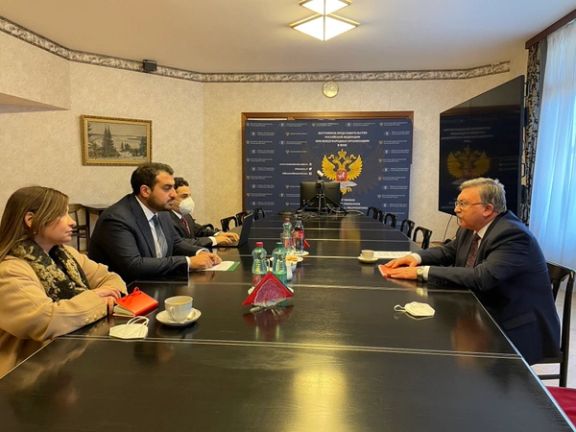
Russia's envoy Mikhail Ulyanov meeting with the Saudi ambassador. January6, 2022
While a Saudi Arabian diplomat last week met with nuclear negotiators from world powers in Vienna, Iran is trying to dispel any perception of being circumvented.
The government spokesman said Tuesday Tehran is not involved and would not comment on the recent meetings of Saudi and South Korean representatives with other parties to the Vienna talks.
At his press briefing Tuesday, Ali Bahadori-Jahromi said the presence of “some countries” in Vienna and their meetings with the other participants in the talks is "their independent decision and based on their mutual relations". "Such consultations is their business and will not affect the atmosphere of the talks," he insisted.
"Naturally, the Iranian delegation is not involved in such meetings and has not, and will not, comment on them," Bahadori-Jahromi told reporters.
The Saudi envoy to international organizations in Vienna, Abdullah bin Khalid, has reportedly met separatelywith Russian, Chinese and French delegations as well as the US Special representative for Iran Robert Malley to discuss the latest developments in the talks for restoring the 2015 nuclear deal, the Joint Comprehensive Plan of Action (JCPOA).
Russia's envoy to the talks, Mikhail Ulyanov, in a tweet after his meeting with the Saudi envoy said the two sides had exchanged views on prospects of a security dialogue in the Persian Gulf region.
The news of Saudi diplomatic contacts with JCPOA negotiators has raised some controversies in Iran. Some pundits argue that the involvement of Riyadh is very different from Seoul's involvement due to the longstanding issue of billions of dollars in Iranian money frozen in South Korea due to US sanctions. Unfreezing these assets is related to the Vienna talks.
Speaking to Iran Diplomacy website, former chairman of the Iranian parliament's national security and foreign policy committee, Heshmatollah Falahatpisheh, said whereas Korea's involvement should be taken positively, the Saudi involvement was negative.
"The Saudi involvement in Vienna talks, through any member of the 4+1 [current JCPOA members including France, Britain, Russia, China, and Germany] or the United States, should be seen in the context of a balancing act against Tehran in the talks," Falahatpisheh, a former conservative lawmaker, said.
Falahatpished added that in his view the French, Americans and even Russians will all benefit from Saudi involvement in the talks which he insisted should have involved only three players – Iran, the US, and the United Nations' Security Council as an international organization. He also criticized Russia's role in the talks and said they were as much responsible for involving the Saudis in the Vienna talks as the European sides, particularly France.
The former high-profile lawmaker also argued that Iran had always insisted it would not consent to anything other than the nuclear issue to be included in the negotiations, but the Saudi involvement has in effect broken Iran's redlines. "Saudi involvement in Vienna means attempts to examine the regional concerns they claim to have due to Iran's missile and defensive power as well as its regional influence," he said.
Arab countries in the region, particularly Saudi Arabia, have long demanded to be engaged in the nuclear talks with Iran which they say is directly related to their security due to very close geographical proximity.
Last week, Saudi Arabia’s foreign minister Prince Faisal bin Farhan reiterated Riyadh’s concernsabout Iran’s “destabilizing role” and “transgressions” in its nuclear program.
Riyadh and Tehran held talks last year to reduce tensions with the aim of restoring diplomatic ties broken since January 2016.
Speaking to Al Jazeera, Foreign Minister Hossein Amir-Abdollahian described the ongoing dialogue with Saudi Arabia as "positive and constructive" and said Tehran was ready to restore relations with Riyadh "at any time".
Ali Khamenei and Vladimir Putin meeting in Tehran. November 1, 2017
Kayhan newspaper Monday attacked reformists for doubting Russia and China's role as Iran works with world powers in Vienna to revive the 2015 nuclear deal.
In a note published Monday, the flagship hardliner newspaper said reformists had long been “whitewashing” the 2015 agreement – the JCPOA (Joint Comprehensive Plan of Action) – while imputing dubious motives to both Moscow and Beijing.
Kayhan has close links with Supreme Leader Ali Khamenei’s office and its editor is appointed by Khamenei.
Kayhan, whose editor Hossein Shariatmadari opposed the JCPOA, signed by the reformist-backed government of President Hassan Rouhani, said reformists were alarmed that the agreement would be revived with better terms under President Ebrahim Raisi (Raeesi), who took office in August.
Among reformists expressing concern over Russia, Fayyaz Zahed, senior member of Etemad Melli Party, wrote Saturday in the party's Etemad newspaper that “a nuclear Iran” would be “a threat to Russia, more than it is to Europe and America.”
Zahed highlighted Moscow’s security relationship with Israel – presumably over Syria, where the two sides have coordinated their air presence, even though Moscow, like Tehran, backs President Bashar al-Assad.
Zejad also called for direct talks with the United States. While Iran has ruled out face-to-face discussions with the US since Washington left the JCPOA in 2018 and worked to keep the negotiations locked to JCPOA structures, extensive bilateral meetings preceded the deal being agreed in 2015.
"Meet and speak with Americans yourselves,” Zahed counseled. “The Leader has previously authorized that. Why should the most important decisions and negotiations of the country in decades be entrusted to precarious and unreliable middlemen?"
The author clearly referred to Russian and Chinese diplomats rather than those of France, Germany and the United Kingdom, the other JCPOA signatories in Vienna. Zahed suggested that Iran might somehow “become the price paid by Russia and China for resolving tensions” with the US over Ukraine and Taiwan.
Iran as kingmaker
A great sense of Iran not flexing its muscles was conveyed in a commentary in the reformist Shargh daily, where economist Gholamreza Nazarboland last Tuesday called Iran a "kingmaker" and "balancer" in the Middle East that could tip the scales of world power simply by who it chose to align with.
"It is probably for this reason that Russia has used the opportunity to place itself in the current talks in Vienna in the role of a connecting link in the absence of the US which is not directly present," Zahed wrote.
Alleging that Russian envoy and avid tweeter, Mikhail Ulyanov "shrewdly" pushed Russian policy, deciding “which facts to report and which to hide,” Zahed suggested Moscow sought to make Iran dependent on Russia, and to control its relations with the “western world,” particularly the US.
Some conservatives are also wary of Russia and China influencing negotiations. The conservative Jomhouri Eslami has repeatedly accusedUlyanov of "meddling." In an editorial Tuesday headlined "Ulyanov Is Not Iran's Envoy", it criticized Iran’s foreign ministry for not taking action.
Jomhouri Eslami was outraged that in many meetings with delegations from Saudi Arabia, the US, and European countries, Ulyanov had "engineered" the outcome of the Vienna talks to suit his own government's interests.
"Protesting to Ulyanov's behavior is a patriotic act, demand for independence, and aimed at preventing foreign interference,” the editorial declared.
Nuclear negotiators in a formal session of talks in Vienna in December.
Iran’s foreign ministry spokesman said Monday Tehran is not satisfied with the pace of nuclear talks in Vienna but would not accept deadlines.
"Time is important to us, but it is not possible the other side moves like a turtle and we move at the speed of light," Saeed Khatibzadeh said.
He added that Iran wanted a “sustainable and reliable” agreement on reviving the 2015 nuclear deal with world powers, the JCPOA (Joint Comprehensive Plan of Action), with the talks encompassing “removal of sanctions, guarantees, verification, and nuclear issues.”
Khatibzadeh said Iran and the United States had exchanged views through informal written texts on all four issues. The US, which left the JCPOA in 2018 and imposed ‘maximum pressure’ sanctions on Iran, takes part indirectly in the Vienna process.
The spokesman emphasized that Iran would negotiate only with the JCPOA framework, and would not accept any intermediate steps towards reviving the 2015, nor enter into talks in Vienna over other matters. Khatibzadeh stressed the need to ensure Washington re-joined the JCPOA and did not again withdraw.
“We must all work to ensure that the United States’ return to the JCPOA is accompanied by necessary guarantees and verification,” he said. “The removal of sanctions should also be carried out effectively in accordance with the JCPOA. Such issues cannot materialize through an interim agreement.”
Bilateral and multilateral expert-level talks have been underway since the Vienna talks resumed on January 3 after a three-day break for New Year. The negotiation teams of Iran and Russia met Monday afternoon.
On Sunday, Iran's leader Ali Khamenei said that “holding talks and negotiating with the enemy at a certain juncture does not mean surrendering.” Khamenei ruled out direct talks with the US after President Donald Trump left the JCPOA in 2018, and Iran has insisted that talks on reviving the agreement take place within multilateral JCPOA structures.
There has been little news in the past week about the details of the negotiations. France and the United States have said there has been modest progress, although Iran and Russia have been insisting everything is on the right track.
The limited progress occurred after Western powers warned Iran that time is running out, and there are just “weeks not months” left to reach an agreement. Iran is enriching uranium while negotiations have continued for eight months. Growing stockpiles of fissile material can give Tehran more leverage in the talks.
The White house warned Tehran on Sunday against harming any US citizens, after top Iranian officials threatened revenge for the killing of Qasem Soleimani in a US drone strike in 2020.
Taliban's acting foreign minister Amir Khan Muttaqi (C) during a meeting with Iranian president's special envoy to Afghanistan Hassan Kazemi Qami on January 9, 2022
The Taliban has confirmed that acting foreign minister Amir Khan Muttaqi met with opposition figure Ahmad Massoud during his visit to Iran.
Muttaqi saw both the leader of the National Resistance Front and Herat governor Mohammad Ismail Khan while in Tehran, Zabiullah Mujahid, the Taliban’s main spokesman and acting deputy information minister, tweeted on Monday.
Mujahid wrote that Muttaqi had assured them that they could “return home without any worries.” Massoud has been widely touted as a leader who might rally military resistance to Afghanistan’s new rulers.
Muttaqi also met with Iranian Foreign Minister Hossein Amir-Abdollahian and Hassan Kazemi Qami, the Iranian president's special Afghan envoy. On Monday, Iran’s foreign ministry spokesman Saeed Khatibzadeh said Iran had “hosted various Afghan groups on various occasions.”
Afghanistan International had quoted unnamed sources saying that Mutaqqi had arrived in Tehran on the invitation of the Islamic Revolution Guard Corps (IRGC) and would meet opposition figures, including Massoud snd Ismail Khan, who tried to rally anti-Taliban forces in July in Herat.
A photo taken in Kabul airport before his departure showed a Mahan airline plane waiting on the tarmac. Mahan is an IRGC-affiliated company.
Prime Minister Naftali Bennett said on Monday that Israel would not be bound by any nuclear deal with Iran and would continue to consider itself free to act "with no constraints" if necessary.
Indirect talks between Iran and the United States on salvaging the 2015 Iran nuclear deal resumed a week ago in Vienna. France's foreign minister said on Friday that progress had been made, although time is running out.
"In regard to the nuclear talks in Vienna, we are definitely concerned ... Israel is not a party to the agreements," Bennett said in public remarks, in a briefing to a parliamentary committee.
"Israel is not bound by what will be written in the agreements, if they are signed, and Israel will continue to maintain full freedom of action anywhere any time, with no constraints," he said.
Israel which considered the 2015 agreement, JCPOA, insufficient to stop Iran from acquiring nuclear weapons has said that any new agreement should permanently prevent Tehran from becoming a buclear power.
Israel has called on world powers to maintain a credible military option against Iran while they pursue an agreement.
Some experts have questioned whether Israel, on its own, has the military capabilities to halt what it says is an Iranian quest for nuclear weapons. Iran denies that it seeks atomic arms.
The Asadi-Lari family during a previous interview on January 2, with photos of their children.
The mother of two victims killed when Iran shot down an airliner in 2020 says the family has sued senior officials for what they call a ‘premediated act.’
In a new interview published Monday in the reformist newspaper Shargh, Zahra Majd and her husband Hossein Asadi-Lari, who lost their children when flight PS752 was shot down January 8, 2020, disclosed their family had sued Ali Shamkhani, Secretary of the Supreme National Security Council (SNSC), and Hossein Salami, commander-in-chief of the Revolutionary Guards (IRGC).
Iran has said the Ukrainian Airways plane was shot down because a of “human error” at a time of high alert due to a possible United States attack, leading to the civilian airliner being misidentified. The lawsuit brought against Shamkhani claims the SNSC was responsible for not closing Iran’s airspace on the day of the incident and was involved in the deliberate downing of the plane.
The IRGC Aerospace Commander Amir-Ali Hajizadeh took overall responsibility for the downing of the plane three days after the incident.
Monday’s interview came a day after the publication of the family's two other interviews with Ensaf News and the Iranian Students News Agency (ISNA), when the family, breaking a silence of two years, alleged the missiles were intentionally fired at the plane to prevent US retaliation against Iran for a missile attack on US bases in Iraq just hours earlier, itself in response for the US killing Iranian general Qasem Soleimani and nine others in Baghdad.
Majd told Shargh that over a month after the incident, when visiting to express condolences, a visit implying he expected the family to accept their loss with stoicism, Salami had said the incident had prevented 10 million from being killed in a war with the US, making her children martyrs.
The family believes Salami's remarks, which he asked them to keep confidential, proves the flight was downed intentionally and not through human error.
This is the first time that one of the victims' families living in Iran has made such allegations in press interviews. Mohsen Asadi-Lari is a former high-ranking health ministry official.
Majd and her husband said that for three days after January 8 they had refused to believe that the plane had been targeted by Iran’s defense forces. Majd complained that the state broadcaster (IRIB) never talked to victims' families even though they had shunned foreign media, which she alleged would distort their remarks.
But she told Shargh that she would not talk to IRIB even if asked. “They will manipulate it to get what they want even if they talk to us," she told Shargh, accusing authorities of rigidly controlling the trial and court sessions, as well as private memorial ceremonies held by families and inscriptions on victims' gravestones. "We are not free to do and talk as we want."
Majd and her husband insisted that the ten low-ranking military personnel on trial are not the real culprits. Her husband claimed the person named as the operator of the air-defense system, referred to by the initials M.KH, was an expert in the Tor-M1 surface-to-air system that shot down the plane and that it was unbelievable that he had made such an error.”
"Hajizadeh [the IRGC aerospace commander] was indicted but his prosecution was prohibited,” Majd told Shargh. “This is very important. He has been indicted but [will not be prosecuted] no matter how much we shout… We found out about this in our private meeting [with the judge presiding the trial].”