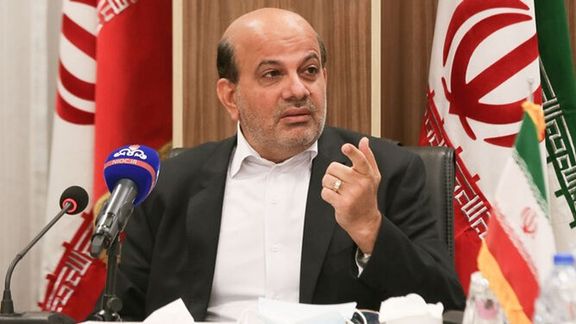
Mohsen Khojastehmehr, CEO of Iran's national oil company.
The CEO of Iran’s national oil company has said that oil exports have been increasing in recent months and Tehran has been able to repatriate the cash, despite sanctions.
Mohsen Khojastehmehr told Fars news website affiliated with Iran’s Revolutionary Guards that the government is trying to boost production to the pre-sanction levels until March, as stockpiles of exportable oil bi-products are dwindling.
Iran was producing 3.8 million barrels a day before the United States pulled out of the 2015 nuclear agreement (JCPOA) in May 2018 and imposed sanctions on Iran’s oil exports. For a while Iran continued to produce more as its exports declined from 2.1 million barrels per day to around 200,000 in 2019 and excess inventories began building up by early 2020 and production had to be cut back.
Khojastemehr said that since August when hardliner president Ebrahin Raisi has assumed officie, oil exports have increased, and Tehran is receiving the money. “I cannot mention any numbers on exports, but I can say that the situation has improved,” he said. “Revenues from oil exports return to the country…We have a duty in the oil company to sell the oil and give the money to the central bank, which decides what to do with it,” Khpjastemehr added.
Iran’s oil exports began increasing in September 2020, before the presidential elections in the United States, reaching from 200,000 bpd to around 600,000 according to monitoring groups. The claim that exports increased further since Raisi took office and the proceeds received in cash cannot be verified.
Looking at Iran’s financial situation, with annual inflation holding at around 45 percent and a weak national currency that has fallen further since Raisi came to office, it is not clear if Tehran has been able to repatriate foreign currency generated by oil exports.
A business representative, Masoud Daneshmand told Iran’s Labour News Agency (ILNA) on January 3 that Iran gives China oil and receives “inferior quality products”. The chairman of Iran-Switzerland Chamber of Commerce, Sharif Nezam-Mafi, on December 24 criticized the government's plans to increase barter transactions with other countries and pointed out that Iran needed technology which developed countries are not likely to transfer to Iran through barter.
But there is little doubt that in 2021 Iran increased its oil exports, as some believe the Biden Administration has stopped enforcing sanctions rigorously as it tries to restore the JCPOA and has said it is willing to lift most economic sanctions if Tehran stops the expansion of its nuclear program.
COVID patients receiving treatment in a Tehran hospital.
Iran will reportedly receive $90 million from the World Bank for measures to fight the Covid-19 pandemic, a spokesperson for the organization has said.
The World Bank approved the aid on December 21 because Iran is "the epicenter of Covid-19 infections in the region" and mitigating “the ongoing humanitarian crisis in the country” would reduce the contagion of the disease beyond its borders that benefits the neighbors, particularly as the Omicron variant is causing a new wave of cases.
The spokesperson told AFP that the loan "will be utilized only for procuring additional lifesaving, essential medical equipment to strengthen Iran's pandemic response", emphasizing that "This funding will not go to the Iranian budget and all loan proceeds, as well as procurement and disbursements, are being managed by the World Health Organization”.
“Distribution and installation of equipment will take place at health facilities approved by the World Bank and will be subject to independent monitoring and verification," added the spokesperson.
In May 2020, the World Bank granted Tehran $50 million via the Iran Covid-19 Emergency Response Project "on an exceptional basis" due to the pandemic.
Iran, which confirmed the first Omicron case on December 19, is the worst hit countries in the Middle East by more than 132,000 deaths since February 2020.
Iran’s health ministry has announced that the average consumption of milk and dairy products has decreased about 30 percent in the last two years.
The director of the ministry’s nutrition department, Zahra Abdollahi, said on Friday that the rise in food prices and inflationare the main reasons that have made people consume less milk products.
She noted that the country’s average consumption has always been under the recommended amount but the economic consequences of the Covid-19 pandemic and inflation have contributed to the sharp decline.
Abdollahi added that such low consumption of dairy products -- and consequently less calcium and phosphorus -- can cause serious health issues among people, particularly in children.
She stressed that currently osteoporosis is one of the leading diseases in Iran, warning that such a low consumption of dairy products can further increase such problems in the coming years.
Mentioning some reports that predict a 60-percent rise in the price of milk products in the coming months, she urged the authorities to consider subsidies and plans for free-of-charge milk for students.
The Iranian government has cut the subsidy on milk, which resulted in higher prices for dairy products, while free-of-charge milk is no longer distributed in elementary schools.
Despite having the biggest dairy products factory in the Middle East, Iran has a per capita consumption of about 60 to 80 kilograms a year, that is about half of the global average.
Iran's envoy in nuclear talks Ali Bagheri-Kani met with Korean Vice Foreign Minister Choi Jong-Kun on Thursday.
Iran's chief envoy in Vienna nuclear talks says South Korea must release Tehran's frozen funds no matter the outcome of the negotiations to restore the JCPOA.
According to the official government news website IRNA, Ali Bagheri-Kani made the remarks on Thursday as he met with Korean Vice Foreign Minister Choi Jong-Kun on the sidelines of the official negotiations.
He added that "unilateral US sanctions cannot justify the non-payment of debts to Iran".
The Korean diplomat said in a tweeton Thursday, “We exchanged views on our bilateral relationship including the frozen fund. Korea and Iran will work together and preserve our historically important relationship.”
Washington says it will waive sanctions on South Korea over frozen Iranian assets only with “everything” agreed in Vienna nuclear talks.
Since introducing ‘maximum pressure’ sanctions and leaving the JCPOA in 2018, the US has imposed banking sanctions on Iran. Two South Korea banks hold $7-9 billion of Iranian money, owed for oil imports.
Iran has funds frozen not just in South Korea but in Japan, Iraq, India, and China, mainly for oil and gas deliveries. The semi-official Iranian Students News Agency (ISNA) reported November 13 that Iran's assets frozen abroad totaled $50 billion, with $8 billion in South Korea, $3 billion in Japan, and $6 billion in Iraq.
Homeless people sleeping on Tehran city buses in late December 2021.
Controversies over "night bus sleepers" and whether to allow people to sleep on city buses have deepened in Iran, as high inflation impoverishes more people.
Most are not drug addicts, the report said Saturday, and were people who work but cannot afford the cheapest guesthouses as accommodation. The night bus sleepers told ISNA that buses offered the chance for a few hours’ secure sleep away from shelters they found unsanitary and unsafe. Some said they always sleep in buses.
Ahmad Alavi, a member of Tehran City Council, told ISNA Sunday that municipality officials were aware that night bus sleepers were different from the “typical” homeless who were often addicted to drugs and frequented homeless shelters.
Social media activists responded to the report by suggesting mosques should open their doors for rough sleepers on cold winter nights, while hardliners who control the government and religious institutions opposed the idea on grounds that mosques should be used strictly for religious purposes. Mosques were not "dormitories," tweeted Abdollah Ganji, editor-in-chief of Javan newspaper, affiliated with the Revolutionary Guard.
Homeless family sleeping on a night bus in Tehran, late December 2021.
In response, social media users said mosques are being used for state propaganda and housing the Basij, the paramilitary arm of the Revolutionary Guards, and even for economic activities such as cryptocurrency mining which is much cheaply done in mosques due to the special rates they pay for electricity.
There are around 2,000 mosques in Tehran alone. According to Tehran Municipality, Tehran had around 130,000 homeless last year while shelters could only accommodate around 3,000.
Adding to the media hubbub, Mehdi Chamran, conservative chairman of Tehran City Council, said Tuesday he had asked the mayor, Alireza Zakani, to stop people sleeping on buses and to find other accommodation. He said foreign media running the story had “forgotten how garbage scavengers live in London or other places."
Living costs, particularly housing, have risen sharply in Tehran, which according to the Economist's 2021 index of worldwide cost of living jumped from 106th in 2019 to 29th in 2021. The EIU attributed the rise to “continued supply-side constraints, goods shortages and rising import prices following the reimposition of US sanctions.” The EIU ranked Tel Aviv as the most expensive city in the world, followed by Paris.
According to a report by EcoIraneconomic website published January 3, the index for ‘misery’ – adding the unemployment rate to inflation – rose 20 points to 55 points in the twelve months leading to September 2021.
The increase results entirely from rising inflation as government figures, on which the EcoIran report was based, show a fall in unemployment from around 12 percent in summer 2020 to 9.6 percent in 2021.Economists say the figuredoes not include those losing work during the pandemic, and that the government-run Iran Statistical Center considers anyone who has worked for at least one hour a week to be employed. According to ISC,unemployment is at the lowest levelsince 1996, with the center highlighting “the spread of the coronavirus disease which has caused many young adults to leave the labor market.”
The Washington-based conservative Cato Institute, committed to ‘libertarian’ economics, ranked Iran 8th in the world in its Hanke's 2020 Annual Misery Index, with Venezuela as the world’s most miserable country.
People from across Iran have sent audio messages to Iran International Television about the shortages and high prices of medicines and pharmaceutical products.
While Iranian officials claim there is no scarcity of medications, several Iranians from across the country have expressed their concerns about a lack of foreign medicines.
A citizen of Sardasht in West Azerbaijan told Iran International that the prices of a simple painkiller has increased over four times in recent months.
Another Iranian has talked about the sharp rise in the prices of simple cold medicines that increased about six times in recent weeks.
According to another citizens, most of the drugs which are not available in pharmacies are sold with higher prices in the black market.
In an audio file sent to Iran International, a citizen stressed that the Islamic Republic "has taken patients hostages."
This woman said that after six months since she registered her case with the Food and Drug Administration and the Red Crescent, now the medicine she needs is available, but at a price significantly higher than the normal price.
He also criticized government policies that led to the decrease in imports, warning that medication prices may rise dramatically in the coming months because of restrictions by the health ministry, not foreign sanctions. His comment referred to the fall in the value of Iran’s currency and the need for the government to provide subsidized dollars to importers.
The director-general of Drugs and Controlled Substances Department of Iran’s Health Ministry, Heidar Mohammadi, said in mid-December that if foreign currency is not provided for imports, shortages of medications will reach an alarming level in the upcoming months.
Noting that the number of unavailable drugs is about 40, he warned that unless the government provides cheap dollars, the list of unavailable drugs would hit 400 to 500 soon.
Iranian officials periodically try to blame United States' sanctions for shortages of medication, but in fact, food, health and humanitarian products are not sanctioned. Iran imports around 100 million euros of medicines a month just from Europe and also large quantities from China and India.
Just before the US pulled out of the 2015 nuclear agreement (JCPOA) in May 2018, the former Iranian president Hassan Rouhani decided to offer dollars at 42,000 rials for essential imports to keep food and medicine cheap. Current free market rate for dollars is 290,000 rials.
However, the subsidized dollars did little to keep prices low, simply due to the corruption ingrained in Iran’s supply chain. There are numerous exposed cases of companies applying to receive the cheap dollars to import essential commodities but pocketing huge profits by importing luxury goods, such as thousands of foreign cars.