• العربية
  • فارسی
Brand
  • Iran Insight
  • Politics
  • Economy
  • Analysis
  • Special Report
  • Opinion
  • Podcast
  • Iran Insight
  • Politics
  • Economy
  • Analysis
  • Special Report
  • Opinion
  • Podcast
  • Theme
  • Language
    • العربية
    • فارسی
  • Iran Insight
  • Politics
  • Economy
  • Analysis
  • Special Report
  • Opinion
  • Podcast
All rights reserved for Volant Media UK Limited
volant media logo

Iranians Complain About Shortages And High Prices Of Medicines
Iran International Newsroom
Jan 5, 2022, 19:21 GMT+0Updated: 17:37 GMT+1
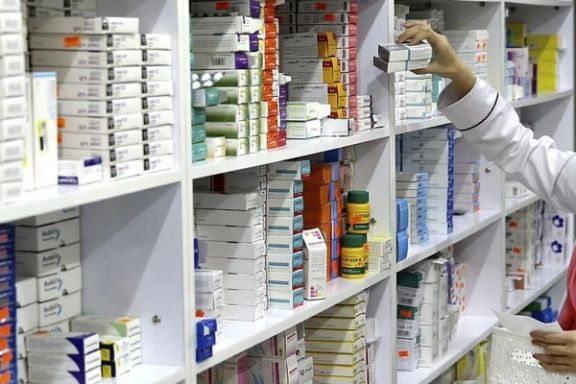
A pharmacy in Iran's capital Tehran.

People from across Iran have sent audio messages to Iran International Television about the shortages and high prices of medicines and pharmaceutical products.

While Iranian officials claim there is no scarcity of medications, several Iranians from across the country have expressed their concerns about a lack of foreign medicines.

A citizen of Sardasht in West Azerbaijan told Iran International that the prices of a simple painkiller has increased over four times in recent months.

Another Iranian has talked about the sharp rise in the prices of simple cold medicines that increased about six times in recent weeks.

According to another citizens, most of the drugs which are not available in pharmacies are sold with higher prices in the black market.

In an audio file sent to Iran International, a citizen stressed that the Islamic Republic "has taken patients hostages."

This woman said that after six months since she registered her case with the Food and Drug Administration and the Red Crescent, now the medicine she needs is available, but at a price significantly higher than the normal price.

Last week, an official of Iran’s drug importers union saidgovernment claims of being self-sufficient in production of raw materials for medicines and pharmaceutical products is not true.

He also criticized government policies that led to the decrease in imports, warning that medication prices may rise dramatically in the coming months because of restrictions by the health ministry, not foreign sanctions. His comment referred to the fall in the value of Iran’s currency and the need for the government to provide subsidized dollars to importers.

The director-general of Drugs and Controlled Substances Department of Iran’s Health Ministry, Heidar Mohammadi, said in mid-December that if foreign currency is not provided for imports, shortages of medications will reach an alarming level in the upcoming months.

Noting that the number of unavailable drugs is about 40, he warned that unless the government provides cheap dollars, the list of unavailable drugs would hit 400 to 500 soon.

Iranian officials periodically try to blame United States' sanctions for shortages of medication, but in fact, food, health and humanitarian products are not sanctioned. Iran imports around 100 million euros of medicines a month just from Europe and also large quantities from China and India.

Just before the US pulled out of the 2015 nuclear agreement (JCPOA) in May 2018, the former Iranian president Hassan Rouhani decided to offer dollars at 42,000 rials for essential imports to keep food and medicine cheap. Current free market rate for dollars is 290,000 rials.

However, the subsidized dollars did little to keep prices low, simply due to the corruption ingrained in Iran’s supply chain. There are numerous exposed cases of companies applying to receive the cheap dollars to import essential commodities but pocketing huge profits by importing luxury goods, such as thousands of foreign cars.


Most Viewed

Ideology may be fading in Iran, but not in Kashmir's ‘Mini Iran'
1
INSIGHT

Ideology may be fading in Iran, but not in Kashmir's ‘Mini Iran'

2
INSIGHT

Hardliners push Hormuz ‘red line’ as US blockade tests Iran’s leverage

3
VOICES FROM IRAN

Hope and anger in Iran as fragile ceasefire persists

4

Iran International says it won’t be silenced after London arson attack

5

US sanctions oil network tied to Iranian tycoon Shamkhani

Banner
Banner

Spotlight

  • Hardliners push Hormuz ‘red line’ as US blockade tests Iran’s leverage
    INSIGHT

    Hardliners push Hormuz ‘red line’ as US blockade tests Iran’s leverage

  • Ideology may be fading in Iran, but not in Kashmir's ‘Mini Iran'
    INSIGHT

    Ideology may be fading in Iran, but not in Kashmir's ‘Mini Iran'

  • War damage amounts to $3,000 per Iranian, with blockade set to add to losses
    INSIGHT

    War damage amounts to $3,000 per Iranian, with blockade set to add to losses

  • Why the $100 billion Hormuz toll revenue is a myth
    ANALYSIS

    Why the $100 billion Hormuz toll revenue is a myth

  • US blockade targets Iran oil boom amid regional disruption
    ANALYSIS

    US blockade targets Iran oil boom amid regional disruption

  • Iran's digital economy battered by prolonged blackout
    INSIGHT

    Iran's digital economy battered by prolonged blackout

•
•
•

More Stories

Father And Daughter: Controversy On Soleimani’s Death Anniversary

Jan 5, 2022, 16:47 GMT+0
•
Iran International Newsroom

A photo of Qasem Soleimani’s daughter holding the latest iPhone 13 has led to a storm of criticism that overshadowed the second anniversary of her father’s death.

Hundreds of social media posts scorned Zeinab Soleimani for brandishing a phone that costs more than ten times the monthly salary of an ordinary employee in Iran while the Islamic Republic based its propaganda on Qasem Soleimani’s modest lifestyle.

To make matters worse, pictures of Zeinab's cell phone surfaced on social media on the same day the Islamic Republic's Supreme Leader called on the nation to avoid buying expensive American cell phones.

Both opponents and loyal supporters of the Islamic Republic asked why Soleimani's daughter should buy a cell phone which is expensive and manufactured by a major US company. A new iPhone is an item that most young Iranians should wait years before they can afford it, wrote moderate Rouydad24 website in Tehran.

In a bipolar situation on cyberspace, some Iranians criticized Zeinab for undermining her father's ideals and the regime's anti-US slogans. "If America is bad, why do you buy their cell phones,” they asked. Those at the other political extreme argued: "Iranian people have nothing against the people of America. US government's policies are bad, but the companies are privately owned."

Zeinab has kept silent about the controversy, but some hardline supporters tried to argue that the picture was photoshopped. Others proved them wrong in a matter of minutes using pirated cutting-edge software.

Some hardliners said the handset was a gift from Zeinab's husband, a Lebanese Hezbollah member. Opponents said if the husband could afford that, it means Iran’s money to the militant group is spent on personal luxuries.

Some other hardliners responded that Zeinab should nonetheless respect her father's ideals, adding that the picture has deeply disappointed the supporters of the Islamic revolution. Still others tried to defend her by claiming that the phone belonged to the young lady standing next to Zeinab in the picture.

Some social media users published pictures of Zeinab in other locationswith the same handset to prove that the phone belonged to her. However, most of those who criticized Zeinab, had nothing to say against the expensive phone. It was the hypocrisy and double-standards of some Iranian hardliners they were criticizing. Some people still remember that Iranians on social media lashed out at the hardlliner editor of Kayhan newspaper Hossein Shariatmadari a few months ago in his office where he wrote articles against the United States using the latest Apple computer.

Some Iranian social media users highlighted the luxurious lifestyle prevalent among the clerical community of Iran. This group of users mentioned the affluent lifestyle of former President Akbar Hashemi Rafsanjani's family and others, including owning expensive phones

Some other social media users asked if there is nothing wrong with purchasing US-made productss, why Supreme Leader Ali Khamenei banned COVID-19 vaccines from the United States last January.

Observers say Zeinab and her sister Narjess are certainly controversial figures to watch and follow. Narjess stirred controversy with her candidacy for Tehran City Council, although her father had barred her from running for political office when he was alive. Zeinab also created another controversy recently by reportedly donating $2 million to promote temporary marriage among Lebanese Shiites.

Loud Explosion Terrifies People Near Tehran As IRGC Refers To 'Rocket Test'

Jan 5, 2022, 14:36 GMT+0

The sound of a loud explosion heard in a town near Tehran has caused a stir among Iranian internet users, with reports of terrified people out in the streets.

The loud blast was first reported on Wednesday afternoon by the residents of the town of Shahr-e Qods (formerly known as Ghal‘eh Hasan Khan) west of Tehran.
It was labeled as an incoming missile explosion by twitter users which was rejected by a security official from the governor's office of the Tehran province.
The rumors prompted Iran’s Revolutionary Guards to issue a statement on the incident.
The public relations office of one of IRGC’s local bases announced that the explosion was the result of a “controlled rocket launch” that took place during a “regular training session” in the base.
The statement urged people to stay calm and no to trust the news from the social media.

There are no independent reports yet about the source of the loud explosion. The area is mainly residential and a missile or rocket test by the military seems strange. There are no known large military bases in the area suitable for a missile test.

Sounds of explosions lead to speculations of possible foreign attack, given several mysterious sabotage acts at Iran's well-defended nuclear and other sensitve targets since July 2020.

Sharp Drop In Iran’s Gas Exports Shuts Down Iraqi Power Plants

Jan 5, 2022, 09:26 GMT+0

The Iraqi government says several power plants in the country have stopped operations due to a sharp decrease in natural gas imports from Iran.

Iraqi Electricity Ministry spokesman Ahmed Moussa said on Tuesday the reduction of gas supplies by Iran has caused widespread electricity shortages especially in central and southern parts of the country.

According to Moussa, Iran has reduced its gas exports to Iraq from 50 million cubic meters per day to about 8.5 million, cutting about 4,000 megawatts from the national grid, which now carries only 13,000 megawatts.

Iraq, which depends on Iran for about one third of its electricity, needs about 35,000 megawatts of power during peak winter demand, with only about one-third available now.

The reason for the drop is attributed to billions of dollars of unpaid bills by Baghdad, due to US banking sanctions against Iran. But the drop in Iran’s gas supplies may also be the result of a recent accident in a pipeline in Iran that shut down one of the units of South Pars gas field, reducing at least 15 million cubic meters of daily production, which Iran desperately needs.

Last winter, Iran experienced large power cuts in major cities. Protests broke out on a few occasions. When authorities started burning mazut, a dirty unrefined fuel to generate electricity, it led to heavy pollution in cities adding to the popular anger.

Hackers Interrupt Briefing By Lawyers For Victims Of Airliner Downed By Iran

Jan 5, 2022, 08:33 GMT+0

Hackers on Tuesday interrupted a video briefing by lawyers for relatives of those who died when Iran shot down a Ukrainian airliner, playing clips of loud music and showing sometimes violent images for more than two minutes.

The lawyers ended the Zoom call and restarted it without further incident. The briefing was held after a Canadian court this week awarded C$107 million ($84 million) to the families of six people who died when Iranian Revolutionary Guards downed the jet near Tehran two years ago.

The interference started shortly after Mark Arnold, one of the lawyers, said "if anybody from the Islamic Republic of Iran is on this call ... we're coming after your assets."

Images of a doll with sharp teeth and a dog with shining eyes then popped up on the screen, followed by a clip of a man singing a rap song with obscene lyrics and then repeated images of a man running towards a camera and pretending to kick it.

"I cannot speculate on who hijacked the call, but it was indeed interference," Jonah Arnold, another lawyer on the call, said by email when asked whether he thought Iranian actors were responsible.

No one has claimed responsibility. The lawyers had sent out a news release to the media with the dial-in details and password for the call.

Iran shot down the airliner in January 2020. All 176 people onboard were killed, including 55 Canadian citizens and 30 permanent residents.

The six family members awarded compensation by the court had filed a civil lawsuit against Iran and other officials they believe were to blame for the incident.

Report by Reuters

Attacks On US Forces In Syria, Iraq Continue Amid Iran Nuclear Talks

Jan 5, 2022, 08:03 GMT+0
•
Iran International Newsroom

Attacks on American troops stationed in Iraq and Syria in recent days, attributed to Iran-backed militia forces, came as the nuclear talks in Vienna were making some progress.

US officials in recent weeks had warned that they expected more attacks against US forces in Iraq and Syria, in part because of the second anniversary of the killing of top Iranian general Qasem Soleimani.

Soleimani who was Iran’s top military and intelligence operator in the Middle East, organizing anti-American and anti-Israeli militant groups, was killed by a targeted US drone strike on January 3, 2020, directly ordered by former US president Donald Trump.

Two explosive-laden drones were shot down on Tuesday by Iraq's air defenses as they approached the Ain al-Asad air base, which hosts US forces, west of Baghdad, an official of the US-led international military coalition said.

A similar attack was foiled on Monday, when Iraqi air defenses downed two drones as they approached a base hosting US forces near Baghdad's international airport.

Separately, another coalition official told Reuters that the coalition had carried out strikes against an "imminent threat" after they saw several rocket launch sites near the Green Village in Syria.

While this official did not say which country in the coalition carried out the strikes or who was responsible for the launch sites, Iranian-backed militia groups have occasionally targeted US forces in both Iraq and Syria.

In Washington, Pentagon spokesman John Kirby refused to say that the latest attacks were tied to Iran, but said they follow a pattern of attacks that were carried out by Iranian networks in the past.

"I'm not in a position now to get into specific attribution. That said, we continue to see threats against our forces in Iraq and Syria by militia groups that are backed by Iran," Kirby told reporters.

He also said the coalition strikes in Syria were not carried out by aircraft but did not provide more details on the threat.

The attacks came as nuclear talks continued with Iran in Vienna that seem to be making some progress. Critics of the talks to restore the 2015 nuclear agreement known as JCPOA say that even if negotiations prove successful they would not impact Iran's agressive behavior in the region and its network of militant proxies.

Iranian threats of revenge and retribution increased in the past one week as Soleimani’s death anniversary approached. Both Iran’s Supreme Leader Ali Khamenei and hardliner president Ebrahim Raisi warned that those involved in the Soleimani’s killing must be held responsible.

"If Trump and (former Secretary of State Mike) Pompeo are not tried in a fair court for the criminal act of assassinating General Soleimani, Muslims will take our martyr's revenge," Raisi said in a televised speech on Monday.

The United States is leading the international military coalition fighting Islamic State militants in Iraq and in Syria.

There are roughly 900 U.S. troops in Syria and another 2,500 in Iraq.

With reporting by Reuters