• العربية
  • فارسی
Brand
  • Iran Insight
  • Politics
  • Economy
  • Analysis
  • Special Report
  • Opinion
  • Podcast
  • Iran Insight
  • Politics
  • Economy
  • Analysis
  • Special Report
  • Opinion
  • Podcast
  • Theme
  • Language
    • العربية
    • فارسی
  • Iran Insight
  • Politics
  • Economy
  • Analysis
  • Special Report
  • Opinion
  • Podcast
All rights reserved for Volant Media UK Limited
volant media logo

US Says To Counter Iranian Threat In Region, After Arms Seizure

Maryam Sinaiee
Maryam Sinaiee

Iran International

Dec 24, 2021, 11:53 GMT+0Updated: 17:27 GMT+1
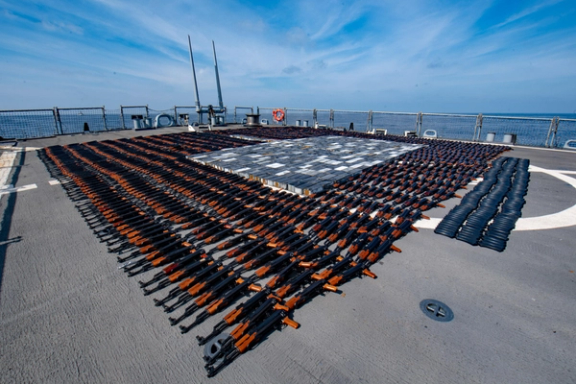
Large quantity of arms seized on a fishing vessel by the US Navy in the Arabian Sea.

The United States said Thursday it will counter Iran’s threat to international and regional security, after an arms shipment to Yemen’s Houthis was seized by the US Navy.

"Iran’s support for armed groups throughout the region threatens international and regional security, our forces, our diplomatic personnel and citizens in the region, as well as our partners in the region and elsewhere," State Department spokesman Ned Price said in a statement, adding that the US is "committed to countering this threat from Iran".

According to Price, the US has seized dozens of anti-tank guided missiles, thousands of assault rifles, and hundreds of machine guns and rocket-propelled grenade launchers from similar vessels in both May and February of this year.

The United States Navy said Thursday that two of its patrol coastal ships seized a cargo of illicit weapons from a fishing vessel in the North Arabian Sea on Monday. The shipment, the Navy said, included upwards of 1,400 AK-47 assault rifles and 226,600 rounds of ammunition.

The vessel carrying the arms and ammunition originated in Iran, the US Navy said in its statement, adding that the ship was on a route historically used to illegally smuggle weapons to the Houthis in Yemen.

Direct or indirect supply, sale, or transfer of weapons to the Houthi rebels, who are fighting a Saudi-led coalition, is a violation of a UN Security Council arms embargo in force since 2015 and US sanctions. The Saudi-led coalition intervened in the Yemeni civil war in that year to back the country's internationally recognized government which appeared to be losing against the rebels.

Price also warned about the flow of weapons to Yemen saying it enables the Houthi offensive against the southern city of Marib and increases the suffering of civilians while stressing that both parties in the Yemen’s civil war -- the Houthi rebels and the internationally recognized government of President Abdrabbuh Mansur Hadi -- "must reach a political settlement together to end the war".

The war in Yemen is widely seen as a proxy conflict between regional and ideological rivals Saudi Arabia and Iran.

Houthi rebels who blame the Saudis of targeting civilians in rebel areas have also launched dozens of missile and drone attacks on Saudi Arabia in recent years including the attack on Saudi oil establishments in Abqaiq plant and Khurais in September 2019.

Saudi Arabia, the US and some Western countries directly blamed Iran for launching the attack, but Iran has always dismissed the allegations. Iran maintains that it only provides the Houthis with "political and advisory" support and has repeatedly accused the Saud-led coalition of war crimes in Yemen.

A panel of UN experts in a report in February 2020 said some of the new weapons used by the rebels since 2019 had "technical characteristics similar to arms manufactured in the Islamic Republic of Iran".

The UN report cited a weapons shipment seized off Yemen’s coast by the US Navy that included a cruise missile, an anti-ship missile and surface-to-air missiles, and concluded that the attack on Saudi Aramco oil facilities could not have originated in Yemen although the Houthis claimed responsibility for the strikes Tehran denied any involvement.

The earliest shipment of weapons which the US said it had seized from an Iranian vessel headed for Yemen, in 2013, consisted of Katyusha rockets, heat-seeking surface-to-air missiles, RPG-7s, Iranian-made night vision goggles, and artillery systems that track land and navy targets 40 km away.

Most Viewed

Ghalibaf defends Iran-US talks amid hardline backlash
1
INSIGHT

Ghalibaf defends Iran-US talks amid hardline backlash

2
INSIGHT

A nation in limbo: 100 days after the massacre, has the world moved on?

3
ANALYSIS

From instability to influence: Pakistan’s pivotal role in US-Iran diplomacy

4
ANALYSIS

100 days on: why Iran’s January protests spread across social classes

5

War-hit homeowners feel abandoned as Iran’s reconstruction aid fades

Banner
Banner

Spotlight

  • War-hit homeowners feel abandoned as Iran’s reconstruction aid fades

    War-hit homeowners feel abandoned as Iran’s reconstruction aid fades

  • 100 days on: the anatomy of Iran’s January crackdown
    INSIGHT

    100 days on: the anatomy of Iran’s January crackdown

  • Ghalibaf defends Iran-US talks amid hardline backlash
    INSIGHT

    Ghalibaf defends Iran-US talks amid hardline backlash

  • 100 days on: why Iran’s January protests spread across social classes
    ANALYSIS

    100 days on: why Iran’s January protests spread across social classes

  • From instability to influence: Pakistan’s pivotal role in US-Iran diplomacy
    ANALYSIS

    From instability to influence: Pakistan’s pivotal role in US-Iran diplomacy

  • A nation in limbo: 100 days after the massacre, has the world moved on?
    INSIGHT

    A nation in limbo: 100 days after the massacre, has the world moved on?

•
•
•

More Stories

Iran Claims More Oil Exports Have Boosted Economic Growth

Dec 24, 2021, 10:02 GMT+0
•
Mardo Soghom

Iran has been able to boost oil exports to the extent that it has helped the economy grow by 3.3 percent this year, the government's news website said Friday.

The Islamic Republic News Agency, IRNA said that in the first six monthsof last Iranian year economic growth was 1.8 percent and because of more oil sales it reached 3.3 percent since March 21, when the new calendar year started.

The fact that Iran is selling more oil in 2021 has been reported by international oil trade and shipping monitoring firms, such as Kpler, that has said Iran this year is selling twice as much oil as in 2020.

Iran’s oil exports dropped from more than 2 million barrels per day in 2016-2017 to less than 200,000 in 2019, but started to grow in September 2020, before the US presidential election. No one can say with any certainty how much Tehran is exporting but estimates say volumes reach over 600,000 barrels per day.

Some have argued that this is because of less enforcement by the Biden Administration that has been indirectly negotiating with Iran since April trying to restore the 2015 nuclear agreement. The Administration denies it has been looking the other way, but somehow Tehran is shipping more oil primarily to China via middlemen and using illicit tactics.

China officially does not report any oil imports from Iran, because it is usually diverted through third countries and imported into China as originating from countries such as Malaysia, Iraq or the United Arab Emirates.

Over decades of various sanctions Iran has developed complex ways of circumvention and only diligent and determined pursuit can slow its illicit exports.

But the illicit methods also mean Iran sells the oil with a deep discount and middlemen also make hefty profits. Moreover, because of US banking sanctions Tehran often imports vital goods instead of receiving dollars for the oil.

The claim of 3.3 percent economic growth by IRNA cannot be independently verified and no details are mentioned in the report. In fact, other media in Iran, still under government censorship, sound dire warnings about the state of the economy, often through interviews with local experts and politicians who are currently out of power.

The national currency, rial, has fallen by more than 20 percentjust since August when President Ebrahim Raisi took office. This is indicative of a foreign currency shortage and the government’s reluctance to support the rial with limited reserves it controls.

The IRNA report is one of many other government claims, coming on daily basis, that that the Raisi Administration is hard at work and producing results, while except his hardliner supporters everyone else criticizes lack of progress in solving the economic crisis.

Saudi-Led Coalition In Yemen Destroys Explosives-Laden Boat -State TV

Dec 23, 2021, 20:51 GMT+0

The Saudi-led coalition fighting in Yemen destroyed an explosives-laden boat in the southern Red Sea before it could carry out an attack, Saudi state television said.

The coalition said later that the Iran-aligned Houthi group was using a sports ground called Al Thawra north of the Yemeni capital of Sanaa to store weapons and gave the group a deadline of six hours to remove them.

The deadline expires at 2300 GMT, the coalition added, threatening to attack Al Thawra if the group does not comply.

"If an international committee finds any drones or missiles at Al Thawra we will directly hand them to the United Nations, but if nothing is found, the coalition should permanently halt their attacks," the head of the Houthi supreme revolutionary committee, Mohamed Ali al-Houthi, said on Twitter.

The Houthis have launched repeated cross-border drone and missile attacks on Saudi Arabia since the coalition intervened in Yemen in March 2015 after the movement ousted the Saudi-backed government from Sanaa.

The coalition has escalated attacks on the Yemeni capital over the past month, accusing the group of storing weapons in civilian buildings.

Report by Reuters

With Iraqi Mediation, Iran And Saudi Arabia Will Resume Talks

Dec 23, 2021, 20:22 GMT+0
•
Iran International Newsroom

Iran’s foreign minister says the next round of talks between Tehran and Riyadh will be held in the Iraqi capital Baghdad in the near future.

Hossein Amir-Abdollahian made the remarks in a joint press conference with his Iraqi counterpart Fuad Hussein in Tehran Thursday evening.

He expressed gratitude over the efforts by the Iraqi foreign minister and Premier Mustafa al-Kadhimi who helped resolve “misunderstandings” to bring Tehran and Riyadh back to the negotiating table.

He said that Iran offered a set of “practical and constructive proposals” in the last round of talks, noting that he was informed during today’s meeting with his Iraqi counterpart that the Saudi side has a positive view about them.

“Delegates from the two countries will meet in Baghdad in the near future to discuss the implementation of the next phase of the agreement”, he said.

He also voiced Iran’s readiness for the two countries’ technical delegations to visit their respective embassies and make necessary arrangements and preparations for the normalization of ties.

Iran and Saudi Arabia have held several rounds of talks since April aimed at mending the relations. The two countries severed diplomatic ties in 2016.

Amir-Abdollahian also thanked Iraq for providing a private flight that transferred Iran’s envoy with Houthis in Yemen to Tehran for treatment. Hassan Irloo (Irlu or Irlou) died after his return to the country, reportedly from Covid-19 complications.

This is Hussein’s first visit since Ebrahim Raisi (Raeesi) took office. Following his talks with Amir-Abdollahian, he met with the Iranian president.

Answering a question about Iran’s nuclear talks in Vienna that will resume on Monday, Amir-Abdollahian said that “if they want to give one concession and get 10 concessions [in return], the Islamic Republic of Iran will never accept such an approach.”

He also criticized the European participants in the talk, especially France, for their “non-constructive” position.

“In the previous negotiations, the positions taken by some European countries, especially the French, were in general not constructive. We expect the French side to focus on playing a constructive role and help [the progress of] the negotiations”, he said.

He added that the E3 did not present any constructive initiative in the talks but Iran managed to get a verbal approval from all the participants over a draft agreement, which will be discussed next week.

France, the United Kingdom and Germany sharply criticized Iran for failing to take a realistic approach to the talks, when Tehran made new demands during talks in December.

He also appreciated the coordination by European Union's deputy foreign policy chief, Enrique Mora -- who represents the bloc in the Vienna talks, as well as coordinator, and EU foreign policy chief, Joseph Borrell.

“The American side sends some unwritten messages to the meetings and receives the necessary answers in that regard”, he added.

Talks between Iran, three European countries, Russia and China, which have been underway since April in Vienna have so far not resulted in substantial progress.

The United States that left the Joint Comprehensive Plan of Action (JCPOA) in 2018, participates in the talks indirectly, with the mediation of its European allies.

Lebanon's Top Christian Party Signals Possible End Of Hezbollah Alliance

Dec 23, 2021, 18:27 GMT+0

Lebanon's top Christian party has indicated it is considering ending a political alliance with Iran-backed Hezbollah, threatening a fragile union that has shaped Lebanese politics for nearly 16 years.

Gebran Bassil, leader of the Free Patriotic Movement party said earlier this week there would be "political consequences" for action taken against his party by Lebanon's two main Shiite parties Hezbollah and Amal.

Prominent figures close to the party have also said the 2006 Mar Mikhael Agreement between FPM and Hezbollah is at an end.

"Mikhael is dead," FPM pundit Charbel Khalil tweeted on Tuesday.

The party's support was critical in bringing President Michel Aoun, the FPM's founder, to power in 2016, and the FPM has provided critical Christian political cover for Hezbollah's armed presence under Lebanon's sectarian power-sharing system.

Hezbollah has not publicly commented.

Pro-Hezbollah Sheikh Sadiq Al-Nabulsi said on Wednesday that Hezbollah had "a very high tolerance for pain and criticism" but Bassil was at risk of losing its support.

"Today the FPM has no real ally other than Hezbollah, so why are you letting go of your last ally?" he said.

Bassil's party has faced growing political pressure to distance itself from Hezbollah since the country's 2019 financial meltdown.

Traditional allies in the Arab Gulf have been unwilling to provide Lebanon with aid, as they have in the past, because of what they have said is Hezbollah's grip on the country and its support for Iran-backed Houthi rebels battling Saudi-backed forces in Yemen.

The group is classified by the United States and major western nations as a terrorist group.

In Lebanon, Hezbollah has taken a hardline stance against the judge investigating the August 2020 Beirut blast, causing a row that has left Prime Minister Najib Mikati's government unable to meet since Oct. 12 even as poverty and hunger worsen.

But Hezbollah remains Bassil's strongest ally. And with presidential and parliamentary elections due next year, some analysts say the FPM could be posturing.

"The FPM is stuck between a rock and a hard place today. they certainly realise that the Christian street no longer condones any form of acquiescence to Hezbollah's demands," said Karim Emile Bitar, director of the Institute of Political science at Beirut's Saint Joseph University.

"But they simply cannot afford to completely let go of this alliance because it would ruin Bassil's presidential ambitions and would certainly prevent them from getting a significant parliamentary bloc."

Reuters report from Beirut

Tehran May Be Deescalating In Iraq As Baghdad Calls For Iran-US Direct Talks

Dec 23, 2021, 18:08 GMT+0
•
Iran International Newsroom

Iraq's Foreign Minister Fuad Hussein has said in a news conference in Tehran Thursday, that "It is time for Iran and the United States to start direct talks."

Hussein added that Baghdad is willing to play an active part in solving the problems between Iran and the United States. He said tensions between Iran and America are part of Iraq's domestic problems as they affect its internal situation for various reasons.

He added that any breakthrough in relations between Tehran and Washington will have a positive impact on the political, economic and security situation in Iraq, which is pursuing a series of critical talks in Tehran and Washington to serve its own interests.

Hussein said that now that the 7th round of the nuclear talks has ended in Vienna, it appears that there is a problem in the mechanism of the negotiations which will be solved if Iran and the United States talk directly to each other rather than through European mediators.

The Iraqi official also expressed support for the dialogue between Tehran and Riyadh and said that Baghdad looks forward to the fifth round of the talks between Iran and Saudi Arabia.

In another sign of change in the relations between Iran and Iraq, Iran's President Ebrahim Raisi said during a meeting with Iraq's Foreign Minister in Tehran on Thursday that "the Islamic Republic has always supported the establishment of a strong and powerful parliament and government in Iraq."

This comes while the opposition of Iran’s proxy groups to the results of the latest round of parliamentary elections in Iraq is the main hindrance on the way of forming a new Iraqi government. Meanwhile, the pro-Iran militia in Iraq have been involved in violence since the elections in October, and their political rivals have also launched attacks on Iranian establishments in Iraq.

During the meeting with the Iraqi official, Raisi described the parliamentary elections in Iraq as "peaceful and secure." This is the first time an Iranian official portrays the Iraqi election in a good light.

Thursday’s developments in Tehran are in line with reports by international news agencies about Iran’s change of approach to developments in Iraq. A Reuters report on Thursday said that Iran is intervening to quell destabilizing internal unrest stirred up by its proxy militias.

The report was referring to last month's drone attack on the residence of Iraq's Prime Minister Mustafa al-Kadhimi which some officials in Baghdad blamed on Iran-backed groups. Iran's Qods Force Commander Esmail Ghaani immediately rushed to Baghdad to reassure Iraqi officials and tell the pro-Iran groups to accept the result of the election won by populist cleric Moqtada al-Sadr.

It is not clear if Iran’s change of approach toward Iraq is related to its negotiations with world powers aimed at restoring the 2015 nuclear agreement and lifting of US sanctions. But being implicated in tensions in the neighboring country would not help its cause at the talks.