• العربية
  • فارسی
Brand
  • Iran Insight
  • Politics
  • Economy
  • Analysis
  • Special Report
  • Opinion
  • Podcast
  • Iran Insight
  • Politics
  • Economy
  • Analysis
  • Special Report
  • Opinion
  • Podcast
  • Theme
  • Language
    • العربية
    • فارسی
  • Iran Insight
  • Politics
  • Economy
  • Analysis
  • Special Report
  • Opinion
  • Podcast
All rights reserved for Volant Media UK Limited
volant media logo

Tehran May Be Deescalating In Iraq As Baghdad Calls For Iran-US Direct Talks
Iran International Newsroom
Dec 23, 2021, 18:08 GMT+0Updated: 17:36 GMT+1
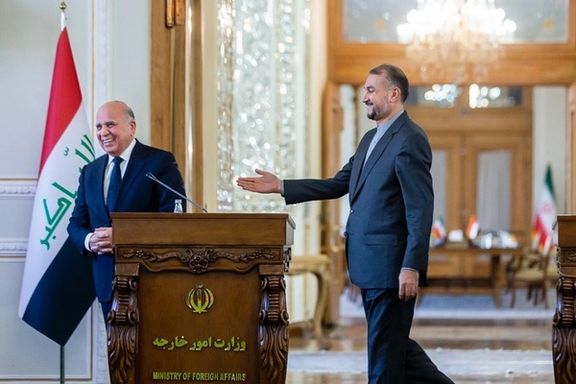
Iranian and Iraqi foreign ministers in Tehran at a joint press conference. December 23, 2021

Iraq's Foreign Minister Fuad Hussein has said in a news conference in Tehran Thursday, that "It is time for Iran and the United States to start direct talks."

Hussein added that Baghdad is willing to play an active part in solving the problems between Iran and the United States. He said tensions between Iran and America are part of Iraq's domestic problems as they affect its internal situation for various reasons.

He added that any breakthrough in relations between Tehran and Washington will have a positive impact on the political, economic and security situation in Iraq, which is pursuing a series of critical talks in Tehran and Washington to serve its own interests.

Hussein said that now that the 7th round of the nuclear talks has ended in Vienna, it appears that there is a problem in the mechanism of the negotiations which will be solved if Iran and the United States talk directly to each other rather than through European mediators.

The Iraqi official also expressed support for the dialogue between Tehran and Riyadh and said that Baghdad looks forward to the fifth round of the talks between Iran and Saudi Arabia.

In another sign of change in the relations between Iran and Iraq, Iran's President Ebrahim Raisi said during a meeting with Iraq's Foreign Minister in Tehran on Thursday that "the Islamic Republic has always supported the establishment of a strong and powerful parliament and government in Iraq."

This comes while the opposition of Iran’s proxy groups to the results of the latest round of parliamentary elections in Iraq is the main hindrance on the way of forming a new Iraqi government. Meanwhile, the pro-Iran militia in Iraq have been involved in violence since the elections in October, and their political rivals have also launched attacks on Iranian establishments in Iraq.

During the meeting with the Iraqi official, Raisi described the parliamentary elections in Iraq as "peaceful and secure." This is the first time an Iranian official portrays the Iraqi election in a good light.

Thursday’s developments in Tehran are in line with reports by international news agencies about Iran’s change of approach to developments in Iraq. A Reuters report on Thursday said that Iran is intervening to quell destabilizing internal unrest stirred up by its proxy militias.

The report was referring to last month's drone attack on the residence of Iraq's Prime Minister Mustafa al-Kadhimi which some officials in Baghdad blamed on Iran-backed groups. Iran's Qods Force Commander Esmail Ghaani immediately rushed to Baghdad to reassure Iraqi officials and tell the pro-Iran groups to accept the result of the election won by populist cleric Moqtada al-Sadr.

It is not clear if Iran’s change of approach toward Iraq is related to its negotiations with world powers aimed at restoring the 2015 nuclear agreement and lifting of US sanctions. But being implicated in tensions in the neighboring country would not help its cause at the talks.


Most Viewed

Iran negotiators ordered to return after internal rift over Islamabad talks
1
EXCLUSIVE

Iran negotiators ordered to return after internal rift over Islamabad talks

2
ANALYSIS

US blockade enters murky phase as tankers spoof signals and buyers hesitate

3
ANALYSIS

Why the $100 billion Hormuz toll revenue is a myth

4

US tightens financial squeeze on Iran, warns banks over oil money flows

5
ANALYSIS

US blockade targets Iran oil boom amid regional disruption

Banner
Banner

Spotlight

  • Hardliners push Hormuz ‘red line’ as US blockade tests Iran’s leverage
    INSIGHT

    Hardliners push Hormuz ‘red line’ as US blockade tests Iran’s leverage

  • Ideology may be fading in Iran, but not in Kashmir's ‘Mini Iran'
    INSIGHT

    Ideology may be fading in Iran, but not in Kashmir's ‘Mini Iran'

  • War damage amounts to $3,000 per Iranian, with blockade set to add to losses
    INSIGHT

    War damage amounts to $3,000 per Iranian, with blockade set to add to losses

  • Why the $100 billion Hormuz toll revenue is a myth
    ANALYSIS

    Why the $100 billion Hormuz toll revenue is a myth

  • US blockade targets Iran oil boom amid regional disruption
    ANALYSIS

    US blockade targets Iran oil boom amid regional disruption

  • Iran's digital economy battered by prolonged blackout
    INSIGHT

    Iran's digital economy battered by prolonged blackout

•
•
•

More Stories

Shiite Shrine, Christmas, Santa, All In One Place

Dec 23, 2021, 13:48 GMT+0
•
Maryam Sinaiee

Tehran's Tajrish Bazaar with its shrine, Christmas trees, and shopping for the Winter Solstice festival is a vignette of plurality of traditions at this time of year.

The old bazaar in the affluent northern Tehran is very popular with people from every walk of life. The busy Shiite shrine of Emamzadeh Saleh in one of the narrow passages of the bazaar is nestled among shops with massive displays of pomegranates, watermelons and nuts - staples for the celebration of the pre-Islamic Winter Solstice festival – and not far from it, Christmas trees and decorations catch the eye.

But it's not only the bazaar that looks Christmassy. "You wonder if this is really Tehran or a street in Europe when you walk in the streets of Tehran these days and look at shops. Shops are filled with Christmas trees and Santa Clauses. Street vendors are also selling Christmas trees and decorations everywhere in the city," Didar News wrote.

Reading poetry on Yalda celebration, the longest night of the year.
100%
Reading poetry on Yalda celebration, the longest night of the year.

This winter, Tehranis alone paid over 60 billion rials (over $200,000) for Christmas trees. According to Didar News, 90 percent of the trees were purchased by non-Christians -- that is, Iranian Muslims -- who in the past twenty years have also been celebrating western festivals such as Halloween and Valentine's Day. Fresh pines this year sold for around five million rials while small artificial trees cost around a million.

There are around 120,000 Armenian and Assyro-Chaldean Christians in Iran. Unlike converts to Christianity, they enjoy some degree of freedom of worship and have their own representatives in the parliament.

Iranian Armenians celebrate Christmas on January 6 and cook herbed rice and pan-fried fish , the same dish as other Iranians make for the Nowrouz festival, and make traditional Armenian sweets such as perog and gata loaves.

Shopping in Tehran for the winter Yalda festival.
100%
Shopping in Tehran for the winter Yalda festival.

Earlier this week Iranians sent each other millions of text messages to congratulate the Winter Solstice festival (known as Yalda or Chelleh Night) just as they do on the ancient Iranian New Year, the birthday of the Prophet Muhammad, and increasingly more in recent years, Christmas and western New Year.

The celebration of Yalda on the night of Winter Solstice and the Iranian New Year (Nowrouz) on the day of Spring Equinox both date back to ancient, pre-Islamic times. The non-Islamic Nowrouz is still the main calendar event for most Iranians. The strength of the Nowrouz tradition is such that even the Supreme Leader Ali Khamenei makes a televised speech on the day.

A store selling Christmas decorations in Tajrish, Tehran.
100%
A store selling Christmas decorations in Tajrish, Tehran.

Iran's religious establishment and hardliners often refer to such festivals, especially the Winter Solstice festival as "pagan" calendar events. They call on people not to celebrate such festivals and sometimes even call for banning them. But ancient traditions appear to have gained more popularity since the 1979 Islamic Revolution despite non-stop religious propaganda.

Many other Iranians think that celebrating pre-Islamic festivals is not against their Islamic beliefs and adopting other traditions such as Christmas is fine, as long as it is not at the cost of Iranian traditions such as Nowrouz.

"Different groups of people may feel they don't belong to their homeland if selling Christmas trees and Yalda food at Tajrish Bazaar is banned or if the Shrine of Emamzadeh Saleh is shut down to pilgrims. Feeling a stranger in one's homeland will breed anger and hate," a commentary in the moderate conservative Asr-e Iran website said Wednesday. "One can proudly say that in the Iranian society the Islamic, Western, and ancient Iranian cultures have somehow reached co-existence even though the government does not approve of it."

US Navy Seizes Illicit Weapons Originating From Iran Aboard A Vessel

Dec 23, 2021, 07:50 GMT+0

The US Navy said on Wednesday that two of its patrol coastal ships seized a cargo of illicit weapons from a fishing vessel in the North Arabian Sea on Monday.

The shipment consists of approximately 1,400 AK-47 assault rifles and 226,600 rounds of ammunition, the fleet said in a statement.

"The stateless vessel was assessed to have originated in Iran and transited international waters along a route historically used to traffic weapons unlawfully to the Houthis in Yemen," it added.

Direct or indirect supply, sale or transfer of weapons to the Houthi movement violates UN Security Council resolutions and US sanctions.

The vessel's five crew members, who identified themselves as Yemeni nationals, will be returned to Yemen, the fleet said, adding that the US naval forces sank the vessel after removing the crew and illicit cargo.

Guided-missile cruiser USS Monterey (CG 61) seized dozens of advanced Russian-made anti-tank guided missiles, thousands of Chinese Type 56 assault rifles, and hundreds of PKM machine guns, sniper rifles and rocket-propelled grenade launchers from a stateless vessel transiting the North Arabian Sea in May.

Iran supplies weapons to Houthi rebels in Yemen who are fighting a Saudi-led coalition that intervened in the country’s civil war in 2015 to back the internationally-recognized government.

Report by Reuters

Saudi-Led Coalition Strikes Houthi Security Camp In Yemen's Sanaa

Dec 23, 2021, 07:26 GMT+0

The Saudi-led coalition fighting Iran-aligned Houthi forces in Yemen said it launched air strikes against a Houthi security forces camp in the capital Sanaa.

The operation, which the coalition said destroyed seven drone and weapons stores at the camp, was in response to a drone the coalition said had been launched from Houthi territory towards Saudi's Red Sea city of Jizan.

The coalition has intensified attacks against targets in Sanaa in recent weeks, as Houthi forces continue to fire drones and missiles at Saudi Arabia.

The Yemeni capital is held by the Iran-aligned Houthi movement, which has been battling the coalition, which backs Yemen's internationally recognized government, for seven years.

Houthi-run Masirah TV said the strikes had hit the Sabaeen neighborhood of Sanaa in the early hours, damaging some civilian homes and causing some damage to a maternity and children's hospital.

During the conflict, which has killed tens of thousands and displaced millions, Houthi forces have regularly sent drones and fired missiles into Saudi Arabia, and the Saudi-led coalition has retaliated with air strikes inside Yemen.

The coalition said it carried out the operation in accordance with international humanitarian law.

Report by Reuters

Sri Lanka To Barter Tea To Settle $250 Million Iran Oil Debt

Dec 22, 2021, 19:43 GMT+0

To settle its $251 million debt to Iran, Sri Lanka will barter tea in monthly instalments of $5 million, because of United States sanctions on Iranian banking.

Head of Iran’s Trade Promotion Organization, Alireza Peyman-Pak and Sri Lanka Minister of Plantation, Ramesh Pathirana signed the barter agreement in Colombo on Tuesday.

Pathirana said that the deal makes it possible for the Ceylon Petroleum Corporation to settle its debts with the National Iranian Oil Company without violating US sanctions.

“This scheme will not violate any UN or US sanctions since tea has been categorized as a food item on humanitarian grounds while none of the black-listed Iranian banks will be involved in the equation,” read a statement by Sri Lanka’s plantation ministry.

According to the agreement, Sri Lanka’s Treasury will release equivalent of $5 million in rupees every month to the Sri Lanka Tea Board - a state-run industry regulator– that will then pay individual exporters in rupees at the central bank’s exchange rate.

Iran is among the top 10 importers of Ceylon Tea for the past several decades although purchases have declined following US sanctions.

Iran is trying to increase barter deals amid sanctions. “We have the lower hand and we have to make concessions, which means we have to accept any goods at any price”, Hamidreza Salehi, a member of Tehran’s Chamber of Commerce, has said.

Food, Housing Costs In Iran Rose Up To 700 Percent In Six Years

Dec 22, 2021, 13:37 GMT+0
•
Iran International Newsroom

Food and housing expenses in Iran have increased between 300 to 740 percent in the past six years, while wages went up by around 270 percent, a new report says.

The comparison between prices in December 2015 and now is revealing in one important respect. Iran was still under international sanctions six years ago after the nuclear agreement was concluded but economic restrictions were officially still in place. Prices did not change much after sanctions were lifted in early 2016 until the United States imposed new sanctions in 2018, with a devastating impact on the country’s economy.

Fararu website in Tehran has compared prices for this period, without any commentary but the comparison is interesting in the sense that rising prices are closely linked with the fall in the value of Iran’s currency.

The rial has dropped by 732 percent in six years, or rather from December 2017, when it became apparent that Donald Trump was likely to pull out of Barack Obama’s nuclear deal with Iran and impose sanctions.

One can argue that Iran had held up much better during international economic sanctions from 2011-2015, compared with how it has coped with Trump 'maximum pressure'. One reason could be that around the time when international sanctions were imposed global oil prices were hovering around $100-110 a barrel, which provided Iran with a cushion of dollar reserves. In contrast, Trump imposed sanctions on Iran’s oil exports when the average price was $70 a barrel in 2018.

The oil price of $100 in early 2010s was equivalent to 120 dollars in 2018. So, Iran was earning substantially more from its oil exports around 2010 than it did in 2018 after a big price collapse that had started in 2014.

While the US dollar rose 730 percent, housing costs climbed 740 percent on average. This has put a tremendous pressure on wage earners as in some cases rents eat up almost all of a worker's salary.

The main reason why housing costs have increased in par with the value of the dollar is that Iranian real estate owners regard their investment as a hedge against devaluation and ask prices and rents that keeps their income intact in dollars. Sale of properties can decrease, but no one is willing to sell homes and apartments at a loss calculated in dllars. Rents are a different story, as owners ask for more knowing that renters have no other choice.

Beef and chicken prices have also increased by over 300 percent, while Iranian-produced rice, which is a main food staple, has gone up by 500 percent.

The Fararu report calculates that in contrast with much higher prices, wages and salaries have increased by around 270 percent in six years, reaching a maximum of around $140 per month. There is little difference of income between a factory worker and an office employee or a young professional.

In fact, the income of workers in large industrial companies is safer than in smaller services firms which in many instances pay less to employees.

Iranian labor groups say that the minimum monthly salary needed for a family of 3.3 persons should be $400 to afford basic food and housing.

The economic hardship people face has created a potentially explosive political environment where a repeat of mass protests can take place at any moment, according to even government-controlled media in Iran.





