• العربية
  • فارسی
Brand
  • Iran Insight
  • Politics
  • Economy
  • Analysis
  • Special Report
  • Opinion
  • Podcast
  • Iran Insight
  • Politics
  • Economy
  • Analysis
  • Special Report
  • Opinion
  • Podcast
  • Theme
  • Language
    • العربية
    • فارسی
  • Iran Insight
  • Politics
  • Economy
  • Analysis
  • Special Report
  • Opinion
  • Podcast
All rights reserved for Volant Media UK Limited
volant media logo

Iran's Defense Ministry Sets Up 'Economic Headquarters'

Mardo Soghom
Mardo Soghom

Iran International

Dec 6, 2021, 14:49 GMT+0Updated: 17:39 GMT+1
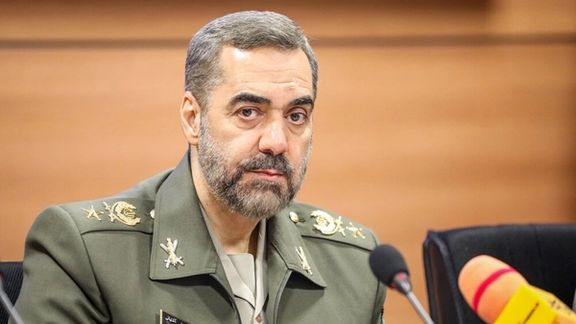
Iran's Defense Minister Mohammad-Reza Gharaei Ashtiani.

Iran’s defense ministry is creating an “economic headquarters” to coordinate and marshal its capabilities for more effective business and commercial operations.

In a meeting of the ministry’s Strategic Council on Monday chaired by Defense Minister Mohammad-Reza Gharaei Ashtiani, a host of other officials were present, including directors of “ideological-political” offices, intelligence and counterintelligence, and managers of the ministry’s business subsidiaries, official government news website IRNA reported.

Iran’s defense ministry operates within the framework of the presidential administration, but the chief commander of all armed forces is Supreme Leader Ali Khamenei. The armed forces are divided to two separate armies, the Islamic Revolution Guard Corps (IRGC) and the traditional army, the Artesh. The IRGC carries tremendous political and economic power in the country, in effect controlling the traditional army.

The main tasks of the defense ministry is development of weapons and equipment for the armed forces. Most of the Islamic Republic’s homegrown military and dual-use technologies, such as drones, are developed by the ministry. This role was highlighted in the meeting of the Strategic Council, where the defense minister praised Mohsen Fakhrizadeh, the nuclear-military scientist who was assassinated near Tehran in November 2020, most likely by Israel.

The defense minister said that Fakhrizadeh was “a source of great services to the holy Islamic regime and he was able to make great strides in developing military industries.”

It is not clear what the exact plans for an economic coordination taskforce would be and the state-controlled media did not elaborate. But from the brief announcement made it seems that the defense ministry wants to marshal its capabilities to play a larger role in helping the economy in an environment of tough United States sanctions.

It is also possible that in a tough economic environment the ministry wants to establish more control over companies it controls. Various people or interest groups are benefitting from the ministry's resources, businesses and factories. Creating an economic task force could allow the leadership to channel all economic activities to benefit the ministry in a more meaningful way.

Ashtiani, mentioned the keyword “centralization” of economic activities as a necessity.

Since the early 1990s, after the end of the Iran-Iraq war, the IRGC was allowed to set up businesses and get involved in the economy. Then-president Akbar Hashemi Rafsanjani who made the decision thought that it could benefit both the country and the tens of thousands of veterans who had fought for years in the battlefield. But IRGC’s business ventures turned into a quest of building an economic empire that today dominates the country. The military force has become the biggest public works contractor in Iran, sweeping aside private businesses.

The same was emulated by the defense ministry to a lesser extent. Fakhrizadeh, who was a top defense ministry official had set up businesses, an Iran International report revealed last year after his assassination. His family indirectly respondedin an interview with the state TV in early December 2020, in which they acknowledged that he did indeed owned “knowledge-based” companies.

Occasionally, the president of the country and even Khamenei have urged to military to curtail their economic activities, but these calls have been met with IRGC’s pushback. In July 2017, President Hassan Rouhani had to retreat after speaking of a “government with guns”, referring to IRGC’s political and economic power.

On Monday, Ashtiani referred to the president and Khamenei when he said the new economic headquarters is meant to help meet their “expectations”.

He also mentioned, “Monitoring both domestic and foreign economic environment, identifying corresponding opportunities, economic policy-making,” and a host of coordinating tasks for the economic headquarters.


Most Viewed

Ideology may be fading in Iran, but not in Kashmir's ‘Mini Iran'
1
INSIGHT

Ideology may be fading in Iran, but not in Kashmir's ‘Mini Iran'

2
INSIGHT

Hardliners push Hormuz ‘red line’ as US blockade tests Iran’s leverage

3
VOICES FROM IRAN

Hope and anger in Iran as fragile ceasefire persists

4

US sanctions oil network tied to Iranian tycoon Shamkhani

5

Iran International says it won’t be silenced after London arson attack

Banner
Banner

Spotlight

  • Hardliners push Hormuz ‘red line’ as US blockade tests Iran’s leverage
    INSIGHT

    Hardliners push Hormuz ‘red line’ as US blockade tests Iran’s leverage

  • Ideology may be fading in Iran, but not in Kashmir's ‘Mini Iran'
    INSIGHT

    Ideology may be fading in Iran, but not in Kashmir's ‘Mini Iran'

  • War damage amounts to $3,000 per Iranian, with blockade set to add to losses
    INSIGHT

    War damage amounts to $3,000 per Iranian, with blockade set to add to losses

  • Why the $100 billion Hormuz toll revenue is a myth
    ANALYSIS

    Why the $100 billion Hormuz toll revenue is a myth

  • US blockade targets Iran oil boom amid regional disruption
    ANALYSIS

    US blockade targets Iran oil boom amid regional disruption

  • Iran's digital economy battered by prolonged blackout
    INSIGHT

    Iran's digital economy battered by prolonged blackout

•
•
•

More Stories

Iran's Says Relations Between Arab States And Israel Bad For Region

Dec 6, 2021, 11:08 GMT+0

Iran’s foreign minister said Monday that relations between “a few Arab states and the Zionist regime” is not in the interest of stability and peace in the region.

Hossein Amir-Abdollahian who was speaking at a joint press conference with visiting Syrian foreign minister Faisal Mekdad also demanded the exit of foreign forces from Syria that are present “without coordination with the sovereign government elected by the Syrian people.”

The establishment of full relations last year between the United Arab Emirates and Bahrain with Israel was a sign of Tehran’s inability to isolate its arch enemy in the region. Iranian officials also made veiled threats against Arab countries willing to establish ties with Israel.

Iran strongly opposes the presence of a few hundred US troops in Syria that were stationed when the United States was fighting the Islamic State group with help of local militias.

Amir-Abdollahian also expressed satisfaction that some Western and Arab countries are reconsidering their policies in regard with Syria.

Iran played a pivotal role in defending Bashar al-Assad’s government from opposition forces in the Syrian civil war by dispatching troops and financial assistance.

UAE, Iran Highlight Need For Cooperation In Tehran Meetings

Dec 6, 2021, 09:35 GMT+0
•
Iran International Newsroom

UAE's top national security adviser Sheikh Tahnoon bin Zayed Al Nahyan met in Tehran with President Ebrahim Raisi and national security chief Ali Shamkhani.

The Iranian government’s news website IRNA reported that Shamkhani told Tahnoon, “warm and friendly ties with neighbors as well as sharing economic, trade and investment potentials are the most important priority for the Islamic Republic in its foreign policy.”

Shamkhani in a veiled reference to the United States said that regional countries can cooperate to ward off “interventionist policies” by powers from outside the region.

Iran’s national security advisor called for mutual efforts with the United Arab Emirates to “end some military and security crises” that have caused hardship for the peoples of the region. He added, “Talks and mutual understanding should replace a military approach to solve differences.”

Later, President Ebrahim Raisi in his meeting with Sheikh Tahnoon reiterated the same positions, and also warning of Israel's influence in Arab countries, in a veiled reference to full relations between the UAE and Tehran's arch-enemy in the region.

"The Zionists in the region pursue their evil plans and wherever they can find a foothold, they try to use it as a tool for expansion and sedition, therefore, regional countries should be careful," Raisi said.

The United Arab Emirates and its ally Saudi Arabia have been fighting Iran-backed Houthi forces in Yemen since 2015. They also backed opposing sides in the Syrian civil war. The Sunni Gulf states see Iran’s aggressive regional policies, including arming and financing militant networks as a serious threat to their security.

IRNA says that Tahnoon in turn told Shamkhani Iran as a large and powerful country has a unique geopolitical position in the region and expanding “warm and brotherly ties” between Abu Dhabi and Tehran is a top priority for the UAE.

IRNA also quoted Tahnoon as saying that the two countries have significant potential for economic cooperation in transit, energy, health care and investments. He added, “It is necessary to form expert taskforces to pinpoint areas of cooperation in various economic fields.”

Iran has been using Dubai as a key outlet to international markets often referring to it as a one-stop-shop that could provide goods to Iran from a variety of Asian and other countries. Iranian trade and tourism has somewhat declined in recent years both because of cold relations between the two countries and also because of US sanctions reducing Iran’s economic interactions overall.

Many Iranian merchants maintain offices in Dubai where they have residence and business permits. Many Iranians also own real estate in Dubai and foreign-based satellite televisions constantly advertise properties in the UAE Iranians can buy with little or no legal restrictions.

Iran and Saudi Arabia also held talks earlier this year to reduce tensions, but Saudis have described the talks as exploratory, without any breakthroughs. No new meetings have been announced. Abu Dhabi has said that it will keep Riyadh and other allied abreast of it talks with Tehran.

Saudi Crown Prince Starts Tour Of Gulf Arab States

Dec 6, 2021, 08:45 GMT+0

Saudi Arabia's de facto ruler Crown Prince Mohammed bin Salman starts a tour of Gulf Arab states on Monday ahead of an annual Gulf summit, amid nuclear talks with Iran.

Prince Mohammed will visit Oman, the United Arab Emirates, Bahrain, Qatar and Kuwait, Saudi-owned Al Arabiya television reported. Oman will be the first leg of the tour.

It would be the crown prince's first trip to neighboring Qatar since Riyadh and its Arab allies imposed an embargo on Doha in mid-2017.

Al Arabiya said the summit of Gulf Arab leaders would be held in the Saudi capital Riyadh in mid-December.

Saudi Arabia and the UAE have engaged with long-time foe Iran in a bid to contain regional tensions as indirect talks between Washington and Tehran to revive the 2015 nuclear pact drag.

The latest round of talks with Iran ended on December 3 without any results, leading to dismay among Western powers. Persian Gulf Arab states saw the 2015 nuclear deal as flawed for not addressing Tehran's missiles program and network of regional proxies.

Saudi Arabia's crown prince starts his regional tour on the same day that the UAE's top national security adviser is expected to Iran.

Saudi Arabia in April launched direct talks with Iran, to reduce tensions. Riyadh has described the discussions, held in Iraq, as largely exploratory.

Raisi Only Briefly Refers To Iran's Nuclear Issue In Televised Talk

Dec 5, 2021, 20:08 GMT+0
•
Maryam Sinaiee

In a televised talk Sunday, Iran’s President Ebrahim Raisi only briefly addressed Iran's nuclear issue saying he is keenly pursuing the "lifting of sanctions".

Raisi said Western countries thought his government would not continue the nuclear talks and "had nothing [worthy] to say" but "it has now been proven that we [did]. We presented a text [in the new round of talks] and the matter is being pursued," he said.

In the one-hour program, Raisi spoke about the nuclear issue for less than 2 minutes.

The first round of talks after Raisi took office was held from November 29-December 3 and ended without any progress. The United States and European allies voiced dismay and pessimism, saying Iran reneged on all compromises made during earlier rounds oftalks in Vienna.

He added that his government "does not tie the country's budget and economy" to the issue of nuclear talks and is working towards the "lifting of US sanctions" while making every effort to "neutralize [the impact of] sanctions" through establishment of a special taskforce for the purpose.

The interview announced a day earlier was on the occasion of the first 100 days of his presidency, although that was 20 days ago.

The interviewer referred to Iran's full membership in the Shanghai Cooperation Organization(SCO) in September as one of Raisi's foreign policy "achievements" and Raisi himself said he has been very active in foreign policy matters with an emphasis on relations with neighboring and regional countries and held "over 100 meetings and phone calls" with leaders of other countries since taking office.

Biggest achievement

When asked how he himself rated his administration's performance, he spoke about the accelerated pace of Covid-19 vaccination in the past 4 months and blamed the Rouhani government for the slow progress until August. Raisi claimed credit for “over 100 million doses of Covid vaccines" administered in four months, which he said made it possible to reopen “over 100,000 businesses".

Asked why vaccines were not readily available before he took office despite purchase orders having been placed during his predecessor, he said he had contacted officials of other countries personally, ordered the government to provide the cash needed for buying vaccines and supported domestic vaccine developers.

Iran’s vaccination effort until August was slow compared to other countries because Supreme Leader Ali Khamenei banned the purchase of American and British vaccines for political reasons at a time when they were the main products available.

Soon after taking office, in a phone call with the Chinese President Xi Jinping, Raisi urged China to deliver Covid vaccines to Iran urgently. Chinese vaccines make up most of vaccines imported.

The state-controlled TV's interviewer described the government's performance in healthcare including vaccination as "brilliant". Critics of the government have alleged that Raisi's administration has been taking credit for vaccines procured by the previous government.

Critics have said the Islamic Republic officials have lied and bluffed their way during the pandemic.

The riddle of the economy

Regarding the economic crisis people face, Raisi said when he took office reserves of basic commodities were troublingly low but his administration has managed to procure basic foodstuff such as wheat to bring the reserves to an acceptable level.

Raisi said his government is monthly paying 10,000 billion rials ($230 million) on average for purchases made by the previous government. He claimed that his government has succeeded in making all necessary payments without borrowing from the central bank which would cause higher inflation. He said inflation has come under control and the rate of its growth is decreasing.

Iran’s former central bank chairman Abdolnasser Hemmati tweeted Sunday that the government is essentially printing money, since all banks in Iran are affiliated with the state and when the government borrows money from them, the central bank has to print more money.

The president’s critics from all factions say that he has done little in his first months to address multiple crises facing the country, the most important of which is a nuclear agreement to pave the way for lifting of US sanctions. He has been warned that without removing the crippling restrictions, there could be no solution to the huge budget deficit, high inflation and the rapidly falling standards of living.

Conservative Figures Warn Raisi About Losing Public Trust

Dec 5, 2021, 17:36 GMT+0
•
Iran International Newsroom

Four months after President Ebrahim Raisi took office, most of his critics come from the like-minded conservative camp rather than from his political rivals.

Some of the harshest comments about the new administration's failures and disappointing performance come from hardliner conservatives such as former lawmakers Ahmad Tavakoli, Mohammad Javad Bahonar and current lawmaker Elias Naderan. Tavakoli and Naderan are both economists and their comments bring Raisi's economic policy under attack.

According to reformist daily Sharq, Tavakoli's criticism of Raisi for choosing "problematic individuals" for his cabinet and the superstitious myths his supporters are spreading about Raisi's supernatural capabilities have met with criticism within the conservative camp.

Tavakoli, a well-known advocate of campaigning against corruption, wrote in a recent letter to Raisi that his policy about allocating preferential rate of exchange for purchasing essential commodities for the nation, follows "a wrong policy dictated by the International Monetary Fund that has brought about bankruptcy for several Iranian governments" since the late 1980s "when Iran began to experience inflation rates higher than 49.5 percent."

Conservative politician Ahmad Tavakoli. File photo
100%
Conservative politician Ahmad Tavakoli.

Meanwhile, members of the parliament say that Elias Naderan, the Chairman of one of the Iranian Parliament's budget committees made serious charges against the administration during a joint meeting of the administration and the parliament last week. His recent comment has not been made public yet, but he said two months ago that "The economy is the Achilles heel of the Raisi administration. It is good that he has so many economists in the cabinet, but what is more important is creating some kind of coordination among them."He called on Raisi to say clearly who is in charge of the country's economy.

Naderan said that the administration appears to be trying to circumvent the parliament in drawing the budget bill and stressed that this will bring about a new wave of inflation.

Meanwhile, high-profile conservative politician and former deputy speaker of the Majles for several years, Bahonarhas said in a pointed statement, "We do not expect Raisi to solve all the problems before the end of the Iranian year in March, but at least we like to hear that he has started to reform the economy in a way that would encourage investors and entrepreneurs to become active."He also suggested that Raisi should hand over dealing with ad-hoc emergencies to others and instead focus on more essential problems."

It is not just the Raisi administration that is the target of attacks and questions by like-minded politicians. The Majles has also been criticized for more or less the same kind of shortcomings. The last time Naderan asked the Majles about its inaction, it was when Naderan asked lawmakers why the Majles has had no visible output in the area of offering solutions for the country's problems after longer than a year since the Majles election.

Naderan also warned lawmakers against likening Raisi to puritan saints and popular politicians of the early 1980s. "These are exaggerations and unnecessary pleasantry aimed to secure a place for those lawmakers in the government," he said, adding that sycophants are not doing a service to Raisi, nor they are doing a good thing for the society.

Speaking about sycophants, Bahonar has also said recently that what they do is harmful to the government because they create unjustified expectations among the nation.

Meanwhile, Principlist activist Hassan Kanani Moqaddam said on Saturday that Raisi should seriously investigate the cases of nepotism and giving jobs to officials' family members and be accountable for these cases before the conservative camp and the nation. If he fails to do that, he is going to lose the society's trust in him, Kanani Moqaddam said.