• العربية
  • فارسی
Brand
  • Iran Insight
  • Politics
  • Economy
  • Analysis
  • Special Report
  • Opinion
  • Podcast
  • Iran Insight
  • Politics
  • Economy
  • Analysis
  • Special Report
  • Opinion
  • Podcast
  • Theme
  • Language
    • العربية
    • فارسی
  • Iran Insight
  • Politics
  • Economy
  • Analysis
  • Special Report
  • Opinion
  • Podcast
All rights reserved for Volant Media UK Limited
volant media logo

US Says Iran Abandoned Previous Compromises In Latest Nuclear Talks
Iran International Newsroom
Dec 4, 2021, 20:38 GMT+0Updated: 17:39 GMT+1
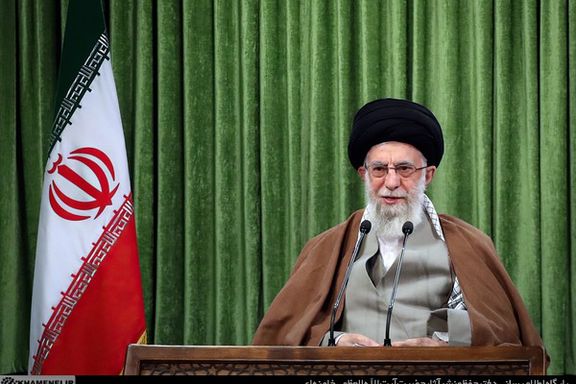
Iran's Supreme Leader Ali Khamenei.

Iran abandoned any compromises it had made in previous nuclear talks, pocketed those made by others, and demanded more this week, a senior US official has said.

Reuters reported Saturday that according to an unnamed US official speaking to reporters, Tehran's stance during the first such talks in more than five months disappointed not just the United States and its European allies but also China and Russia, historically supportive of Iran.

While stressing that the United States still wanted to revive the Joint Comprehensive Plan of Action (JCPO), the official told reporters time was running short.

The indirect US-Iranian talks on saving the deal broke off on Friday in Vienna as European officials also voiced dismay at sweeping demands by Iran's hardline government.

The latest talks were the first with delegates sent by Iran's anti-Western President Ebrahim Raisi, who was elected in June and whose government had said it needed time to prepare for fresh talks after the six rounds between April and June. But Iran delayed its return to the talks and ramped up its uranium enrichment, expanding its stockpile to more than 200 kg of fissile material purified to 20 and 60 percent. This has cut the breakout time for Tehran to weeks instead of months.

The senior US official said Iran used the time to speed up its nuclear program in "provocative" ways and to stonewall the UN nuclear watchdog charged with monitoring its eroding compliance with the deal.

While seeking to leave the door ajar for talks, the official blamed Iran as "the reason why there is not ... a mutual return to compliance" with the original deal.

Tehran, however, has placed the onus on Washington, noting that then-President Donald Trump withdrew the United States from the deal in 2018 and reimposed sanctions, prompting Iran to begin violating the nuclear restrictions starting in 2019.

The 2015 agreement imposed strict limits on Iran's uranium enrichment activities, extending the time it would need to produce enough fissile material for a nuclear weapon, if it chose to, to at least a year from around two to three months.

While saying it was unclear whether China and Russia might ramp up economic pressure on Iran if talks fail, he suggested their positions may be evolving.

"They also were quite taken aback by the degree to which Iran had walked back its own compromises and then doubled down on the requests that it (made)," he said. "They do share a sense of disappointment, to put it diplomatically."

The US official said he did not know when the next round of talks would resume - others had said next week - and said the date was less important than Iran's willingness to negotiate.

American officials have said they would consider other options if they cannot revive the deal, a phrase understood to include the possibility of military ones, however remote.

Reporting by Reuters

Most Viewed

US blockade enters murky phase as tankers spoof signals and buyers hesitate
1
ANALYSIS

US blockade enters murky phase as tankers spoof signals and buyers hesitate

2
INSIGHT

Ideology may be fading in Iran, but not in Kashmir's ‘Mini Iran'

3
INSIGHT

Hardliners push Hormuz ‘red line’ as US blockade tests Iran’s leverage

4
VOICES FROM IRAN

Hope and anger in Iran as fragile ceasefire persists

5

US sanctions oil network tied to Iranian tycoon Shamkhani

Banner
Banner

Spotlight

  • Hardliners push Hormuz ‘red line’ as US blockade tests Iran’s leverage
    INSIGHT

    Hardliners push Hormuz ‘red line’ as US blockade tests Iran’s leverage

  • Ideology may be fading in Iran, but not in Kashmir's ‘Mini Iran'
    INSIGHT

    Ideology may be fading in Iran, but not in Kashmir's ‘Mini Iran'

  • War damage amounts to $3,000 per Iranian, with blockade set to add to losses
    INSIGHT

    War damage amounts to $3,000 per Iranian, with blockade set to add to losses

  • Why the $100 billion Hormuz toll revenue is a myth
    ANALYSIS

    Why the $100 billion Hormuz toll revenue is a myth

  • US blockade targets Iran oil boom amid regional disruption
    ANALYSIS

    US blockade targets Iran oil boom amid regional disruption

  • Iran's digital economy battered by prolonged blackout
    INSIGHT

    Iran's digital economy battered by prolonged blackout

•
•
•

More Stories

Media In Iran Debate If Nuclear Talks Are Suspended For Good

Dec 4, 2021, 17:56 GMT+0

In the wake of unsuccessful nuclear negotiations in Vienna, some state media in Iran on Saturday tried to put a more positive spin saying talks will continue.

Western media including British newspaper Guardianhave covered the end of the seventh round of nuclear negotiations saying that the talks "were suspended on Friday, with Europe warning that Iran had walked back on all previous diplomatic progress and fast-forwarded its nuclear programme." But some Iranian media including the IRGC-linked newspaper Javan have described the event as "European and US partners of the JCPOA taking Iran's proposals home with them for consultations in their capitals."

At the same time, other media such as proreform website Fararu have opined that "The nuclear talks are not about Iran's nuclear program. They are about a new, emerging world order as the United States' power is declining." Fararu furthermore quoted British journalist Peter Oborne as saying that the nuclear talks mark the beginning of a new Cold War in which instead of the United States and the Soviet Union, now China and the US are facing each other. Fararu quoted him as saying that this new Cold War started as the US hurriedly withdrew from Afghanistan and turned its focus to Asia.

The administration-owned daily newspaper Iran ran an optimistic front-page headline: "Laying the foundations for lifting the sanctions."

But Kar-o-Kargar daily, close to former Rouhani spokesman Ali Rabiei, ran an utterly pessimistic front-page headline: "The shadow of despair on the negotiating table." While Iran believes that the talks are going to be resumed next week, Kar-o-Kargar said that the talks have come to end for good.

Economic daily Asia took a position in between the two and quoted reformist lawmaker Massouid Pezeshkian as saying that negotiations would be meaningless without "give and take" and suggested that if Iran is looking for a solution to its economic problems, its nuclear negotiators should return to the talks next week.

Foreign policy analyst Ali Bigdeli told Setareh Sobh daily that Iran should withdraw its excessive demands and stick to a minimal request for lifting some of the sanctions.

Another economic daily, Jahan-e Sanat discussed the negotiations with several Iranian experts in a series of debates that were primarily focused on the role of China in the nuclear talks. Observers generally said that China appeared to be silent during this round of the negotiations. Experts told Jahan-e Sanat that the suspension of the talks is in China's interest and that China favors a situation where Iran and the West do not reach an agreement.

Jalal Sadatian, a former Iranian diplomat, told the daily that China is worried about any improvement in Iran's ties with the West. He added that both China and Russia benefit from the sanctions on Iran. Particularly China benefits from being the sole customer for Iran's oil.

Another former diplomat, Fereidoun Majlesi, agreed with Sadatian and said that "thanks to the sanctions, China has now monopolized trade with Iran and is using the situation to sell everything at a higher price while buying Iran's oil at unbelievable discounts."

Asked why Iran counts on China and Russia as its supporters in the nuclear negotiations, Majlesi said: "Iran feels committed to enmity with the United States and this brings it close to China from an ideological standpoint." He further said that Iran is isolated in the international community but likes to say that there are countries such as China that are Iran's allies.

Mohammad Marandi, a member of the Iranian negotiating team as well as some Iranian officials in Tehran said on Friday that that Iran will turn to China if the United States refuses to return to the JCPOA.

Ironically, Iranian journalist and historian Hossein Dehbashi revealed on Twitter on Saturday that Marandi is a US citizen and questioned his support for Iran in the negotiations. Marandi in his response posted a picture on Twitter and claimed the photo shows him in Basij militia uniform when he was 16.

Macron Says Regional Sates, Israel Should Be Involved In Talks With Iran

Dec 4, 2021, 16:46 GMT+0

French President Emmanuel Macron has reiterated that regional states should be involved in talks with Iran to improve the chances of a nuclear agreement.

Speaking to reporters Saturday, Macron said it is important “to reengage a slightly broader dynamic and involve regional powers as well,” an added. “It is difficult to reach an agreement if the Gulf states, Israel and all those whose security is directly affected are not involved.”

It was significant that Macron mentioned Israel, that Iran has repeatedly threatened to destroy. Israel has also vowed never to allow Iran to acquire nuclear weapons.

The French president had said in January that Saudi Arabia and other regional powers should be part of talks to restore the 2015 Iran nuclear deal, JCPOA.

The United States and its three European allies, the United Kingdom, France and Germany that are negotiating with Iran in Vienna also want to address Tehran’s regional policy of supporting militant, proxy groups, but Tehran has flatly rejected any talks beyond the revival of the JCPOA.

Talks with Iran that resumed on November 29 adjourned on Friday without a success amid pessimism among Western countries who said that Tehran did not show any sign of being ready to reach a deal.

US, Europe Dismayed As Iran Nuclear Talks Adjourn In Vienna

Dec 3, 2021, 20:47 GMT+0
•
Iran International Newsroom

Nuclear talks over Iran's nuclear deal broke off until next week as European officials voiced dismay Friday at sweeping demands by Iran's hardline government.

Iran suspended talks in June after President Ebrahim Raisi’s election saying it needed time to form a new government, but it kept delaying its return, heightening suspicions among US and European officials that Iran is playing for time while advancing its nuclear program.

"Iran right now does not seem to be serious about doing what's necessary to return to compliance, which is why we ended this round of talks in Vienna," US Secretary of State Antony Blinken told the Reuters Next Conference.

"If the path to a return to compliance with the agreement turns out to be a dead-end, we will pursue other options," he added, without elaborating.

But the US has been making this threat for weeks, saying that it will wait for the new round of talks in Vienna to see if Tehran is serious.

Diplomats said the Iranian delegation had proposed sweeping changes to a text that was painstakingly negotiated in previous rounds and that European officials had said was 70-80% finished.

'DISAPPOINTMENT AND CONCERN'

"Over five months ago, Iran interrupted negotiations. Since then, Iran has fast-forwarded its nuclear program. This week, it has back-tracked on diplomatic progress made," senior officials from France, Britain and Germany said in a statement, adding that Iran was demanding "major changes" to the text.

It is "unclear how these new gaps can be closed in a realistic time frame", they added.

The three European powers expressed "disappointment and concern" at Iran's demands, some of which they said were incompatible with the deal's terms or went beyond them.

The 2015 agreement imposed strict limits on Iran's uranium enrichment activities, extending the time it would need to produce enough fissile material for a nuclear bomb, if it chose to, to at least a year from around two to three months. Most experts say that period is now shorter than before the deal.

Iran denies seeking nuclear weapons, saying it only wants to master nuclear technology for peaceful purposes.

After more than two years of Iranian adherence to the core curbs, however, then-President Donald Trump pulled the United States out of the deal in 2018, calling it too soft on Tehran, and reimposed painful US economic sanctions on Tehran.

Tehran retaliated from 2019 by breaching many of the deal's limits on enrichment and other restrictions, advancing well beyond them. With the deal's nuclear benefits now badly eroded, some Western officials say there is little time left before the foundation of the deal is damaged beyond repair.

French President Emmanuel Macron said he thought it likely the current round of talks would not succeed and appeared to look beyond them, hinting at involving more nations, such as Gulf Arab states, in a wider discussion if the Vienna talks fail.

"I think it's very difficult to find an agreement if the Gulf countries, Israel, all those whose security is directly affected, don't take part," he told reporters in Dubai. Macron had expressed the same stance last year.

FIRM STANCE

Iranian nuclear negotiator Ali Bagheri Kani's uncompromising stance is that since Washington left the deal, it should make the first move by lifting all sanctions imposed on Tehran since then, even those unrelated to Tehran's nuclear activities.

However, he left the door ajar for more talks by saying European nations could propose their own drafts for discussion, Iranian state media reported.

However, more talks would mean the talks stretching into 2022 as the holiday season approaches and more time for Iran to add to its stockpile of highly enriched uranium.

With reporting by Reuters

Iran Says Europeans Can Also Propose Own Drafts In Nuclear Talks

Dec 3, 2021, 18:33 GMT+0

The top Iranian negotiator told state media Friday European sides can propose their own drafts for discussion, after they expressed dismay over Iran's demands at nuclear talks.

"There is no problem if the Europeans also provide drafts, and they can be discussed, but they must be based on principles approved by both sides," Ali Bagheri Kani, a deputy foreign minister, said according to the state broadcaster IRIB, before leaving Vienna.

Some European negotiators have reportedly said that what is included in Iran’s documents is nothing more than what had been agreed but not finalized five months ago. They added that Iran has still not answered some of the questions pending since the end of the first six rounds of talks in June.

Indirect US-Iranian talks on salvaging the 2015 Iran nuclear deal teetered on the brink of crisis on Friday as they broke off until next week.

US Secretary of State had said that by the conclusion of today’s meetings it should be clear if Iran is serious in the new round of talks.

CNN State Department correspondent Jennifer Hansler tweeted Friday that a State Department spokesman criticized Iran’s approach to the latest round of talks telling CNN that President Ebrahim Raisi’s administration “did not come to Vienna with constructive proposals.”

Nuclear Talks With Iran 'Appear To Have Made No Progress'

Dec 3, 2021, 16:14 GMT+0
•
Iran International Newsroom

Hardliners in Iran have been trumpeting pessimistic ideas about the outcome of nuclear negotiations in Vienna all Friday as the first round of talks wrapped up.

Friday Prayer Imams took the lead in putting forward excessive demands such as calling for lifting all sanctions against Iran before starting to discuss the United States' return to the JCPOA framework.

On Thursday, Tehran news outlets quoted hardliners as claiming that the Iranian delegation has humiliated the US diplomats by not allowing them to join the talks and forcing them to listen to other negotiators from an adjacent room.

IRGC-linked Fars news agency carried comments by hardliner commentator Mohammad Marandi on pro-Iran Al-Mayadeen TV in Lebanon. Marandi is accompanying the Iranian delegation as an "adviser" who has been seen interpreting for the delegation as most of its members do not speak English.

Fars quoted Marandi as saying that Iran has a plan B in case the United States refuses to return to the 2015 nuclear deal (JCPOA). The plan, Marandi said, includes continuing the nuclear program and strengthening Iran's ties with Asian countries.

The only Asian country that continues any significant trade relations with Iran after the US withdrawal from the JCPOA in 2018 is China with whom Iran has signed a 25-year agreement for cooperation.

Marandi said that Iran is waiting for JCPOA partners to comment on the two draft documents Tehran put forward on Thursday. No official response has been observed on the part of the European trio and the United States and Russia and China to the drafts. However, French President Emmanuel Macron has said that this round of negotiations appears to have remained inconclusive and made no progress.

Thursday evening Russian negotiator Mikhail Ulyanov denied reports that the negotiations have failed to reach any positive results.

Meanwhile, Marandi told Al-Mayadin that Iran has yet a third draft that it has not presented to the JCPOA member states. He added that based on these drafts the US and European sides cannot accuse Iran of having excessive demands. Elsewhere in the interview with Al-Mayadin, Marandi acknowledged that "The European side has expressed its dissatisfaction with the drafts."

According to Reuters, Senior European trio (British, French and German) diplomats taking part in the talks expressed "disappointment and concern" Friday at Tehran's proposed alterations to a text that had been agreed on in previous rounds. "Major changes (have been) demanded (by Iran)," the officials said in a statement, adding that some were incompatible with the JCPOA, adding that it is "unclear how these new gaps can be closed in a realistic timeframe based on Iranian drafts," they said

Some European negotiators have reportedly said that what is included in Iran’s documents is nothing more than what had been agreed but not finalized five months ago. They added that Iran has still not answered some of the questions pending since the end of the first six rounds of talks in June.

Marandi wrote in a tweet: "The US/EU can't have their cake & eat it too. They can't expect the Islamic Republic of Iran to go back to 2015, yet they keep parts of their post-JCPOA sanctions regime intact. The new administration has made it clear that the barbaric Western maximum pressure sanctions must go."

Responding to Marandi's comment, Iranian-American analyst Ali Vaez wrote in a December 2 tweet: "This is why a diplomatic deadlock is the likeliest outcome in Vienna. Iran can’t expect a nuclear deal to unshackle it from sanctions aimed at non-nuclear policies. That is the definition of having your cake and eating it too."







