• العربية
  • فارسی
Brand
  • Iran Insight
  • Politics
  • Economy
  • Analysis
  • Special Report
  • Opinion
  • Podcast
  • Iran Insight
  • Politics
  • Economy
  • Analysis
  • Special Report
  • Opinion
  • Podcast
  • Theme
  • Language
    • العربية
    • فارسی
  • Iran Insight
  • Politics
  • Economy
  • Analysis
  • Special Report
  • Opinion
  • Podcast
All rights reserved for Volant Media UK Limited
volant media logo

Conservative Figures Warn Raisi About Losing Public Trust
Iran International Newsroom
Dec 5, 2021, 17:36 GMT+0Updated: 17:36 GMT+1
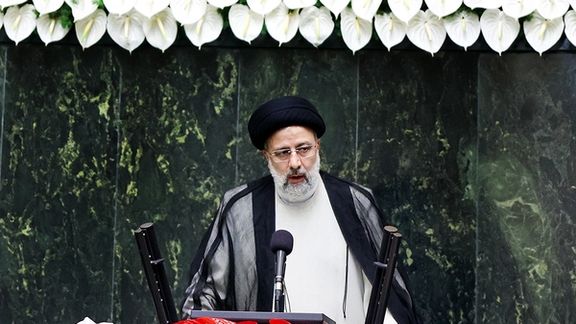
Iranian president Ebrahim Raisi. FILE Photo

Four months after President Ebrahim Raisi took office, most of his critics come from the like-minded conservative camp rather than from his political rivals.

Some of the harshest comments about the new administration's failures and disappointing performance come from hardliner conservatives such as former lawmakers Ahmad Tavakoli, Mohammad Javad Bahonar and current lawmaker Elias Naderan. Tavakoli and Naderan are both economists and their comments bring Raisi's economic policy under attack.

According to reformist daily Sharq, Tavakoli's criticism of Raisi for choosing "problematic individuals" for his cabinet and the superstitious myths his supporters are spreading about Raisi's supernatural capabilities have met with criticism within the conservative camp.

Tavakoli, a well-known advocate of campaigning against corruption, wrote in a recent letter to Raisi that his policy about allocating preferential rate of exchange for purchasing essential commodities for the nation, follows "a wrong policy dictated by the International Monetary Fund that has brought about bankruptcy for several Iranian governments" since the late 1980s "when Iran began to experience inflation rates higher than 49.5 percent."

Conservative politician Ahmad Tavakoli. File photo
100%
Conservative politician Ahmad Tavakoli.

Meanwhile, members of the parliament say that Elias Naderan, the Chairman of one of the Iranian Parliament's budget committees made serious charges against the administration during a joint meeting of the administration and the parliament last week. His recent comment has not been made public yet, but he said two months ago that "The economy is the Achilles heel of the Raisi administration. It is good that he has so many economists in the cabinet, but what is more important is creating some kind of coordination among them."He called on Raisi to say clearly who is in charge of the country's economy.

Naderan said that the administration appears to be trying to circumvent the parliament in drawing the budget bill and stressed that this will bring about a new wave of inflation.

Meanwhile, high-profile conservative politician and former deputy speaker of the Majles for several years, Bahonarhas said in a pointed statement, "We do not expect Raisi to solve all the problems before the end of the Iranian year in March, but at least we like to hear that he has started to reform the economy in a way that would encourage investors and entrepreneurs to become active."He also suggested that Raisi should hand over dealing with ad-hoc emergencies to others and instead focus on more essential problems."

It is not just the Raisi administration that is the target of attacks and questions by like-minded politicians. The Majles has also been criticized for more or less the same kind of shortcomings. The last time Naderan asked the Majles about its inaction, it was when Naderan asked lawmakers why the Majles has had no visible output in the area of offering solutions for the country's problems after longer than a year since the Majles election.

Naderan also warned lawmakers against likening Raisi to puritan saints and popular politicians of the early 1980s. "These are exaggerations and unnecessary pleasantry aimed to secure a place for those lawmakers in the government," he said, adding that sycophants are not doing a service to Raisi, nor they are doing a good thing for the society.

Speaking about sycophants, Bahonar has also said recently that what they do is harmful to the government because they create unjustified expectations among the nation.

Meanwhile, Principlist activist Hassan Kanani Moqaddam said on Saturday that Raisi should seriously investigate the cases of nepotism and giving jobs to officials' family members and be accountable for these cases before the conservative camp and the nation. If he fails to do that, he is going to lose the society's trust in him, Kanani Moqaddam said.


Most Viewed

US blockade enters murky phase as tankers spoof signals and buyers hesitate
1
ANALYSIS

US blockade enters murky phase as tankers spoof signals and buyers hesitate

2
INSIGHT

Ideology may be fading in Iran, but not in Kashmir's ‘Mini Iran'

3
INSIGHT

Hardliners push Hormuz ‘red line’ as US blockade tests Iran’s leverage

4
VOICES FROM IRAN

Hope and anger in Iran as fragile ceasefire persists

5

US sanctions oil network tied to Iranian tycoon Shamkhani

Banner
Banner

Spotlight

  • Hardliners push Hormuz ‘red line’ as US blockade tests Iran’s leverage
    INSIGHT

    Hardliners push Hormuz ‘red line’ as US blockade tests Iran’s leverage

  • Ideology may be fading in Iran, but not in Kashmir's ‘Mini Iran'
    INSIGHT

    Ideology may be fading in Iran, but not in Kashmir's ‘Mini Iran'

  • War damage amounts to $3,000 per Iranian, with blockade set to add to losses
    INSIGHT

    War damage amounts to $3,000 per Iranian, with blockade set to add to losses

  • Why the $100 billion Hormuz toll revenue is a myth
    ANALYSIS

    Why the $100 billion Hormuz toll revenue is a myth

  • US blockade targets Iran oil boom amid regional disruption
    ANALYSIS

    US blockade targets Iran oil boom amid regional disruption

  • Iran's digital economy battered by prolonged blackout
    INSIGHT

    Iran's digital economy battered by prolonged blackout

•
•
•

More Stories

How Much The Nuclear Program Has Impoverished Iran

Dec 5, 2021, 15:45 GMT+0
•
Dalga Khatinoglu

Iran's economy has had almost no growth since its nuclear program gained momentum in 2004, to a large extent by the damage economic sanctions have inflicted.

Iranian hardliners claim they have defeated US sanctions, simply because the Islamic Republic still stands, but the cost of defiance has been the economic ruin of the country, mostly borne by citizens.

Iran’s counterproductive approach in pursuing even a civilian nuclear program is evident from the Bushehr reactor, built by Russia for generating 1,000 megawatts of electricity. It became operational a decade ago. Iran spent up to $8 billion to build the reactor, which has produced around $5 billion of electricity, leaving a profit of just $3 billion in ten years. Meanwhile, its fossil fuel power generation infrastructure was neglected and no renewable energy investments, except ill-planned dams, were made. Today, Iran suffers from serious power shortages.

But this is just a small example of the damage Iran’s nuclear ambitions have inflicted on the country.

100%

In 2020, based on World Bank estimates, Iran’s Gross National Product (GDP) reached $191.7 billion, which was one third of what it was ten years ago. The main reason for this huge economic retrenchment was international and United States sanctions against Iran since 2011, imposed to limit its nuclear program. The international community, including Russia and China, were concerned that Iran was pursuing more than a peaceful program and cooperated with the West to impose international economic sanctions beginning in 2010 and intensifying in 2011.

Long-term USD/rial exchange rates
100%
Long-term USD/rial exchange rates

Calculated based on the free market rate of the US dollar in Tehran, the size of Iran’s economy in 2020 was the same as it was in 2004. After a substantial growth around 2010 due to very high oil prices, the economy began to decline from 2012 when international sanctions left their deep mark on Iran revenues.

During the period since 2011, successive Iranian governments relied on internal borrowing financed by printing money to maintain their operations. As a result, liquidity grew tenfold exacerbating inflation and in effect devaluing the national currency. People began losing their purchasing power and gradually falling into poverty.

100%

Since early 2018, Iran’s rial has dropped to more than 300,000 against the US dollar, while just four years ago the dollar was traded at 32,000 rials. Before the Islamic Republic, one US dollar bought 70 rials.

The government has been using the central bank as a money printing machine, instead of reforming the economy, and adopting policies to attract foreign and domestic investments. Government debt to the central bank and other state or quasi-state banks has grown tenfold in the past decade.

Based on estimates by the International Monetary Fund, government debt was 6.5 percent of Gross National Product from 2,000-2017, but in 2020 it had reached 33 percent of GDP.

100%

The impact on ordinary people has been devastating. While the minimum income needed to live just above poverty, as the rial lost value, has grown 70-fold in the past 20 years, wages and salaries have increased only 38-fold. While blue collar workers earn around $100-120 per month, office workers make $150-180. The minimum monthly income needed for a family of 3.3 people is $400.

The real numbers speak volumes about official claims that the Islamic Republic has defeated sanctions. The country has simply become poorer.

Arab League Chief Voices Concern Over Iranian Threats In The Region

Dec 5, 2021, 14:51 GMT+0

The Secretary General of the Arab League has said Iran wants to control the Straits of Hormuz and the Bab al-Mandab either directly or through proxies it funds.

Ahmed Aboul Gheit said during the Rome Mediterranean Dialogue mentioning attacks carried out in the 2019 in the Persian Gulf and against Saudi oil installations, as well as Houthi threats to navigation in the Red Sea highlighted Iran’s policies in the region.

The Arab League issued a statement on Saturday quoting Aboul Gheit as having said that both straits are vital for the global economy and protection of navigation in these areas should be a global priority.

Persian Gulf Arab states and their Sunni allies such as Egypt are concerned at Iran’s regional policy of creating and supporting militant groups to expand its influence.

Aboul Gheit said that Iran’s behavior and actions are the reason why it is difficult to establish a security system in the Persian Gulf. Iranian officials often boast of their influence in the region, which largely rests on Shiite proxy forces.

He added that he hopes ongoing negotiations would dissuade Iran from pursuing its policies. Both Saudi Arabia and the United Arab Emirates have begun engaging Iran in talks to reduce tensions.

Iran's Currency Continues To Fall After Disappointing Nuclear Talks

Dec 5, 2021, 10:42 GMT+0

The decline in the value of Iran’s currency continued Sunday, after disappointing nuclear talks with world powers in Vienna added to economic uncertainty.

The free market value of the US dollar in Tehran shot up to 300,500 rials Sunday, a historic low for the battered currency. On Saturday the dollar had reached to just over 300,000 rials.

Despite government efforts to claim that the nuclear negotiations are not dead and could continue in a few days, the public remained unconvinced, buying more dollars.

The government feeling market demand restricted access to dollars at official exchange outlets earlier in the week, but the move led to demand shifting to unofficial dealers.

The current exchange rate shows the rial has fallen 4,500-fold since the Islamic Republic was set up in 1979. During the monarchy one US dollar was equal to just 70 rials.

The Iranian currency has fallen more than ninefold since early 2018, when it became apparent that then-president Donald Trump was inclined to leave the JCPOA and impose sanctions on Iran. He did so in May of that year and the rial has kept falling ever since.

Top UAE Security Official Visit Tehran On Monday

Dec 5, 2021, 09:06 GMT+0

The United Arab Emirates' top national security adviser Sheikh Tahnoon bin Zayed Al Nahyan will visit Tehran on Monday to discuss ways to expand bilateral ties.

The visit comes a week after negotiations between Iran and major powers resumed in Vienna to revive a 2015 nuclear deal (JCPOA), lift US sanctions on Iran and put a stop to escalations in Tehran's nuclear program.

Reports have indicated that the UAE might be hedging its bets given a desire by the Biden Administration to revive the JCPOA and by the US exit from Afghanistan. The general perception is that Washington has shifted its focus to China and east Asia.

Sheikh Tahnoon is expected to meet his counterpart, the Supreme National Security Council's Secretary General Ali Shamkhani, Noor News, affiliated with the Council said.

Sheikh Tahnoon is a brother of the country’s de facto ruler Abu Dhabi Crown Prince Mohammed bin Zayed.

Anwar Gargash, diplomatic adviser to the UAE president, said last month that his country was "taking steps to de-escalate tensions with Iran as part of a policy choice towards diplomacy and away from confrontation."

The Emirati diplomat said the UAE remained deeply concerned about Iran's behavior in Iraq, Syria, Yemen, Lebanon.

Iran, Venezuela Presidents Hold Phone Discussion, Call For More Trade

Dec 4, 2021, 20:19 GMT+0

Economic and trade ties between Iran and Venezuela should expand Iran’s President Ebrahim Raisi told his counterpart Nicolas Maduro in a phone call on Saturday.

Raisi told Maduro that bilateral relations between the two countries are strategic and emphasized that ties should expand during his administration that came into office in August. He added that bilateral ties should be strengthened specially in trade and economy.

Tehran has established close relations with Caracas in the past 15 years and has defied US sanctions on both countries by shipping fuel across the Atlantic to prop up the beleaguered Maduro government. The Trump administration seized one such large shipment and auctioned off the cargo.

Raisi also emphasized the quest of both countries to defy the United States, saying that “we will continue the path of progress.” He also highlighted the need for more cooperation in the energy sector and congratulated Maduro for the recent elections in his country.

US sanctions have battered the economy of the two countries as they are unable to export oil to global markets and their national currencies have nosedived in recent years.