• العربية
  • فارسی
Brand
  • Iran Insight
  • Politics
  • Economy
  • Analysis
  • Special Report
  • Opinion
  • Podcast
  • Iran Insight
  • Politics
  • Economy
  • Analysis
  • Special Report
  • Opinion
  • Podcast
  • Theme
  • Language
    • العربية
    • فارسی
  • Iran Insight
  • Politics
  • Economy
  • Analysis
  • Special Report
  • Opinion
  • Podcast
All rights reserved for Volant Media UK Limited
volant media logo

Iran’s Ambition To Build A ‘Resistance Highway’ To The Mediterranean
Iran International Newsroom
Nov 19, 2021, 08:34 GMT+0Updated: 17:34 GMT+1
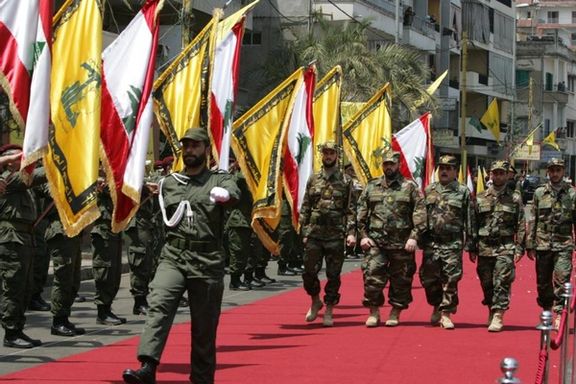
Iran-Backed Hezbollah militia marching in Beirut, Lebanon. FILE PHOTO

A news website in Tehran says the Islamic Republic is eying a highway project that would link Tehran to Beirut, in a grandiose plan to reach the Mediterranean.

Fararu, a prominent pro-reform website Thursday published an article by Mohammad Mehdi Hatami, the website's economic correspondent, that Iran is thinking of using its influence in Iraq, Syria and Lebanon to build a highway to connect Tehran to the Mediterranean Sea via Iraq and Syria.

Iran has even given a name to the highway: The Resistance Highway. However, Fararu's economic correspondent argued that this is not a task to be accomplished easily as it can change the geopolitics of the region.

Fararu also noted that that Iran is now seriously thinking of building the highway as Iran and Saudi Arabia's rivalry over supremacy in the region is almost at its peak.

Iranian military commanders and hardline politicians have never concealed the Islamic Republic's interest in the Mediterranean region. Many of the pro-regime media and officials take it for granted in their rhetoric that Iran needs to have or already has a foothold in Syria's Mediterranean shores.

Iran is revealing the ambition at a time when US sanctions have ruined its economy, its influence in Iraq and Syria is debatable partly for the same reason and its influence in Lebanon is effectively challenged by Saudi Arabia.

Iranian website Khabar Online in September 2019 quoted IRGC news sourcesas saying that "Iran's access to long-range ballistic missiles with a range of 2,000 kilometers has left no safe place for US warships from the Arabian Sea to the Mediterranean." The website added that "Foreign players, particularly the United States have received Iran's message that the Mediterranean region is within reach of Iran's missiles."

In late October, Defa (Defense) Press, a news outlet linked to the Iranian military forces, quoted Major General Yahya Rahim Safavi, a former commander of the IRGC, who is currently Khamenei's top military adviser, as saying: "Iran's strategic depth is stretched from the Persian Gulf to the Mediterranean Sea."

Even a year before that, IRGC's acting commander in Lorestan province, General Habibollah Tavakoli saidthat Iran's Western borders are no longer next to Iraq, but they are located in the Mediterranean Sea where Tehran's enemies have been stopped.

All these claims about Iran's strategic depth are in defiance of sanctions and international isolation that have paralyzed and shrank Iran's economy, Fararu noted in an unusually candid tone for a publication operating under Iran’s strict state control. The website’s editor, Mohammad Hossein Khoshvaght is said to be a relative of Supreme Leader Ali Khamenei.

This comes while other regional players are also eying a new emerging situation in the region. Fararu says the emergence of the Taliban and the recent meeting between the United Arab Emirate Emirate's Foreign Minister and Syrian leader Bashar Assad are the signs of this emerging situation.

Iranian officials often complain that despite spending blood and treasure in Syria, the Islamic Republic is not benefitting economically from its presence there and Russians control the lion’s share of influence. There are speculations that the Syrian president Bashar al-Assad might try to reduce Iran’s presence.

Nevertheless, according to Fararu, the plans for building the highway are outlined by a think tank at the Imam Sadeq University in Tehran where most of the Raisi Administration's cabinet ministers come from. However, it is difficult to differentiate between practical ideas and wishful thinking, particularly because the same think tank has failed to solve any of Iran's problems.


Most Viewed

State media slam Araghchi's Hormuz tweet, say it let Trump claim victory
1

State media slam Araghchi's Hormuz tweet, say it let Trump claim victory

2
OPINION

The Hormuz get out of jail card turned to a grave

3

Iran International says it won’t be silenced after London arson attack

4
INSIGHT

How Tehran bends its own red lines to boost state rallies

5

Iran halts petrochemical exports to supply domestic market

Banner
Banner

Spotlight

  • Too early to tell who is winning Iran war, experts say
    PODCAST

    Too early to tell who is winning Iran war, experts say

  • How Tehran bends its own red lines to boost state rallies
    INSIGHT

    How Tehran bends its own red lines to boost state rallies

  • Iran blackout cripples freelancer, small business incomes
    VOICES FROM IRAN

    Iran blackout cripples freelancer, small business incomes

  • Ideology may be fading in Iran, but not in Kashmir's ‘Mini Iran'
    INSIGHT

    Ideology may be fading in Iran, but not in Kashmir's ‘Mini Iran'

  • US blockade enters murky phase as tankers spoof signals and buyers hesitate
    ANALYSIS

    US blockade enters murky phase as tankers spoof signals and buyers hesitate

  • Why the $100 billion Hormuz toll revenue is a myth
    ANALYSIS

    Why the $100 billion Hormuz toll revenue is a myth

•
•
•

More Stories

US Charges, Sanctions Iranians For Cyber Plot To Meddle In 2020 Election

Nov 18, 2021, 19:08 GMT+0

The US announced criminal charges on Thursday against two Iranians accused of launching a cyber campaign to meddle in the 2020 US presidential election.

The US also sanctioned six Iranian officials for their roles in the alleged plot.

Seyyed Mohammad Hossein Musa Kazemi, 24, and Sajjad Kashian 27, are each facing charges that they obtained confidential US voting information from at least one state election website.

They are also accused of sending threatening emails to intimidate voters and sending a video that contained disinformation about purported election infrastructure vulnerabilities.

The indictment alleges they also gained access to a US company's computer network in a plot to disseminate false claims about the election, but their plot was foiled thanks to intervention by the FBI and the company, which the indictment did not identify by name.

Secreatry of State Antony Blinken said, "Designation of Iranian cyber actors represents the collective efforts of the US Treasury, State Department and the FBI. The US government took decisive action against those seeking to interfere with the sanctity of our elections."

“This indictment details how two Iran-based actors waged a targeted, coordinated campaign to erode confidence in the integrity of the electoral system and to sow discord among Americans,” said Assistant Attorney General Matthew G. Olsen.

Two weeks before the November election, top intelligence officials in then-President Donald Trump's administration alleged that both Russia and Iran were attempting to interfere in the election and had gained access to some US voter registration data.

Report by Reuters

Long-Time Former Iranian Diplomat Zahedi Dies In Switzerland

Nov 18, 2021, 15:51 GMT+0

Ardeshir Zahedi, former Iranian foreign minister, ambassador to Washington during the monarchy and son-in-law of the Shah passed away in exile on Thursday.

Zahedi who lived in Switzerland was 93 years old and was born into a powerful family in 1928 in Tehran. His father, Fazlollah Zahedi, was a general who served as prime minister and played an instrumental role during political upheaval in Iran in 1953 when he led a military coup that brought Mohammad Reza Shah Pahlavi back to power.

Zahedi who attended an American School in Beirut continued his education in Utah State University and graduated as an agricultural engineer. After returning to Iran, he became a senior official in the Point Four assistance program launched by US President Harry S. Truman in 1949.

Zahedi served as ambassador in Washington from 1960-1962 and again from 1973 until the 1979 revolution. He was foreign minister from 1966-1971.

In the final years of his life Zahedi adopted controversial positions, including his praise for Quds Force commander Qasem Soleimani who was killed by a US drone attack in Baghdad in January 2020, ordered by former president Donald Trump.

Iran Slams Canada For UN Resolution Censuring Its Rights Abuses

Nov 18, 2021, 15:00 GMT+0
•
Maryam Sinaiee

Iran said Thursday that Canada must "stop systematic policy on killing indigenous people" after the UN passed a Canadian-sponsored resolution censuring Iran for serious rights abuses.

Saeed Khatibzadeh, the foreign ministry spokesman, said Thursday that the resolution by the General Assembly's Third Committee was "based on weak and scattered international votes" and alleged that many countries voting in favor had been subject to "various political pressures and threats".

The spokesman called on Canada to accept responsibility for its complicity in Israeli “crimes against humanity against the Palestinian people.”

Iran often responds to allegations of human rights abuse by claiming the double standards of the accuser. When asked in June about his role in the 1988 prison executions in Iran, President Ebrahim Raisi (Raeesi) accused the Mujahideen-e Khalq of violence, the opposition group whose members made up the bulk of those executed in 1988.

Human Rights Watch recently said the Canadian government, which refuses to accept the International Criminal Court considering alleged Israel crimes in occupied territory, supported “draconian military rule over Palestinians in the occupied West Bank.”

The resolution by UN Thrid Committee on Iran expressed concern at the “alarmingly high frequency" of the imposition and carrying-out of the death penalty, including executions based on forced confessions or for crimes that do not qualify as the most serious crimes, were overly broad or vaguely defined. It passed at the UN General Assembly committee Wednesday 79-32, with 64 abstentions. The Iranian representative successfully requested a recorded vote.

The General Assembly allocates to its Social, Humanitarian and Cultural Affairs Committee, commonly referred to as the "Third Committee", agenda items relating to a range of social, humanitarian affairs and human rights issues that affect people all over the world.

The MEK immediately called for “the clerical regime, including [Supreme Leader] Ali Khamenei, Ebrahim Raisi, and Gholam-Hossain Mohseni Ejeii [the judiciary chief],” to be “prosecuted by international tribunals.”

Torture and cruel treatment

The resolution expressed serious concern at the imposition of the death penalty against those under 18 at the time of the offence. "Torture or other cruel, inhuman or degrading treatment or punishment," which the resolution said could include sexual violence, were also highlighted.

The resolution called for the release of anyone detained for exercising human rights and fundamental freedoms, including anyone detained solely over peaceful protests, including any in November 2019 and January 2020.

Iran was urged to "end reprisals against human rights defenders, peaceful protesters and their families, journalists and media workers covering the protests, and individuals who cooperate or attempt to cooperate with the United Nations human rights mechanisms."

Truth and reconciliation

Zahra Ershadi, Iran's ambassador and deputy permanent representative to the United Nations, in a statement read to the UN Third Committee, called the resolution "insincere and indefensible political." She said it “replete with factual errors…and unmasks the deliberate hostile policy of incitement to Iranophobia.”

Ershadi accused Canada of genocide over the 215 bodies of indigenous children unearthed in May at one of Canada’s largest residential schools for native Canadians and in its policies of forced assimilation. She said the wider West has been remained silent.

Canada’s delegate at the UN assembly said Wednesdaythat Canada has established a Truth and Reconciliation Commission. Prime Minister Justin Trudeau said Canadians were "horrified and ashamed" at how Canada had behaved and promised remedial action. A Canadian federal court in September upheld a 2016 ruling ordering the government to compensate indigenous children forced into foster care.

Israel Accuses Defense Minister's Household Aide Of Iran-Related Espionage

Nov 18, 2021, 11:52 GMT+0

Israel has charged a household aide of Defense Minister Benny Gantz's with espionage, saying on Thursday he offered to spy on him on behalf of "a person identified with Iran.”

In a statement, the Shin Bet security service said the suspect corresponded with the unnamed person over social media. It said he provided photographs taken in the house as proof he had access and proposing installing malware on Gantz's computer.

The Shin Bet said the suspect, who performed housekeeping and cleaning tasks in Gantz's residence, was indicted on espionage charges by a court in Lod, a city near Tel Aviv. It said he was arrested after an investigation earlier this month.

It was not immediately clear whether he had entered a plea.

The Public Defender's Office, which assigned a lawyer to aid the suspect, said he had acted out of "financial duress" and had not intended to harm national security.

Gal Wolf, the attorney representing him, implied on Kan public radio that the man had intended to extract money without actually being able to carry out any espionage.

"A person can boast and say he can deliver the goods, (but) the Shin Bet's statement does not stand the test of reality," Wolf said.

In its announcement, the Shin Bet said that while the suspect posed a potential danger to national security, he "was not exposed to classified material and subsequently none was passed on from him to the elements with whom he made contact".

Report by Reuters

US, GCC Countries Condemn Iranian Policies In Advance Of Nuclear Talks

Nov 18, 2021, 11:30 GMT+0
•
Mardo Soghom

The United States and the Gulf Cooperation Council (GCC) have condemned Iran’s ballistic missiles program days before nuclear talks with Iran resume in Vienna.

The US and the GCC, which have a Strategic Partnership agreement, held a meeting of their working group in Riyadh, Saudi Arabia on Wednesday. A statement by the US State Department said the two sides “affirmed the longstanding partnership between the US and the members of the GCC”, as well as “shared determination to contribute to regional security and stability” in the Middle East.

But the two sides focused on “a range of aggressive and dangerous Iranian policies, including the proliferation and direct use of advanced ballistic missiles and Unmanned Aircraft Systems.” The statement said that these weapons have been by Iran or its proxies “in hundreds of attacks against civilians and critical infrastructure in Saudi Arabia and civilian merchant seamen in international waters of the Sea of Oman, and endangered American troops combatting ISIS.”

US allies in the Persian Gulf have been long concerned about Tehran’s belligerent regional policies and its expanding military and political influence in Iraq, Syria, Lebanon and Yemen, where they maintain and support tens of thousands of proxy forces.

The joint US and GCC meeting also “agreed that Iran’s nuclear program is of grave concern, as Iran has taken steps for which it has no civilian need but that would be important to a nuclear weapons program.”

As Iran has delayed the resumption of nuclear talks held earlier this year, the Biden Administration seems eager to offer assurances to its Arab allies in the region, which could also serve as a tough message to Tehran.

The Biden team came into office aiming to distance itself from the Trump administration’s tough approach toward Iran and its very close ties with Saudi Arabia and Israel. But as its attempts to reach agreement with Tehran to revive the 2015 nuclear agreement (JCPOA) have so far failed, Washington needs to keep ties with traditional allies strong.

But the US and the GCC also appeared to be extending a carrot to Iran, urging Tehran to shift its long-held aggressive policies.

The State Department statement said the US and GCC believe, “Iran has a better alternative to these continued escalations and can contribute to a more secure and stable region.” GCC members briefed the meeting about their continued efforts to build diplomatic channels with Tehran and expressed hope that “these regional diplomatic efforts developing over time to promote peaceful ties in the region, based on a long history of economic and cultural exchanges.”

Saudi Arabia has held four rounds of talks with Iran this year, but Saudi officials have said while the meetings have been cordial and useful, they have not been substantive. The United Arab Emirates will also soon send a delegation to Iran.